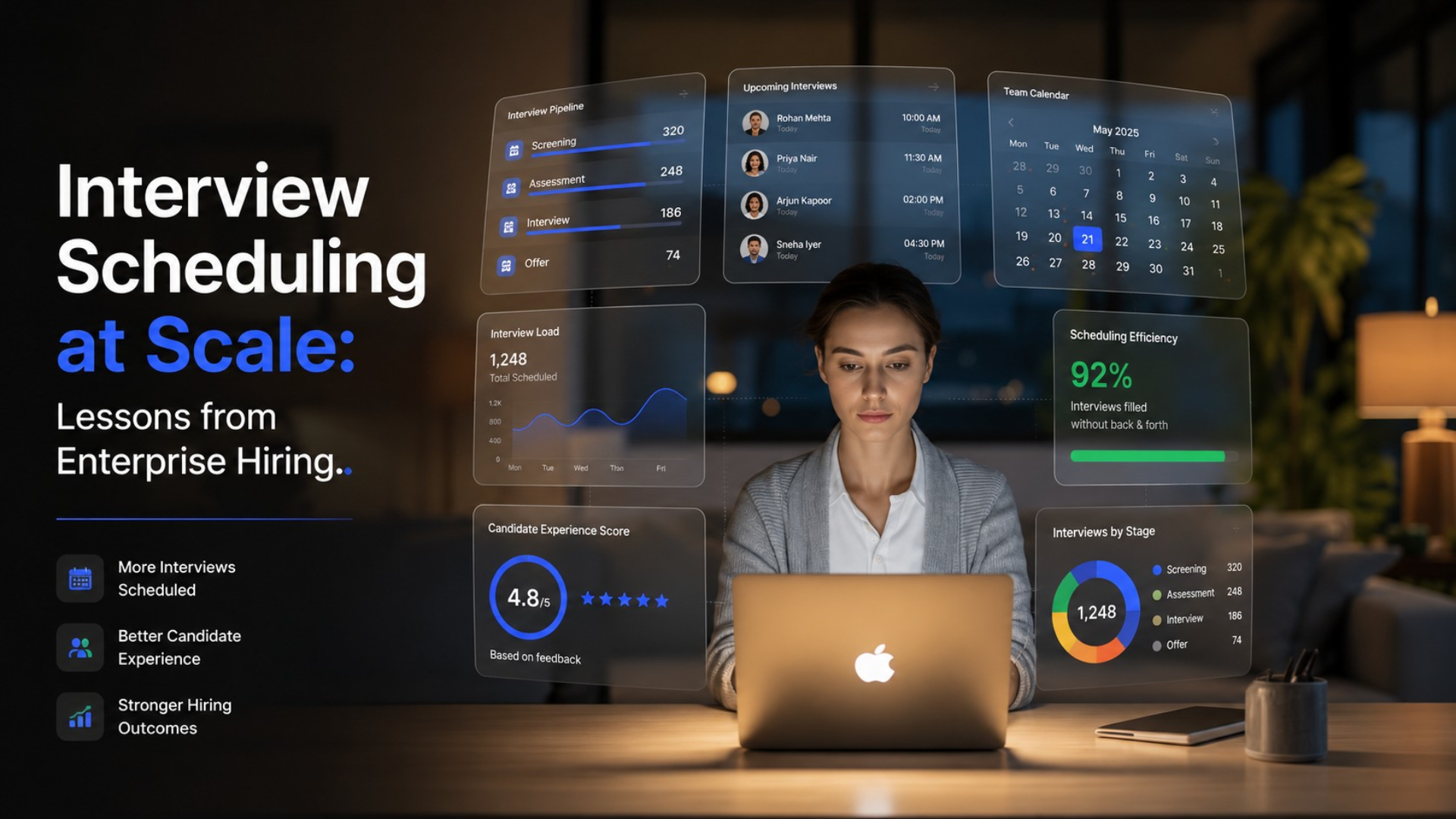
Rachel Chen, the head of global talent acquisition at a multinational technology company with over twelve thousand employees, opened her quarterly hiring review and found a number that made her stomach drop. Average time-to-interview had increased from eight business days to twelve over the past quarter, and candidate withdrawal rates during the scheduling phase had risen by nearly thirty percent. Her team had hired seventy additional recruiters in the past year, yet scheduling capacity had not improved. The problem was not recruiter count. It was coordination complexity. With forty-seven offices across nineteen countries, over three hundred hiring managers, and interview panels ranging from two to eight participants, the scheduling challenge had grown far beyond what any manual process could handle. Rachel realized that no amount of additional recruiter headcount would solve a problem that was fundamentally structural. The enterprise hiring machine was being choked by its own scheduling complexity, and the solution would require a completely different approach to how interview coordination was managed and automated.
Why Enterprise Hiring Breaks Traditional Scheduling
Rachel Chen, the head of global talent acquisition at a multinational technology company with over twelve thousand employees, faced a scheduling challenge that no amount of recruiter effort could solve. Her team was hiring across forty-seven offices in nineteen countries, coordinating with over three hundred hiring managers, and managing interview panels that ranged from two to eight participants depending on the role and level. Each month, her team scheduled roughly four hundred interviews, each requiring alignment across multiple calendars, time zones, and approval chains. The manual coordination process was consuming nearly forty percent of her recruiting team capacity, creating bottlenecks that extended average time-to-interview to twelve business days and contributing to a candidate withdrawal rate
that had risen steadily over three consecutive quarters. Rachel situation illustrates the fundamental problem with enterprise interview scheduling: the complexity that makes coordination difficult at small scale becomes operationally crippling at enterprise scale, and the traditional approach of throwing more recruiter hours at the problem eventually reaches a point of diminishing returns where each additional hire requires proportionally more coordination effort.
The enterprise scheduling problem is qualitatively different from what smaller organizations experience. At small scale, scheduling is a nuisance. At enterprise scale, it is a structural constraint that limits the speed and quality of the entire hiring function. The difference arises from several compounding factors. First, the number of participants per interview increases with organizational complexity, because enterprise hiring processes typically involve multiple evaluation stages with different interviewer combinations. Second, the geographic distribution of participants means that timezone management becomes a constant challenge rather than an occasional complication. Third, the organizational hierarchy introduces approval chains that add delays at multiple points in the process. Research published by SHRM on enterprise talent acquisition has found that scheduling complexity increases nonlinearly with organization size, and that companies above five thousand employees experience disproportionately higher scheduling overhead per hire compared to midmarket peers.
The consequences of this scheduling overhead are not limited to recruiter productivity. When scheduling takes twelve days instead of two, candidates have twelve additional days to receive competing offers, lose interest, or form negative impressions of the organization. Enterprise employers often assume that their brand strength and compensation packages will protect them from candidate attrition caused by slow processes, but this assumption is increasingly dangerous in a talent market where top candidates have multiple attractive options and where employer brand perception is shaped as much by process experience as by brand reputation. The most forward-thinking enterprise talent leaders are recognizing that scheduling is not a back-office problem but a strategic constraint that requires a technology-driven solution designed specifically for the complexity of large-scale hiring. An agentic AI recruiting platform that handles multi-participant, multi-timezone coordination as an autonomous workflow is becoming an essential component of the enterprise hiring technology stack.
The Hidden Costs of Scheduling at Enterprise Scale
The visible cost of enterprise scheduling is the recruiter time consumed by coordination. Rachel team was spending roughly forty percent of their capacity on scheduling logistics, which translated to millions of dollars in annual recruiter compensation allocated to administrative work rather than strategic recruiting activities. But the hidden costs are far larger and more damaging to the business. Research from McKinsey on hiring velocity and business performance has demonstrated that every week of delay in filling a role has a measurable impact on revenue, productivity, and team morale. For enterprise organizations with hundreds of open requisitions, scheduling-driven delays of even a few days per hire compound into thousands of lost productivity days across the organization. These are not theoretical costs. They
are real, measurable, and they grow larger with every additional day that positions remain unfilled because candidates are lost to faster competitors.
A second hidden cost is the degradation of candidate quality over time. The best candidates in any talent market are also the most in-demand, and they typically make decisions within a narrow window of opportunity. When enterprise scheduling processes take two weeks to coordinate a first interview, the candidates who remain in the pipeline are disproportionately those who have fewer competing options, which means the organization is systematically filtering out the highest-quality candidates in favor of those with less market leverage. This quality degradation is invisible in most recruiting analytics because it manifests as a decline in average candidate caliber rather than as an explicit data point. However, its impact on hiring outcomes is profound and long-lasting. The problem is further compounded when scheduling tools rely on outdated candidate or interviewer data, because invalid time proposals trigger rescheduling cycles that extend the process even further and push additional candidates past their decision threshold.
A third hidden cost is the strain on hiring manager relationships. When scheduling requires repeated interventions from hiring managers to resolve conflicts, confirm availability, or accommodate last-minute changes, those managers begin to view the recruiting function as an operational burden rather than a strategic partner. Over time, this perception erodes the collaboration between recruiting and hiring managers that is essential for effective hiring. Hiring managers become less responsive to recruiter requests, less engaged in interview preparation, and less willing to participate in process improvements. This relational cost is difficult to quantify but critically important, because the quality of hiring manager engagement is one of the strongest predictors of hiring outcome quality. Enterprise organizations that treat scheduling as an administrative afterthought are paying these hidden costs every day, often without recognizing that the root cause is a coordination problem that technology can solve. Many teams attempt to address the symptom by adding more tools, but without an integrated approach, additional tools often increase fragmentation rather than reducing the underlying coordination complexity.
How Leading Enterprises Approach Scheduling Differently
The enterprises that have solved the scheduling challenge share several characteristics that distinguish their approach from the traditional model. First, they treat scheduling as a technology problem rather than a people problem. Rather than expecting recruiters to manage coordination through individual effort, they deploy AI-powered scheduling systems that handle the complexity of multi-participant, multi-timezone coordination as an automated workflow. According to LinkedIn talent solutions research, organizations that have implemented AI scheduling at enterprise scale report average reductions of sixty to eighty percent in time-to-schedule, with corresponding improvements in candidate satisfaction and offer acceptance rates. These are not marginal improvements. They represent a fundamental change in how the hiring pipeline operates and how quickly the organization can move from candidate identification to hired employee.
Second, leading enterprises design their scheduling systems around the candidate experience rather than around internal convenience. This means offering candidates self-service scheduling options that work on mobile devices, display times in the candidate local timezone, and require no login or account creation. It also means that when rescheduling is necessary, the system handles it automatically without requiring the candidate to contact a recruiter. The impact on candidate perception is significant. Candidates who experience seamless scheduling interpret it as evidence of organizational competence and respect for their time, perceptions that directly influence offer acceptance and employer brand advocacy. Referral candidates, who are among the most valuable segments of any enterprise talent pipeline, are especially sensitive to scheduling quality. Research on why referrals outperform cold outreach shows that the referral advantage depends on a positive end-to-end experience, and scheduling friction early in the process undermines the trust that makes referrals so valuable.
Third, leading enterprises invest in real-time data integration across all calendar systems, applicant tracking platforms, and communication channels. Scheduling technology is only as effective as the data it operates on, and enterprises with fragmented technology stacks routinely suffer from data synchronization lags that produce invalid time proposals and trigger rescheduling loops. This is particularly challenging when hiring for niche or technical roles where the candidate pool is small and every day of delay significantly increases the risk of losing a qualified candidate to a competitor. Leading enterprises solve this problem by implementing unified platforms that maintain real-time synchronization across all relevant systems, ensuring that every scheduling proposal is based on current and accurate availability data. They also recognize that scheduling is one component of a broader hiring workflow. Discussions about the difference between AI sourcing and AI recruiting highlight the same principle: the enterprises that achieve the best hiring outcomes are those that maintain momentum and consistency across every phase of the pipeline, from initial sourcing through final offer.
Building a Scheduling Infrastructure That Scales
Building an enterprise scheduling infrastructure requires a deliberate approach that addresses technology, process, and change management simultaneously. The first step is establishing clear scheduling policies that reduce ambiguity and enable automation. Define standard interview durations for each role type and level. Set maximum response time expectations for interviewers. Create timezone-aware availability windows that prevent proposals outside normal working hours. Establish rules for panel composition, interviewer recusal, and assessment sequencing. These policies serve as the rules engine that the scheduling system uses to generate valid proposals, and their clarity directly determines the quality and speed of the automated output. Without well-defined policies, any scheduling tool will require frequent manual intervention that undermines the efficiency gains it was designed to deliver. According to Gartner, organizations that formalize scheduling policies before implementing automation achieve significantly better outcomes than those that attempt to automate an undefined process.
The second step is selecting a scheduling platform that supports enterprise-level complexity.
The platform must handle multi-participant coordination across five or more interviewers, maintain real-time calendar synchronization across multiple enterprise calendar systems, support timezone-aware scheduling across global offices, and integrate with the applicant tracking system and communication platforms already in use. The platform should also provide analytics that enable continuous optimization, including metrics such as time-to-schedule, rescheduling frequency, candidate withdrawal rates, and interviewer utilization rates. Guidance on how to evaluate an AI sourcing tool before buying emphasizes that integration depth and real-time data quality are the two most reliable predictors of enterprise scheduling success, and these criteria apply with even greater force at scale where the consequences of poor integration are multiplied across hundreds of monthly interviews.
The third step is phased implementation with rigorous measurement. Enterprise organizations should begin with a pilot team or business unit, establish baseline metrics, deploy the scheduling platform, and measure the impact before expanding to the broader organization. This approach reduces risk, builds internal confidence, and creates data-backed evidence of value that supports organization-wide adoption. It also surfaces implementation challenges in a controlled environment where they can be addressed before they affect the broader recruiting function. Analysis of follow-up dynamics in hiring has shown that organizations which measure scheduling performance as a distinct metric are far more likely to sustain improvements over time, because measurement creates accountability and prevents the gradual reversion to manual processes that often follows technology deployments without ongoing governance.
From Scaled Scheduling to Strategic Hiring
The ultimate payoff of building a scalable scheduling infrastructure is not simply faster interview booking. It is the transformation of the recruiting function from an operationally constrained service team into a strategic talent advisory capability. When scheduling no longer consumes forty percent of recruiter capacity, that capacity becomes available for the work that actually drives hiring excellence: sourcing passive candidates, building talent communities, coaching hiring managers on assessment quality, and developing workforce plans that align hiring with business strategy. This shift from operational coordination to strategic influence is the real return on investment for enterprise scheduling automation, and it compounds over time as the recruiting team develops capabilities that were previously impossible under the weight of manual logistics. A concern that often arises in enterprise organizations is whether AI-driven scheduling will reduce the recruiter role or make the process feel impersonal. Research on whether recruiters should worry about AI replacing their jobs consistently demonstrates that AI amplifies recruiter effectiveness by eliminating the low-value tasks that consume their capacity, enabling them to focus on the relationship-driven work that defines recruiting excellence at enterprise scale.
For enterprise talent leaders like Rachel, the transition from manual to automated scheduling is not merely an efficiency improvement but a strategic repositioning of what the recruiting function can deliver to the business. Every hour reclaimed from scheduling logistics is an hour that can be invested in building the talent pipelines, employer brand, and hiring manager
partnerships that drive long-term competitive advantage. The implementation approach matters as much as the technology. Deloitte analysis of enterprise talent acquisition transformation has found that organizations which combine scheduling automation with broader process optimization, clear governance structures, and continuous measurement achieve the most sustained and impactful results. The technology is the enabler, but the strategic vision and organizational discipline are what determine whether the investment delivers its full potential.
The evidence from enterprises that have already made this transition is compelling. EY has documented that large organizations investing in AI-powered scheduling infrastructure report faster time-to-fill across all business units, higher offer acceptance rates, stronger candidate satisfaction scores, and measurable improvements in recruiter engagement and retention. For enterprise hiring teams, the message is clear: scheduling at scale is a solvable problem, and solving it unlocks recruiting capacity, candidate quality, and business impact that manual coordination can never deliver. The enterprises that treat scheduling as a strategic priority today will be the ones that consistently attract and secure the best talent tomorrow.