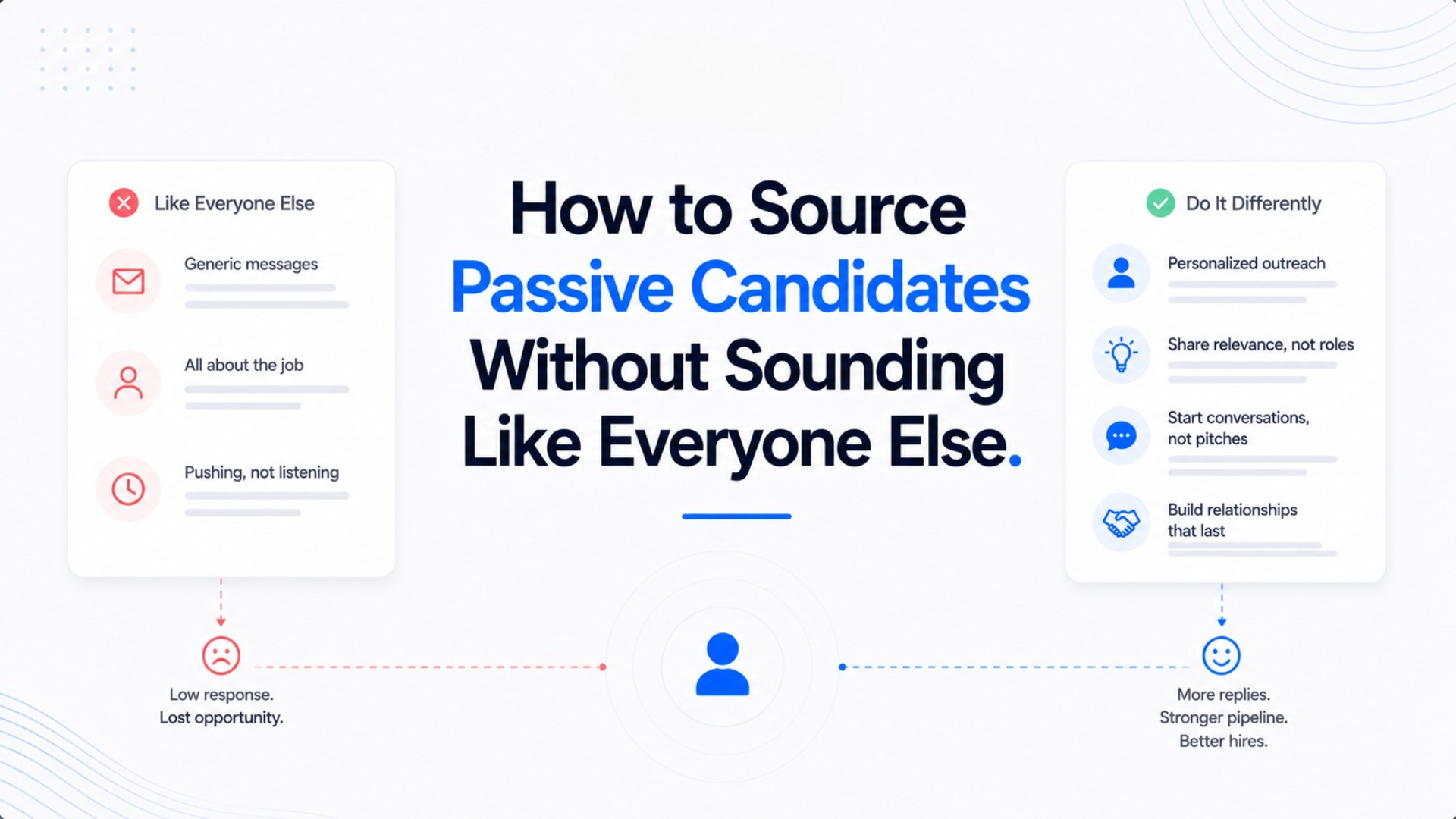
The average passive candidate receives between twenty and fifty recruiting messages per month. Most of them follow the same script: an enthusiastic opening line, a brief job description, and a call to action asking for fifteen minutes of their time. The recruiter hitting send believes their message is personalized because they swapped in the candidate's name and company. The candidate reading it sees the fourteenth variation of the same template they received this week and archives it without a second thought. This is the fundamental problem with passive candidate sourcing today: not a shortage of candidates, but a surplus of sameness. According to SHRM's talent acquisition research, response rates to cold outreach have declined by over thirty percent in the past three years, driven largely by message fatigue among passive candidates who have learned to tune out generic recruiter noise.
The recruiters who consistently succeed in engaging passive talent are not the ones with the most polished templates or the largest candidate databases. They are the ones who approach outreach as an intelligence problem rather than a volume problem. They invest time in understanding what makes each candidate unique before they ever compose a message. They time their outreach to moments when candidates are most receptive. They lead with insight rather than opportunity. And increasingly, they use AI-powered platforms to do all of this at scale without sacrificing the personalization that makes the difference between a response and an archive. This article explores what that looks like in practice and how you can apply it to your own sourcing workflow.
Why Most Passive Candidate Outreach Fails
The failure of most passive outreach is not a messaging problem in isolation. It is an intelligence problem that manifests as a messaging problem. When a recruiter sends a message that
says 'I came across your profile and was impressed by your experience at [Company],' the candidate immediately recognizes this as a template because it contains no information that could not have been gleaned from a five-second profile scan. The recruiter has not demonstrated any understanding of the candidate's actual work, challenges, career trajectory, or motivations. They have simply confirmed that they can read a LinkedIn headline. LinkedIn's recruiting resources show that messages which reference specific, non-obvious details about a candidate's work receive response rates three to five times higher than generic messages. Yet the majority of recruiters continue to send generic messages because their tools and workflows are designed for volume, not relevance.
There is also a structural problem with how most recruiting teams approach passive sourcing. The process typically begins with a search query, produces a list of candidates, and then applies the same outreach sequence to everyone on that list. This search-first, broadcast-later model treats all candidates who match a keyword profile as interchangeable recipients. But passive candidates are not interchangeable. A senior engineer at a pre-IPO startup has fundamentally different motivations and risk tolerance than a senior engineer at a mature enterprise. A product leader who just shipped a major launch is in a completely different psychological state than one whose project was just cancelled. Treating them the same is not just lazy— it is strategically ineffective. The recruiters who understand the difference between AI sourcing and AI recruiting know that sourcing is about identification while recruiting is about engagement, and passive candidate success depends on excelling at both.
The third reason outreach fails is timing. Even a well-crafted, deeply personalized message will underperform if it arrives at the wrong moment. A candidate who just received a promotion is unlikely to respond to outreach in the following months. A candidate whose company just announced layoffs is likely to be inundated with messages and may not see yours. A candidate who just published a thought leadership piece or presented at a conference, however, may be unusually receptive to a message that references that specific work. Most recruiters have no systematic way to identify these optimal timing windows. They send messages when the requisition dictates, not when the candidate signals readiness. Gartner's HR trends research identifies timing optimization as one of the highest-impact capabilities in modern talent acquisition, precisely because it transforms outreach from an interruption into a relevant, well-timed conversation starter.
Intelligence Before Outreach: What to Know Before You Write
The most successful passive sourcing programs share a common trait: they invest significantly more time in candidate intelligence than in message composition. Before a single word of outreach is written, the recruiter or their AI platform has built a multi-dimensional understanding of the candidate that goes far beyond what appears on their resume. This includes the candidate's career trajectory and the pattern of moves they have made, what those moves suggest about their priorities, the specific projects and accomplishments that define their professional reputation, the technologies, methodologies, and domains where they have deep
expertise, and signals about their current satisfaction and likely openness to a conversation.
Building this level of intelligence manually for every candidate would be prohibitively time-consuming, which is why the most effective recruiting teams use AI-powered talent intelligence platforms to do it at scale. An agentic AI recruiting platform can analyze millions of data points across a candidate's professional footprint— publications, open-source contributions, conference presentations, patent filings, company news, and network activity— to construct a comprehensive candidate profile that includes insights no manual review could produce. This is fundamentally different from why some AI recruiting tools have outdated candidate data, because intelligence platforms continuously refresh their understanding rather than relying on static snapshots. The result is a candidate profile that is not just deeper but more current, giving the recruiter a genuine informational advantage when crafting their outreach.
The practical impact of this intelligence-first approach is significant. When a recruiter can reference a specific technical challenge a candidate solved, a conference talk they delivered, or a strategic shift at their current company that may affect their role, the message stops feeling like outreach and starts feeling like a professional conversation. The candidate perceives the recruiter as someone who has done their homework, which builds trust and credibility before the relationship has even begun. This is the same dynamic that makes referrals outperform cold outreach— the referral sender has contextual knowledge about the candidate that makes the introduction feel relevant and personal. AI intelligence gives every recruiter that same contextual advantage, at scale, for every candidate in their pipeline.
The Anatomy of a Message That Actually Gets a Response
A message that breaks through the noise does not need to be long, clever, or salesy. It needs to be relevant. The most effective passive candidate messages share a common structure that can be described in three parts. First, the signal— a specific observation about the candidate's work, career, or professional context that demonstrates genuine knowledge. This is not 'I saw your profile on LinkedIn.' This is 'Your recent work on the distributed caching layer at [Company] caught my attention because we are solving a remarkably similar scalability challenge.' The signal proves you have done more than run a search. It proves you understand what the candidate actually does.
Second, the bridge— a concise connection between the candidate's expertise and a specific opportunity or challenge, framed in terms that matter to the candidate rather than to the hiring company. Instead of 'We are hiring a senior engineer for our platform team,' the bridge says 'We are building a team to tackle real-time data processing at scale, and your experience with exactly that problem makes you someone I would love to learn more from.' The bridge is not a job pitch. It is an invitation to a professional conversation about a shared domain of interest. The distinction matters because passive candidates are not looking for jobs, but they are often open to interesting conversations about their field.
Third, the ask— a low-commitment, specific request that makes responding easy. The worst
possible ask is 'Would you be open to a quick call?' because it is vague, it signals that the recruiter wants to pitch, and it requires the candidate to commit time before they have any reason to trust the recruiter's credibility. A better ask is 'Would you be open to sharing how your team approached the caching challenge? I am genuinely curious and it would help me think through our own approach.' This ask works because it flatters the candidate's expertise, requires no commitment to a job discussion, and gives the recruiter a legitimate reason to follow up with additional context. Understanding how many followups one hire needs, the first message is about opening a door, not closing a deal. Most passive hires require multiple touchpoints, and a message designed to start a conversation rather than extract a commitment creates the foundation for a productive follow-up sequence.
Using AI to Personalize at Scale Without Losing Authenticity
The biggest objection to intelligence-driven outreach is scalability. If every message requires deep research and careful composition, how can a recruiting team sourcing hundreds of candidates per month possibly maintain that standard? The answer is AI-assisted personalization, where the platform handles the intelligence gathering and drafting while the recruiter provides the strategic judgment and quality control. This is not about automating generic messages— it is about automating the research that makes personalization possible. McKinsey's research on organizational talent consistently shows that AI-augmented workforces outperform purely manual ones in both speed and quality, and recruiting outreach is no exception.
An AI platform can analyze a candidate's professional footprint in seconds, identifying the most compelling signal points to reference in outreach, the optimal timing based on behavioral patterns and career signals, the most relevant framing for the opportunity based on the candidate's demonstrated interests and career trajectory, and the most effective ask based on what has historically generated responses from similar candidate profiles. The recruiter then reviews this AI-generated intelligence, applies their own knowledge of the role, the hiring manager's priorities, and the company's value proposition, and crafts or approves a message that is both deeply informed and authentically human.
This collaborative model avoids the two extremes that doom most outreach programs. On one side is fully manual outreach, which produces high-quality messages but at a volume that is insufficient for competitive talent markets. On the other side is fully automated outreach, which achieves volume but sacrifices the relevance that drives response rates. AI-assisted personalization occupies the productive middle ground: messages that are individually tailored at a scale that manual effort alone could never achieve. The recruiters who embrace this model often find that more tools produce the same hiring problems when those tools operate in isolation. The key is an integrated platform where intelligence, personalization, and outreach are connected in a single workflow rather than scattered across multiple point solutions.
Timing, Channels, and the Follow-Up Strategy That Converts
Even the most personalized message will fail if it arrives at the wrong time or through the wrong channel. The most effective passive sourcers treat timing and channel selection as strategic decisions informed by data, not habits. AI platforms can analyze a candidate's activity patterns— when they are most active on professional platforms, when they typically publish or engage with content, and when they have historically been most responsive to outreach— to identify optimal sending windows. Deloitte's talent research found that outreach timed to candidate activity signals generates up to forty percent higher response rates than outreach sent at random intervals, because the message arrives when the candidate is already in a professional mindset and more likely to engage.
Channel diversity is equally important. Most recruiters default to LinkedIn InMail because it is convenient and integrated into their existing workflow. But passive candidates who are not actively looking may check LinkedIn infrequently, while being highly responsive on email, Twitter, or industry-specific communities. The most successful sourcers use multi-channel outreach strategies that meet candidates where they are, not where the recruiter prefers to operate. AI platforms can identify which channels each candidate is most active on and recommend the optimal channel mix for each outreach sequence. This is especially critical for niche and technical roles, where the best candidates often spend more time on GitHub, Stack Overflow, or specialized forums than on mainstream professional networks.
The follow-up strategy is where most outreach programs lose their potential. Research consistently shows that the majority of positive responses from passive candidates come not on the first message but on the second, third, or fourth touchpoint. Yet most recruiters abandon the sequence after one or two attempts, either because they lack the time to persist or because they have nothing new to say. AI platforms solve both problems. They automate the timing and delivery of follow-up sequences, ensuring no candidate falls through the cracks. And they generate new, relevant content for each follow-up by referencing additional signal points from the candidate's profile, sharing relevant market insights, or providing updates about the role or team that add value rather than repeating the same ask. Evaluating an AI sourcing tool should always include an assessment of its follow-up capabilities, because the follow-up is where the hire is actually made, not the first message.
What Passive Sourcing Looks Like When It Works
When intelligence-driven passive sourcing is working correctly, the results are transformative. Response rates to outbound messaging increase by a factor of three to five times. The quality of initial conversations improves because both parties are engaging from a position of mutual knowledge rather than asymmetric information. Time-to-hire for critical roles decreases because the pipeline is being built proactively rather than reactively. And the recruiter's role shifts from a high-volume message sender to a strategic talent advisor who spends the majority of their time on high-value activities like relationship building, candidate assessment, and hiring manager consultation.
The shift from generic to intelligent outreach also has a compounding effect. As recruiters
engage passive candidates with genuinely relevant, well-timed messages, their professional reputation in the talent market improves. Candidates talk to each other, and a recruiter known for thoughtful, informed outreach becomes someone candidates want to hear from— even when they are not looking. This reputational advantage is one of the most undervalued assets in talent acquisition, and it can only be built through consistently excellent outreach over time. The recruiters who wonder whether AI will replace their jobs should understand that AI is not replacing the recruiter— it is amplifying the recruiter's ability to build exactly this kind of reputation at scale.
Huntlo.ai is built to make this kind of intelligent passive sourcing accessible to every recruiting team. Its talent intelligence engine continuously monitors candidate signals, identifies optimal outreach timing, and generates personalized message recommendations that help you stand out in even the most crowded inboxes. Whether you are engaging niche technical candidates or building pipeline for hard-to-fill leadership roles, Huntlo gives you the intelligence to sound like you have done your homework— because you have. The future of passive sourcing is not louder or faster outreach. It is smarter outreach. And with Huntlo, that future is available right now.