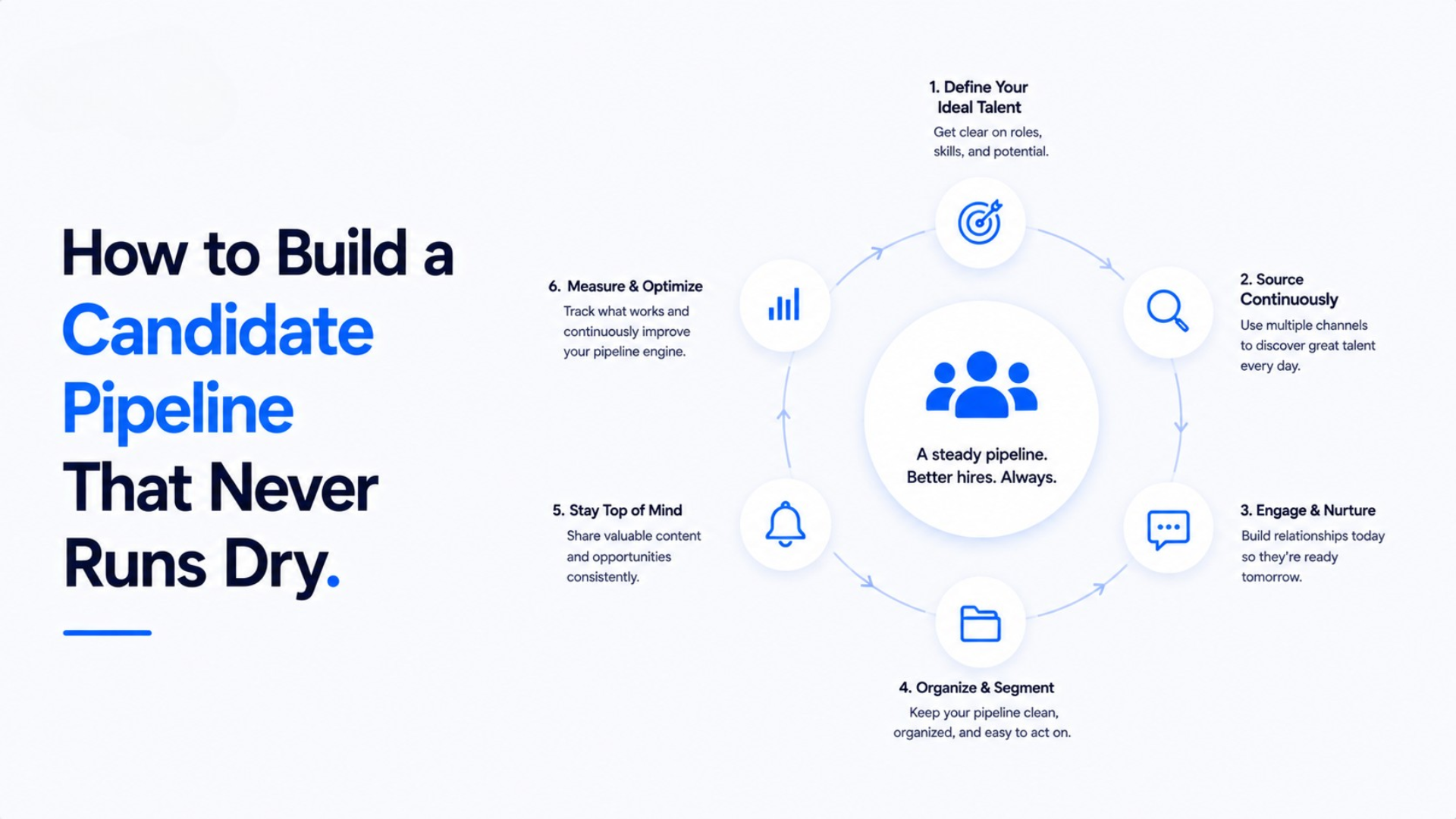
A recruiting director at a rapidly growing fintech company faces the same challenge every quarter: twelve to fifteen open engineering roles, a pool of candidates that seems to evaporate the moment it is built, and a team of recruiters who spend the first two weeks of every month sourcing from scratch because the pipeline from last quarter is empty. The director knows that pipeline recruiting is the answer, but every attempt to build a sustainable pipeline has failed. Candidates are identified, added to a spreadsheet, contacted once, and then forgotten. Three months later, when a new role opens, the spreadsheet is stale, the contacts are cold, and the team is back to sourcing from zero. This cycle, build a pipeline, let it decay, start over, is the most common failure mode in recruiting. It is not caused by a lack of effort or intention. It is caused by the absence of a system. A pipeline that never runs dry is not a collection of names in a spreadsheet. It is a continuously maintained, intelligently refreshed, systematically engaged network of qualified candidates who are always warm, always current, and always ready to have a conversation when the right opportunity emerges. Building this kind of pipeline requires a different approach to recruiting, one that treats candidate relationships as long-term assets rather than short-term transactions, and one that uses technology to maintain the operational discipline that human memory and spreadsheets cannot sustain.
The concept of a continuously full pipeline is not new. Sales teams have operated on this model for decades, maintaining customer relationship management systems that track prospects through awareness, consideration, and decision stages. But recruiting has been slow to adopt the same systematic approach, partly because recruiting has traditionally been measured by hires rather than by pipeline health, and partly because the tools available to recruiters have been designed for transactional sourcing rather than relationship management. According to LinkedIn's talent solutions research, only fifteen to twenty percent of recruiting teams currently maintain a structured, continuously refreshed candidate pipeline, and those that do report forty to sixty percent faster time-to-fill and twenty-five to thirty-five percent lower cost-per-hire than teams that rely on reactive sourcing. The building sustainable talent pipeline is not a competitive advantage for the few. It is an operational discipline that any recruiting team can adopt, and the gap between teams that have it and teams that do not is widening as the talent market becomes more competitive and candidates become more selective about how they engage with recruiters.
Why Most Pipeline Attempts Fail
The most common reason pipeline-building efforts fail is that they treat the pipeline as a project rather than a process. A project has a beginning, a middle, and an end. A process is continuous and ongoing. Most recruiting teams start their pipeline initiative with enthusiasm, identifying candidates, building spreadsheets, and making initial contact. But within a few weeks, the urgency fades, open requisitions demand attention, and the pipeline maintenance falls by the wayside. Three months later, the pipeline is stale and unusable. The candidate pipeline maintenance problem is fundamentally a priority problem. When pipeline maintenance competes with urgent requisition filling for recruiter time, the requisition always wins because it has a deadline, a hiring manager waiting, and a metric attached. Pipeline maintenance has none of these immediate pressures, so it gets deferred until it is forgotten entirely. Understanding why more tools produce the same hiring problems, the solution is not to try harder or to schedule more pipeline-building time. The solution is to embed pipeline maintenance into the daily recruiting workflow so that it happens automatically as a byproduct of the work the recruiter is already doing, rather than as a separate activity that requires additional time and motivation.
The second reason pipelines fail is data decay. A candidate who was interested and available three months ago may have accepted a new role, changed their career direction, or simply become less responsive because the initial engagement was not followed up. According to SHRM's talent acquisition research, candidate data in manually maintained pipelines decays at a rate of two to three percent per month, which means that after six months without active maintenance, roughly fifteen to twenty percent of the pipeline is no longer accurate. The recruiters who maintain successful pipelines are not the ones who build the biggest initial list. They are the ones who maintain the highest data freshness through continuous engagement and regular updates. The recruiting pipeline framework must include data freshness as a core metric, because a pipeline with stale data is not a pipeline at all. It is a database of ghosts.
Understanding why some AI recruiting tools have outdated candidate data, data freshness is the single most important operational metric for pipeline health, and it requires either a massive investment of manual effort or a technology platform that refreshes candidate information automatically.
The Three-Layer Pipeline Architecture
A pipeline that never runs dry is structured in three distinct layers, each serving a different purpose and requiring a different maintenance approach. The first layer is the awareness pool, which contains every professional who matches the organization typical hiring profile but who has not yet had a direct interaction with the recruiting team. This is the broadest layer of the pipeline, potentially containing hundreds or thousands of candidates, and it is maintained primarily through technology, passive monitoring of professional activity, career changes, and engagement signals. The recruiter does not manually interact with every candidate in the awareness pool. The AI platform monitors them and surfaces the ones who show signs of receptivity, moving them into the second layer. The second layer is the engagement pool, which contains candidates who have had at least one meaningful interaction with the recruiter or the organization. These candidates know who you are, they have a baseline level of recognition and trust, and they are warm enough to respond to a direct message. The third layer is the active pool, which contains candidates who are in active conversation about a specific role or who have been recently engaged and are highly receptive. The continuous candidate pipeline flows from awareness to engagement to active as candidates are warmed through repeated, value-driven interactions. According to McKinsey's people organization insights, organizations that maintain this three-layer structure report fifty percent more predictable hiring outcomes than those without a structured pipeline, because the layered approach ensures there is always a pool of candidates at the right stage of warmth when a role opens.
The three-layer architecture also solves the scalability problem that defeats most pipeline initiatives. Recruiters cannot maintain personal relationships with hundreds of candidates simultaneously. But they do not need to. The awareness layer is maintained by technology, not by human effort. The engagement layer requires periodic but not intensive touchpoints, a relevant article shared, a brief congratulatory message on a career milestone, or a thoughtful comment on a published piece. Only the active layer requires the kind of deep, time-intensive conversation that consumes significant recruiter time. By structuring the pipeline in layers and applying the right level of effort to each layer, the pipeline recruiting system becomes sustainable because the recruiter workload is distributed across candidates according to their warmth level rather than applied uniformly to every candidate regardless of their stage. Understanding the difference between AI sourcing and AI recruiting, the AI platform manages the awareness and engagement layers through automated monitoring and triggered outreach, while the recruiter focuses their human effort on the active layer where genuine conversation and relationship building are required.
The Inflow: How to Keep New Candidates Entering
A pipeline that never runs dry requires a continuous inflow of new candidates to replace those who are hired, become unavailable, or age out of the pipeline. The inflow should come from multiple channels to ensure diversity and resilience. The first inflow channel is the natural byproduct of recruiting. Every time a recruiter sources candidates for an open role and identifies someone who is strong but not quite right for that specific position, that candidate should flow into the pipeline. Every candidate who declines an offer because of timing or location, every interviewee who is not selected but is genuinely qualified, and every referral who does not match the current role should be captured and added to the awareness pool. This channel alone can supply a significant portion of the pipeline if the recruiter is disciplined about capturing every qualified interaction rather than letting candidates fall through the cracks after the current requisition is filled. The talent pipeline best practices start with this simple discipline: no qualified candidate should ever be lost after a single interaction. Understanding why referrals outperform cold outreach, the referral channel is the second inflow source, because referred candidates arrive with a pre-existing connection that makes them easier to warm and faster to engage.
The third inflow channel is proactive market monitoring. The recruiter or the AI platform continuously scans the talent market for emerging professionals, career changers, and candidates who are showing early signals of openness to new opportunities. This channel is where the pipeline grows beyond the boundaries of current requisitions and current networks, bringing in candidates who would never be found through reactive sourcing. Understanding how many follow-ups one hire actually needs, candidates who enter the pipeline through proactive monitoring often require fewer follow-ups to engage because they have been identified based on signals of receptivity rather than cold outreach. The fourth inflow channel is community engagement, attending events, participating in online forums, and contributing to professional communities where target candidates gather. According to Gartner's HR trends research, recruiting teams that maintain active community engagement as an inflow channel report thirty percent more diverse candidate pipelines than teams that rely solely on database-driven sourcing, because community engagement naturally attracts candidates from varied backgrounds and career paths.
The Engagement Engine: Keeping the Pipeline Warm
The biggest pipeline killer is not a failure to add candidates. It is a failure to engage them after they have been added. A pipeline with five hundred candidates who have not been contacted in three months is not a pipeline. It is a database. The pipeline engagement strategy must ensure that candidates in the engagement and active layers receive regular, relevant touchpoints that maintain their warmth and keep the recruiter top of mind. The key word is relevant. Generic check-in messages, automated holiday greetings, and mass newsletters do not maintain pipeline warmth. They erode it, because they signal to the candidate that they are on
a list rather than in a relationship. Effective pipeline engagement is specific, personalized, and value-driven. It references the candidate recent work, acknowledges their accomplishments, and provides information or insights that are genuinely useful to their career. According to Deloitte's talent research, recruiters who send personalized, value-driven engagement messages maintain response rates of twenty to thirty percent from their pipeline candidates, compared to two to five percent for recruiters who send generic check-ins.
The engagement engine also requires a consistent cadence. Pipeline candidates should hear from the recruiter at least once every four to six weeks, with the frequency increasing for candidates in the active layer. This cadence ensures that the relationship stays warm without becoming intrusive. The content of the engagement should vary to avoid repetitiveness. One touchpoint might share a relevant industry article. The next might congratulate the candidate on a career milestone detected through monitoring. The next might invite them to an event or connect them with someone useful in their network. The candidate relationship pipeline thrives on variety and genuine value, not on frequency alone. Understanding what makes an AI recruiting platform agentic vs. just automated, the best platforms automate the operational aspects of engagement, tracking cadence, detecting milestones, and drafting personalized messages, while the recruiter reviews and approves each touchpoint to ensure quality and authenticity. Understanding AI recruiting for niche and technical roles, this personalized engagement approach is especially effective for niche talent, because specialists are more responsive to content that demonstrates genuine understanding of their domain than to generic recruiting outreach.
Measuring and Optimizing Pipeline Health
A pipeline that is not measured cannot be managed. The metrics that matter for pipeline health are different from the metrics that matter for individual requisition filling. The first metric is pipeline size by layer. How many candidates are in the awareness, engagement, and active pools? A healthy pipeline has a roughly pyramid shape, with the largest number at awareness and the smallest at active. If the awareness pool is shrinking, the inflow is insufficient. If the engagement pool is not growing relative to awareness, the warming process is not working. If the active pool is consistently empty, the engagement-to-active conversion is failing. The second metric is pipeline velocity, which measures how quickly candidates move from one layer to the next. A pipeline where candidates sit in the awareness layer for months without progressing has a warming problem. The third metric is pipeline conversion rate, which measures what percentage of active pool candidates become hires when a matching role opens. This is the ultimate measure of pipeline quality, because it indicates whether the pipeline contains candidates who are not just warm but genuinely qualified and interested. The always-on talent pipeline should produce a conversion rate from active pool to hire of at least thirty to forty percent, meaning that for every three candidates activated for a role, at least one should become a hire.
The fourth metric is pipeline freshness, the percentage of candidate records that have been
verified or updated within the last thirty days. This metric directly measures whether the pipeline is being maintained or decaying. A freshness rate below seventy percent indicates a pipeline that is becoming unreliable. The fifth metric is engagement response rate, which measures what percentage of pipeline candidates respond to engagement touchpoints. A declining response rate indicates that the engagement content is not resonating or that the cadence is too aggressive. Understanding how to evaluate an AI sourcing tool before buying, the ability to track these pipeline health metrics should be a core requirement for any platform that supports pipeline recruiting, because without visibility into pipeline health, the pipeline will inevitably decay. And for recruiters who wonder whether AI will replace their jobs, the answer is that AI will not replace recruiters who build and manage living candidate pipelines. It will replace recruiters who start from zero every time a requisition opens, because pipeline recruiters with AI support will always be faster, more consistent, and more effective. The never run out of candidates outcome is not a matter of working harder. It is a matter of building a system that works continuously.
How Huntlo.ai Builds and Maintains Your Perpetual Pipeline
Huntlo.ai provides the complete platform for building a candidate pipeline that never runs dry. The AI continuously monitors the talent market, identifies and scores candidates who match your organization hiring patterns, and maintains fresh intelligence on every candidate in your pipeline. The three-layer architecture, awareness, engagement, and active, is built into the platform, with automated monitoring for the awareness layer, triggered engagement for the engagement layer, and human-led conversation support for the active layer. When a requisition opens, Huntlo surfaces the most qualified and most receptive candidates from your existing pipeline, so you never start from zero. The platform also supports AI recruiting for niche and technical roles, ensuring that even the most specialized pipelines are continuously monitored and refreshed with fresh intelligence.
For recruiting leaders who are tired of the build-decay-rebuild cycle and want a pipeline that produces qualified candidates on demand, Huntlo provides the technology, the workflow, and the measurement to make perpetual pipeline recruiting a reality. Your next great hire is already in the talent market. Huntlo ensures they are already in your pipeline.