A chief people officer at a Series C technology company sits down for her weekly recruiting review. She does not ask how many requisitions are open or how many candidates were sourced this week. She asks her recruiting team three questions. First, what has changed in the talent market for our key roles in the past seven days? Second, which candidates in our pipeline have shown engagement signals that suggest they are becoming receptive? Third, what competitive hiring threats have emerged from companies targeting the same talent pools? Her team answers each question in minutes, pulling from an AI-powered talent intelligence platform that has been monitoring the market continuously. They know that a competitor just posted eight engineering roles matching their hiring profile, that seventeen candidates in their pipeline have updated their LinkedIn profiles in the past week, and that three senior engineers at a target company have recently started following their company page. This is talent intelligence in action, and it is the operating model that is replacing traditional candidate search at every organization that takes recruiting seriously. Traditional search answers the question: who matches this job description right now? Talent intelligence answers a far more valuable set of questions: who should we be building relationships with, what is happening in the talent market, and when is the right time to engage?
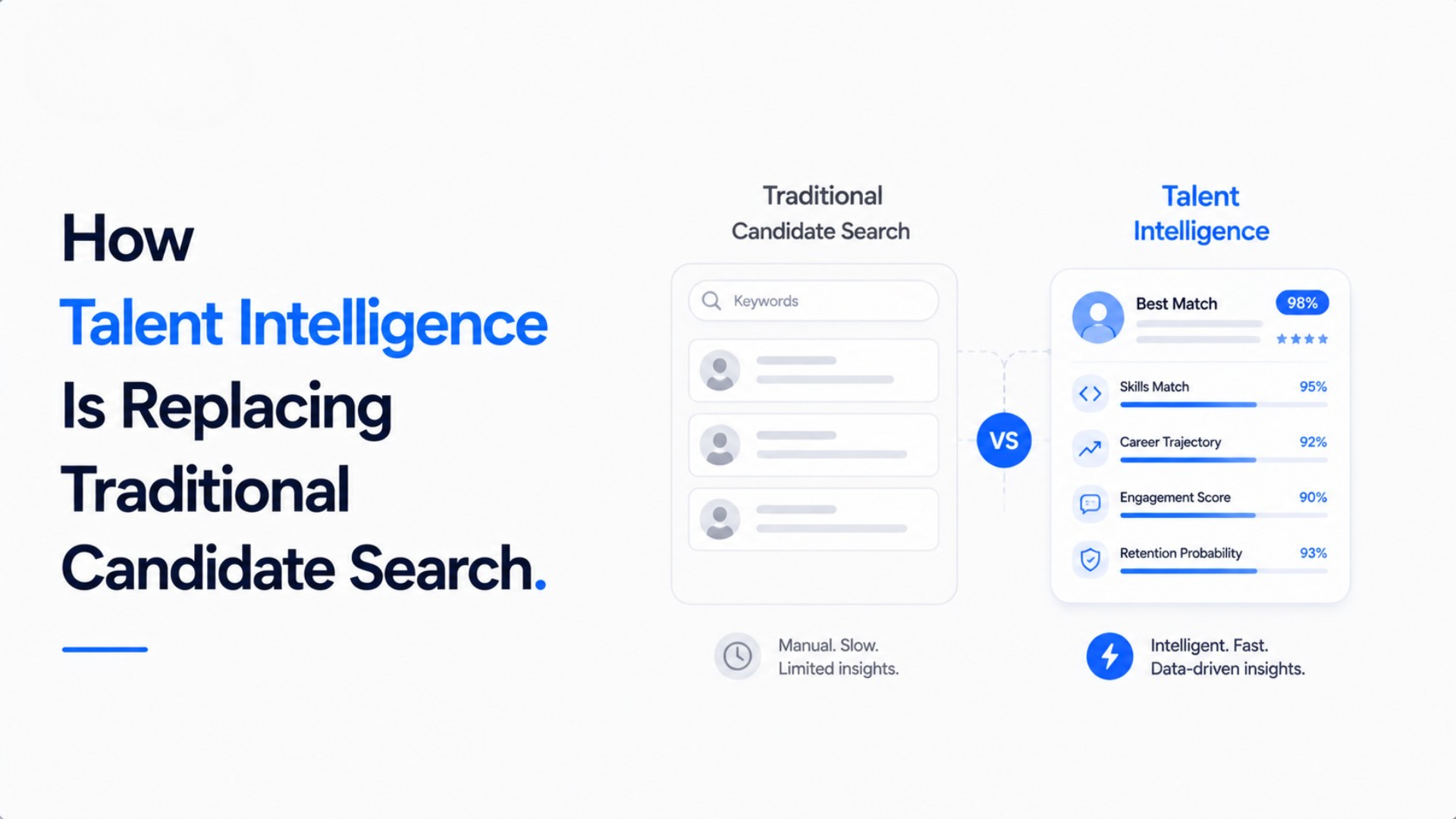
The distinction between candidate search and talent intelligence is not a semantic difference. It is a fundamental difference in what the recruiting function does and how it creates value. Candidate search is a transactional activity, find a candidate who matches a job description, contact them, and move them through the hiring process. Talent intelligence is a strategic activity, understand the talent market, predict hiring needs, identify opportunities and threats, and build long-term candidate relationships that produce hires on demand. According to LinkedIn's talent solutions research, organizations that have adopted talent intelligence as their primary recruiting operating model report fifty to sixty percent faster time-to-fill, thirty to forty percent lower cost-per-hire, and twenty-five percent higher quality-of-hire scores compared to organizations that rely primarily on reactive candidate search. The talent intelligence replacing search is not a future trend. It is a present reality for the recruiting teams that have made the transition, and the gap between intelligence-led teams and search-led teams is widening every quarter.
What Talent Intelligence Actually Means
Talent intelligence is the systematic collection, analysis, and application of data about the external talent market to inform recruiting decisions. It operates on three levels. The first level is candidate intelligence, which is deep, continuously updated knowledge about individual candidates, their skills, career trajectories, engagement signals, and likely receptivity to outreach. This is the most granular level and the one that most directly replaces traditional candidate search. Instead of searching for candidates when a role opens, the intelligence platform has already been tracking and scoring candidates, so the recruiter accesses a pre-built, prioritized shortlist rather than building one from scratch. The second level is market intelligence, which is knowledge about the talent landscape as a whole, including skill availability, geographic distribution, compensation trends, and competitive hiring activity. This level informs strategic decisions about where to hire, what to pay, and how to position the employer brand. The third level is predictive intelligence, which uses historical patterns and real-time signals to forecast future talent market conditions, such as which skills will become scarce, which companies are likely to experience talent exodus, and which candidates in the pipeline are approaching career inflection points. The talent intelligence platform that provides all three levels of intelligence transforms recruiting from a reactive, search-driven function into a proactive, intelligence-driven one. According to Gartner's HR trends research, by 2026 more than sixty percent of large enterprises will have adopted talent intelligence as a core recruiting capability, up from less than twenty percent in 2023, because the competitive advantage it provides is too significant to ignore.
The real-time talent market data that powers talent intelligence comes from multiple sources. Professional platforms like LinkedIn provide profile data, activity signals, and network connections. Public sources like GitHub, published papers, conference programs, and patent filings provide evidence of skills and expertise. Company data sources provide information about hiring activity, funding events, leadership changes, and organizational restructuring that affect candidate availability. The talent intelligence platform aggregates and synthesizes all of
these sources into a unified, continuously updated picture of the talent market. Understanding why some AI recruiting tools have outdated candidate data, the value of the intelligence depends entirely on the freshness and breadth of the underlying data. A platform that only pulls data periodically from a single source will produce incomplete and stale intelligence. A platform that continuously aggregates data from multiple sources produces comprehensive and current intelligence that gives the recruiting team a genuine strategic advantage. Understanding the difference between AI sourcing and AI recruiting, talent intelligence encompasses both functions by providing the candidate discovery capability of sourcing and the market understanding capability of strategic recruiting in a single, integrated platform.
Why Traditional Search Cannot Compete
Traditional candidate search is structurally limited in ways that talent intelligence is not. The first limitation is timing. Traditional search is triggered by a requisition, which means the recruiter starts looking for candidates only after the need has been formalized. This reactive timing means the recruiter is always behind the curve, starting their search at the same moment as every other recruiter with the same role. Talent intelligence is continuous, which means the platform has been monitoring candidates and building pipeline before the requisition existed. The second limitation is perspective. Traditional search sees the talent market through the narrow lens of a single job description. It finds candidates who match that specific description and ignores everyone else. Talent intelligence sees the talent market in its entirety, understanding skill adjacencies, career trajectories, and transferable capabilities that enable the identification of candidates who would succeed in the role but who do not match the job description on paper. The recruiting intelligence vs search comparison at the perspective level reveals that traditional search is looking through a keyhole while talent intelligence is looking through a panoramic window. According to McKinsey's people organization insights, organizations using talent intelligence report identifying forty to sixty percent more qualified candidates per role than those using traditional search, because the intelligence platform evaluates a broader candidate pool and applies more sophisticated matching logic.
The third limitation is adaptability. Traditional search produces a static list of candidates at a point in time. If the talent market changes after the search is run, if a candidate becomes available, if a competitor launches a hiring offensive, or if a new skill combination emerges, the static list does not update. The recruiter must run the search again to capture the changes. Talent intelligence is dynamic and self-updating. It continuously adjusts its candidate rankings, engagement recommendations, and market assessments as new data becomes available. The talent landscape analysis that talent intelligence provides is not a snapshot. It is a continuously evolving understanding of the market that gets more accurate over time. Understanding why more tools produce the same hiring problems, adding more traditional search tools does not overcome these structural limitations because each additional tool operates within the same reactive, narrow-perspective, static framework. The strategic talent data that intelligence platforms provide is fundamentally different in kind, not just in degree, from the candidate lists that traditional search tools produce. According to SHRM's talent
acquisition research, recruiting leaders who have transitioned from search-based to intelligence-based recruiting describe the difference as moving from driving blind to driving with a real-time GPS and traffic overlay.
The Four Pillars of a Talent Intelligence System
A complete talent intelligence system is built on four pillars that work together to provide comprehensive, actionable recruiting intelligence. The first pillar is continuous candidate monitoring, the always-on process of tracking candidate profiles, career movements, and professional activity across the talent market. This pillar ensures that the recruiting team has current information about every candidate in their pipeline and in the broader market, not just the information that was available the last time someone ran a search. The second pillar is engagement signal detection, the ability to identify when a candidate is becoming receptive to a conversation based on behavioral changes such as profile updates, increased platform activity, new connections, and company following patterns. This pillar transforms recruiting from a volume game into a timing game, enabling the recruiter to reach candidates at the moment they are most likely to respond. The candidate market monitoring capability that these two pillars provide gives the recruiting team a real-time view of candidate availability that is impossible with periodic, reactive search. According to Deloitte's talent research, organizations with continuous monitoring and signal detection reduce their average outreach-to-response time by fifty percent because they are engaging candidates at optimal moments rather than random ones.
The third pillar is competitive intelligence, the ability to track what other organizations are doing in the talent market, which roles they are hiring for, which companies they are targeting for talent, and what compensation and value propositions they are offering. This pillar enables the recruiting team to anticipate competitive threats, adjust their strategy in response to competitor activity, and position their outreach to differentiate from the messages candidates are receiving from other organizations. The fourth pillar is predictive analytics, the ability to forecast future talent market conditions based on historical patterns and current signals. Predictive analytics can identify which skills will become scarce in the coming quarter, which candidates in the pipeline are approaching career inflection points, and which target companies are likely to experience talent turnover. The predictive hiring intelligence that this pillar provides enables the recruiting team to act proactively rather than reactively, building pipeline for roles before they are opened and engaging candidates before competitors know they are available. Understanding what makes an AI recruiting platform agentic vs. just automated, the platforms that provide all four pillars of talent intelligence are agentic systems that operate autonomously to maintain a comprehensive, real-time picture of the talent market, rather than automated tools that simply execute predefined searches on demand.
How to Transition Your Team to Intelligence-Led Recruiting
Transitioning from traditional search to talent intelligence is not a tool switch. It is an
operating model change that affects how the recruiting team spends its time, how it measures success, and how it interacts with hiring managers. The transition works best when it follows three phases. The first phase is parallel operation, where the intelligence platform runs alongside existing search processes for two to four weeks. The recruiting team uses both approaches and compares the results, building confidence in the intelligence platform output and identifying any gaps in its coverage. The second phase is intelligence-primary, where the talent intelligence platform becomes the primary source of candidate identification and market insight, and traditional search is used only as a supplementary validation tool. In this phase, the recruiter workload shifts from searching to engaging, because the platform is producing candidate shortlists that would have taken days to build manually. The third phase is intelligence-native, where the entire recruiting workflow is designed around the talent intelligence platform. Weekly recruiting reviews focus on market intelligence and pipeline health rather than on sourcing activity metrics. Hiring manager conversations include talent market briefings that inform role design and expectation setting. The AI talent intelligence model becomes the default operating mode, and traditional search is used only for edge cases that the intelligence platform does not cover. According to LinkedIn's recruiting resources, organizations that follow this phased transition report zero disruption in hiring output during the transition period and measurable improvements in quality-of-hire and time-to-fill within sixty days of reaching the intelligence-native phase.
The transition also requires a shift in how recruiting success is measured. Traditional recruiting metrics, messages sent, profiles viewed, and response rates, measure activity. Talent intelligence metrics, pipeline health, market coverage, signal detection accuracy, and intelligence-to-hire conversion, measure effectiveness. A recruiter who sends fifty messages a week but is working from a stale, incomplete picture of the talent market is generating activity without impact. A recruiter who sends twenty messages based on fresh intelligence, optimal timing, and deep candidate context is generating impact with less activity. Understanding how many follow-ups one hire actually needs, intelligence-led outreach also requires fewer follow-ups per hire because the initial outreach is better targeted and better timed. Understanding why referrals outperform cold outreach, the effectiveness advantage of intelligence-led recruiting is the same mechanism that makes referrals effective, relevance and credibility. Intelligence-led outreach is relevant because it is based on current candidate data, and it is credible because it demonstrates genuine understanding of the candidate situation. For organizations evaluating an AI sourcing tool before buying, the breadth of intelligence capabilities across all four pillars should be the primary evaluation criterion, because a platform that only provides candidate search without market intelligence, signal detection, and predictive analytics is not a talent intelligence platform. It is just a faster search tool. And for recruiters who wonder whether AI will replace their jobs, the answer is that AI will replace recruiters who rely on traditional search as their primary method, because recruiters who operate with talent intelligence will consistently outperform them across every metric that matters.
How Huntlo.ai Delivers Complete Talent Intelligence
Huntlo.ai is a full-spectrum talent intelligence platform that provides all four pillars of recruiting intelligence in a single, integrated system. The platform continuously monitors the talent market, tracking candidate profiles, career movements, engagement signals, and competitive hiring activity across every domain that matters to your organization. It provides real-time market intelligence that keeps your recruiting team informed about talent market conditions, competitor hiring patterns, and emerging skill trends. It delivers predictive analytics that forecast talent availability and candidate receptivity, enabling your team to act proactively rather than reactively. And it maintains a continuously refreshed candidate pipeline that ensures every outreach message is based on current, accurate data. When a requisition opens, Huntlo does not start a search. It activates intelligence that has been building for weeks or months, surfacing the most qualified and most receptive candidates with the deep context your recruiters need to engage effectively. The platform also supports AI recruiting for niche and technical roles, where the breadth and freshness of talent intelligence is most critical because the candidate pool is small, specialized, and rapidly evolving.
For recruiting leaders who recognize that the future of recruiting is intelligence-led, Huntlo provides the complete platform to make talent intelligence your team default operating model. Traditional search finds candidates who match a job description. Huntlo understands the talent market well enough to find, engage, and hire candidates before your competitors even know they exist.