Marcus Webb, a senior recruiter at a midsize staffing agency specializing in technology placements, opened his Monday morning to find seventeen scheduling threads awaiting his attention. Three candidates had sent availability over the weekend. Two client hiring managers had changed their schedules without notice. One placement that had taken six days to coordinate was now in jeopardy because the candidate had received another offer during the wait. Marcus did the math: he had spent roughly thirty hours in the past two weeks on scheduling logistics alone, time that produced zero placements and zero client value. His agency billed clients for successful placements, not for scheduling effort, which meant that every hour spent on coordination was an hour of unrecoverable cost. Marcus was not a bad recruiter. He was a good recruiter trapped in a bad process. His story is playing out at agencies everywhere, and the solution is not more effort or more recruiters. It is a fundamentally different approach to interview coordination that uses AI to eliminate the manual back-and-forth that currently consumes the most productive hours of every agency recruiter working day.
The Scheduling Problem That Limits Agency Growth
Marcus Webb, a senior recruiter at a midsize staffing agency specializing in technology placements, spent his entire Thursday afternoon coordinating a single interview between a senior frontend developer and the client engineering lead. The candidate was available mornings only. The client lead was in back-to-back meetings until the following week. The timezone difference between San Francisco and London meant that the overlap window was barely two hours. After nine email exchanges across four days, the interview was confirmed for the following Wednesday, nine business days after the initial scheduling attempt. By that point, Marcus had invested roughly three hours of billable time into a single coordination task
that generated zero revenue. His experience is representative of a structural problem that limits the growth potential of every recruitment agency: scheduling is the invisible tax that consumes recruiter capacity without producing any client-facing or candidate-facing value, and at agency scale where recruiters manage dozens of active placements simultaneously, this tax becomes the primary constraint on revenue per recruiter and overall agency profitability.
The agency scheduling challenge is fundamentally different from the in-house hiring problem because agencies must coordinate across three parties rather than two. In an in-house hiring process, the recruiter controls both the candidate side and the interviewer side of the equation. In an agency model, the recruiter must align the availability of the candidate, the client hiring manager, and often additional client stakeholders such as team leads, panel interviewers, or HR business partners. Each additional party multiplies the coordination complexity, and the recruiter sits in the middle managing communication with both sides. Research published by SHRM on staffing agency operations has found that agency recruiters spend thirty to forty-five percent of their working hours on scheduling and logistics, a proportion that increases as the number of active client placements grows. This is not a marginal inefficiency. It is the single largest operational constraint on agency recruiter productivity and a direct limit on how many placements a recruiter can manage simultaneously.
The impact on agency economics is straightforward and significant. If a recruiter spends forty percent of their time on scheduling, they can only devote sixty percent to the revenue-generating activities of sourcing, candidate assessment, and client relationship management. An AI-powered scheduling system that handles coordination autonomously can reduce this overhead by eighty to ninety percent, effectively giving each recruiter back a full additional day of productive capacity per week. The most advanced implementations operate as an agentic AI recruiting platform that evaluates all participant calendars simultaneously, resolves timezone conflicts, applies client-specific scheduling policies, and confirms interviews without requiring recruiter intervention. For agencies operating on placement fees, the revenue impact of this recovered capacity is substantial and immediate, because every additional hour of productive recruiter time translates directly into additional candidate submissions, client conversations, and completed placements.
Why Agency Scheduling Is Harder Than It Looks
The difficulty of agency scheduling is not simply a matter of having more parties involved. It is compounded by several factors that are unique to the agency business model. First, agency recruiters typically manage placements for multiple clients simultaneously, each with different scheduling requirements, interviewer availability patterns, and internal processes. A recruiter managing fifteen active placements might be coordinating across fifteen different client organizations, each with its own culture of responsiveness, its own calendar systems, and its own expectations for how scheduling should work. This context-switching is cognitively demanding and error-prone. Research from McKinsey on professional services productivity has found that context-switching between multiple client engagements reduces individual productivity by twenty to thirty percent compared to focused single-client work, and
agency recruiters are among the most extreme examples of this effect because scheduling coordination requires constant attention to multiple simultaneous threads.
Second, agency recruiters often lack direct access to client calendar systems, which means they cannot verify interviewer availability independently and must rely on the client to provide accurate availability information. When that information is delayed, incomplete, or inaccurate, the recruiter is forced into additional rounds of communication that extend the scheduling timeline. This problem of outdated candidate or interviewer data is particularly acute in agency contexts because the recruiter has limited ability to validate the information they receive. A client might say a hiring manager is available on Tuesday afternoon, but if that manager accepts a conflicting internal meeting before the candidate confirms, the proposed slot becomes invalid and the process restarts. Each restart adds days to the timeline and erodes the confidence of both the candidate and the client in the agency ability to manage the process efficiently.
Third, agency scheduling is complicated by the commercial pressure to demonstrate responsiveness and professionalism to both candidates and clients. In a competitive agency market, the client relationship depends on the agency ability to move quickly and present candidates who are ready to interview at short notice. When scheduling takes a week, it undermines the agency value proposition and gives clients a reason to question whether the agency is the right partner for their hiring needs. This is especially true when hiring for niche or technical roles where clients expect agencies to deliver pre-vetted candidates who can move through the interview process rapidly. Slow scheduling signals operational weakness, and in a market where clients can switch agencies with relatively little friction, that signal can be commercially fatal. Many agencies attempt to solve these problems by adding more tools, but without an integrated approach, additional tools often create more complexity rather than reducing the underlying coordination challenge.
How AI Scheduling Compresses the Agency Timeline
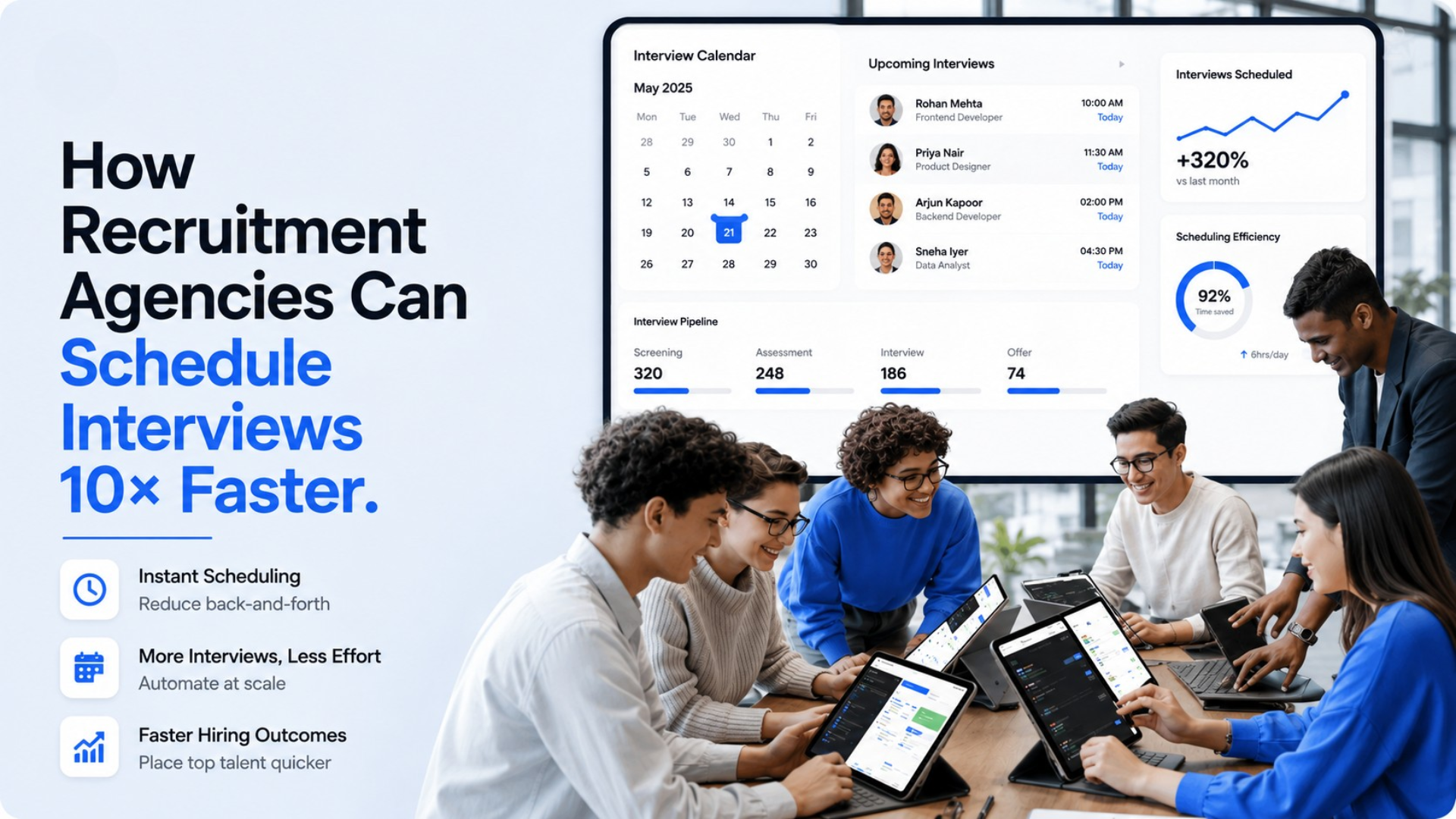
AI scheduling transforms the agency timeline by replacing sequential coordination with parallel resolution. In a manual process, the recruiter sends an availability request to the candidate, waits for a response, sends available options to the client, waits for the client to confirm, and then relays the confirmed time back to the candidate. Each wait adds hours or days to the process. An AI scheduling system evaluates all participant availability simultaneously, identifies viable time slots within seconds, and presents confirmed or near-confirmed options that require only final approval from each party. According to LinkedIn talent solutions data, agencies that have implemented AI scheduling report average time-to-schedule reductions of seventy to ninety percent, with the most dramatic improvements occurring in multi-party, multi-timezone scenarios where manual coordination is slowest. For a process that previously took nine business days, a ninety percent reduction means confirmation within one day, which is the difference between a candidate who is still engaged and one who has already accepted another opportunity.
The impact on candidate experience is equally transformative. Candidates working with
agencies are typically considering multiple opportunities through multiple channels, and the speed of the scheduling process directly influences their perception of both the agency and the client. When an agency can schedule an interview within hours of a candidate expressing interest, it signals operational excellence and respect for the candidate time. Research on why referrals outperform cold outreach has shown that the speed and professionalism of the early-stage process is one of the strongest predictors of candidate engagement and commitment, and this principle applies with equal force to agency-placed candidates. When scheduling is slow, candidates interpret the delay as a lack of agency competence, which reduces their willingness to invest effort in preparation and makes them more likely to accept competing opportunities from faster-moving channels.
For agencies managing high-volume placement workflows, the compounding effect of AI scheduling is remarkable. Consider an agency with twenty recruiters, each managing fifteen active placements. If each placement requires an average of two scheduling events per hiring stage and the hiring process has four stages, that is twenty-four hundred scheduling events per hiring cycle. If AI scheduling reduces each event from two days to two hours, the total time savings across the agency is over four thousand recruiter-days per cycle. This is not an incremental improvement. It is a structural change in agency capacity that enables either significant revenue growth without additional headcount or a reduction in recruiter workload that improves retention and quality of service. The connection between scheduling efficiency and broader recruiting performance is well established in discussions about the difference between AI sourcing and AI recruiting, because the agencies that achieve the best outcomes are those that maintain momentum and professionalism across every phase of the placement process, from initial candidate contact through final offer and onboarding.
What Agencies Need in a Scheduling Solution
Not all scheduling tools are suitable for the agency context, and selecting the wrong solution can create more problems than it solves. The first and most critical requirement is multi-client support. Agency recruiters need a scheduling system that can manage placements across multiple client organizations, each with different scheduling policies, interviewer pools, and calendar systems. A tool designed for in-house hiring that assumes a single organization context will force agency recruiters to manually switch between client configurations, adding complexity rather than reducing it. The second requirement is client calendar integration. While agencies often lack direct access to client calendar systems, the most effective scheduling platforms provide mechanisms for clients to share availability without granting full calendar access, such as dedicated scheduling portals or periodic availability synchronization. This reduces the information asymmetry that causes so many rescheduling cycles. According to Gartner, agencies that implement scheduling tools with strong multi-client capabilities report significantly higher adoption rates and better scheduling outcomes than those that deploy single-employer tools adapted for agency use.
The third requirement is branded candidate experience. Agency recruiters represent both themselves and their clients to candidates, and the scheduling experience reflects on both
brands. The scheduling interface should be customizable with agency branding, mobile-responsive, and capable of sending automated communications that feel personal rather than robotic. The fourth requirement is integration with the agency CRM or applicant tracking system. Scheduling data should flow automatically into placement records, updating status, timeline, and communication history without manual data entry. This integration is essential for the analytics that agency leaders need to manage their business effectively. Analysis of follow-up dynamics in hiring shows that agencies with integrated scheduling and CRM systems have significantly better visibility into placement pipeline health and can identify and address scheduling bottlenecks before they impact client or candidate satisfaction. Guidance on how to evaluate an AI sourcing tool before buying emphasizes that integration depth and multi-client support are the two most important criteria for agency scheduling solutions, because tools that lack these capabilities will require constant workarounds that undermine the efficiency gains they promise.
The fifth requirement is analytics and reporting that support agency business management. Agency leaders need visibility into scheduling performance across all recruiters, all clients, and all placements. Metrics such as average time-to-schedule, rescheduling frequency, candidate withdrawal rates during scheduling, and client satisfaction with scheduling speed enable data-driven decisions about process improvement and technology investment. A common concern among agency recruiters is whether AI scheduling will make their role feel less valuable to clients. Research on whether recruiters should worry about AI replacing their jobs consistently shows the opposite: AI amplifies recruiter value by eliminating administrative overhead and enabling recruiters to invest more time in the candidate relationships, client advisory, and strategic placement management that define agency excellence. The most successful agency implementations present AI scheduling to clients as a service enhancement that delivers faster results, not as a cost-cutting measure that reduces the human touch.
Turning Scheduling Speed Into a Competitive Advantage
For recruitment agencies, scheduling speed is not just an operational metric. It is a commercial differentiator that directly influences client acquisition, client retention, and candidate quality. In a market where agencies compete for both client contracts and candidate access, the ability to move candidates through the interview process faster than competitors is a tangible and measurable advantage that clients recognize and value. When an agency can present a shortlisted candidate and schedule the first client interview within twenty-four hours, it demonstrates a level of operational capability that distinguishes it from competitors still relying on manual coordination. Deloitte analysis of professional services competitiveness has found that operational speed and reliability are among the top three factors clients cite when selecting and retaining service providers, and this finding applies directly to the agency recruitment market where speed of delivery is a proxy for overall agency quality.
The competitive advantage compounds over time as faster scheduling enables agencies to work with more clients, manage more placements per recruiter, and attract higher-quality candidates who prefer working with responsive agencies. This creates a virtuous cycle where
scheduling efficiency drives better outcomes, which drive stronger client relationships, which drive more placement opportunities. Agencies that invest early in AI scheduling infrastructure establish a capability gap that competitors without similar technology will find increasingly difficult to close. The implementation approach matters. EY research on professional services digital transformation has found that agencies that combine scheduling automation with broader process redesign, clear client communication about the new capability, and ongoing performance measurement achieve the strongest and most sustained competitive results. The technology enables the speed, but the strategic positioning of that speed as a client value proposition is what transforms scheduling efficiency into a genuine competitive moat.
For agency recruiters like Marcus, the shift from manual scheduling to AI-powered coordination is personal and immediate. Instead of spending Thursday afternoon on a single coordination thread, Marcus could have confirmed that interview in minutes and spent the remaining hours on activities that generate revenue and strengthen client relationships. Every scheduling interaction that takes hours instead of minutes is revenue left on the table and a client relationship that is not receiving the attention it deserves. The path to ten-times-faster scheduling is not theoretical. It requires a scheduling platform built for the multi-client complexity of agency work, integrated with the tools recruiters already use, and deployed with the change management discipline that ensures adoption and sustained value. The agencies that make this investment today will be the ones that grow fastest tomorrow, because in the agency business, speed is not optional. It is the currency of trust, the foundation of client loyalty, and the engine of profitable growth.