David had the call on Wednesday afternoon, and it could not have gone better. The candidate asked about the product roadmap, wanted to know how the engineering team made decisions, and even asked about the onboarding experience for senior hires. David walked away convinced this was the one. He told himself he would send a detailed follow-up by Thursday morning. Then a hiring manager called about a different role that had just become urgent. Then two candidates for another search needed interview feedback by end of day. Then it was Friday, and the detailed follow-up became a quick check-in, which became no follow-up at all because the candidate had already accepted another offer by the time David opened their thread again on Monday. The candidate did not ghost. The process failed them. David had their attention, their interest, and their trust on Wednesday afternoon. The hiring journey that followed did nothing to sustain any of those three things.
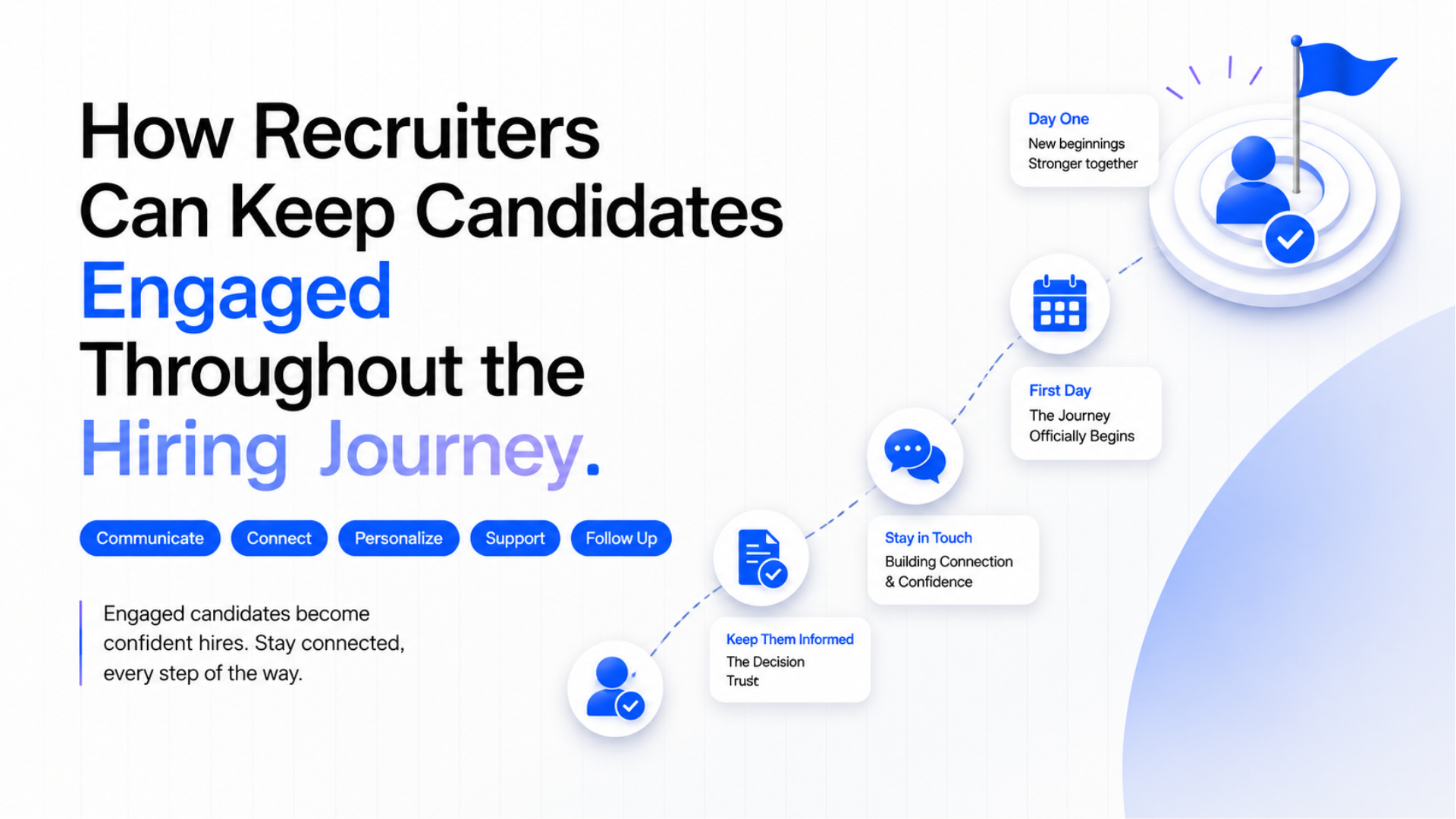
The hiring journey is not a straight line from sourcing to offer. It is a series of transitions, each of which creates an opportunity for the candidate to disengage. Between the first message and the first call. Between the screening call and the interview. Between interviews. Between the final interview and the offer. Each transition is a moment where the candidate asks themselves, implicitly or explicitly, whether this opportunity is worth their continued time and attention. The recruiter's job is to ensure the answer is always yes, yet most recruiting processes are designed to manage logistics rather than maintain engagement. Schedules are coordinated, feedback is collected, and offers are drafted, but between these operational milestones, the candidate is left waiting without meaningful communication. According to SHRM's talent acquisition research, the average professional candidate experiences three to five days of silence between each hiring stage, and each day of silence measurably reduces
their likelihood of continuing. The problem is not that recruiters do not care about engagement. It is that the systems they use are built for process management, not for relationship continuity.
Why Engagement Drops Between Hiring Stages
Understanding why engagement drops requires looking at the hiring process from the candidate's perspective. When a candidate first engages with a recruiter, they are in an active evaluation mode. They are curious about the role, interested in the company, and motivated to learn more. This motivation is not permanent. It is a window of receptivity that opens when the candidate first connects and closes gradually if nothing sustains it. The problem is that most recruiting processes are designed around the recruiter's timeline and the organization's internal coordination needs, not around the candidate's engagement window. The recruiter sends a message, the candidate responds, and then the process pauses while the recruiter coordinates schedules, collects feedback from hiring managers, or waits for approval to move forward. During these pauses, the candidate's window of receptivity narrows. Other opportunities arrive. Work demands intensify. The initial excitement fades. By the time the recruiter reaches back out, the candidate is in a different emotional state than they were during the last interaction, and the follow-up has to rebuild engagement that should never have been lost.
The structural cause of this problem is that recruiting teams treat engagement as a byproduct of process execution rather than as a process in itself. Engagement is assumed to happen naturally as long as the hiring stages are moving forward, but this assumption is wrong. Process execution and candidate engagement are two different things, and optimizing for one does not automatically optimize for the other. A well-coordinated interview schedule is operationally efficient but does nothing to maintain the candidate's interest and trust between the scheduling confirmation and the interview itself. Timely interview feedback is professionally responsible but does not address the candidate's emerging concerns about role scope or team dynamics that may have surfaced during the conversation. McKinsey's organizational insights have found that recruiting teams achieving the highest conversion rates are those that explicitly separate engagement management from process management, dedicating specific activities, metrics, and in many cases technology to maintaining candidate connection at every point between process milestones. The recruiters who understand the difference between AI sourcing and AI recruiting see this distinction clearly. Sourcing creates the connection. Recruiting, the ongoing engagement part, is what keeps it alive.
The First Touch: Setting the Tone for the Entire Journey
Candidate engagement does not begin at the first follow-up. It begins at the first touchpoint, and the quality of that first interaction sets expectations for everything that follows. A candidate who receives a generic outreach message that could have been sent to anyone forms an immediate expectation that the rest of the process will be equally impersonal. A candidate who receives a message that demonstrates specific knowledge of their background, references
their recent work, and connects their experience to the opportunity forms an equally powerful but opposite expectation: this company values me as an individual, and the people here pay attention. This initial expectation becomes the baseline against which every subsequent interaction is measured. If the first message was highly personalized but the follow-ups are generic, the candidate experiences a negative contrast that is actually more damaging than consistently generic communication would have been, because it feels like a bait-and-switch.
The practical implication is that engagement strategy must be designed end-to-end before the first message is ever sent. The team should know what the follow-up cadence will look like, what information will be shared at each stage, and who will be responsible for each touchpoint. This is especially critical for niche and technical roles where candidates receive multiple competing outreach messages and quickly distinguish between recruiters who have done their homework and those who have not. The most effective first-touch strategies combine specific, reference-rich outreach with a clear preview of what the candidate can expect from the process. Telling the candidate, explicitly, that they will hear back within twenty-four hours and that the next conversation will cover specific topics does two things. It demonstrates respect for the candidate's time by setting clear expectations, and it creates accountability for the recruiting team to follow through. This transparency is a powerful engagement tool, because candidates who know what to expect are far less likely to disengage due to uncertainty. The principle is the same reason referrals outperform cold outreach so consistently. The referring employee sets expectations and provides context before the candidate ever speaks to a recruiter, creating a foundation of trust that the recruiting process then either reinforces or undermines.
Between the Call and the Interview: The Danger Zone
If the first touch sets expectations, the gap between the initial call and the first interview is where most of those expectations are either reinforced or broken. This is the most dangerous zone in the hiring journey because it combines two engagement risks. First, the gap is typically the longest single pause in the process. Scheduling an interview with a hiring manager who has limited availability can take a week or more, and during that week the candidate's initial enthusiasm decays. Second, the transition from recruiter-led communication to hiring-manager-led communication creates a handoff risk. The candidate has built a rapport with the recruiter during the initial conversations, and suddenly they are interacting with someone new who may not have the same context or communication style. This handoff often feels to the candidate like the organization lost interest in them personally and is now treating them as a credential to be evaluated rather than a person to be engaged.
Effective recruiters manage this danger zone with three specific practices. First, they prepare the candidate for the interview with specific, practical information about the person they will meet, the format of the conversation, and the topics that are likely to arise. This preparation serves a dual purpose: it helps the candidate perform better, which increases the probability of advancing, and it demonstrates that the recruiter is still actively invested in the candidate's
success. Second, they maintain communication during the scheduling gap, sharing relevant information such as team updates, recent project announcements, or articles about topics the candidate expressed interest in during the screening call. These touchpoints do not need to be frequent or lengthy. A single well-timed, relevant message during a week-long scheduling gap is often sufficient to maintain engagement. Third, they debrief with the candidate after the interview, gathering their impressions, addressing any new concerns, and communicating next steps with the same specificity they established in the first interaction. Understanding how many followups one hire actually needs helps calibrate the cadence, but the quality and relevance of each touchpoint in the danger zone matters more than the count. As noted in the research on organizations with more tools but the same hiring problems, adding technology without an engagement strategy produces volume without impact. The danger zone is where engagement strategy proves its value or reveals its absence.
Keeping Momentum Through the Interview Loop
The interview loop presents a unique engagement challenge because the candidate interacts with multiple people across multiple conversations, often over a period of weeks. Each interview is an opportunity to deepen the candidate's interest and each interview is also an opportunity to create doubt, confusion, or frustration that can derail the process. The most common engagement failures during the interview loop are inconsistent messaging, where different interviewers describe the role or the team in contradictory ways; feedback black holes, where the candidate waits days or weeks after each interview without any communication; and recruiter disappearance, where the recruiter who managed the early stages steps back once the interview loop begins and the candidate feels abandoned by their primary point of contact. Each of these failures sends a negative signal that accumulates across the loop, and by the final interview the candidate's overall impression may be more negative than any single interview would suggest.
Maintaining engagement through the interview loop requires the recruiter to serve as a consistent thread that connects every stage. Before each interview, the recruiter provides preparation context. After each interview, the recruiter debriefs with the candidate and provides a status update. Between interviews, the recruiter maintains periodic touchpoints that demonstrate ongoing interest and provide value. This consistent presence is especially important when the interview feedback is mixed or the hiring decision is taking longer than expected, because uncertainty during the loop is the most powerful driver of candidate disengagement. An agentic AI recruiting platform can significantly reduce the operational burden of this continuous engagement by generating interview preparation briefings, post-interview debrief summaries, and interim touchpoint recommendations that keep the candidate connected without requiring manual effort for every interaction. According to LinkedIn's recruiting resources, candidates who experience consistent recruiter presence throughout the interview loop are forty-five percent more likely to accept an offer than those who feel handed off to the interview team and left to navigate the process alone. The recruiters asking whether AI will replace their jobs should recognize that this continuous presence function is precisely the kind of high-value,
relationship-intensive work that AI amplifies rather than eliminates.
The Pre-Offer Phase: Where Most Hires Are Won or Lost
The period between the final interview and the offer is where the highest-quality hiring decisions are made or broken. Candidates who reach this stage are seriously considering the opportunity, but they are also seriously considering their alternatives. A candidate who has made it through three or four rounds of interviews has demonstrated sustained interest, but they have also had multiple opportunities to develop concerns, compare the role against other opportunities, and question whether the process has been respectful enough to justify their continued investment. The pre-offer phase is where all of the engagement work that came before either pays off or fails. If the recruiter has maintained consistent, personalized, transparent communication throughout the journey, the candidate enters this phase with a reservoir of trust that can withstand the stress of waiting for a decision. If the engagement has been inconsistent, the candidate enters this phase ready to walk away at the first sign of delay or uncertainty.
The most effective pre-offer engagement strategy has three components. First, a clear and honest timeline. The recruiter should communicate when the candidate can expect a decision, and if that timeline shifts, the recruiter should proactively update the candidate rather than waiting for them to ask. Silence during the pre-offer phase is devastating to engagement because the candidate interprets it as a lack of decisiveness or, worse, a lack of interest. Second, proactive concern resolution. By this stage in the process, the candidate has almost certainly developed concerns that they may not have voiced. Compensation alignment, role scope, team dynamics, and relocation logistics are the most common. The recruiter who anticipates these concerns and addresses them before the candidate has to ask demonstrates the same attentiveness that characterized the best moments of the process. Third, reinforcement of the candidate's specific value. The pre-offer phase is the right time to remind the candidate, specifically and genuinely, why the team is excited about them. Not a generic expression of interest but a reference to the specific skills, experiences, or perspectives they bring that the team found compelling. Gartner's HR trends research identifies the pre-offer phase as the highest-leverage moment in the hiring journey, because small engagement improvements at this stage have an outsized impact on offer acceptance rates. However, all of this engagement work depends on having accurate, current candidate data. Teams that have struggled with outdated candidate data in AI tools know that even the most thoughtful pre-offer strategy will fail if it is based on information that no longer reflects the candidate's situation or priorities.
Building a System That Engages Every Candidate, Every Time
The engagement strategies described in this guide are effective, but they are also labor-intensive if implemented manually. A recruiter managing fifteen active candidates cannot simultaneously maintain personalized, timely, multi-touchpoint engagement with all of them without external support. This is where AI-powered engagement systems become essential. The right
platform monitors engagement signals across every candidate, generates context-aware follow-up recommendations, flags candidates whose engagement is declining, and ensures that no candidate falls through the cracks due to recruiter workload or process bottlenecks. When evaluating these systems, it is important to use a rigorous framework, such as the one for evaluating an AI sourcing tool before buying, adapted for engagement capabilities specifically. The key evaluation criteria should include signal awareness, the ability to detect engagement changes in real time; contextual personalization, the ability to generate messages that reference specific conversation history; and adaptive cadence, the ability to adjust follow-up timing based on candidate behavior rather than fixed schedules.
The organizations achieving the highest candidate engagement rates are those that have built integrated systems combining clear process design, recruiter accountability, and AI-powered execution. Process design ensures that engagement is planned at every stage, not left to chance. Recruiter accountability ensures that engagement quality is measured and managed as a key performance indicator, not treated as an afterthought. And AI-powered execution ensures that the engagement plan can be delivered consistently at scale, regardless of recruiter workload or hiring volume. EY's technology insights report that organizations with mature AI-driven engagement systems maintain candidate engagement rates above seventy-five percent throughout the entire hiring journey, compared to industry averages of thirty to forty percent. Deloitte's talent research concludes that the recruiting teams winning today's talent market are not those with the most aggressive sourcing tactics or the largest budgets. They are the ones that have recognized candidate engagement as a core competency, invested in the processes and technology to deliver it consistently, and made it the central operating principle of their entire hiring operation.
Every candidate who responds to your first message is giving you something valuable: their attention and their trust. The hiring journey that follows either honors that gift or wastes it. Most recruiting processes today waste it, not through any single catastrophic failure but through the slow accumulation of small engagement gaps, delayed follow-ups, generic messages, unclear timelines, and inconsistent communication, that collectively tell the candidate they are not a priority. Keeping candidates engaged throughout the hiring journey is not about working harder. It is about building a system, supported by AI, that maintains personalized, timely, and transparent communication at every stage. Huntlo.ai provides that system, from signal-based follow-up timing to context-aware message generation to real-time engagement monitoring. Stop losing candidates you already won. Build a journey that keeps them. Build it with Huntlo.