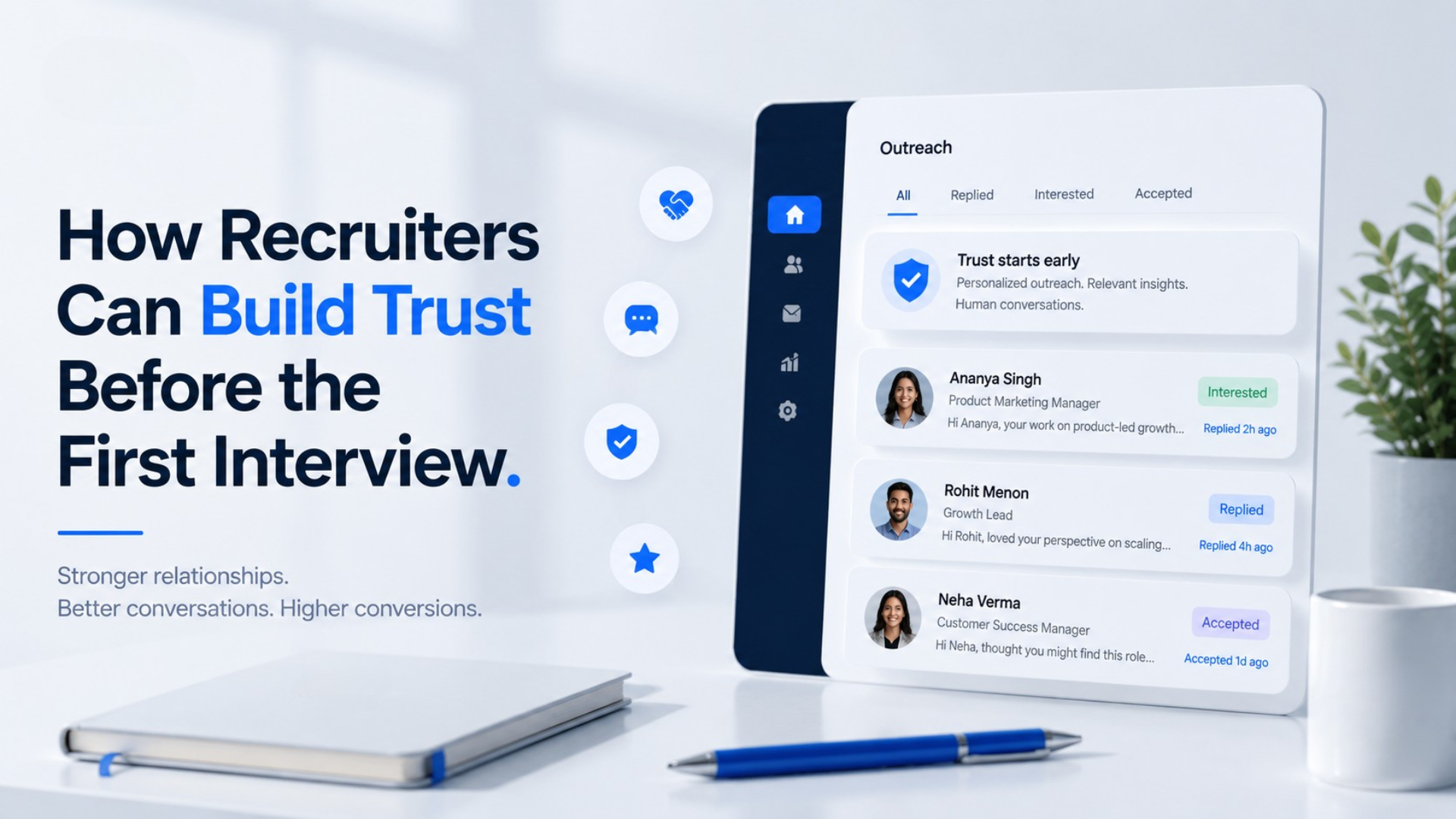
Most recruiters think trust is something that develops over the course of an interview. They show up, ask good questions, provide honest feedback, and assume that professionalism equals trustworthiness. But by the time a candidate sits down for that first conversation, their perception of the recruiter is already formed. It was shaped by the initial outreach message, the follow-up (or lack of one), the information shared about the role, and a dozen other small signals that accumulated before anyone said hello. The interview is not where trust begins. It is where trust is tested against the expectations that were already set.
This distinction matters enormously because most recruiting teams invest heavily in interview preparation and almost nothing in pre-interview trust-building. They will spend hours calibrating interview panels, writing structured rubrics, and training hiring managers on behavioral questions. Meanwhile, the candidate’s first three interactions with the company—the sourcing message, the follow-up, and the interview scheduling process—are handled as administrative tasks, delegated to the most junior person on the team or automated with no regard for the trust signals they send.
The cost of this neglect is not abstract. According to research from SHRM’s talent acquisition research, candidate dropout rates between the initial contact and the first interview range from 30–50% for competitive roles, and the single most cited reason candidates give for withdrawing is a lack of confidence in the recruiter or the process. Not the compensation. Not the role itself. Trust. This article breaks down exactly what trust signals candidates are evaluating before they ever meet you, and how to systematically build those signals into every pre-interview touchpoint.
The Trust Gap: Why Candidates Show Up Skeptical
To understand how to build trust, you first need to understand why candidates start from a position of skepticism. The answer is experience. Most employed professionals, particularly
those in high-demand fields, have been on the receiving end of enough bad recruiting experiences to develop a set of defensive assumptions. They assume the recruiter has not read their profile carefully. They assume the salary range will be vague until they have invested significant time. They assume the “exciting opportunity” is the same role description they have seen from ten other agencies. These assumptions are not cynical—they are statistically accurate. The average candidate in a competitive market receives 5–15 recruiter outreach messages per month, and the overwhelming majority confirm their worst suspicions about how recruiters operate.
This means the recruiter does not start at zero trust. They start at negative trust. Every generic message, every delayed follow-up, every piece of inaccurate information about the candidate’s background pushes the trust balance further into the red. Building trust is not about adding positive signals on a blank slate. It is about first overcoming the negative expectations that candidates bring to every interaction, and then creating enough positive contrast to stand out from the dozens of other recruiters vying for the same person’s attention.
The trust gap also explains why referrals consistently outperform cold outreach by such a wide margin. A referred candidate starts with positive trust because a trusted colleague vouched for the recruiter and the company. A cold outreach candidate starts with negative trust because past experience has taught them to be guarded. The recruiter’s job with a cold candidate is not just to inform them about a role—it is to systematically dismantle their skepticism before it calcifies into indifference or active avoidance. Understanding this dynamic is the first step toward building a trust-building strategy that actually works.
Accuracy: The Most Underestimated Trust Signal
If you had to pick the single most powerful trust signal in pre-interview recruiting, it would not be speed, enthusiasm, or even personalization. It would be accuracy. When a candidate reads an outreach message that correctly identifies their current role, references a specific project or achievement, and describes a role opportunity that genuinely aligns with their career trajectory, the trust impact is immediate and significant. The candidate’s internal monologue shifts from “this is another mass message” to “this person actually knows something about me.” That shift is the foundation on which every subsequent interaction is built.
The inverse is equally powerful and far more common. When a recruiter addresses a candidate by the wrong name, references an outdated job title, or describes a role that clearly does not match the candidate’s seniority level, the trust damage is severe and often irreversible. The candidate does not think “maybe this was a one-time mistake.” They think “if this person cannot get basic facts right before we have even started talking, how reliable will they be when it matters?” The accuracy bar is not high—candidates are not expecting perfect dossiers—but getting fundamental details wrong is one of the fastest ways to lose a candidate before the relationship has even begun.
This is where many AI recruiting tools inadvertently undermine trust. Platforms that rely on
stale data or batch-processed candidate profiles can generate outreach that is personalized in structure but inaccurate in substance. As we explored in our analysis of why some AI tools have outdated candidate data, the difference between a tool that refreshes candidate information in real time and one that works from weeks-old databases is the difference between a message that builds trust and one that destroys it. Candidates can tell the difference, even if they cannot articulate exactly why a message feels off. They sense the lag, and it erodes their confidence in the recruiter behind it.
Transparency: What Candidates Need to Know Upfront
Accuracy is about getting the facts right. Transparency is about sharing the right facts at the right time. These are related but distinct trust signals, and candidates evaluate both independently. Transparency in pre-interview recruiting means proactively addressing the questions that candidates are afraid to ask because they do not want to seem difficult or disinterested. It means sharing the salary range before the candidate has to ask. It means being honest about the stage of the hiring process, the timeline, and the interview format. It means acknowledging potential concerns about the role—the travel requirements, the reporting structure, the challenges the team is facing—instead of waiting for the candidate to discover them later and feel misled.
The psychological mechanism behind transparency’s trust-building power is straightforward: when a recruiter shares information the candidate did not explicitly ask for, the candidate interprets it as evidence that the recruiter is on their side. The reasoning is intuitive—if the recruiter were trying to manipulate the candidate into a process that might not serve them, they would withhold uncomfortable details. The fact that they are sharing them voluntarily signals that the recruiter’s incentive is aligned with the candidate’s best interest, or at minimum that the recruiter values honesty over conversion. This alignment perception is the core of trust in any advisory relationship, and recruiting is fundamentally an advisory relationship, even though most recruiters do not think of it that way.
Transparency also creates a practical advantage: it filters. Candidates who would have withdrawn later because the role did not match their expectations self-select out early, saving everyone time. Candidates who stay do so with accurate expectations, which makes the interview more productive and the offer stage less likely to break down. This filtering effect is one of the reasons why the first recruiter message matters more than the job description—it sets the transparency tone for the entire relationship. A first message that is open about what the role involves and what the process looks like creates a trust foundation that makes every subsequent interaction more productive.
Consistency Across Touchpoints: How Mixed Signals Destroy Credibility
A recruiter sends a warm, personalized LinkedIn message. The candidate responds. Three days pass with no reply. Then the candidate gets a generic email from an automated system
asking them to schedule an interview. The interview confirmation comes from yet another email address with no personal context. When the candidate arrives at the interview, the hiring manager seems unaware that the recruiter has been in contact with them. This sequence is not hypothetical—it is the default experience for a significant portion of candidates going through recruiting processes at mid-size and large companies. And it is a trust-destroying machine.
The problem is not any single touchpoint. It is the inconsistency between them. A candidate can forgive a slow follow-up if the follow-up, when it comes, is thoughtful and personal. They can forgive an automated scheduling email if it follows a genuine human conversation. But when the touchpoints feel like they are coming from different organizations with different levels of investment in the candidate, the candidate concludes that no one is actually managing their experience. They are being processed, not recruited. The trust that was built in the first message is eroded by the second, demolished by the third, and nonexistent by the time they reach the interview.
Consistency does not require that every interaction be equally personal. It requires that every interaction be coherent—that each touchpoint demonstrates awareness of what came before and contributes to a single, unified candidate experience. This is precisely the challenge that agentic AI recruiting platforms are designed to solve. Unlike simple automation that fires off disconnected messages on a schedule, agentic systems maintain a continuous understanding of the candidate relationship, ensuring that every touchpoint—whether human-sent or AI-assisted—is informed by the full history of the interaction. The candidate experiences consistency, and consistency breeds trust.
Closing the Information Asymmetry
In most recruiting interactions, the recruiter holds significantly more information than the candidate. The recruiter knows the salary band, the team dynamics, the hiring manager’s priorities, the company’s financial health, and the competitive landscape. The candidate knows only what has been shared with them, which is often deliberately minimal. This information asymmetry is not just a practical disadvantage for the candidate—it is a trust barrier. Candidates who feel they are making decisions with incomplete information do not trust the person controlling the information flow, because they assume the asymmetry is intentional and self-serving.
Closing this asymmetry does not mean sharing every internal detail about the company. It means proactively providing the information that a reasonable candidate would need to make an informed decision about whether to invest their time in the process. This includes concrete details about the role’s scope and challenges, honest information about the team’s current state and what the new hire would be walking into, a realistic timeline, and clarity on the decision-making process. It also means being willing to answer questions that go beyond the standard FAQ, and doing so without deflecting or stalling.
The information asymmetry problem is especially acute in specialized and technical roles, where candidates are evaluating not just the company but the specific technical challenges they would be working on. In these domains, as we’ve discussed in our piece on AI recruiting tools for niche and technical roles, candidates expect a level of technical fluency from the recruiter that most generalist recruiters cannot provide. When the recruiter cannot answer basic questions about the tech stack, the architecture decisions, or the engineering culture, the asymmetry widens and trust collapses. The solution is not to turn every recruiter into a domain expert—it is to ensure that the recruiter has access to the right information and shares it proactively with the candidate, even if that means looping in a hiring manager or team lead earlier in the process than traditional recruiting workflows dictate.
Social Proof and Credibility Signals That Work
Beyond accuracy, transparency, consistency, and information sharing, there is a fourth category of trust signals that recruiters rarely leverage deliberately: social proof. Candidates trust recruiters more when they have evidence that other people trust the recruiter too. This can take many forms, and the most effective ones are often the simplest. A recruiter who mentions a mutual connection—even a loose one, like “I noticed you and [Name] both spoke at the same conference last year”—immediately establishes social proximity. A recruiter who can reference a successful placement with someone in the candidate’s network, even without naming them directly, provides third-party validation. A recruiter whose LinkedIn profile shows genuine engagement with the candidate’s professional community signals that they are embedded in the candidate’s world, not just passing through it.
The follow-up cadence also functions as a credibility signal. Candidates interpret persistent, value-adding follow-ups as evidence that the recruiter is invested in the relationship, not just filling a req. As we covered in our analysis of how many follow-ups one hire actually needs, the majority of successful placements involve between four and seven touches, and the candidates who eventually convert often cite the recruiter’s persistence and responsiveness as key factors in their decision to engage. The follow-up is not just a logistical tool—it is a trust-building mechanism, because it demonstrates that the recruiter values the candidate enough to invest time in the relationship even before there is a guaranteed return.
There is also a subtler form of social proof that operates at the brand level. Recruiters who represent companies with strong employer brands start with a trust advantage, but even recruiters at lesser-known companies can leverage social proof by sharing relevant content, engaging thoughtfully with industry discussions, and building a visible professional presence that signals competence and credibility. The key insight from LinkedIn’s research on candidate engagement is that candidates increasingly evaluate the individual recruiter’s profile and activity, not just the company’s brand. A recruiter who appears knowledgeable, active, and respected in their domain earns trust before they send a single message. This is why the distinction between AI sourcing and AI recruiting matters for trust: sourcing identifies the candidate, but the recruiter’s credibility—built through consistent, informed engagement—is what
convinces the candidate to respond.
How Huntlo Builds Trust Into Every Pre-Interview Touchpoint
The trust-building framework described in this article—accuracy, transparency, consistency, information sharing, and social proof—is powerful, but it is also labor-intensive when done manually. A recruiter who is managing 15–20 open roles and reaching 50–100 candidates per week cannot realistically research every candidate deeply enough to ensure accuracy, craft fully transparent messages, maintain perfect consistency across touchpoints, and close the information asymmetry for every interaction. Something has to give, and in most recruiting teams, what gives is quality. Trust-building becomes a luxury reserved for the most senior or highest-priority candidates, while everyone else gets the standard treatment.
Huntlo was designed to eliminate that trade-off. The platform’s AI researches each candidate’s current professional context in real time, ensuring that the accuracy signal is present in every outreach message—not just the ones the recruiter had time to handcraft. It generates messages that include transparent details about the role and process, because the system understands that withholding information erodes trust. It maintains conversation continuity across follow-ups, so the candidate experiences a coherent relationship rather than a series of disconnected pings. And it provides the recruiter with contextual information—recent company news, industry trends, the candidate’s recent activity—that helps close the information asymmetry without requiring the recruiter to become an expert in every domain they hire for.
The result is a recruiting workflow where trust is not a function of how much time the recruiter has, but a built-in property of every candidate interaction. As we’ve noted in our guide on transitioning from cold outreach to meaningful conversations, the difference between recruiting that works and recruiting that does not is often not the channel or the template—it is whether the candidate feels that the person on the other end understands them well enough to be trusted. Huntlo ensures that understanding is present at scale, so that every candidate, not just the lucky few, experiences the kind of informed, consistent, transparent outreach that builds trust before the first interview ever begins.
Related reading:
Why Referrals Outperform Cold Outreach | More Tools, Same Hiring Problems | How Many Follow-Ups Does One Hire Need?
AI Sourcing Tool Comparison Framework: How to Evaluate Before You Buy