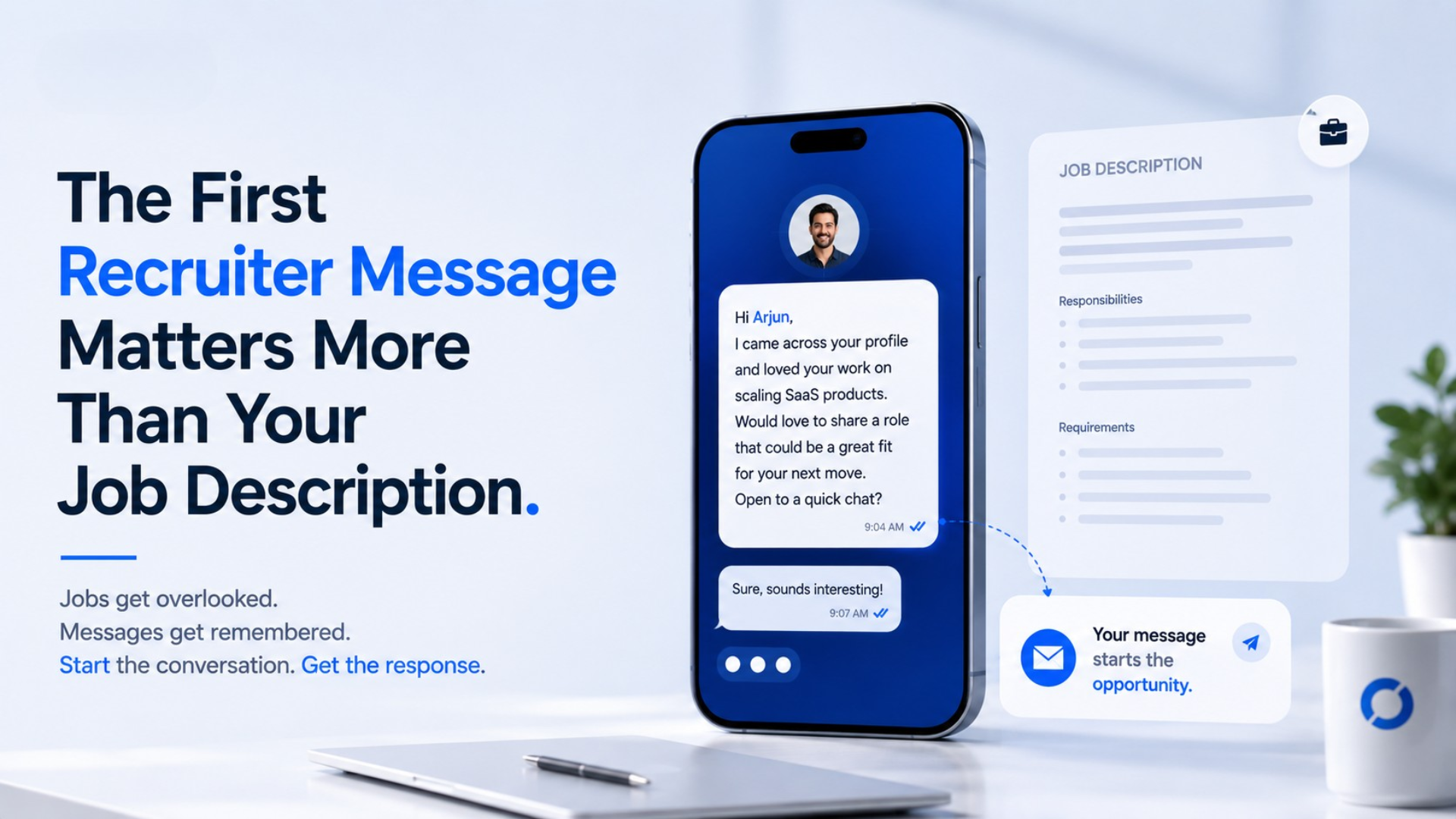
Consider what happens when a talented, gainfully employed professional receives a recruiting message. They see the notification on their phone or in their inbox. They make a split-second decision about whether to open it. If they open it, they make a second split-second decision about whether to read beyond the first sentence. If they read the first sentence, they make a third split-second decision about whether the message deserves a response. These three decisions happen in a total of perhaps ten seconds, and they determine whether your organization’s job description — the document that your hiring manager spent two weeks perfecting, that your HR team reviewed for compliance, that your marketing team polished for brand consistency, and that you posted on six job boards — will ever be seen by this candidate at all. In most cases, it will not. The candidate will read the first message, decide it is not worth their time, and move on. The job description, for all its careful crafting, will remain unread. The gatekeeper between your opportunity and the candidate is not the job description. It is the first message. And for the vast majority of organizations, the first message is the weakest link in the entire hiring chain.
This is not an opinion. It is a structural consequence of how candidate attention works in a competitive talent market. The average professional in a high-demand field receives between five and twenty-five recruiting messages per week, depending on their seniority, platform presence, and geographic market. They do not read all of them. They do not even open all of them. They triage aggressively, based on a rapid assessment of the sender, the subject line or opening line, and the perceived relevance of the message to their own situation. The messages that pass this triage are the ones that demonstrate, in the first few seconds of reading, that the sender knows who the candidate is and has a reason for reaching out that is specific to them. The messages that fail are the ones that read like they could have been sent to anyone — because they could have been sent to anyone, and the
candidate senses this immediately. The job description is irrelevant to this triage process. It does not factor into the candidate’s decision about whether to engage. It only becomes relevant after the candidate has already decided that the first message is worth their time, which means the first message is not a delivery mechanism for the job description. It is the filter that determines whether the job description is ever delivered at all.
The Job Description Fallacy: Why Companies Invest in the Wrong Thing
The job description fallacy is the belief that the quality of the job description is the primary determinant of whether qualified candidates engage with a role. This belief is pervasive, institutionalized, and almost entirely wrong. Job descriptions matter. They matter for candidates who are actively searching for roles, who have already decided to make a move, and who are comparing specific opportunities against each other. For those candidates, the job description is a critical decision-making tool, and investing in its quality is time well spent. But the candidates who are actively searching and already committed to a move are the easiest candidates to hire. They are the ones who find you through job boards, career pages, and search engines. The candidates who are hardest to hire — the passive candidates, the senior professionals, the specialized experts who are not looking but are open to the right opportunity — do not read job descriptions. They do not need to, because they are not in a searching mindset. They are approached, and the quality of the approach determines whether they engage.
The misallocation of effort is striking when you examine it quantitatively. A typical organization will spend hours crafting a job description: the hiring manager writes the initial draft, HR reviews it for compliance and internal equity, the recruiting team optimizes it for search, and marketing may adjust the language for brand alignment. The total investment per job description can easily reach five to ten hours of organizational time. The first outreach message, by contrast, is typically written in two to five minutes by a recruiter who is managing dozens of other candidates simultaneously. The message is often a variation of a template that was written once and has been reused for months. The investment ratio is enormous: ten hours on the document that candidates read only after they have already decided to engage, and five minutes on the message that determines whether they decide to engage at all. This inversion of effort is one of the most consequential and least discussed inefficiencies in talent acquisition, and it persists because the job description is a visible, measurable artifact that organizations can point to as evidence of their investment in quality, while the first message is invisible, individual, and measured only by the response rate it produces — a metric that most organizations do not track at the message level. According to SHRM’s talent acquisition research, fewer than fifteen percent of organizations systematically measure or optimize the performance of their initial outreach messages, even though those messages are the single highest-leverage touchpoint in the entire hiring process. The first message is where the candidate’s journey begins or ends, and for most organizations it receives the least strategic attention of any stage in the pipeline.
What a Great First Message Does That a Job Description Cannot
A job description is a statement of organizational need. It describes what the company wants, what qualifications are required, what responsibilities the role involves, and what benefits are offered. It is a necessary document, but it is inherently self-centered. It is written from the company’s perspective, for the company’s purposes, and in the company’s voice. A great first message is something fundamentally different: it is a statement of relevance to the candidate. It demonstrates that the person reaching out understands something specific about the candidate’s career, accomplishments, or interests, and that this understanding is the reason for the contact. This distinction — organizational need versus individual relevance — is the reason the first message has more impact than the job description. The job description tells the candidate what the company wants. The first message tells the candidate why they, specifically, should care. And the candidate’s decision to engage is driven far more by the perception that the outreach is personally relevant than by the attractiveness of the role itself.
Consider the difference in practice. A candidate receives a message that says: “I came across your profile and wanted to reach out about a Senior Data Scientist role at our company. Here is the job description — let me know if you are interested.” This message is polite, professional, and completely ineffective for any candidate who is not already actively searching. It provides no evidence that the recruiter knows anything about the candidate beyond their job title. It offers no reason to engage beyond the existence of an open role. It positions the recruiter as a broadcaster and the candidate as a consumer of information, with the implicit expectation that the candidate will do the work of evaluating whether the role is relevant. Now consider an alternative: “I noticed you led the implementation of the real-time recommendation engine at your current company. We are building something similar at a much larger scale, and I think the challenges you would encounter here might be exactly the kind of problems you find most interesting. Would you be open to a brief conversation about what we are working on?” This second message does something the job description cannot do. It makes the candidate feel seen. It references a specific accomplishment, connects it to a specific challenge at the hiring company, and frames the opportunity not as a job to apply for but as a problem the candidate might find interesting to solve. The candidate’s response is not “I need to read the job description first.” It is “Tell me more about the challenge.” That is the power of the first message, and it is a power that no amount of job description optimization can replicate.
The Anatomy of a First Message That Gets Read, Replied To, and Remembered
The best first messages in recruiting share a common structure, even though their content varies dramatically based on the candidate, the role, and the industry. The structure has four components, and the order of those components is as important as the components themselves. The first component is a specific observation about the candidate. This is not a compliment. Compliments feel performative when they come from a stranger who is clearly trying to get something. An observation is different. It is a factual reference to something the candidate has done, built, led, published, or achieved, stated with enough detail to
demonstrate genuine familiarity. “I read your recent article on distributed systems” is an observation. “You seem like an impressive engineer” is a compliment. The observation works because it creates immediate credibility: the candidate recognizes that this message is based on research, not a keyword search. The second component is a connection between the observation and the opportunity. This is where many recruiters go wrong, by jumping from the observation directly to the job description. The connection should be about the work, not the role. It should describe a challenge, a project, or an environment at the hiring company that is relevant to the candidate’s demonstrated interests and expertise. The goal is to make the candidate curious about the company’s work, not to sell them on the job title.
The third component is an invitation, not a request. The difference matters. “Can we schedule a call?” is a request. It asks the candidate to commit time before they have any reason to be invested. “Would you be open to exchanging a few messages about what we are building?” is an invitation. It offers a low-commitment way to learn more, which reduces the psychological barrier to engagement. The fourth component is brevity. The first message should be no longer than three to five sentences. This is not because candidates cannot read longer messages. It is because a longer message signals that the recruiter is going to be high-effort to interact with, and candidates make this calculation unconsciously. A concise message says: “I respect your time, I have a specific reason for reaching out, and engaging with me will not be a burden.” A lengthy message says: “I am going to require a lot of your attention.” In a competitive attention environment, brevity is not just a style preference. It is a strategic advantage. According to LinkedIn’s talent solutions data, outreach messages under one hundred words consistently outperform longer messages in response rates, with the strongest performance in the sixty to eighty word range. The implication is clear: the first message should deliver maximum relevance in minimum space, creating just enough curiosity to prompt a response without demanding enough attention to trigger a delete.
Why This Matters Even More for Specialized and Senior Roles
The principle that the first message matters more than the job description applies to all candidate segments, but its importance scales dramatically with seniority and specialization. For entry-level and mid-level roles where the candidate pool is large and the qualifications are relatively standardized, a well-written job description combined with a decent first message may be sufficient to generate adequate candidate flow. The candidates are often actively searching, they are comparing multiple similar opportunities, and the job description plays a meaningful role in their decision-making. For senior roles, specialized technical roles, and leadership positions, the dynamic is entirely different. The candidate pool is small, the candidates are almost never actively searching, and their willingness to engage depends almost entirely on whether the initial outreach demonstrates genuine understanding of their expertise and a compelling reason why they should invest their limited time in a conversation. For these candidates, the job description is almost irrelevant to the initial engagement decision. They will read it eventually, but only after the first message
has earned their attention.
The challenge for recruiters targeting senior and specialized candidates is that crafting a genuinely insightful first message for these profiles requires deep understanding of the candidate’s domain. A message to a machine learning researcher that says, “We are looking for someone with strong AI skills” will be immediately dismissed, because “strong AI skills” is not a phrase that means anything to someone who has spent a decade working on specific subproblems within the field. The message needs to demonstrate domain awareness: an understanding of the candidate’s specific research area, the technical challenges they have worked on, or the systems they have built. This is the same challenge that makes AI recruiting tools for niche roles so difficult to evaluate and deploy. As explored in Do AI Recruiting Tools Work for Niche or Technical Roles?, the ability to generate domain-specific outreach that resonates with specialized candidates is not a feature that all AI tools can deliver equally, and the gap between tools that can and tools that cannot is the gap between effective and ineffective outreach for the hardest-to-hire segments. For senior and specialized roles, the first message is not just the gateway to the job description. It is the entire hiring process in miniature: a demonstration of whether the hiring organization understands the candidate’s world well enough to be worth engaging with at all.
The First Message as the Real Job Description
There is a useful way to think about this that reframes the entire relationship between the first message and the job description: the first message is the real job description. Not in the literal sense — it does not list responsibilities, qualifications, or benefits — but in the experiential sense. It is the candidate’s first direct experience of what it would be like to work with the people at this company. A thoughtful, specific, well-researched first message tells the candidate: “The people at this company pay attention. They do their homework. They value expertise. They communicate clearly.” A generic, copy-paste first message tells the candidate: “The people at this company cut corners. They treat candidates as interchangeable. They do not value my time.” The candidate may never articulate these inferences consciously, but they shape the candidate’s emotional response to the outreach, and that emotional response drives the behavioral decision to engage or ignore. This is why referral candidates have such high engagement rates: the referral itself functions as a powerful first message, because it comes from a trusted source who has already established that the company is worth considering. The referral creates the relevance signal that a cold first message has to create from scratch. The dynamics of this advantage are analyzed in Why Referrals Outperform Cold Outreach, and the key insight is that the referral’s power comes not from trust alone but from the pre-existing relevance that the referring employee establishes. A cold first message that achieves the same quality of relevance — by demonstrating genuine understanding of the candidate — can close much of the gap between referred and non-referred candidate engagement.
This framing also explains why so many organizations struggle to hire despite having strong employer brands and competitive compensation. They have invested in the brand and the offer, but they have not invested in the moment of first contact. The candidate’s
experience of the brand does not start when they visit the careers page. It starts when they read the recruiter’s message. If that message is generic, the brand investment is wasted, because the candidate’s first data point about the company is a message that feels like it was sent to a hundred people. The disconnect between a polished employer brand and a sloppy first message is one of the most common and most damaging inconsistencies in talent acquisition, and it is a direct consequence of the job description fallacy: organizations that invest their quality effort in the document and neglect the delivery mechanism. The broader organizational implication is that talent acquisition teams need to reallocate their investment. Less time polishing job descriptions that candidates will never read. More time ensuring that the first message — the actual moment of contact — is worthy of the candidate’s attention. As Harvard Business Review’s hiring research has consistently shown, the candidate’s earliest interactions with an organization have a disproportionate impact on their perception of the employer brand, their willingness to continue in the process, and even their decision to recommend the company to others regardless of whether they are hired. The first message is not just a recruiting tool. It is a brand moment, and it should be treated with the same strategic care that organizations bring to any other brand-critical touchpoint.
Making Every First Message Count, at Scale
The argument of this article is not that recruiters should spend more time writing first messages. Most recruiters already know that better messages produce better results, and they would write better messages if they had the time. The argument is that the first message is the highest-leverage touchpoint in the hiring process, and that organizations need a system that treats it accordingly — a system that can produce the quality of first message described in this article not for one or two priority candidates, but for every candidate in the pipeline, consistently, at the scale that modern hiring demands. This is precisely the capability that Huntlo provides. Every first message generated by Huntlo’s AI is grounded in a specific analysis of the candidate’s profile. The AI identifies the candidate’s most notable accomplishments, relevant experience, and career signals, and it constructs a message that follows the observation-connection-invitation-brevity structure described above. The message is not selected from a template library. It is generated fresh, which means that two candidates for the same role will receive fundamentally different first messages, each one reflecting their unique professional context. This is the standard that top recruiters aspire to for their highest-priority candidates, and it is the standard that Huntlo delivers for every candidate, automatically.
The impact on the hiring process is significant not just at the response stage but throughout the pipeline. Candidates who engage because of a strong first message enter the pipeline with a positive initial impression, which means the pre-interview nurture is building on a foundation of relevance and respect rather than trying to compensate for a weak start. Interview show rates improve because candidates arrive with genuine interest rather than vague curiosity. And the overall employer brand benefits because every candidate who receives outreach from your organization — whether they engage or not — experiences a
message that reflects well on the company, rather than the generic outreach that erodes brand perception with every send. The gap between sourcing a candidate and engaging them is the gap that matters most, and it is the gap that traditional tools leave widest. As explored in What’s the Difference Between AI Sourcing and AI Recruiting?, sourcing without engagement is an expensive exercise in list-building. Huntlo closes that gap by making the first message the strong, relevant, candidate-specific communication that it needs to be — not for a handful of priority candidates, but for the entire pipeline. Your job description is important. But it will only matter to candidates who actually read it, and the only thing that determines whether they read it is the quality of the message that delivered it.
Related Topics:
Why Do Some AI Recruiting Tools Have Outdated Candidate Data?
What’s the Best Way to Evaluate an AI Sourcing Tool Before Buying?