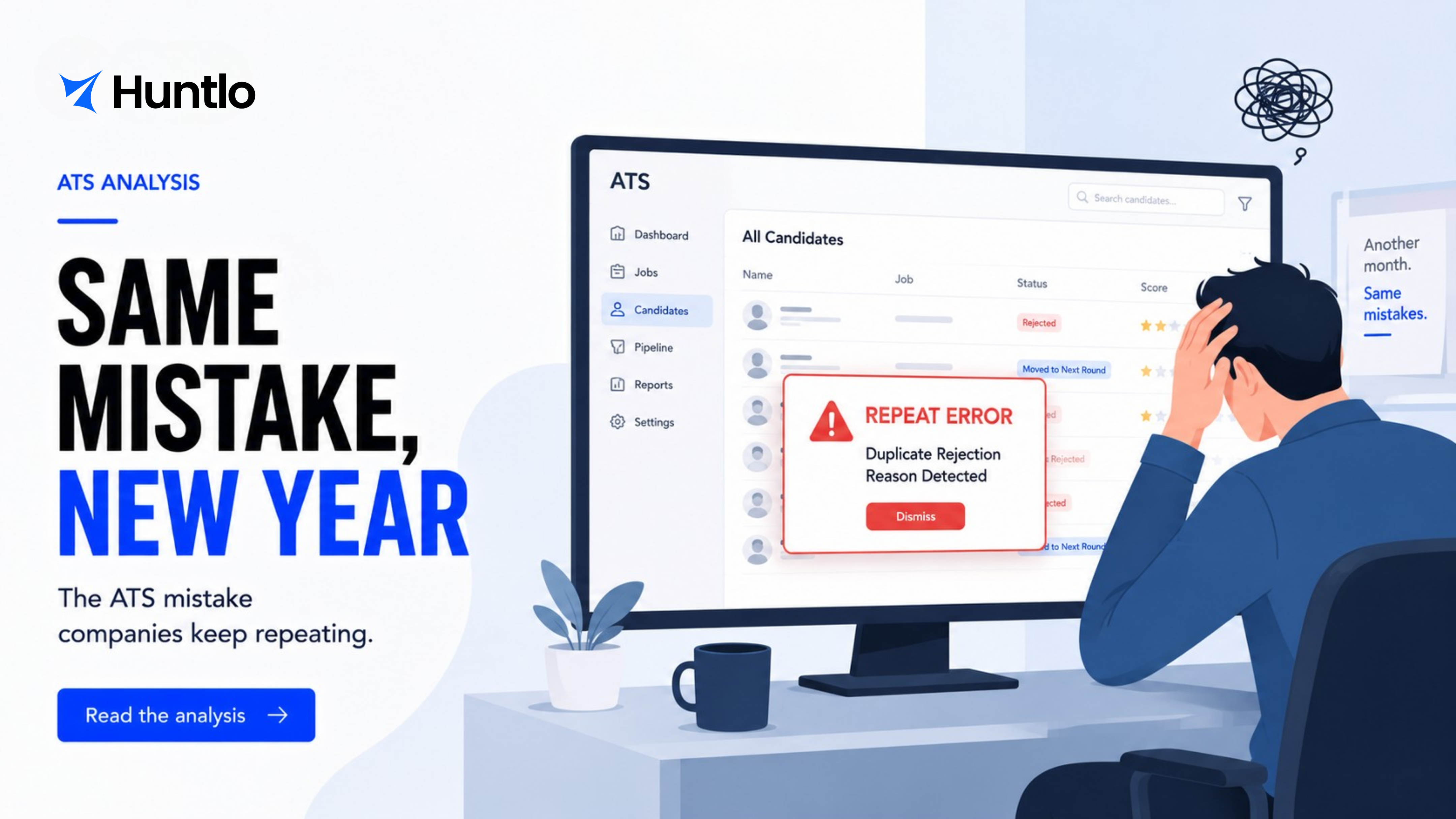
In 2024, a Fortune 500 technology company completed an 18-month, $2.3 million implementation of a new enterprise ATS. The project involved a dedicated team of 12 people, external consultants, extensive requirements gathering, custom workflow design, and a phased rollout across three business units. At the project's conclusion, the company celebrated with an all-hands meeting where the talent acquisition VP declared that the new ATS would "transform our hiring." Six months later, average time-to-fill had improved by 4%. Candidate response rates were unchanged. Recruiter satisfaction had actually declined. The company's hiring problems were essentially the same as they had been before the $2.3 million investment.
This is not an unusual story. It is a typical story. According to Gartner's HR technology survey, the average enterprise ATS implementation costs between $500,000 and $3 million and takes 12-24 months. The expected ROI — typically projected as 15-25% improvement in key hiring metrics — rarely materializes. A G2 analysis of ATS customer satisfaction found that only 31% of organizations report "significant improvement" in hiring outcomes after a new ATS implementation. The remaining 69% report "marginal" or "no" improvement. The pattern is consistent across company sizes, industries, and geographies: organizations invest heavily in their ATS, expect transformative results, and get disappointing ones.
The problem is not that ATS platforms are bad products. They are not. The problem is that organizations keep using them for the wrong purpose. They keep making the same five mistakes, year after year, implementation after implementation. This article names those mistakes, explains why they persist, and provides the alternative architecture that actually produces results.
Mistake One: Treating the ATS as a Sourcing Tool
The most fundamental and most damaging ATS mistake is expecting it to find candidates. This mistake is understandable from a historical perspective. In the early 2000s, when the ATS market was establishing itself, the primary recruiting workflow was inbound: candidates applied through job postings, and the ATS managed those applications. The ATS was the first and often only point of contact with candidates, so it was natural to think of it as the sourcing system.
But the recruiting world has changed. Over 70% of the global workforce consists of passive candidates who are not actively applying for jobs, according to LinkedIn's Global Talent Trends report. These candidates will never be found by an ATS career portal. They will never fill out an application form. They exist on LinkedIn, GitHub, professional networks, and in talent pools that ATS platforms have no access to. Requiring these candidates to enter the recruiting process through an ATS application is like requiring customers to walk into a physical store to buy a product they discovered online — it introduces unnecessary friction that causes most of them to simply walk away.
SHRM's talent acquisition benchmarks report that the average enterprise job posting receives 250 applications but generates only 5-10 qualified candidates — a 2-4% qualification rate. Meanwhile, AI-powered sourcing platforms that proactively discover passive candidates on external platforms achieve qualification rates of 15-25%, because the initial candidate pool is pre-filtered by AI matching before any outreach occurs. The difference in efficiency is enormous: an inbound ATS-centric approach requires processing 250 applications to find 5-10 qualified candidates, while an outbound AI-sourcing approach requires engaging 40-60 candidates to find the same number. The recruiter's effort is 4-6 times lower with the outbound approach.
Despite this evidence, organizations continue to invest in making their ATS better at "sourcing." They buy ATS add-ons for candidate rediscovery, career site optimization, and talent network building. They spend hundreds of thousands of dollars on ATS enhancements that marginally improve the inbound funnel while ignoring the much larger opportunity in the outbound funnel. It is like spending money to make a store's front door more attractive while 70% of your potential customers are shopping online and will never walk through that door.
Huntlo addresses the sourcing problem directly. The platform sources candidates from over 50 external platforms and databases — including LinkedIn, GitHub, job boards, professional networks, and regional talent databases — using AI to match candidates to roles based on multi-dimensional analysis. The candidates Huntlo finds are not applicants who happened to see a job posting. They are passive professionals who match the role requirements and can be engaged through personalized, multi-channel outreach. The ATS has no capability to do this, and no amount of ATS customization or add-on investment will give it this capability, because the ATS was not built for outbound discovery. Huntlo was.
Mistake Two: Building the Recruiting Workflow Around the ATS
The second mistake follows from the first: because organizations treat the ATS as the sourcing system, they build their entire recruiting workflow around the ATS. Every step of the process — from requisition approval to candidate screening to interview scheduling to offer management — is configured within the ATS's workflow engine. The ATS becomes the hub, and every other tool, if any, is a spoke that feeds data into the ATS.
This architecture was reasonable in 2005 when the ATS was the primary recruiting technology. It is unreasonable in 2026 when AI sourcing platforms, multi-channel outreach engines, and conversational AI screening tools have become essential capabilities that the ATS cannot provide. Building the workflow around the ATS forces these newer, more capable tools into a subordinate role where they must adapt to the ATS's data model, workflow constraints, and reporting limitations rather than operating in the way that produces the best results.
McKinsey's research on enterprise technology architecture describes this as the "legacy hub problem": organizations that built their technology architecture around a legacy system find it increasingly difficult to adopt newer, more capable technologies because the legacy system's constraints limit the value the newer technologies can provide. The recruiting industry's legacy hub is the ATS, and the newer technologies are AI sourcing, multi-channel outreach, and conversational screening.
The practical impact of the ATS-centric workflow is that the recruiting process is designed to serve the ATS rather than the candidate or the outcome. Recruiters must create candidates in the ATS before they can do anything with them. Screening must happen through the ATS's screening module (if it has one) or through a separate tool that then syncs data back to the ATS. Interview scheduling must go through the ATS's calendar integration. Every step adds friction, and every integration point is a potential failure point where data is lost, delayed, or corrupted.
The alternative architecture — which leading organizations are increasingly adopting — places the AI sourcing and engagement platform at the center of the workflow and treats the ATS as a downstream system that receives data for compliance and record-keeping purposes. In this architecture, the recruiter works primarily in the AI platform, where sourcing, outreach, screening, and pipeline management happen in a single, integrated environment. When a candidate is qualified and ready to be formally submitted for a role, the data flows to the ATS via integration — typically webhooks — for compliance documentation, offer management, and onboarding.
Huntlo's webhook-based ATS integration is designed for exactly this architecture. The platform generates and manages the entire candidate engagement lifecycle, and when a candidate reaches the appropriate stage in the pipeline, Huntlo pushes the candidate's data — including their complete engagement history, screening results, and qualification status — to the ATS for formal processing. The ATS receives clean, structured data that it can use for its intended purposes (compliance, reporting, offer management) without being responsible for the upstream engagement activities that it was never designed to handle.
Mistake Three: Overspending on ATS Customization
The third mistake is spending too much money customizing the ATS. Enterprise ATS platforms like Workday, SAP SuccessFactors, Greenhouse, and Lever offer extensive customization options — custom fields, custom workflows, custom reports, custom approval chains, custom integrations. Organizations take advantage of these options, often enthusiastically, building elaborate ATS configurations that mirror their ideal recruiting process in painstaking detail.
The problem is that ATS customization is expensive, slow, and brittle. According to Gartner's total cost of ownership analysis for ATS platforms, customization accounts for 40-60% of the total cost of an ATS implementation. An implementation that costs $1 million in license fees will typically cost an additional $600,000-1.5 million in customization, integration, and configuration services. And the customization does not end at go-live. Ongoing maintenance of custom configurations — keeping them working through ATS updates, changing them when business requirements evolve, and supporting them when users encounter issues — typically costs 15-25% of the initial customization cost per year.
The brittleness of custom ATS configurations is even more problematic. Custom workflows that are carefully designed for a specific set of requirements become fragile when those requirements change. A hiring process that was configured for a 4-step interview flow breaks when the business decides to add a 5th step. A custom report that was designed for a specific department structure produces errors when the organization restructures. A custom integration that was built to connect the ATS to a specific sourcing tool breaks when that tool releases an API update. Every change to the business environment requires a corresponding change to the ATS configuration, which requires time, expertise, and money.
Forrester's research on enterprise software customization found that organizations with highly customized ATS platforms spend 3-5 times more on ongoing maintenance than organizations with lightly customized configurations, and that the highly customized systems are 2.5 times more likely to experience significant disruptions during vendor updates. The organizations with lightly customized configurations reported higher user satisfaction and faster time-to-value, because their systems were simpler, more stable, and easier to adapt.
The insight here is that the ATS should be configured for its core functions — compliance documentation, offer management, onboarding workflows, and standard reporting — and should not be customized to handle capabilities that belong in a specialized platform. If an organization needs AI-powered sourcing, that capability should live in an AI sourcing platform, not in a customized ATS module. If an organization needs multi-channel outreach, that capability should live in an outreach platform, not in a customized ATS email system. By keeping the ATS lean and focused on its core functions, organizations dramatically reduce customization costs, improve system stability, and create space for specialized tools that do specific jobs better.
Huntlo's approach supports this lean-ATS philosophy. By handling sourcing, outreach, screening, and pipeline management in its own platform — and pushing clean data to the ATS via webhooks when appropriate — Huntlo reduces the need for ATS customization. The ATS does not need custom sourcing integrations, because Huntlo handles sourcing. It does not need custom outreach workflows, because Huntlo handles outreach. It does not need custom screening modules, because Huntlo handles screening. The ATS can be configured in its simplest, most stable form, with Huntlo handling the complex, AI-driven activities that the ATS was never designed to support.
Mistake Four: Measuring Recruiting Through the ATS's Lens
The fourth mistake is allowing the ATS to define what gets measured. ATS platforms come with built-in reporting dashboards that display metrics like applications per requisition, application-to-interview conversion rate, time-to-fill from application to offer, and source-of-hire attribution. These metrics are easy to generate because the ATS has the data to calculate them — they are derived from application records, which are the ATS's primary data type.
The problem is that these metrics measure the inbound funnel — the process of receiving, reviewing, and processing applications. They do not measure the outbound funnel — the process of finding, engaging, screening, and qualifying passive candidates. For organizations where the majority of quality hires come from outbound sourcing, ATS-centric metrics provide an incomplete and misleading picture of recruiting performance.
Consider the metric "time-to-fill." In an ATS-centric model, time-to-fill is measured from the date a requisition is posted (or approved) to the date an offer is accepted. This metric includes the time spent sourcing candidates, but it does not differentiate between time spent on inbound applications (which arrive on their own schedule) and time spent on outbound sourcing (which the recruiter controls). An organization that has a 45-day time-to-fill might assume it has a sourcing problem, when in reality its outbound sourcing team identifies qualified candidates within 5 days but the inbound application process takes 40 days to generate enough candidates to fill the req. The ATS metric obscures the real bottleneck.
Harvard Business Review's analysis of performance measurement emphasizes that metrics drive behavior: you get what you measure. When organizations measure recruiting performance through the ATS's lens — applications, conversion rates, time-to-fill from posting — they incentivize behaviors that optimize those metrics, which often means optimizing the inbound funnel at the expense of the outbound funnel. Recruiters are encouraged to post more jobs, optimize career sites, and process applications faster — all worthwhile activities, but none of them address the larger opportunity of proactively engaging passive candidates who will never apply through the ATS.
Huntlo's analytics provide the metrics that the ATS cannot. Because the platform covers the entire outbound funnel — from candidate identification through engagement, screening, qualification, and submission — it can report on metrics like sourcing-to-engagement conversion rate, outreach response rate by channel, screening pass rate, and time from identification to qualified submission. These metrics directly reflect the effectiveness of the outbound recruiting process and provide actionable intelligence for improvement. When combined with ATS metrics (which capture the compliance and offer stages), the full picture of recruiting performance emerges — but it only emerges if the organization has tools that measure both funnels.
Mistake Five: Choosing the ATS Based on Features It Cannot Deliver
The fifth mistake is selecting an ATS based on features that sound impressive in a demo but fail in production because the ATS's architecture cannot support them effectively. This mistake is particularly common with AI-related features.
In recent years, every major ATS vendor has added AI capabilities to their platform — AI-powered candidate screening, AI-assisted job description writing, AI-driven interview scheduling, and AI-based candidate ranking. These features are heavily promoted in sales presentations and marketing materials. They sound transformative. And they are — in the limited context of the ATS's inbound-centric workflow.
The problem is that these ATS AI features operate on the ATS's data, which consists primarily of applications. An AI that ranks candidates based on application data is ranking based on a very limited dataset: the information the candidate chose to include in their application. This dataset is typically much less rich than the data available from the candidate's LinkedIn profile, GitHub contributions, published articles, and professional network — all of which an external AI sourcing platform like Huntlo can access and analyze. The ATS's AI is working with 20% of the available data, while an external AI platform is working with 100%. The result is predictable: the external platform produces better matches, better outreach, and better hiring outcomes.
Gartner's analysis of AI capabilities in enterprise software describes this as the "data moat" advantage. The quality of AI output is directly proportional to the quality and quantity of input data. An ATS that has access only to application data has a shallow data moat. An AI sourcing platform that accesses 50+ external data sources has a deep data moat. No amount of sophisticated algorithm development can overcome a shallow data moat — the AI simply does not have enough information to make good decisions.
This means that organizations should not evaluate ATS platforms based on their AI features, because those features are inherently limited by the ATS's data access. The ATS should be evaluated on its core strengths: compliance documentation, workflow management, offer processing, onboarding, and reporting. The AI capabilities should be evaluated separately, in a dedicated AI sourcing and engagement platform that has access to the rich, multi-source data that AI needs to perform well.
Huntlo's deep data moat — 50+ sourcing platforms, multi-channel engagement history, conversational screening data, and talent pool intelligence — gives its AI capabilities a significant advantage over any ATS-embedded AI. The matching engine has more candidate data to work with. The personalization engine has more context to draw from. The screening AI has more interaction history to inform its assessments. And all of this intelligence is available at $99/seat/month — a fraction of what organizations pay for the AI add-ons that ATS vendors sell.
Why Organizations Keep Making These Mistakes
If these mistakes are so well-documented and so consistently costly, why do organizations keep making them? The answer is a combination of institutional inertia, vendor influence, and organizational politics.
Institutional inertia is the simplest explanation. The ATS has been the center of recruiting technology for over two decades. Entire organizational structures, job descriptions, budget categories, and career paths are built around the ATS-centric model. Changing this model requires rethinking assumptions that have been held for years, which is psychologically and organizationally difficult. The people who designed the current ATS-centric architecture — and who built their careers around it — are often the people who must authorize its replacement. This creates a natural resistance to change, even when the evidence for change is overwhelming.
Vendor influence is another factor. ATS vendors are large, well-established companies with significant marketing budgets and deep relationships with enterprise buyers. They actively promote the narrative that the ATS should be the center of the recruiting technology ecosystem, because their business model depends on it. When an ATS vendor tells a prospective customer that their platform can "do it all" — sourcing, screening, outreach, and compliance — they are selling a vision that serves their revenue interests, not the customer's hiring outcomes. The vendor's sales team is trained to address every concern with a feature or add-on, creating the impression that the ATS can be all things to all people.
The HR Executive's guide to ATS selection, a well-regarded industry publication, regularly publishes articles questioning the wisdom of ATS-centric recruiting, yet the practice persists because the vendor ecosystem's marketing power overwhelms the critical analysis. Every major HR conference features ATS vendors as sponsors and exhibitors, and the conference content is often shaped by those sponsorship relationships. The result is an echo chamber where the ATS-centric model is continually reinforced.
Organizational politics also play a role. The decision to invest in a new ATS is typically made by HR leadership and approved by the CFO. The decision to invest in an AI sourcing platform is often made at a lower level — by the talent acquisition director or the staffing agency owner. An HR leader who championed a $2 million ATS implementation is not going to publicly acknowledge that the ATS is not the center of the recruiting universe, because that acknowledgment would undermine the investment they advocated for and the organizational change they led. Instead, they double down on the ATS, investing in more customizations and more add-ons, hoping to make it work better.
Breaking this cycle requires leadership from the top. The CEO, COO, or board member who can look at the recruiting function's outcomes objectively — without the institutional attachment to the ATS — is the person who can authorize the architectural shift. This is why the most successful transitions away from ATS-centricity often happen in organizations where the CEO or COO takes a direct interest in talent acquisition outcomes and is willing to question the conventional wisdom that the ATS should be the center of everything.
The Right Architecture: ATS as Compliance Backbone, AI Platform as Engagement Engine
The alternative to the ATS-centric model is not "no ATS." Compliance requirements, offer management, and onboarding workflows still need a system of record, and the ATS is the right tool for that job. The alternative is an architecture where the AI sourcing and engagement platform operates as the primary recruiting engine and the ATS serves as the compliance and documentation backbone.
In this architecture, the workflow looks like this. A hiring manager submits a requisition. The recruiter loads the requisition into the AI platform (Huntlo), which uses AI to identify matching candidates from 50+ sources. The platform generates personalized outreach and delivers it across the candidate's preferred channel — email, LinkedIn, WhatsApp, or AI voice. The candidate responds, and the platform's conversational AI conducts an initial screening conversation. The recruiter reviews the screening results, adds their own assessment, and if the candidate is qualified, submits them for the role. The submission data — candidate profile, screening results, recruiter assessment — flows to the ATS via webhook for compliance documentation and offer management.
The ATS's role in this architecture is focused and appropriate. It receives clean, structured data from the AI platform. It maintains the audit trail that regulators require. It manages the offer and onboarding process. It generates the compliance reports that HR and legal need. It does what it was designed to do, and it does not try to do what it was not designed to do.
The AI platform's role is also focused and appropriate. It handles the activities that require AI, multi-channel capability, and real-time engagement — sourcing, matching, outreach, screening, and pipeline management. These activities happen in a platform that was built for them, not in an ATS that was adapted for them through expensive customizations.
The integration between the two systems — handled by Huntlo's webhook capability — is the bridge that connects the engagement engine to the compliance backbone. The webhook pushes data from Huntlo to the ATS in real-time, ensuring that the ATS has a complete, accurate record of every candidate interaction without requiring the recruiter to manually transfer data between systems. The integration is lightweight, reliable, and does not require the expensive, brittle custom integrations that characterize ATS-centric architectures.
The Financial Case for the New Architecture
The financial case for this architecture is compelling, and it comes from both the cost savings and the outcome improvements that the new architecture enables.
On the cost side, organizations that adopt the platform-centric architecture can dramatically reduce their ATS customization and licensing costs. An ATS that is used primarily for compliance and offer management can operate on a lower tier — the enterprise tier with extensive workflow customization is no longer necessary. The savings on ATS licensing and customization can be substantial: organizations that downsize their ATS configuration typically save 30-50% on their ATS total cost of ownership, according to G2's TCO analysis. The savings are reinvested in the AI sourcing platform — Huntlo at $99/seat/month — which costs a fraction of what organizations typically spend on ATS customization.
On the outcome side, the AI platform delivers capabilities that the ATS cannot: proactive candidate discovery, personalized multi-channel outreach, real-time conversational screening, and data-driven pipeline analytics. These capabilities directly improve the metrics that matter: time-to-hire (reduced by 30-50% in most implementations), candidate quality (measured by hiring manager satisfaction, which improves by 20-30%), and recruiter productivity (measured by qualified candidates per recruiter per week, which improves by 25-40%).
The combined effect — lower technology costs and better hiring outcomes — creates a financial case that is difficult to argue against. An organization that reduces its ATS spend by $200,000 per year and improves its time-to-hire by 30% (which, for a team filling 100 roles per year at an average fully-loaded cost per open role of $500/day, saves $150,000 in open-role carrying costs) is saving $350,000 per year while getting better results. The cost of the AI platform — $99/seat/month for a 15-person team is $17,820/year — is trivially small compared to the savings.
Regional Considerations: Where the ATS Mistake Is Most Costly
The ATS-centric mistake is costly everywhere, but it is particularly damaging in certain regional markets where the ATS's limitations create specific problems.
In India, where NASSCOM reports that the technology hiring market is growing at 15-20% annually and candidate expectations for communication speed and channel flexibility are extremely high, an ATS-centric approach that forces candidates through a career portal application process is a significant competitive disadvantage. Indian candidates — particularly tech professionals in Bangalore, Hyderabad, and Pune — expect to be engaged on WhatsApp and expect rapid, personalized communication. An ATS that can only send email notifications cannot meet these expectations. An AI platform like Huntlo that offers native WhatsApp outreach and AI-powered personalization can.
In the GCC, where Mercer's workforce data shows that the professional workforce is predominantly expatriate and highly mobile, the speed of the hiring process is a critical competitive factor. An ATS-centric process that requires multiple manual steps between candidate identification and engagement is too slow for a market where the best candidates receive multiple competing offers within days. Huntlo's integrated sourcing-to-screening workflow, which can move a candidate from identification to qualified submission in 24-48 hours, provides the speed that GCC hiring demands.
In Europe, where GDPR imposes strict requirements on candidate data handling, an ATS-centric approach creates compliance risks when candidate data is collected and processed through multiple disconnected tools. A platform-centric approach, where candidate data is managed in a single environment with consistent data governance, is inherently more compliant. Huntlo's design — built to support India's DPDPA and compatible with GDPR principles — provides the data governance framework that European recruiting teams need.
Stop Repeating the Mistake. Start Building the Right Architecture.
The ATS mistake that companies keep repeating is not a mystery. It is a predictable consequence of institutional inertia, vendor influence, and organizational politics. But predictability does not make it acceptable. Every year that an organization continues to build its recruiting operation around its ATS is a year of suboptimal hiring outcomes, wasted technology spending, and competitive disadvantage.
The solution is clear. Use the ATS for what it does well: compliance, offer management, onboarding, and reporting. Use an AI sourcing and engagement platform for what the ATS cannot do: proactive candidate discovery, personalized multi-channel outreach, conversational AI screening, and data-driven pipeline management. Connect the two systems through integration. Measure outcomes across the entire funnel, not just the inbound part that the ATS can see.
Huntlo provides the AI sourcing and engagement platform that this architecture requires. At $99/seat/month with no usage caps, it is the most cost-effective way to build the engagement engine that transforms hiring outcomes. The ATS remains — but in its proper place. Not at the center of the recruiting universe, but in its rightful role as the compliance backbone that supports the real work of recruiting, which happens in the AI platform.
Stop making the mistake. Start building the right architecture. Your candidates, your recruiters, and your hiring managers will notice the difference immediately.
Related Topics:
How Can GCCs Automate Hiring Workflows in 2026
Is AI Sourcing Worth It for Small Recruitment Teams
Best AI Recruiting Tools for Hiring in India vs Global Markets — 2026 Guide