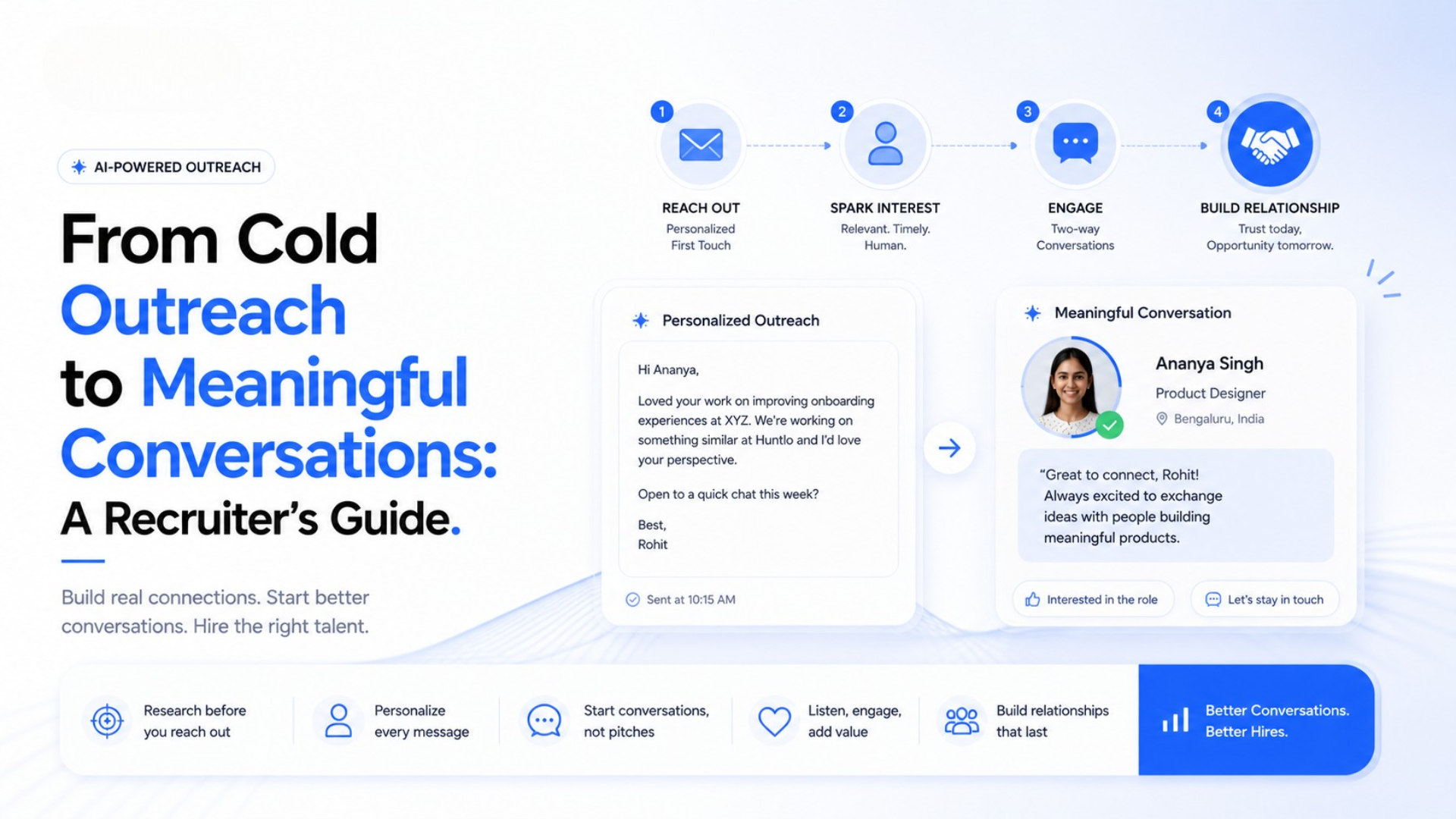
There is a moment every experienced recruiter recognizes: the point where an outreach message stops being a message and becomes a conversation. It happens when the candidate writes back with something longer than two sentences. When they ask a question of their own. When they mention a colleague who might also be interested. When they share a concern about their current role that goes deeper than surface-level dissatisfaction. That moment is not random, and it is not rare for top recruiters. But for the majority of the industry, it is rare indeed. Most candidate outreach does not produce conversations. It produces silence, or at best a one-line response that dies after a single exchange. The gap between sending messages and having meaningful conversations is the single most consequential divide in talent acquisition. It separates recruiters who fill roles efficiently from those who struggle with the same market conditions. It separates organizations that attract top talent from those that wonder why their employer brand is not stronger. And it is a gap that can be closed, systematically, by understanding what turns a cold message into a warm dialogue and building that understanding into the outreach process itself.
The challenge is not that recruiters do not want better conversations. Virtually every recruiter would prefer to spend their time in genuine dialogue with interested, qualified candidates rather than firing generic messages into the void. The challenge is that the systems, habits, and incentives most recruitment teams operate within are designed to produce messages, not conversations. The metrics track sends and opens. The tools are optimized for volume. The timelines reward speed over depth. And the training, to the extent it exists, focuses on how to write a message, not how to build a conversation. This guide is about making that shift: from outreach as a broadcasting activity to outreach as a conversational discipline. It covers the principles, the practical techniques, and the systemic changes that transform cold outreach into the kind of meaningful recruiter-candidate exchanges that lead
to hires, to referrals, and to long-term talent relationships that pay dividends for years.
What a “Meaningful Conversation” Actually Means in Recruiting
Before discussing how to create meaningful conversations, it is worth defining what the term means in a recruiting context, because it is frequently misunderstood. A meaningful conversation is not a long conversation. A candidate who responds to every follow-up with polite deferrals over the course of six weeks is having a long interaction, but not necessarily a meaningful one. A meaningful conversation is also not a friendly one. A candidate who exchanges pleasantries and compliments the company culture but never engages with the substance of the opportunity is being personable, but the conversation has not achieved depth. What makes a conversation meaningful in recruiting is the exchange of information that advances the decision-making process for both parties. The candidate learns something genuine about the role, the team, or the company that they did not know before and that is relevant to their career decision. The recruiter learns something genuine about the candidate’s motivations, constraints, or aspirations that they did not know before and that is relevant to the hiring decision. Both parties leave the conversation with a clearer understanding of whether there is a potential fit, and both parties have invested enough time and thought to feel that the interaction was worthwhile regardless of the outcome.
This definition matters because it provides a practical standard against which to evaluate outreach. If your outreach messages are designed to elicit a yes-or-no response — “Are you open to new opportunities?”, “Can we schedule a call?”, “Would you like to hear more?” — they are designed to produce a transaction, not a conversation. The candidate’s possible responses are narrow, and the conversation, if it happens at all, is shallow by design. Contrast this with outreach that is designed to provoke thought and invite a substantive response: “I noticed you led the migration to microservices at your current company. I am curious — what was the biggest unexpected challenge you ran into during that transition?” This second message cannot be answered with a yes or no. It requires the candidate to reflect, to share an experience, and to invest something of themselves in the response. That investment is the seed of a meaningful conversation, and it is the single most important mechanism for converting a cold outreach contact into a warm, engaged candidate. According to SHRM’s research on talent acquisition effectiveness, recruiters who structure their initial outreach around open-ended, candidate-specific questions report conversation rates that are two to three times higher than those who lead with transactional asks, because the question itself signals respect for the candidate’s expertise and creates a natural opening for dialogue rather than a gate-keeping decision point.
The Architecture of a Conversation-Opening Message
A conversation-opening message has a fundamentally different structure than a standard recruiting outreach message, and understanding the architectural difference is the first step toward consistently producing conversations rather than silence. The standard outreach message follows what might be called the brochure structure: it presents information about the role, the company, and the recruiter, and then asks the candidate to take a next
step. The implicit logic is that if the candidate likes what they read, they will respond. The conversation-opening message follows what might be called the inquiry structure: it leads with a genuine observation or question about the candidate’s work, establishes relevance through specificity, and creates space for the candidate to respond with substance rather than a binary decision. The brochure structure asks the candidate to consume information. The inquiry structure invites the candidate to share information. That difference in direction — consuming versus sharing — is what determines whether a response becomes a conversation or remains a transaction.
The practical components of a conversation-opening message are: first, a specific observation about the candidate that demonstrates the recruiter has done more than read their job title. This could reference a project, a publication, a career transition, a skill set combination, or a pattern in their career trajectory. The key is that it must be specific enough that the candidate recognizes it as genuine research rather than automated flattery. Second, a connection between that observation and the opportunity the recruiter is presenting. This does not mean pitching the role explicitly in the first message. It means creating a bridge between what the candidate has done and why the recruiter is reaching out to them specifically. Third, an open-ended question or invitation that gives the candidate a substantive way to respond. The question should be related to the observation, not to the role itself. The goal of the first message is not to sell the job. It is to start a conversation that may eventually lead to a discussion of the job. Fourth, a low-commitment close that makes it easy for the candidate to engage without committing to a call, an interview, or any other heavy next step. “No pressure to reply in detail — even a brief thought would be great” is the kind of close that reduces friction and increases the probability of a first response.
This four-part structure is not a template to be copied word for word. It is a framework that can be adapted to any candidate, any role, and any channel. The key discipline is maintaining the inquiry direction: leading with curiosity about the candidate rather than enthusiasm about the role. Recruiters who master this shift consistently report that their response rates improve not because they are sending more messages, but because the messages they send are producing a different quality of response. A candidate who replies to an inquiry-based message is engaging in a conversation, even if that first reply is brief. They are sharing something about themselves, and that creates a foundation for the recruiter to build on in subsequent exchanges. This is fundamentally different from a candidate who replies “Send me more info” to a brochure message, because that response puts the burden of continued conversation back on the recruiter without the candidate having invested anything of their own. The distinction between sourcing candidates and actually recruiting them is critical here. Sourcing identifies the right people. But as explored in What’s the Difference Between AI Sourcing and AI Recruiting?, sourcing without the ability to convert those identifications into genuine dialogue is an expensive exercise in list-building. The conversation-opening message is the bridge between sourcing and recruiting, and its quality determines whether that bridge stands or collapses.
Moving Beyond Transactional Questions: What to Ask and Why
The questions a recruiter asks in the early stages of a candidate interaction determine the trajectory of the entire conversation. Transactional questions — “What is your current compensation?”, “When are you available to start?”, “Are you interviewing elsewhere?” — are necessary at some point in the process, but asking them too early converts the conversation into an interrogation rather than a dialogue. The candidate feels evaluated rather than engaged, and the dynamic shifts from collaborative to adversarial. Meaningful recruiting conversations follow a different sequence: they begin with exploratory questions that demonstrate interest in the candidate as a professional and as a person, then gradually move toward more specific and eventually transactional questions as mutual interest is established and the conversation naturally progresses toward a hiring decision. This sequencing is not just a matter of politeness. It is a strategic choice that maximizes the information the recruiter gathers while maintaining the candidate’s engagement and trust.
The best exploratory questions share three characteristics. They are specific to the candidate’s experience, so the candidate cannot give a canned answer. They are genuinely interesting, so the candidate wants to answer them even if they are not interested in the role. And they create follow-up opportunities, so the recruiter can continue the conversation naturally based on the candidate’s response. For example, asking a product manager who recently launched a consumer app, “What was the user insight that most surprised you during the beta phase?” is specific, interesting, and rich with follow-up potential. The candidate’s answer will reveal how they think about users, how they handle ambiguity, and how they communicate complex ideas — all of which are directly relevant to evaluating them for a role, but none of which feel like an evaluation question. The conversation flows naturally from their answer into deeper territory, and by the time the recruiter needs to ask about compensation or availability, there is enough rapport and mutual investment that those questions feel like a natural part of the process rather than an abrupt shift into transactional mode.
For specialized and technical roles, the exploratory question strategy is even more important, because these candidates are accustomed to being contacted by recruiters who clearly do not understand their work. A machine learning engineer who receives a message asking, “What is your experience with Python?” will immediately recognize that the recruiter has not bothered to understand their field, and the conversation is over before it starts. But a message that asks, “I saw your paper on transformer efficiency at NeurIPS last year. How are you thinking about the tradeoff between model compression and inference latency in production systems?” will almost certainly get a response, because it treats the candidate as the expert they are and creates a conversation that is worth having on its own merits. As discussed in Do AI Recruiting Tools Work for Niche or Technical Roles?, the ability to engage specialized candidates in their own language is not a nice-to-have skill. It is the prerequisite for any outreach success with this segment, and it requires either deep recruiter expertise or an AI system that can generate technically informed messages from the candidate’s profile. Most organizations lack the former, which is why the latter has become essential.
The Follow-Up as Conversation, Not Reminder
The conventional follow-up in recruiting is a reminder: “Just following up on my previous message.”, “Wanted to check if you had a chance to review the role details.”, “Circling back to see if you are still interested.” These messages are sent with good intentions, but from the candidate’s perspective, they are nagging. They add no new value, they create no new reason to respond, and they implicitly communicate that the recruiter has nothing more to offer beyond repetition. The candidate’s silence after the first message was not necessarily a rejection. It may have been a busy week, a forgotten notification, or a “I will reply later” intention that was overtaken by other priorities. A reminder follow-up does nothing to address any of these scenarios. It simply repeats the original ask and hopes that persistence alone will produce a different result. Sometimes it does. But the conversation that results from a reminder follow-up is usually shallow, because the candidate is responding out of obligation or curiosity, not out of genuine engagement with the content of the exchange.
The alternative is to treat the follow-up as a continuation of the conversation rather than a repeat of the original message. This means adding new value, new information, or a new angle in every subsequent touchpoint. The second message might share an article or insight relevant to the candidate’s field, or mention a new development at the company that was not public when the first message was sent, or reference something the candidate has posted or published since the initial outreach. The third message might offer an introduction to someone in the candidate’s network, or share market data about compensation trends in their role, or ask a different exploratory question that builds on the original one. Each touchpoint adds to the conversation rather than repeating it, which means the candidate has a fresh reason to engage each time. This approach also solves the psychological problem of follow-up fatigue. A candidate who receives three reminder messages feels pressured and annoyed. A candidate who receives three messages, each of which offers something interesting and relevant, feels respected and valued, even if they ultimately decide the role is not right for them. The practical challenge is that creating differentiated, value-adding follow-up content for every candidate at every touchpoint is extraordinarily time-consuming when done manually. This is precisely the kind of task where intelligent automation makes a dramatic difference, as long as the automation is sophisticated enough to generate genuinely relevant follow-up content rather than generic templates with the candidate’s name inserted. As covered in What Makes an AI Recruiting Platform Agentic vs. Just Automated?, the difference between automation that executes repetitive tasks and agentic AI that adapts its behavior based on context is the difference between follow-ups that feel robotic and follow-ups that feel like a continuing conversation. The latter is what produces meaningful engagement at scale.
When the Conversation Goes Silent: Re-engaging Without Desperation
Even the best-conducted recruiting conversations go silent sometimes. The candidate was engaged, the exchange was substantive, and then — nothing. The recruiter sends a
follow-up and receives no response. Another follow-up, still nothing. The silence could mean many things: the candidate accepted another offer, decided to stay in their current role, or simply became too busy to manage the conversation alongside their other responsibilities. Or it could mean none of those things. The candidate may still be interested but may have forgotten to reply, or may be waiting for a specific piece of information before re-engaging, or may be in a period of their life where professional communications are not a priority. The recruiter cannot know which scenario is true, which means the re-engagement strategy needs to work across all of them: it must not be pushy (which would alienate a candidate who is simply busy), it must not be desperate (which would signal weakness and reduce the recruiter’s credibility), and it must not be generic (which would confirm the candidate’s suspicion that the conversation was never really about them personally).
The most effective re-engagement messages share three qualities. First, they acknowledge the silence directly but without guilt or pressure. A simple, “I know things get busy, and I do not want to add to your inbox load” is more effective than either ignoring the silence or making the candidate feel bad about it. Second, they offer something new. This is the same principle as the value-adding follow-up, but with even lower expectations. The goal is not to restart the full conversation but to create a moment of positive re-engagement that leaves the door open. A relevant industry article, a brief market insight, or a genuine compliment on a recent professional achievement all serve this purpose. Third, they include an explicit no-pressure escape clause that makes it easy for the candidate to decline gracefully. “If the timing is not right, I completely understand — just let me know and I will not follow up further on this” is a powerful close because it gives the candidate control over the interaction. Paradoxically, candidates are more likely to re-engage when they feel they have the freedom not to, because the absence of pressure makes the conversation feel safe rather than transactional.
For agency recruiters, who manage relationships across multiple clients and candidate pools, the challenge of re-engagement is amplified by volume. An agency recruiter may have dozens or hundreds of conversations in various stages of silence at any given time, and manually crafting individualized re-engagement messages for each one is not feasible. As explored in Agency Owners Are Solving Different Problems Than Recruiters Think, the most successful agencies are investing in systems that can maintain conversational context across long time horizons and generate re-engagement touchpoints that feel personal and relevant even when they are system-triggered. This is not about replacing the recruiter’s judgment. It is about giving the recruiter a system that handles the operational complexity of maintaining hundreds of candidate relationships simultaneously, so the recruiter can focus their personal attention on the conversations that are closest to conversion. The candidates who experience this kind of persistent, respectful, value-adding engagement over time are the ones who eventually respond — not because they were pressured into it, but because the accumulated quality of the outreach made the conversation worth having.
Building a System That Produces Conversations, Not Just Messages
The principles in this guide — inquiry-based opening messages, exploratory questions, value-adding follow-ups, and respectful re-engagement — are individually well-understood by experienced recruiters. The problem is not knowledge. The problem is execution at scale. A recruiter who applies these principles diligently to ten candidates a day will have excellent conversations. But that same recruiter has twenty or thirty or fifty additional candidates who need attention, and the time required to research each one deeply, craft a personalized inquiry-based message, develop exploratory questions specific to their experience, and create differentiated follow-up content for multiple touchpoints exceeds the hours available in a workday. The result is that these principles are applied selectively, to the candidates the recruiter judges most promising, while the rest receive the standard generic outreach that produces the industry’s typical low conversation rates. This is not a recruiter problem. It is a systems problem, and solving it requires a system that can execute these principles consistently across the entire candidate pipeline, not just the top ten percent.
Huntlo was built to solve exactly this problem. Its AI engine analyzes each candidate’s profile in depth and generates outreach messages that follow the inquiry structure described in this guide: specific observations, genuine questions, and low-commitment closes that invite substantive responses rather than binary decisions. The messages are differentiated for each candidate, so the software engineer receives a different conversation opener than the product manager or the healthcare executive. The follow-up sequences are not reminders. They are context-aware continuations that introduce new information, new angles, and new reasons for the candidate to engage at each touchpoint. And the re-engagement system maintains conversational context over weeks and months, so a candidate who goes silent and returns three weeks later is met with a follow-up that demonstrates continuity and relevance rather than a generic “circling back” message. Beyond the outreach quality, Huntlo addresses the upstream problem of candidate data freshness. Too many recruiting conversations fail before they start because the candidate data is outdated, the contact information is wrong, or the profile being used is months old. The challenges of working with stale data are explored in Why Do Some AI Recruiting Tools Have Outdated Candidate Data?, and they are challenges that Huntlo addresses through continuous data enrichment and verification, ensuring that the conversation is initiated with accurate, current information about the candidate. The result is a system that does not just send more messages. It produces more conversations, more qualified engagements, and ultimately more hires — by treating every candidate interaction as the beginning of a dialogue, not the delivery of a brochure.
The recruiters who will thrive in the talent market of 2026 and beyond are not the ones who send the most messages. They are the ones who have the most meaningful conversations. The distinction is everything. A conversation is where trust is built, where fit is evaluated, where objections are addressed, and where the candidate’s decision to explore an opportunity is actually made. Messages create awareness. Conversations create movement. If your outreach process is optimized for message volume, you are building awareness at scale but not converting it into action. If your outreach process is optimized for
conversation quality, you are building the kind of recruiter-candidate relationships that lead to hires, to referrals, and to a talent pipeline that compounds in value over time. The shift from one to the other is not incremental. It is transformative, and it starts with the principles in this guide and the systems that make those principles operable at the scale that modern recruiting demands.
Related Topics:
What’s the Best Way to Evaluate an AI Sourcing Tool Before Buying?
Why Do Some AI Recruiting Tools Have Outdated Candidate Data?
What Makes an AI Recruiting Platform Agentic vs. Just Automated?