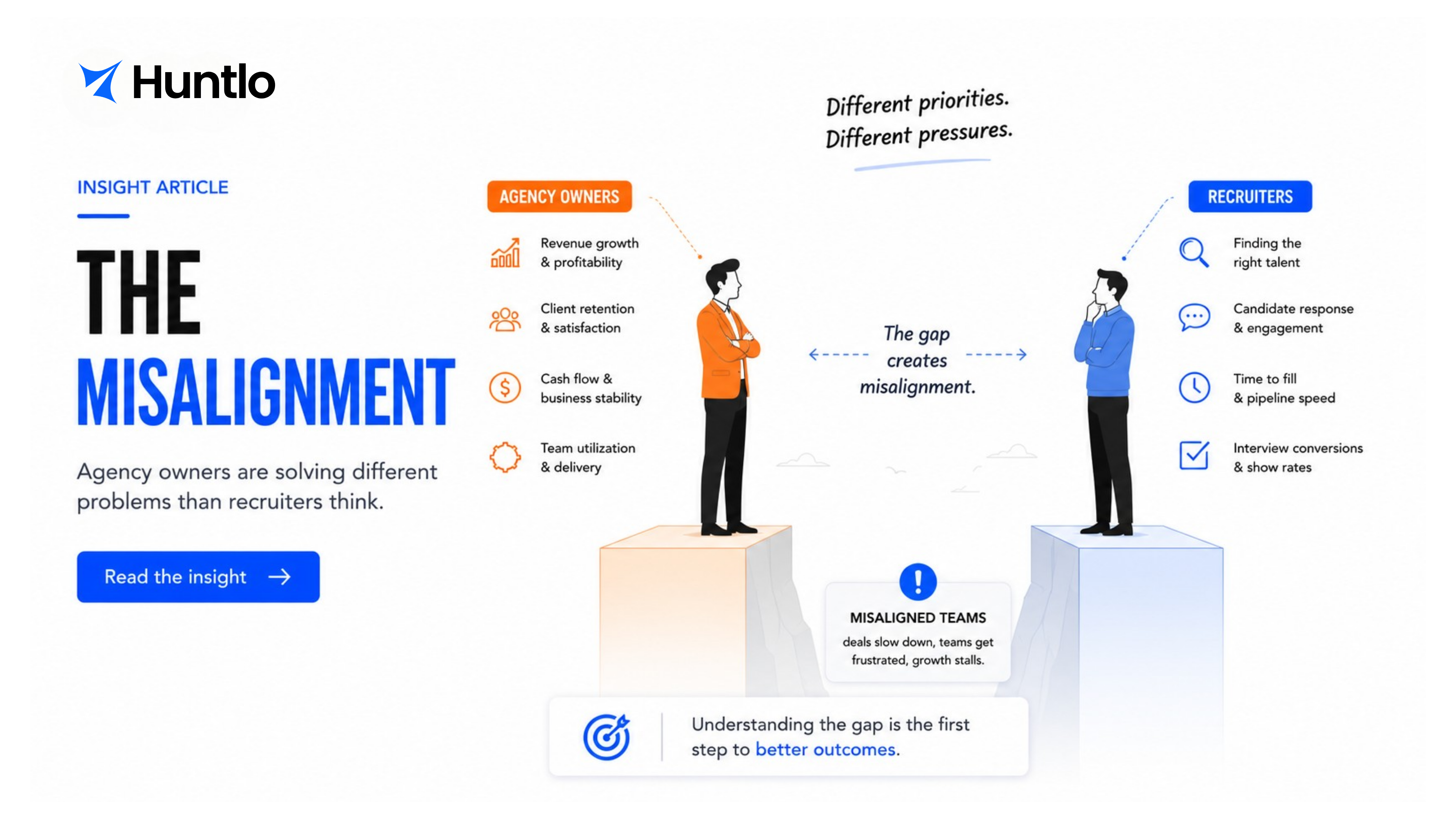
Every staffing agency has two conversations happening at the same time, and they rarely overlap. In the morning standup, recruiters talk about candidate response rates, screening bottlenecks, and hiring managers who take too long to give feedback. In the owner's office — or in the Slack channel that recruiters are not part of — the conversation is about client concentration, gross margin trends, recruiter utilization rates, and whether the business can survive the loss of its two biggest accounts. These are not the same conversations, and they are not leading to the same conclusions about what the agency needs to do next.
This disconnect is not a failure of communication. It is a structural consequence of the different roles that recruiters and owners play in the agency's ecosystem. Recruiters are responsible for execution — finding candidates, filling requisitions, generating placement revenue. Owners are responsible for the business — ensuring that the revenue is profitable, sustainable, and growing. Both roles are essential, but they create different perspectives on what the agency's biggest challenges are and what solutions are most urgent.
Understanding this disconnect is the first step toward resolving it. This article maps the five core problems that agency owners are actually trying to solve, explains why each of these problems looks different from the owner's chair than from the recruiter's desk, and shows how the right technology investment — specifically a unified AI platform like Huntlo — can address both the owner's strategic priorities and the recruiter's operational needs simultaneously.
Problem One: Margin Pressure — The Owner's View vs. The Recruiter's View
For a recruiter, the cost of a sourcing tool subscription is an abstraction. It shows up as a line item on some budget report that they never see. What they see is whether the tool helps them find candidates and get placements. If it does, they are happy. If it does not, they are frustrated. The recruiter's evaluation of a tool is entirely outcome-driven: does this help me place more candidates?
For the agency owner, the cost of technology is not an abstraction. It is a direct line item against gross margin, which is the lifeblood of the business. The typical staffing agency operates on gross margins of 18-25%. For every dollar of placement revenue, $0.75-$0.82 goes to the recruiter's compensation, and the remaining $0.18-$0.25 must cover technology, office space, marketing, administrative staff, and profit. Technology costs that seem small in isolation become significant in aggregate. A team of 10 recruiters, each using LinkedIn Recruiter at $200/month, an AI sourcing tool at $250/month, an outreach tool at $75/month, and a screening tool at $100/month, costs the agency $6,250 per month or $75,000 per year in technology alone. Against a gross margin of 20%, that $75,000 in technology costs requires $375,000 in additional placement revenue just to break even.
Bullhorn's Global Staffing Indicator reports that average gross margins in the staffing industry have been declining for three consecutive years, from 22.3% in 2022 to 20.1% in 2025. The primary drivers of margin compression are rising recruiter compensation (as the war for recruiting talent intensifies), increasing client expectations (clients demand faster fills, better candidates, and lower fees), and growing technology costs (as agencies adopt more tools to meet client expectations). Agency owners are caught in a vise: clients want more, recruiters cost more, and the margin between them keeps shrinking.
Huntlo directly addresses the owner's margin problem. At $99/seat/month with no usage caps, it replaces the typical $500-1,000/month per-recruiter tool stack with a single platform that provides AI sourcing across 50+ sources, multi-channel outreach across email, LinkedIn, WhatsApp, and AI voice, conversational AI screening, and talent pool management with ATS integration. For a 10-recruiter team currently spending $6,250/month on a fragmented stack, switching to Huntlo drops the technology cost to $990/month plus their ATS — a savings of approximately $4,000-5,000/month or $48,000-60,000/year. At a 20% gross margin, that $60,000 annual savings is equivalent to $300,000 in additional placement revenue. No recruiter needs to place a single additional candidate to realize this value — it comes entirely from cost consolidation.
The recruiter's experience improves simultaneously. Instead of managing multiple tools with different logins, interfaces, and data silos, the recruiter works in a single platform where sourcing, outreach, screening, and pipeline management are integrated. The same AI that sources candidates generates personalized outreach, conducts screening conversations, and manages follow-up sequences. The recruiter's job becomes easier and more productive, which leads to more placements — generating additional revenue on top of the cost savings. Both the owner's margin problem and the recruiter's productivity problem are solved by the same investment.
Problem Two: Client Concentration Risk — The Owner's Constant Anxiety
Recruiters think about clients one requisition at a time. They focus on filling the current open role, satisfying the current hiring manager, and generating the current placement fee. This is correct behavior for a recruiter — it is what they are paid to do. But from the owner's perspective, this requisition-by-requisition view obscures a structural risk that keeps owners awake at night: client concentration.
Client concentration is the degree to which an agency's revenue depends on a small number of clients. According to Staffing Industry Analysts (SIA) research, the average staffing agency derives 45-55% of its revenue from its top three clients. For smaller agencies, the concentration can be even more extreme — some agencies derive 70-80% of revenue from a single client. This concentration creates an existential risk: if the top client reduces its hiring volume, switches to a competitor, or brings recruiting in-house, the agency's revenue can collapse overnight.
The owner's problem is not how to fill the current requisition — it is how to build a diversified client base that can absorb the loss of any single client without threatening the agency's survival. Solving this problem requires investing in business development, building relationships with new clients, and maintaining enough capacity to serve multiple clients simultaneously without quality degradation. It also requires the operational scalability to ramp up quickly when a new client is won — because new clients expect results fast, and an agency that cannot deliver immediately will lose the opportunity to demonstrate its value.
Gartner's research on professional services firm risk identifies client concentration as the single largest risk factor for staffing agency failure, ahead of cash flow problems, talent retention, and competitive pressure. Agencies with high client concentration are 4.2 times more likely to experience a revenue decline of 20% or more in any given year compared to agencies with diversified client bases.
This is where the connection between the owner's problem and the recruiter's tooling becomes critical. An agency that needs to scale quickly to serve a new client cannot afford to have its recruiters spending 25-30% of their time managing a fragmented tool stack. It needs recruiters who can be productive immediately — who can source, outreach, and screen candidates across multiple roles and multiple clients without being bottlenecked by technology complexity. A unified platform like Huntlo enables this scalability because it eliminates the tool-switching overhead that consumes so much recruiter time. A new client's requisitions can be loaded into the platform, AI-matched to the talent pool, and put into multi-channel outreach sequences within hours, not days or weeks.
The talent pool management capability is particularly valuable for addressing client concentration. When an agency wins a new client, it often needs to fill roles that are similar to roles it has filled for other clients. Huntlo's talent pool — which maintains a searchable, categorized database of every candidate the agency has ever engaged with — means that the agency can often identify qualified candidates for a new client's roles without starting the sourcing process from scratch. This "instant pipeline" capability dramatically reduces the time-to-first-submission for new clients, which is the single most important factor in client retention during the critical first 90 days of a new engagement.
Problem Three: Recruiter Productivity Variance — The Owner's Management Challenge
Every agency owner knows that their recruiters do not produce at the same level. In a team of 10 recruiters, the top performer might place 15 candidates per month while the bottom performer places 4. This 3.75x productivity variance is typical in the staffing industry, and it creates significant management challenges for owners.
The recruiter's perspective on this variance is straightforward: the top performers are better at recruiting. They write better messages, conduct better screens, build better relationships with hiring managers, and have better market knowledge. The bottom performers need more training, more coaching, or more motivation. This perspective is not wrong, but it misses the structural factors that contribute to productivity variance — and the extent to which those structural factors can be addressed through technology and process rather than individual recruiter skill.
Harvard Business Review's research on performance variance in knowledge work found that in organizations with highly standardized processes and tools, performance variance between individual contributors is typically 2-3x. In organizations with poorly standardized processes and fragmented tools, performance variance is 5-8x. The difference is not that the people are different — it is that the system amplifies or dampens individual skill differences. A standardized system with good tools allows every recruiter to perform at a reasonable baseline, with individual skill differences creating moderate variance above that baseline. A fragmented system with poor tools creates a situation where only the most skilled, most experienced recruiters can overcome the system's friction, creating extreme variance between those who can and those who cannot.
For agency owners, this insight is transformative. If a significant portion of the productivity variance in their team is caused by system friction rather than individual skill, then investing in a better system — a unified platform like Huntlo that standardizes workflows, automates repetitive tasks, and provides consistent AI-powered support to every recruiter — will reduce the variance by raising the performance floor. The bottom performers will improve more than the top performers, because the bottom performers were spending more of their time fighting system friction. The net result is a more predictable, more consistent team that delivers more reliable outcomes for clients.
Huntlo's design specifically addresses the productivity variance problem. The platform's AI-powered sourcing, matching, and personalization capabilities provide a baseline level of quality that every recruiter can achieve, regardless of their individual experience level. A junior recruiter using Huntlo can generate personalized outreach that is competitive with what a senior recruiter would write manually, because the AI handles the personalization based on the candidate's profile data. A recruiter who is weak at screening can rely on Huntlo's conversational AI to conduct thorough, consistent screening conversations, ensuring that every candidate is evaluated against the same criteria. A recruiter who struggles with follow-up discipline can rely on Huntlo's automated follow-up sequences to maintain engagement with every candidate in their pipeline.
This standardization does not eliminate the value of senior recruiter expertise — it ensures that the expertise is applied where it matters most (hiring manager relationships, complex negotiations, strategic sourcing decisions) rather than being consumed by routine tasks that AI can handle. The result is a team where every recruiter performs at a higher baseline, the top performers are freed to focus on high-value activities, and the overall productivity variance narrows to a level that the owner can manage and predict.
Problem Four: Predictable Revenue — The Owner's Forecasting Challenge
Recruiters live in the present tense. They are focused on the requisitions they are working on today, the candidates they are talking to this afternoon, the placements they are trying to close this week. This present-tense orientation is appropriate for the execution role they play. But agency owners must live in the future tense. They need to predict revenue three, six, and twelve months ahead to make hiring decisions, investment decisions, and financing decisions. The gap between the recruiter's present-tense execution and the owner's future-tense forecasting creates one of the most persistent management challenges in the staffing industry.
Revenue predictability in staffing is notoriously difficult because the business model is inherently variable. Placement revenue depends on the volume of requisitions from clients, the speed at which those requisitions are filled, the placement fee rates negotiated with clients, and the ratio of submissions to placements. Each of these variables is subject to significant fluctuation. Client hiring volumes can change with business conditions. Fill rates depend on market talent availability. Fee rates are subject to negotiation pressure. And the submission-to-placement ratio varies with the quality of the recruiter's sourcing and screening.
G2's staffing agency operations report found that only 28% of staffing agency owners describe their revenue forecasting as "reliable," with the remaining 72% describing it as "approximate" or "speculative." This forecasting unreliability creates real business consequences: owners who cannot predict revenue with confidence cannot make informed decisions about hiring recruiters, investing in business development, or taking on debt to fund growth. They are forced to operate conservatively, which means growing more slowly than the market opportunity would allow.
A unified AI platform like Huntlo improves revenue predictability in several ways. First, the platform's pipeline analytics provide real-time visibility into the entire recruiting funnel — from candidates sourced to candidates engaged, screened, submitted, and placed. This end-to-end visibility allows the owner to forecast revenue based on pipeline data rather than gut instinct. If the platform shows that 150 candidates are currently in the screening stage across 30 active requisitions, and the historical screening-to-placement conversion rate is 15%, the owner can forecast approximately 22.5 placements from the current pipeline — a data-driven forecast that can be refined as candidates progress through the funnel.
Second, the platform's talent pool management provides visibility into the agency's long-term candidate assets. If the agency has 5,000 qualified candidates in its talent pool, the owner knows that the agency has a deep bench of potential matches for future requisitions, which reduces the risk that a new client engagement will fail due to an empty pipeline. This talent pool visibility also allows the owner to identify gaps — skill areas where the pool is thin and proactive sourcing is needed — before those gaps become client-facing problems.
Third, the platform's multi-channel outreach and automated follow-up capabilities create more predictable candidate engagement rates. When every candidate receives a consistent, optimized follow-up sequence, the aggregate response rate becomes more stable and predictable. In a manual outreach model, response rates fluctuate wildly based on which recruiters happen to be following up diligently and which are not. In an automated model, the response rate is a function of the platform's configuration and the market's underlying responsiveness, both of which are more stable than individual recruiter behavior.
Problem Five: Competitive Differentiation — The Owner's Strategic Challenge
Recruiters think about competition at the candidate level. They are competing with other recruiters — from other agencies and from internal talent teams — to engage the best candidates for their open requisitions. This candidate-level competition is intense, and recruiters feel it acutely every day. But agency owners think about competition at the business level. They are competing with other agencies for client relationships, for market positioning, and for long-term survival in an industry where barriers to entry are low and competitive pressure is relentless.
The owner's competitive differentiation problem is fundamentally different from the recruiter's candidate competition problem. The owner needs to answer the question: "Why should a client work with our agency instead of the dozens of other agencies that are pitching for their business?" The answer cannot be "our recruiters send more InMails" or "our recruiters have better LinkedIn profiles." Those are table stakes, not differentiators. The answer must be something structural — something that creates a sustainable competitive advantage that competitors cannot easily replicate.
McKinsey's research on professional services differentiation identifies three sustainable differentiation strategies for service businesses: operational excellence (delivering better results faster and more consistently), technology advantage (having capabilities that competitors lack), and relationship depth (building deeper, more strategic partnerships with clients). Most staffing agencies attempt to differentiate on relationship depth — emphasizing personal connections with hiring managers and deep industry expertise. This is valuable, but it is also fragile, because relationships can be disrupted by personnel changes on either side.
Technology advantage is a more durable differentiator, but only if the technology creates capabilities that competitors genuinely cannot match. Having "an AI sourcing tool" is not a differentiator, because every agency has one. Having a unified AI platform that provides AI sourcing, multi-channel outreach, conversational screening, and talent pool management in a single integrated environment — and doing it at a cost structure that allows the agency to offer competitive fees while maintaining healthy margins — is a genuine differentiator.
Huntlo enables this kind of technology-based differentiation. Consider the client pitch scenario: an agency owner walks into a meeting with a prospective client and can demonstrate that their platform sources candidates from 50+ databases, engages them across email, LinkedIn, WhatsApp, and AI voice, screens them through conversational AI that provides structured qualification data, and manages a talent pool of thousands of pre-engaged candidates. They can show the client real-time pipeline dashboards, conversion rate analytics, and time-to-hire benchmarks. They can explain that their technology allows them to submit qualified candidates within 48 hours of receiving a new requisition. And they can offer all of this at competitive fee rates because their technology cost per recruiter is $99/month, not $500-1,000/month.
This is a compelling pitch. It is not just about having better tools — it is about having a fundamentally different operational model that produces better, faster, more predictable results at a lower cost. Competitors who are still operating with fragmented tool stacks cannot match this pitch, because they cannot deliver the same speed, consistency, or data-driven transparency. The agency with Huntlo has a structural advantage that is difficult and expensive for competitors to replicate — precisely the kind of sustainable differentiator that owners need.
The Misalignment in Action: A Common Scenario
To make the disconnect concrete, consider a scenario that plays out in agencies every day. A recruiter approaches the owner and says: "I need [hireEZ] to find better candidates. My current sourcing is not producing enough qualified people, and I am falling behind on my placements." The recruiter is solving a recruiter-level problem: they need more qualified candidates.
The owner, meanwhile, is looking at the P&L and sees that the agency's technology costs have increased by 35% year-over-year while gross margins have declined by 2 percentage points. The owner is solving an owner-level problem: the agency is spending too much on technology relative to the revenue it generates.
The recruiter's request and the owner's constraint are in direct conflict. The recruiter wants to add a $250/month tool. The owner wants to reduce technology spending. The conversation that follows is often frustrating for both parties. The recruiter feels the owner does not understand the operational reality of recruiting. The owner feels the recruiter does not understand the financial reality of running a business. Both are right, and both are wrong, because they are solving different problems and talking past each other.
Huntlo resolves this conflict by being the answer to both problems simultaneously. For the recruiter, it provides AI sourcing across 50+ platforms — broader coverage than hireEZ offers — along with multi-channel outreach, conversational screening, and talent pool management that no single point solution can match. For the owner, it costs $99/seat/month — a fraction of the cost of the existing tool stack — and replaces multiple subscriptions with a single one. The recruiter gets better tools. The owner gets lower costs. The conflict disappears.
This resolution is only possible because Huntlo is a platform, not a point solution. A point solution can solve a recruiter's specific problem (better sourcing, faster screening, more outreach channels) but it cannot solve the owner's cost problem because it adds to the stack rather than consolidating it. A platform solves both because it replaces multiple tools with one, reducing costs while improving capability. This is the fundamental architectural advantage that distinguishes a true platform from a collection of features.
Building Alignment: How Owners and Recruiters Can Solve Problems Together
The disconnect between owners and recruiters is not inevitable. It can be resolved — or at least significantly reduced — through deliberate actions on both sides.
For agency owners, the first step is to share the business context with recruiters. Most recruiters do not see the agency's financial statements, client concentration data, or margin analysis. They do not know that technology costs are eroding profitability or that the agency is dangerously dependent on two clients. Sharing this context — in an appropriate, non-alarmist way — helps recruiters understand why the owner makes the decisions they do and creates alignment around shared priorities. A recruiter who understands that the agency needs to diversify its client base is more likely to support the process discipline and tooling investments that enable that diversification.
The second step for owners is to measure and communicate recruiter productivity in ways that connect individual performance to business outcomes. Instead of only measuring placements per recruiter (which is the recruiter's metric), also measure revenue per recruiter, gross margin per recruiter, and client satisfaction per recruiter. These business-level metrics help recruiters see the connection between their daily activities and the agency's financial health. A recruiter who understands that their gross margin per placement is $3,500 and that the agency needs $4,000 to maintain profitability is more motivated to optimize their time and tooling for efficiency.
The third step for owners is to invest in platforms that align recruiter and owner interests. This means choosing technology that makes recruiters more productive (which recruiters want) while also reducing costs and improving predictability (which owners want). Huntlo's $99/seat/month pricing with no usage caps is designed to create this alignment. Recruiters can use the platform as much as they need — unlimited sourcing, unlimited outreach, unlimited screening — without the owner worrying about usage-based overage charges that inflate costs unpredictably.
For recruiters, the first step toward alignment is to develop business awareness. Understanding the agency's financial model, client portfolio, and competitive position does not require an MBA — it requires a willingness to see the business from the owner's perspective. A recruiter who can think about margin impact, client diversification, and operational scalability is a more valuable team member than one who can only think about placements.
The second step for recruiters is to advocate for tools and processes that solve both operational and business problems. Instead of asking for a new tool that solves a specific sourcing challenge, advocate for a platform that solves multiple challenges simultaneously — sourcing, outreach, screening, and pipeline management — while also reducing the agency's overall technology costs. This kind of advocacy demonstrates business thinking and is far more likely to receive the owner's support.
The Platform That Serves Both Masters
The recruiting industry has spent years building tools for recruiters and tools for owners, as if the two groups had fundamentally different needs. They do not. What they need is a platform that addresses the recruiter's operational challenges and the owner's business challenges from the same integrated environment.
Huntlo is that platform. For recruiters, it provides AI-powered sourcing across 50+ platforms, multi-channel outreach across email, LinkedIn, WhatsApp, and AI voice, conversational AI screening that handles initial qualification conversations, and talent pool management that preserves every candidate relationship for future re-engagement. These capabilities make recruiters more productive, more consistent, and more effective — which is what recruiters have always wanted.
For agency owners, Huntlo provides dramatic cost reduction ($99/seat/month versus $500-1,000 for a fragmented stack), operational scalability (new recruiters can be productive in days, not weeks), pipeline predictability (real-time analytics across the entire recruiting funnel), competitive differentiation (a technology capability that most competitors cannot match), and margin protection (lower technology costs mean healthier margins at the same fee rates). These capabilities address the business challenges that keep owners up at night.
The platform achieves this dual alignment because it was designed from the ground up as a unified system, not as a collection of point solutions. The AI that helps a recruiter find candidates is the same AI that helps the owner forecast revenue. The multi-channel outreach that helps a recruiter engage a candidate is the same outreach engine that helps the owner demonstrate technology differentiation to a prospective client. The talent pool that helps a recruiter find a quick match for a new requisition is the same talent pool that gives the owner confidence in the agency's long-term candidate assets.
In a market where competitors charge $149-500 per seat per month for capabilities that Huntlo provides at $99/seat/month, the platform is not just a better tool — it is a better business model for the agency that adopts it. Lower technology costs, higher recruiter productivity, more predictable revenue, and stronger competitive differentiation. For the recruiter, better tools and easier workflows. For the owner, a healthier, more resilient business. The same platform. The same investment. Both problems solved.
Related Topics:
AI Recruiting Software for Staffing Firms
AI Sourcing Tool Comparison Framework: 10 Criteria That Matter
Compliance and Data Privacy: AI Sourcing Tools for Indian Recruiters