Artificial intelligence is rapidly becoming a core part of modern recruitment.
From candidate sourcing and screening to engagement and workflow automation, AI is helping recruiters manage larger hiring volumes with greater efficiency.
But as AI adoption grows, so do concerns around compliance, data privacy, and governance.
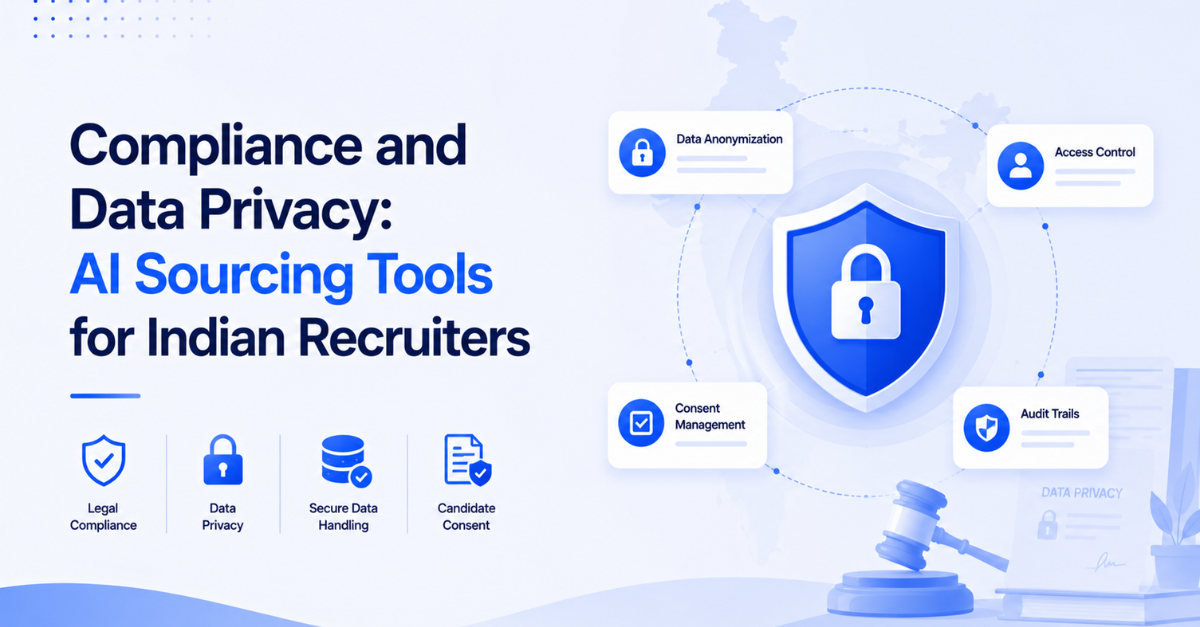
For recruiters in India, these concerns have become increasingly important following the introduction of the Digital Personal Data Protection (DPDP) Act and growing enterprise expectations around data security.
Today, the conversation is no longer just about whether AI recruiting tools can help recruiters hire faster.
The more important question is:
Can recruiters use AI responsibly while protecting candidate data and maintaining compliance?
The answer depends not only on the technology itself but also on how recruiting teams manage their workflows, communication, documentation, and governance processes.
In this article, we'll explore how AI sourcing tools handle candidate data, what Indian recruiters need to know about compliance, and why recruiting operations play a critical role in building a compliant hiring function.
Why Compliance Matters in Modern Recruitment
Recruitment teams collect and process significant amounts of personal information.
This often includes:
Names and contact information
Resumes and employment history
Education records
Location details
Salary expectations
Interview feedback
Communication history
As recruiters increasingly rely on AI recruiting software and recruitment automation platforms, candidate information moves across multiple systems and workflows.
This creates three major concerns.
Growing AI Adoption
AI sourcing tools are now widely used across:
Staffing agencies
Enterprise talent acquisition teams
GCC hiring teams
Startup recruiting functions
Executive search firms
As adoption increases, organizations must understand how candidate information is collected and processed.
Candidate Trust Concerns
Candidates are becoming more aware of how organizations use their personal information.
Poor data practices can negatively impact:
Employer brand
Candidate experience
Response rates
Long-term talent relationships
Enterprise Governance Requirements
Large organizations increasingly require recruiting technology vendors to demonstrate:
Security controls
Data governance processes
Access controls
Auditability
Compliance readiness
For many enterprises, compliance has become a buying criterion alongside functionality.
How AI Sourcing Tools Use Candidate Data
To understand compliance risks, recruiters must first understand how AI sourcing platforms operate.
Most AI sourcing tools process candidate information through three primary stages.
Data Collection
AI recruiting platforms may collect information from:
Public professional profiles
Candidate applications
Talent communities
Internal candidate databases
Recruiter-uploaded candidate records
The exact data sources vary by platform.
Recruiters should always understand where candidate information originates and whether proper permissions exist.
Data Processing
After collection, AI systems typically analyze:
Skills
Experience
Job titles
Career progression
Education
Certifications
Location information
The purpose is usually to improve candidate matching and search relevance.
Candidate Profiles and Matching
Most sourcing tools generate structured candidate profiles to help recruiters identify potential matches.
While this improves efficiency, recruiters should understand:
What information is stored
How long it is retained
Who can access it
How candidates can request updates or removal
Understanding the DPDP Act for Recruiters
India's Digital Personal Data Protection (DPDP) Act represents a significant development in how organizations manage personal information.
While legal interpretation continues to evolve, recruiters should understand several foundational principles.
Key Principles
The DPDP framework emphasizes:
Lawful processing
Purpose limitation
Data minimization
Transparency
Accountability
Organizations should collect and use personal information only for legitimate purposes.
Recruiter Responsibilities
Recruiters should ensure that:
Candidate information is handled responsibly
Internal processes are documented
Data access is controlled
Vendors meet security expectations
Compliance is not solely a technology problem.
It is also a process and operational challenge.
Candidate Rights
Modern privacy frameworks increasingly emphasize individual rights, including visibility into how personal information is used.
Recruiting teams should be prepared to support transparent candidate communication regarding data usage.
Common Data Privacy Risks in AI Recruiting
AI recruiting tools can improve productivity, but they can also create risks when implemented without proper governance.
Overcollection of Data
Recruiters sometimes gather more information than necessary.
Excessive data collection increases:
Compliance exposure
Security risk
Operational complexity
Consent Challenges
Candidate consent becomes difficult to manage when information flows across multiple systems and recruiting stages.
Without structured workflows, communication records may become fragmented.
Third-Party Data Usage
Many recruiting platforms rely on external data sources.
Recruiters should understand:
Data origins
Vendor practices
Data-sharing policies
Processing agreements
Visibility matters.
If recruiters cannot explain where candidate information came from, compliance risks increase.
Evaluating AI Recruiting Vendors
When assessing AI sourcing tools or AI recruiting software, recruiters should evaluate more than sourcing capabilities.
Compliance readiness should be part of the evaluation framework.
Security Questions to Ask
Consider asking vendors:
How is candidate data protected?
What access controls exist?
How is information encrypted?
What security certifications are maintained?
Privacy Questions to Ask
Recruiters should understand:
What data is collected?
How long is it retained?
How can information be deleted?
What candidate controls exist?
Governance Questions to Ask
Governance often receives less attention than security but is equally important.
Ask vendors:
How are actions logged?
Are workflows auditable?
Can recruiting activity be tracked?
Is human oversight supported?
How Recruiting Automation Can Improve Compliance
Many recruiters assume automation increases compliance risk.
In reality, inconsistent manual processes often create the greater risk.
Standardized Workflows
Automation helps create consistent recruiting processes.
This reduces variability across:
Candidate outreach
Screening
Qualification
Follow-ups
Interview coordination
Consistency improves governance.
Auditability
Automated systems can create clear records of recruiting activity.
This makes it easier to understand:
Who contacted candidates
When actions occurred
What communications were sent
How decisions progressed
Communication Consistency
Structured workflows help ensure candidates receive consistent information throughout the hiring process.
This improves:
Transparency
Candidate trust
Documentation quality
Responsible AI in Talent Acquisition
Responsible AI goes beyond compliance checklists.
It focuses on how technology supports fair, transparent, and accountable hiring practices.
Human Oversight
AI should assist recruiters, not replace judgment.
Human review remains essential for:
Candidate evaluation
Hiring decisions
Exception handling
Process governance
Ethical Decision-Making
Recruiting teams should establish clear policies regarding:
AI usage
Candidate communication
Data access
Workflow accountability
Transparency in Automation
Candidates increasingly expect transparency when interacting with automated systems.
Organizations that communicate clearly often build stronger trust.
Why Recruiting Operations Matter for Governance
Many compliance discussions focus on legal requirements.
However, operational execution is equally important.
Candidate Communication
Fragmented communication creates compliance challenges.
When recruiters use multiple disconnected systems, maintaining visibility becomes difficult.
Documentation
Strong recruiting operations ensure:
Records are maintained
Activities are traceable
Processes are repeatable
Workflow Management
Governed workflows reduce risk by ensuring recruiting actions occur within structured processes rather than ad hoc recruiter activity.
This is where modern recruiting automation delivers significant value.
Building a Compliance-First Recruiting Function
The most compliant recruiting teams are rarely those with the most policies.
They are usually the teams with the most disciplined operations.
Technology Strategy
Choose recruiting technology that supports:
Security
Transparency
Auditability
Operational consistency
Process Governance
Establish clear standards for:
Candidate communication
Data handling
Workflow ownership
Vendor management
Continuous Monitoring
Compliance is not a one-time project.
Recruiting leaders should continuously review:
Technology usage
Process adherence
Security practices
Candidate experience
AI Sourcing Is Only Part of the Compliance Conversation
Most AI sourcing platforms focus on helping recruiters discover candidates faster.
But compliance risks rarely emerge during sourcing alone.
They emerge during:
Candidate engagement
Follow-ups
Qualification workflows
Interview coordination
Recruiting operations
This is why the future of recruiting requires more than sourcing tools.
It requires systems that support transparency, consistency, and governance across the entire hiring lifecycle.
The next generation of recruiting technology is moving toward Agentic AI Recruiting Infrastructure—platforms designed not only to identify talent but also to automate recruiting execution while maintaining operational control.
For recruiting teams in India, the goal should not simply be faster hiring.
It should be faster, more compliant, and more trustworthy hiring.
Frequently Asked Questions
Are AI sourcing tools legal in India?
Yes. AI sourcing tools can be used in India, provided organizations handle candidate information responsibly and comply with applicable privacy and data protection requirements.
What is the DPDP Act?
The Digital Personal Data Protection (DPDP) Act is India's data protection framework that establishes principles for handling personal data and outlines responsibilities for organizations processing such information.
How do AI recruiting tools process candidate data?
Most platforms collect candidate information, analyze skills and experience, create searchable profiles, and support matching between candidates and job opportunities.
Is candidate consent required in recruitment?
Recruiters should ensure candidate data is collected and processed transparently and in accordance with applicable legal and organizational requirements.
Are AI recruiting platforms secure?
Security varies by vendor. Recruiters should evaluate encryption practices, access controls, auditability, governance capabilities, and vendor security policies.
What compliance questions should recruiters ask vendors?
Focus on data collection, storage, retention, deletion processes, security controls, auditability, transparency, and governance features.
Can AI recruiting create legal risks?
Any recruiting process can create risk if governance is weak. Proper controls, oversight, documentation, and transparent workflows help reduce those risks.
What is responsible AI recruiting?
Responsible AI recruiting involves using automation in a transparent, ethical, and accountable way while maintaining human oversight and candidate trust.
How can recruiters protect candidate information?
By implementing strong processes, controlling access, using secure technology, documenting workflows, and maintaining transparent communication practices.
What should enterprises evaluate before adopting AI recruiting software?
Organizations should assess security, privacy, governance, auditability, workflow controls, and the vendor's ability to support compliant recruiting operations.
Related Topic
AI Sourcing Tools for Indian Recruitment Agencies: What to Know Before You Buy
How AI Sourcing Tools Handle Regional Language and Location Data
Best AI Recruiting Tools for Hiring in India vs Global Markets (2026 Guide)