Two recruiting agencies are pitching the same client for a critical senior engineering role. Agency A receives the brief on Monday, starts sourcing on Tuesday, sends forty messages by Thursday, and has three candidate profiles to present by the following Monday. Agency B receives the same brief on Monday and presents five deeply vetted, pre-engaged candidates by Wednesday afternoon, two of whom have already expressed interest in the company before the brief was formalized. Agency A started from zero. Agency B started from a position of preparation that was months in the making. This is not a hypothetical scenario. This is the daily reality of competitive recruiting, where the recruiter who finds the candidate first wins the placement, the fee, and the client relationship. The elite recruiter advantage is not about working longer hours or sending more messages. It is about operating on a different timeline altogether, one where candidate identification and engagement begin long before the competitor even knows a role exists.
According to data from LinkedIn's talent solutions research, recruiters who engage candidates within the first forty-eight hours of a role opening fill positions three times faster than those who take a week or more to begin outreach. But the truly elite recruiters do not wait for the role to open at all. They have already identified, engaged, and warmed candidates who match the profiles their clients typically hire. When the requisition arrives, they are not starting a search. They are activating a pre-built network. The recruiter competitive advantage is not a secret technique or a proprietary tool. It is a systematic approach to timing, intelligence, and
relationship management that any recruiter can adopt. The question is not whether you can do what elite recruiters do. The question is whether you are willing to operate on their timeline.
The Timing Gap: Why Starting Early Wins Everything
In competitive recruiting, timing is not a minor factor. It is the dominant factor. The first recruiter to present a strong candidate to a hiring manager establishes the standard against which all subsequent candidates are judged. Every candidate presented after the first one is compared not just to the role requirements but to the candidate who was already shown. This psychological anchoring effect gives the first presenter a structural advantage that has nothing to do with candidate quality and everything to do with presentation order. According to SHRM's talent acquisition research, hiring managers make their first positive impression within the first three to five candidates they review, and candidates presented after that threshold are evaluated more critically simply because the manager has already formed a mental benchmark. The recruiter first-mover advantage is real, measurable, and compound. The recruiter who presents first sets the bar, and every competitor who presents after them is fighting an uphill battle against that established expectation.
The timing gap also affects candidate availability. Top candidates, the ones who are already employed and performing well, receive multiple outreach messages when they become visible in the market. The recruiter who reaches out first has the highest probability of securing a response because the candidate has not yet been contacted by five other recruiters pitching the same role. Understanding why more tools produce the same hiring problems, the recruiters who struggle with timing are not the ones who lack tools or effort. They are the ones who lack a pre-built pipeline that allows them to move immediately when a role opens. The speed in talent acquisition comes from preparation, not from speed itself. The recruiter who spends three months building relationships before a role exists can mobilize in hours. The recruiter who waits for a requisition to begin sourcing will always be days or weeks behind.
Intelligence as a Competitive Weapon
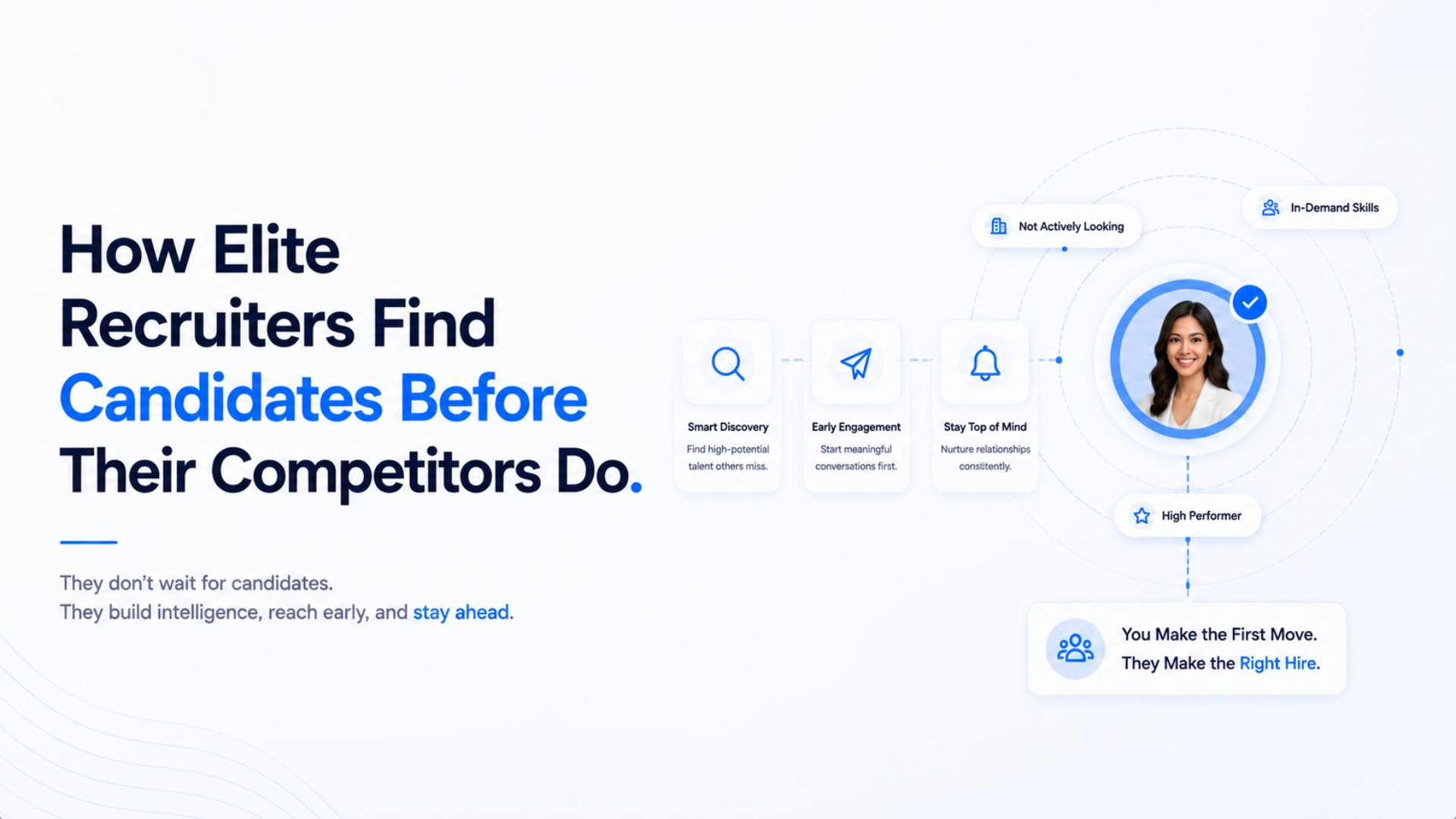
Elite recruiters find candidates before their competitors because they know more about the talent market than their competitors do. This is not intuition or experience, although both help. It is systematic intelligence gathering, the practice of continuously monitoring the talent landscape for signals that indicate candidate availability, career movement, and readiness to engage. The recruiting competitive intelligence that elite recruiters practice includes tracking company hiring patterns to predict which skills will be in demand, monitoring startup funding rounds and product launches to identify companies that will soon need to scale their teams, following industry conference schedules to know where talent clusters will gather, and tracking individual career trajectories to identify professionals who may be approaching a career inflection point. A recruiter who knows that a mid-stage startup just closed a Series B and will need to hire twenty engineers in the next quarter can begin identifying and engaging candidates months before the startup posts its first requisition.
This intelligence advantage creates a compounding effect. The recruiter who consistently identifies trends early builds a reputation as someone who always has great candidates ready, which attracts more clients and more mandates, which provides more data points for future intelligence gathering. According to McKinsey's people organization insights, recruiters who systematically track market intelligence fill roles forty percent faster and achieve twenty percent higher client satisfaction scores than those who rely solely on reactive sourcing. The early candidate identification practice is not about guessing the future. It is about reading the signals that are already visible to anyone paying attention. Understanding the difference between AI sourcing and AI recruiting, intelligence gathering is a sourcing function, but it is one that operates continuously rather than on demand, and the recruiters who treat it as a core discipline rather than an occasional activity are the ones who consistently find candidates first.
Pre-Engagement: The Elite Recruiter Secret Weapon
The single biggest difference between elite recruiters and average ones is what happens before a role opens. Average recruiters wait for a requisition, then search for candidates, then send outreach. Elite recruiters search for candidates and build relationships continuously, so that when a requisition arrives, they are not searching. They are selecting from a pre-engaged pool. The pre-requisition candidate engagement model means that elite recruiters are always in conversation with talented professionals, even when there is no specific role to discuss. They share industry insights, provide career advice, make introductions, and offer value that has nothing to do with a job opportunity. The result is a network of professionals who know the recruiter, trust their judgment, and are willing to take a call when the right role comes along. According to Deloitte's talent research, recruiters who maintain pre-engaged candidate networks report sixty percent shorter time-to-present because they are mobilizing existing relationships rather than building new ones under time pressure.
Pre-engagement also solves one of the hardest problems in recruiting: the cold outreach response rate. The average cold outreach message to a passive candidate generates a response rate of two to five percent. The average outreach to a candidate who has had at least one prior interaction with the recruiter generates a response rate of twenty to thirty percent. That is a five to ten times improvement, and it comes not from better messaging or more compelling subject lines but from the simple fact of pre-existing relationship. Understanding why referrals outperform cold outreach, the mechanism is trust. A candidate who has received value from a recruiter before, whether in the form of an insightful article, a useful introduction, or a thoughtful career conversation, is far more likely to respond when that recruiter reaches out with an opportunity. The proactive recruiting speed that elite recruiters demonstrate is not about typing faster or sending more messages. It is about having already done the relationship work so that the outreach itself is warm, relevant, and credible. Understanding how many follow-ups one hire actually needs, pre-engaged candidates also require fewer follow-ups to convert, which means the recruiter can move faster through the pipeline with less effort.
Pattern Recognition: Seeing Candidates Others Miss
Elite recruiters find candidates before their competitors because they see candidates their competitors do not see. This is not about access to better databases or more expensive tools. It is about the ability to recognize candidate potential in profiles that other recruiters would dismiss as mismatched. Most recruiters search for candidates using job titles and keywords that directly match the job description. A search for a senior machine learning engineer returns profiles with the title senior machine learning engineer. But the elite recruiter also sees the senior data scientist who has been publishing papers on transformer architectures, the research engineer who has been contributing to open-source ML frameworks, and the software architect who recently led a migration to an AI-native tech stack. None of these candidates have the exact title, but all of them have the exact skills, and they are not appearing in the searches that every other recruiter is running. The candidate speed to engage is higher for these overlooked candidates because they are not being contacted by five other recruiters a week.
This pattern recognition capability is what separates good sourcing from great sourcing. It requires the recruiter to understand skills at a deep enough level to see across job titles, industries, and career paths. A recruiter who only understands job titles is limited to the active candidate pool. A recruiter who understands skill adjacencies, career trajectories, and transferable competencies can see qualified candidates everywhere. According to Gartner's HR trends research, recruiters who use skill-based matching rather than title-based matching expand their addressable candidate pool by three to five times, and the candidates they find through skill-based matching are often stronger because they bring diverse perspectives and non-obvious backgrounds. Understanding why some AI recruiting tools have outdated candidate data, pattern recognition also requires fresh data, because the signals that indicate a candidate skill evolution, project involvement, publication activity, are time-sensitive and only valuable when they are current.
The Technology Stack Behind Recruiting Speed
Operating on an elite timeline requires technology that supports continuous, intelligent candidate monitoring. A recruiter who relies on manual searches and spreadsheets cannot maintain real-time awareness of hundreds of potential candidates across multiple domains. They need a platform that tracks career movements, monitors engagement signals, and surfaces the right candidates at the right time based on current and anticipated hiring needs. The recruiting ahead of demand model is only possible when technology handles the operational complexity of continuous monitoring so the recruiter can focus on relationship building and strategic intelligence. According to LinkedIn's recruiting resources, recruiters who use AI-powered sourcing platforms that provide continuous candidate monitoring report thirty-five percent faster time-to-shortlist compared to those who use on-demand search tools, because the AI platform has already been tracking and scoring candidates before the requisition arrived.
The technology also enables a critical capability that manual recruiting cannot match at scale: predictive candidate ranking. An AI platform that has been tracking candidate behavior, career progression, and engagement history can predict which candidates are most likely to respond positively to outreach, which candidates have the strongest skill match for anticipated roles, and which candidates are approaching career inflection points that make them receptive to a conversation. Understanding what makes an AI recruiting platform agentic vs. just automated, the platforms that provide this predictive, continuous intelligence are fundamentally different from the ones that simply run searches when you press a button. They are always-on systems that maintain a living, intelligent picture of the talent market, and the recruiters who use them have an unfair advantage over those who do not. For organizations evaluating an AI sourcing tool before buying, the ability to operate continuously and predictively should be the primary selection criterion, because it is the capability that creates the timing advantage elite recruiters depend on. And for recruiters who wonder whether AI will replace their jobs, the answer is that AI will not replace recruiters who use it to find candidates first. It will replace those who continue to rely on manual, reactive methods while their competitors move faster.
How Huntlo.ai Gives You the Elite Recruiter Advantage
Huntlo.ai is built to give every recruiter the timing advantage that elite recruiters have built their careers on. The platform continuously monitors the talent market, tracking career movements, engagement signals, and professional activity across the candidates and domains that matter to your organization. It maintains a living pipeline of pre-identified, pre-scored candidates who match your hiring patterns, so that when a requisition opens, you are not starting a search. You are activating a network. Huntlo surfaces the most qualified and most receptive candidates first, along with the context you need to approach them effectively: recent accomplishments, career trajectory insights, and engagement signal history. The platform also supports AI recruiting for niche and technical roles, where pattern recognition and deep skill matching are especially critical for finding candidates that competitors miss.
For recruiting leaders who want their team to operate on elite timing, Huntlo provides the complete technology stack to make continuous, intelligence-driven recruiting the default. The recruiters who find candidates first are not working harder than everyone else. They are working on a different timeline, one where preparation compounds and relationships are built before they are needed. Huntlo makes that timeline accessible to every recruiter, so the next time a critical role opens, your team is not racing to catch up. They are already ahead.