Rachel Kim, the director of recruiting at a midsize logistics company, tracked every hour her five-person team spent on interview coordination for three consecutive months. The number stunned her: an average of one hundred and twenty hours per month, which meant that nearly one and a half full-time employees were doing nothing but sending emails, checking calendars, and following up on unconfirmed time slots. Her average time-to-hire was forty-four days, and when she analyzed where those days were spent, she found that scheduling alone accounted for eleven of them, more than any other single phase of the process. After implementing automated scheduling, her team cut coordination time by ninety percent and reduced time-to-hire to twenty-nine days within the first quarter. Rachels experience is not unique, but it illustrates a truth that many hiring leaders have not yet fully absorbed: the fastest way to hire faster is to eliminate the scheduling bottleneck that slows every single hire.
The Scheduling Bottleneck That Slows Every Hire
Interview scheduling is the single largest consumer of recruiter time in most hiring processes, yet it is rarely treated as a strategic priority. Research published by SHRM consistently shows that scheduling ranks among the top three administrative tasks for talent acquisition professionals, consuming between twenty-five and forty percent of total working hours depending on organizational complexity. The reason scheduling consumes so much time is that it is fundamentally a multi-variable optimization problem: every interview involves multiple participants with different availability constraints, different time zones, and different policy requirements. When this coordination is done manually, each participant responds on their own schedule, and every additional participant multiplies the number of potential conflicts that
must be resolved through sequential back-and-forth communication.
The impact of this bottleneck extends far beyond wasted recruiter hours. Every day that scheduling adds to the hiring timeline is a day that a critical role remains unfilled, which means delayed projects, overburdened teams, and lost revenue. For competitive roles where top candidates are evaluating multiple offers simultaneously, scheduling delays directly cause offer losses. A candidate who receives a faster, more organized process from a competitor will often accept that offer before your team even confirms the first interview. The cumulative effect across an entire hiring pipeline is substantial: organizations that reduce scheduling time by even two or three days per hire can compress their overall time-to-hire by ten to fifteen percent, a competitive advantage that compounds with every role filled. Platforms like Huntlo approach scheduling as part of an agentic workflow, where the system independently resolves conflicts and confirms interviews without requiring a human to coordinate every exchange, eliminating the bottleneck entirely rather than merely reducing it.
What makes the scheduling bottleneck particularly insidious is that it is largely invisible to leadership. Most hiring dashboards track time-to-hire, cost-per-hire, and offer acceptance rates, but very few measure scheduling duration as a distinct metric. This means that organizations are often unaware of how much time scheduling consumes or how significantly it affects every other hiring metric. Without visibility into the problem, there is no urgency to solve it, and recruiters continue spending hours on coordination work that adds no strategic value to the hiring process. The first step toward faster hiring for most organizations is simply measuring how long scheduling actually takes and quantifying the gap between current performance and what automated systems can achieve.
What Automated Scheduling Actually Does
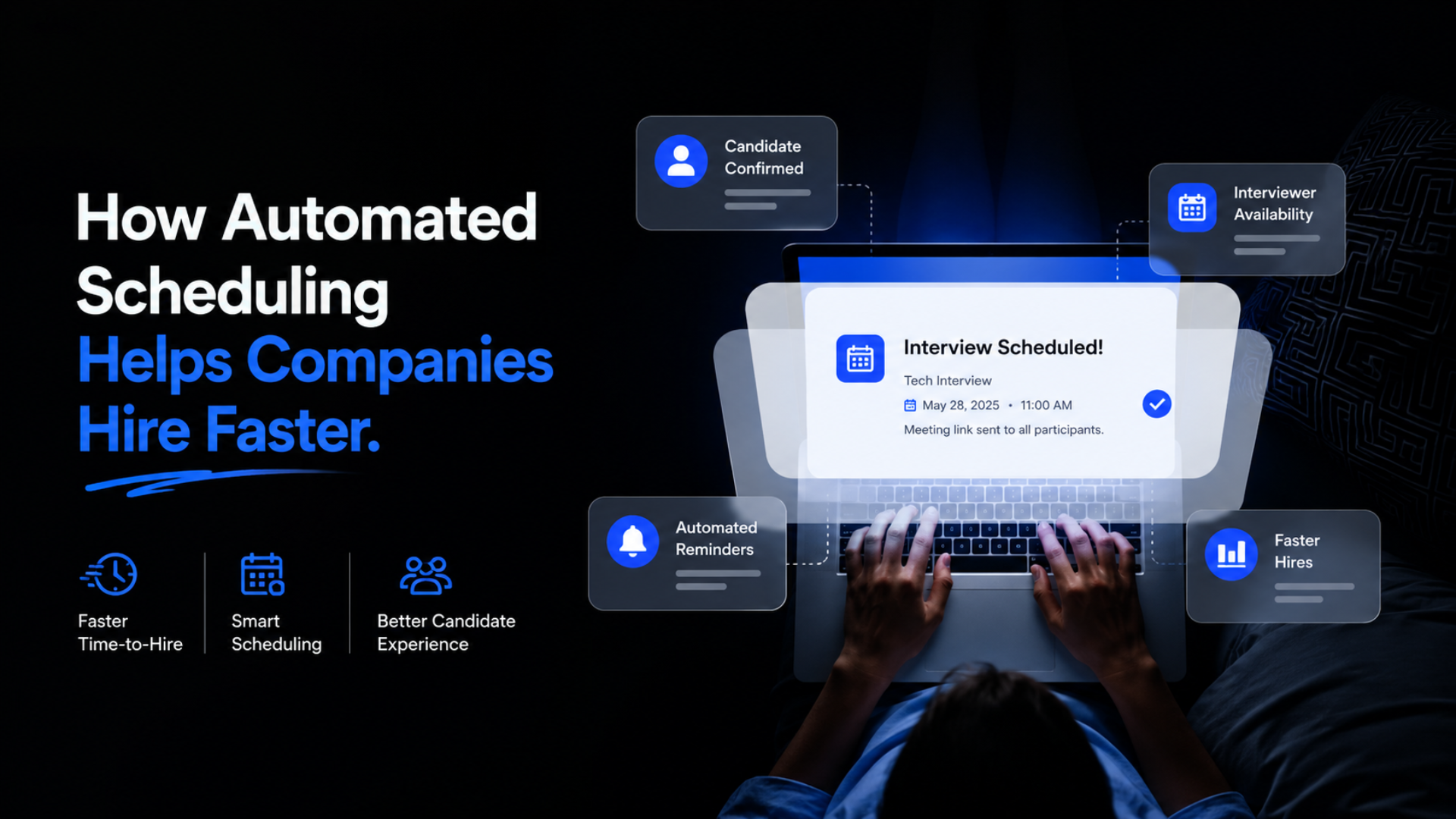
Automated scheduling replaces the sequential, human-driven coordination process with a parallel, system-driven approach. Instead of a recruiter emailing each participant individually, waiting for responses, and manually reconciling availability, an automated system ingests calendar data from all participants simultaneously, evaluates thousands of possible time combinations in seconds, and proposes optimized slots that satisfy every constraint. The recruiter reviews the proposal and approves it with a single action. The system then sends personalized invitations to each participant, handles timezone conversions, and manages confirmations automatically. Research from McKinsey has shown that this parallel approach to coordination is one of the most effective applications of AI in operations, because it replaces a process that is inherently tedious for humans with one that computers handle both faster and more accurately.
The value of automation is especially pronounced for specialized roles where the pool of qualified interviewers is small. When hiring for niche or technical positions, the number of people qualified to assess a candidate may be very limited, and their calendars are typically the most contested. Finding a two-hour window where three senior engineers, a product manager, and a candidate in a different time zone are all simultaneously available can take a week or more through manual coordination. An automated system solves this problem in seconds
because it evaluates all possible configurations without the delays inherent in sequential human communication. However, simply adding more tools to an already fragmented stack will not deliver these results. The gains come from having a single intelligent system that replaces the manual coordination workflow end to end, not from layering another point solution on top of existing ones.
Beyond initial scheduling, automation also transforms the reschedule and cancellation workflow, delivering value that compounds over time. When an interviewer becomes unavailable or a candidate needs to change a slot, the automated system immediately identifies alternative times, checks all participant availability simultaneously, and sends updated invitations without requiring the recruiter to restart the coordination process from scratch. This capability is particularly valuable during peak hiring periods when reschedule volume is highest and recruiter capacity is most constrained. Organizations that measure their reschedule rates often discover that manual rescheduling consumes nearly as much time as initial scheduling, which means that automating both processes effectively doubles the time savings compared to automating initial scheduling alone.
How Speed Improves Every Hiring Metric
When scheduling moves from days to minutes, the effects cascade across every major hiring metric. Time-to-hire drops because the coordination phase, which previously consumed the largest share of the hiring timeline, shrinks to a negligible fraction. According to LinkedIn data, organizations that implement automated scheduling report average time-to-hire reductions of twenty to thirty-five percent. Offer acceptance rates improve because candidates experience a fast, professional process that signals organizational competence. Candidate satisfaction scores increase because the scheduling experience, which is often the candidate first substantive interaction with the hiring team, feels seamless rather than burdensome. These improvements are not marginal; they represent a fundamental shift in how the organization competes for talent.
The quality-of-hire impact is less obvious but equally significant. When candidates are interviewed quickly after being sourced, their interest and enthusiasm are at their peak, leading to more engaged and authentic conversations. Hiring managers also benefit because they assess candidates while their initial evaluation is freshest, reducing the recency bias that can creep in when weeks pass between sourcing and interviewing. A critical enabler of this speed is data accuracy. Systems that rely on outdated candidate or interviewer data will propose invalid slots, triggering rescheduling loops that undermine the speed advantage. Automated scheduling platforms that maintain real-time data synchronization ensure that every proposal is based on current availability, preserving both speed and accuracy throughout the process.
Automation also reduces the volume of follow-up communications that recruiters must manage. Research into how many follow-ups one hire actually needs reveals that a significant proportion of recruitment follow-ups are logistical rather than evaluative, meaning they are about scheduling details rather than candidate assessment. When automation handles these logistical communications, recruiters have fewer messages to manage and can dedicate more
attention to the candidate interactions that actually influence hiring decisions. The net effect is a hiring process that is not only faster but also more focused on the activities that drive quality outcomes.
Why Automation Preserves the Human Element
One of the most common concerns about automating scheduling is that it will make the hiring process feel impersonal or transactional. In practice, the opposite is true. By eliminating the administrative burden of coordination, automation frees recruiters to invest more time in the human interactions that define a positive candidate experience. A recruiter who is not managing calendar conflicts can spend that time having genuine conversations with candidates, providing thoughtful briefings to hiring managers, and gathering structured feedback that improves decision quality. The distinction between AI sourcing and AI recruiting is relevant here, as explored in discussions about the difference between AI sourcing and AI recruiting, because the most effective automation connects each phase of the pipeline rather than replacing the human role within any single phase.
Candidate perception data strongly supports this view across industries and company sizes. Candidates do not perceive automated scheduling as impersonal; they perceive slow, disorganized scheduling as unprofessional and indicative of broader organizational dysfunction. A seamless scheduling experience communicates respect for the candidate time and signals that the organization operates with competence and efficiency. This perception advantage extends to referral candidates, whose initial enthusiasm is often based on trust in the referring employee. When the scheduling process reinforces that trust by being fast and organized, the referral conversion advantage is preserved. When scheduling undermines it with delays and confusion, the referral edge erodes regardless of the quality of the referral itself. Gartner has reported that organizations using integrated AI hiring tools achieve higher candidate satisfaction and better hiring outcomes than those relying on manual coordination.
Getting Started With Automated Interview Scheduling
The implementation path for automated scheduling is straightforward for most organizations, though the approach matters. The first step is selecting a solution that integrates seamlessly with your existing applicant tracking system, calendar platforms, and communication tools rather than requiring a complete technology overhaul. Guidance on how to evaluate an AI sourcing tool before buying applies directly to scheduling solutions: prioritize real-time calendar integration, multi-participant conflict resolution, timezone handling, and the ability to enforce organizational policies like minimum buffer times and required panel compositions. The most successful implementations start with a pilot in one team or role type, measure the impact on scheduling duration and candidate feedback, and expand based on evidence rather than assumptions.
A frequent question from recruiting leaders is whether automation will reduce the need for recruiters or diminish their strategic value within the organization. The evidence, as explored in
research on whether recruiters should worry about AI replacing their jobs, consistently shows that AI amplifies recruiter effectiveness. Recruiters who work with automated scheduling report higher job satisfaction, lower burnout rates, and better hiring outcomes because they spend their time on the relational and strategic aspects of recruiting rather than on calendar management. The organizations that see the greatest returns from scheduling automation are those that reinvest the reclaimed recruiter time into candidate engagement, pipeline strategy, and hiring manager coaching rather than simply reducing headcount.
The financial case for automated scheduling is compelling when measured comprehensively across both direct and indirect cost categories. Deloitte research on talent acquisition efficiency demonstrates that reducing administrative overhead by even fifteen percent produces measurable improvements in quality of hire, time-to-fill, and recruiter retention across enterprise-scale hiring operations. Meanwhile, EY has documented that companies investing in technology-enabled hiring processes report stronger employer branding, higher candidate satisfaction scores, and better offer acceptance rates. For hiring leaders like Rachel, the decision to automate scheduling was not about adopting new technology for its own sake; it was about removing the obstacle that prevented her team from doing the work that actually drives hiring success. The result speaks for itself: faster hires, happier candidates, and a recruiting team that operates with greater speed and confidence than ever before.