Sarah stared at her inbox and felt the familiar weight of silence. She had connected with a strong candidate for a senior engineering role last Wednesday. The call went well. The candidate asked about the tech stack, the team structure, and the product roadmap. She promised to send detailed answers by Friday. She did. It was a thorough, well-written email that addressed every question. Three days passed with no reply. On Monday she sent a shorter note, just checking in. Nothing. By Thursday she drafted a third message, read it twice, and closed the tab. The candidate had updated their LinkedIn title to a new company. She had lost them. Across the recruiting industry, this moment repeats tens of thousands of times every week. A talented recruiter does everything right during the initial conversation, builds real rapport, and then watches the candidate disappear in the follow-up phase. It is not a talent problem. It is not a market problem. It is a timing and personalization problem, and it is one that artificial intelligence is uniquely positioned to solve.
The follow-up phase is where the vast majority of hiring funnels break. Research from SHRM's talent acquisition division consistently shows that candidate dropout between initial contact and the interview stage represents the single largest source of hiring failure, accounting for more than thirty-five percent of all lost hires in professional and technical recruiting. The reasons are well documented but poorly addressed by existing tools. Candidates lose interest because follow-ups arrive at the wrong time, say the wrong thing, or fail to arrive at all. Recruiters are stretched thin, managing dozens of active candidates simultaneously, and the follow-up cadence that each candidate receives is determined more by the recruiter's workload than by the candidate's engagement signals. The result is a system where the most
important communication in the hiring process, the communication that converts interest into action, is also the most neglected and least intelligent.
Why Manual Follow-Ups Fail at Scale
The fundamental problem with manual follow-ups is that they cannot process the volume of signals that determine whether a candidate will respond. A recruiter managing twenty active candidates cannot simultaneously track when each candidate typically checks email, which channels they prefer, what topics they have engaged with most, and how their engagement patterns compare to candidates who successfully converted in the past. The human brain is excellent at building one-on-one relationships but fundamentally limited in its ability to maintain context-rich, personalized communication across dozens of simultaneous conversations. This is not a criticism of recruiters. It is a recognition that the follow-up challenge has outgrown the tools available to address it. When a recruiter sends the same general check-in to five different candidates because they do not have time to customize each one, every one of those messages underperforms relative to what a truly personalized follow-up would achieve.
The consequences of this scalability gap are measurable and significant. McKinsey's people and organization research has found that organizations with structured, data-driven follow-up processes see twenty to thirty percent higher conversion rates from initial contact to interview compared to those relying on ad-hoc recruiter-driven outreach. The difference is not in the quality of the recruiters but in the consistency and precision of the follow-up system. When follow-ups are timed based on engagement signals rather than calendar reminders, when they reference specific details from prior conversations rather than generic talking points, and when they adapt their channel and tone based on the candidate's demonstrated preferences, conversion rates improve dramatically. The challenge has never been understanding what good follow-up looks like. The challenge has been executing it consistently across every candidate, every time. Understanding how many followups one hire actually needs is the starting point, but the real question is how to deliver each of those touchpoints with the precision and personalization that maximizes its impact.
How AI Detects the Right Moment to Reach Out
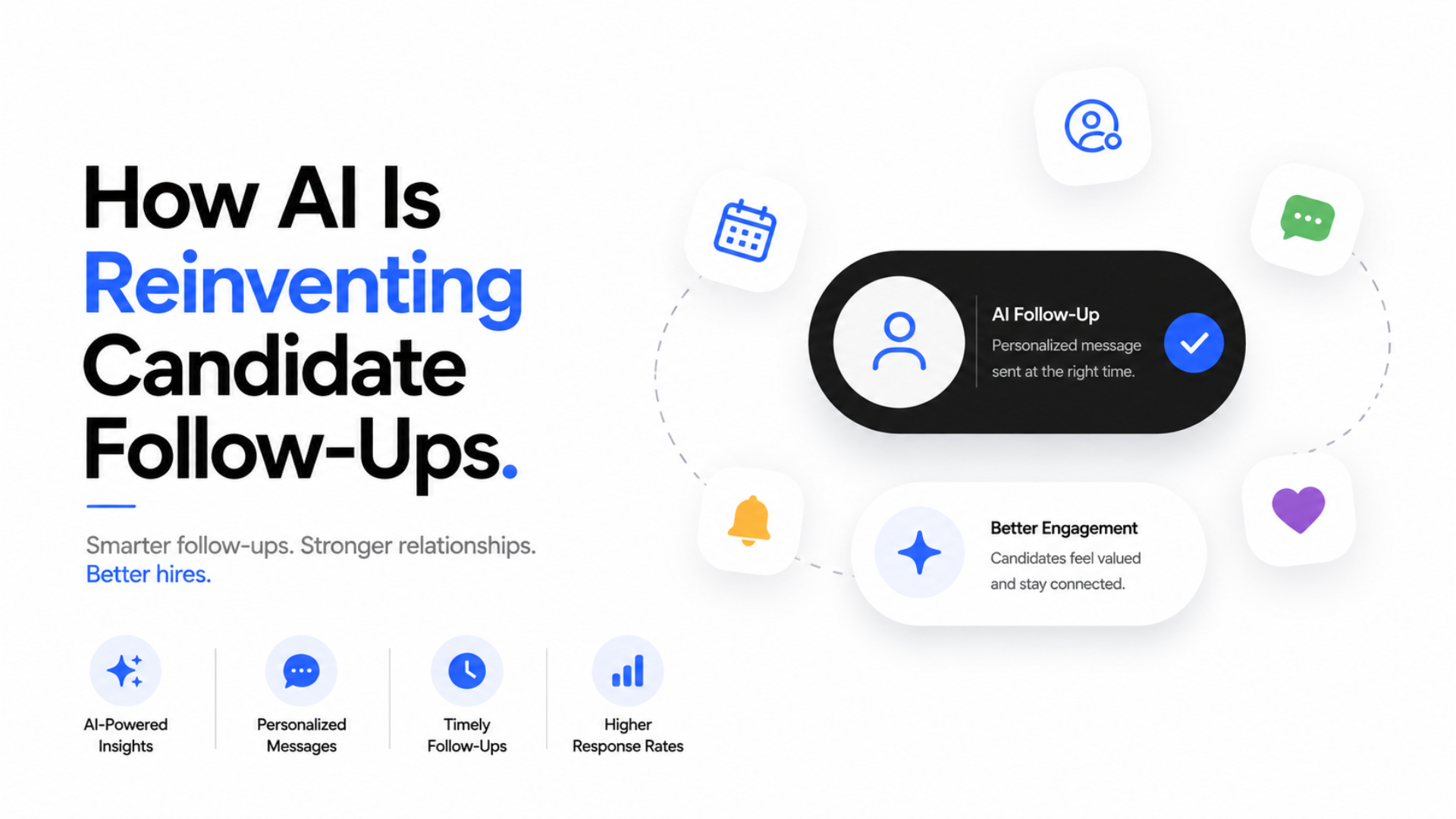
The most visible way AI is reinventing follow-ups is through intelligent timing. Traditional follow-up systems operate on fixed schedules: send day one, follow up day three, final touch day seven. These cadences are easy to implement but they ignore the single most important variable in candidate engagement: the candidate's own behavior patterns. AI-powered follow-up systems take a fundamentally different approach. They continuously monitor engagement signals from each candidate, including email open patterns, response timing, LinkedIn activity, and application behavior, and use these signals to determine the optimal moment for each individual follow-up. A candidate who typically responds to emails within two hours of receiving them in the morning will receive a different follow-up strategy than a candidate who only checks email in the evening and prefers to respond the next day. The AI does not just
schedule the message. It understands the candidate's communication rhythm and works within it.
This signal-based approach extends beyond simple timing. AI systems can detect when a candidate's engagement is warming, indicated by faster email opens, longer time spent on company pages, or increased social media interaction with the employer's content, and accelerate the follow-up cadence to capitalize on that interest. Conversely, they can detect when a candidate's engagement is cooling and either adjust the message to rekindle interest or deprioritize that candidate in favor of others who are more actively engaged. This adaptive capability is what distinguishes an agentic AI recruiting platform from a simple automation tool. Automation sends messages on a schedule. An agentic system observes, learns, and acts based on real-time conditions. The recruiters who understand the difference between AI sourcing and AI recruiting recognize this distinction clearly. Sourcing is about finding candidates. Recruiting is about engaging them, and engagement requires intelligence, not just automation.
From Generic Templates to Context-Aware Messages
Timing matters, but what you say matters just as much. The second major way AI is transforming follow-ups is by making every message contextually relevant. Traditional follow-up templates are designed for scale but sacrifice personalization in the process. A recruiter might have three or four follow-up templates that they rotate through, and while each template includes a placeholder for the candidate's name and the role title, the substance of the message is identical for every recipient. Candidates can tell the difference between a message written for them and a message written for everyone, and they respond accordingly. According to LinkedIn's recruiting insights, personalized follow-up messages receive response rates two to three times higher than generic templates, yet fewer than twenty percent of recruiters consistently personalize their outreach beyond the greeting line.
AI changes this equation by generating context-aware messages that reference specific details from every prior interaction with the candidate. If the candidate mentioned during the initial call that they are particularly interested in a company's approach to engineering culture, the AI-generated follow-up will include a specific reference to that topic, perhaps linking to a recent engineering blog post or mentioning a relevant team initiative. If the candidate expressed concern about commute logistics, the follow-up might proactively address flexible work arrangements before the candidate has to ask. This level of personalization has historically been possible only through referral-style recruiting, where the referring employee provides the recruiter with rich context about the candidate's priorities. It is no coincidence that referrals outperform cold outreach so significantly. AI follow-up systems essentially give every candidate the referral experience by capturing, organizing, and deploying the contextual intelligence that makes referral conversations so much more effective. Many teams that adopt AI-powered follow-ups discover they already had plenty of tools but were still experiencing the same problems, a pattern described in depth in the article about having more tools but the
same hiring problems. The issue was never the number of tools. It was the intelligence connecting them.
Multi-Channel Follow-Up Orchestration
The third dimension of AI-driven follow-up reinvention is channel orchestration. Most candidates today interact with potential employers across multiple channels: email, LinkedIn, text messages, and sometimes phone calls. Each candidate has different channel preferences, and those preferences can change over the course of the hiring process. A candidate might respond quickly to LinkedIn messages during the initial sourcing phase but prefer email once they enter the interview stage. A passive candidate might be most reachable via text message on weekday evenings but completely unresponsive to the same channel during work hours. Managing this complexity manually is impossible at scale, and most recruiters default to a single channel, usually email, for all follow-ups regardless of the candidate's demonstrated preferences.
AI follow-up systems solve this problem by maintaining a unified view of each candidate's channel preferences and engagement history, then automatically routing each follow-up to the channel most likely to generate a response. The system might send the first follow-up via email, the second via LinkedIn, and the third via text, based on which channel the candidate has been most responsive on historically. It can also detect when a candidate has stopped engaging on one channel and test another, ensuring that the message reaches the candidate through the path of least resistance. This orchestration capability is particularly valuable for niche and technical roles where candidates are often highly specialized professionals with strong channel preferences and low tolerance for irrelevant communication. Gartner's HR trends research identifies multi-channel candidate engagement as one of the top three capabilities that differentiate high-performing recruiting teams from average ones, because it directly addresses the fragmentation of candidate attention across platforms and devices.
The Data Behind AI-Driven Candidate Nurturing
The impact of AI-powered follow-ups is not theoretical. Organizations that have implemented intelligent follow-up systems report measurable improvements across every stage of the hiring funnel. Conversion rates from initial contact to first interview typically increase by twenty-five to forty percent. Time to respond decreases by sixty to seventy percent, as AI systems eliminate the delays caused by recruiter workload and manual prioritization. Candidate experience scores improve because candidates receive faster, more relevant, and more respectful communication. Perhaps most importantly, the quality of hire improves because recruiters spend less time chasing unresponsive candidates and more time building genuine relationships with engaged ones. EY's technology industry insights highlight that organizations leveraging AI for candidate engagement report not only higher conversion rates but also stronger employer brand perception, as candidates who experience intelligent, responsive communication naturally form more positive impressions of the hiring organization.
The data also reveals something counterintuitive about follow-up frequency. Many recruiters assume that more follow-ups lead to better results, but the reality is more nuanced. AI systems have shown that the optimal number of follow-ups varies significantly by role type, seniority level, and candidate profile. An early-career candidate applying for a high-volume role may convert after just two well-timed touchpoints, while a senior executive being recruited for a critical leadership position may require six to eight carefully sequenced interactions over several weeks. The key insight is that it is not the number of follow-ups that matters but their relevance, timing, and progression. Each follow-up should advance the conversation in a meaningful way, providing new information, addressing emerging concerns, or deepening the candidate's understanding of the opportunity. AI excels at this because it can track the progression of each candidate's decision-making process and calibrate each message accordingly. The recruiters still wondering whether AI will replace their jobs should find reassurance in this data. AI is not replacing the recruiter. It is making the recruiter's follow-up efforts dramatically more effective by ensuring that every touchpoint is as intelligent and relevant as the first conversation.
What to Look for in an AI Follow-Up Solution
For recruiting teams evaluating AI-powered follow-up capabilities, the criteria matter. Not all AI follow-up tools are created equal, and the difference between a genuinely intelligent system and a dressed-up automation tool can be the difference between a thirty percent improvement in conversion and no improvement at all. The first and most important capability to assess is signal awareness. Does the system monitor real-time engagement signals from each candidate, including email behavior, platform activity, and response patterns, or does it simply execute pre-defined sequences on a timer? The second critical capability is contextual personalization. Can the system generate messages that reference specific details from prior conversations, or does it rely on static templates with minor variable substitution? The third is adaptive learning. Does the system improve its follow-up recommendations over time based on what works for specific candidate segments and role types, or does it apply the same logic regardless of outcomes?
The fourth capability, and one that is often overlooked, is integration depth. An AI follow-up system that operates in isolation from the rest of the recruiting tech stack will always be limited in what it can achieve. The system should have access to candidate data from the ATS, conversation history from the initial outreach and screening calls, and market intelligence about the candidate's current employer and industry context. Without this integration, even the most sophisticated AI can only work with partial information, and partial information produces partial personalization. Teams that have struggled with outdated candidate data in AI tools know firsthand how integration gaps undermine AI performance. When evaluating any solution, it is worth consulting a structured evaluation framework like the one for evaluating an AI sourcing tool before buying, as the principles are directly applicable to follow-up systems. Deloitte's talent research emphasizes that the organizations seeing the greatest ROI from AI in recruiting are those that treat their AI tools as integrated intelligence layers rather
than standalone point solutions, connecting candidate data, conversation history, and market context into a unified system that informs every touchpoint.
The follow-up phase has been the weakest link in recruiting for as long as the profession has existed. Talented recruiters lose candidates not because they lack skill or commitment but because the systems they rely on were designed for a simpler era with fewer candidates, fewer channels, and lower expectations for personalization. AI is not just improving follow-ups. It is fundamentally reinventing what follow-ups can be, transforming them from generic, schedule-driven messages into intelligent, context-aware interactions that respect the candidate's time, preferences, and decision-making process. The result is a hiring funnel that converts more candidates, fills roles faster, and delivers an experience that reflects the professionalism and intentionality of the recruiting team behind it. Huntlo.ai provides the intelligence engine that makes this possible, from signal-based timing and contextual personalization to multi-channel orchestration and adaptive learning. Stop sending follow-ups into the void. Start sending the right message to the right candidate at the right moment. Start with Huntlo.