Rajesh Krishnamurthy, the global head of talent acquisition at a Fortune 500 financial services firm, opened his Monday morning dashboard and saw the numbers he dreaded. Twenty-three interviews needed scheduling across four offices this week. Six panels involved interviewers in at least three time zones. Two senior vice presidents had blocked their calendars for quarterly reviews through Wednesday. A candidate for the London office had given four days notice before her competing offer expired. Rajesh had eight scheduling coordinators working across three regions, and he knew from experience that at least five of those twenty-three interviews would need rescheduling before Friday due to conflicts that would only emerge after the initial invitations went out. His coordinators would spend the week in email threads, calendar comparisons, and manual conflict resolution while hiring managers complained about delays and candidates drifted toward competing offers. Rajesh had presented a business case for AI scheduling to the CHRO three times, and each time the response was that the existing manual process was sufficient. It was not sufficient. Rajesh knew it, his coordinators knew it, and the candidates who accepted offers from faster competitors knew it. The scheduling problem was not a recruiting operations issue. It was a strategic business problem that was costing the organization millions in delayed hires, lost candidates, and wasted managerial time.
The Enterprise Scheduling Problem Is Not Just Bigger, It Is Fundamentally Different
Rajesh Krishnamurthy, the global head of talent acquisition at a Fortune 500 financial services firm with offices in New York, London, Singapore, and Mumbai, faced a challenge that no amount of recruiter effort could solve. His team was hiring three hundred people per quarter across twelve business units, each with its own hiring managers, interview panels, and
scheduling policies. A single senior engineering hire might require a panel of six interviewers spanning three time zones, two different calendar systems, and four layers of management approval before the interview could even be confirmed. Rajesh had a recruiting operations team of eight people dedicated almost entirely to interview scheduling, and they were falling behind. Research published by SHRM on enterprise talent acquisition operations confirms that scheduling complexity is the single largest operational bottleneck in large-scale hiring programs, with enterprise organizations reporting that interview scheduling consumes thirty to forty percent of total recruiting operations capacity. This is not a problem that can be solved by hiring more coordinators. The complexity is structural, and it demands a fundamentally different approach.
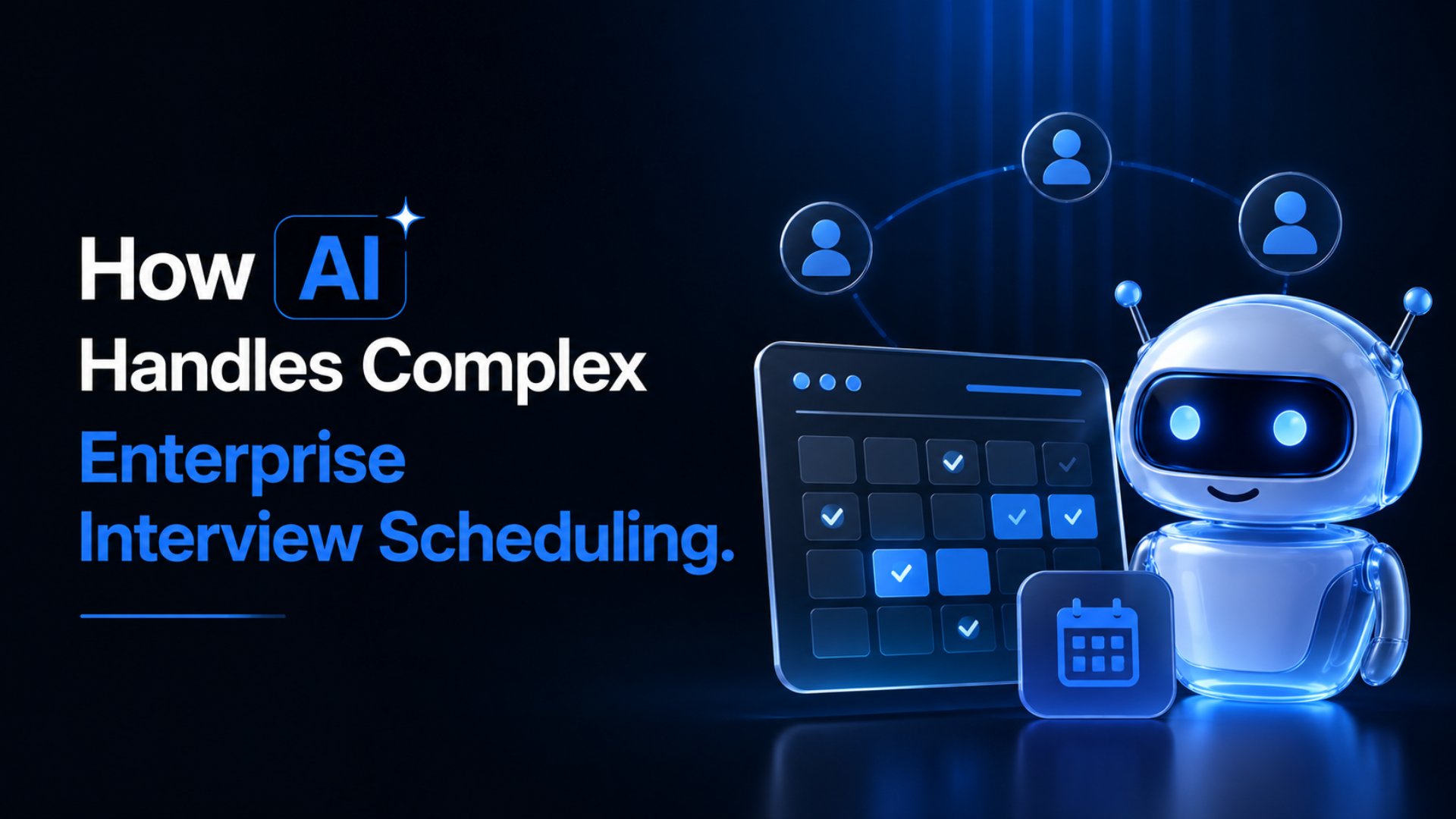
Enterprise scheduling differs from mid-market scheduling in several critical dimensions that make traditional coordination methods inadequate. First, the number of participants per interview is higher. Enterprise panel interviews routinely involve four to eight interviewers, compared to two to three in smaller organizations. Second, the organizational hierarchy adds approval layers. Before an interview can be scheduled, the hiring manager may need to approve the panel composition, the recruiter may need to confirm budget allocation for interviewer time, and compliance teams may need to verify that the interview process meets regulatory requirements. Third, enterprise organizations operate across multiple time zones, calendar platforms, and scheduling policies, which means there is no single source of truth for availability. Fourth, the volume of concurrent hiring activity creates constant interference between scheduling streams, where a change in one interview cascades across dozens of others. These compounding dimensions of complexity mean that enterprise scheduling is not simply a larger version of the same problem. It is a qualitatively different challenge that requires intelligent, adaptive systems rather than manual coordination or simple automation tools. An agentic AI recruiting platform is designed specifically for this type of multi-variable, multi-stakeholder coordination, operating autonomously to resolve scheduling conflicts that would take a human coordinator hours or days to work through manually.
The cost of failing to solve enterprise scheduling complexity is enormous. Rajesh team of eight scheduling coordinators represented an annual investment of approximately eight hundred thousand dollars in salaries and benefits, and they were still unable to keep pace with demand. Hiring managers at his organization reported spending an average of six hours per week on scheduling-related activities, despite having a dedicated operations team. Candidates experienced average scheduling delays of ten to fifteen business days between final-round interview invitation and confirmed date, which translated directly into candidate withdrawal rates of eighteen to twenty-two percent during the scheduling phase. These are not marginal inefficiencies. They are structural failures that cost the organization millions of dollars annually in lost recruiting capacity, delayed hiring timelines, and forfeited talent. The question is not whether enterprise organizations need better scheduling technology. The question is what that technology must be capable of to handle the specific complexity that enterprise hiring demands.
The Technical Architecture Behind AI Enterprise Scheduling
AI systems that handle enterprise scheduling complexity rely on a combination of real-time calendar integration, multi-constraint optimization, and autonomous conflict resolution. The foundation is real-time bi-directional synchronization with every calendar platform in use across the organization. In a typical enterprise environment, this means connecting to Microsoft Outlook, Google Calendar, and any number of specialized scheduling systems used by specific business units or regions. The AI system maintains a continuously updated view of every participant availability, refreshing at intervals measured in seconds rather than hours. This real-time capability is essential because enterprise calendars change constantly: meetings are added, moved, or cancelled; travel schedules shift; urgent priorities emerge. When scheduling decisions are based on stale availability data, the proposed slots are often invalid by the time they reach the participants, which forces the entire coordination cycle to restart. Research from McKinsey on digital transformation in talent acquisition has found that real-time data integration is the single most important technical capability for AI scheduling systems in enterprise environments, and that organizations lacking this capability experience scheduling failure rates two to three times higher than those with real-time synchronization.
Beyond calendar integration, the AI system must handle multi-constraint optimization. Enterprise scheduling is not simply about finding a time when all participants are available. It is about finding a time that satisfies dozens of constraints simultaneously: minimum notice periods defined by organizational policy, buffer times between back-to-back interviews, timezone-aware scheduling that respects working hours for all participants, interviewer-specific availability patterns, candidate preferences, room or video-conferencing resource availability, and compliance requirements such as documented interview panels for regulated positions. For niche or technical roles where the pool of qualified interviewers is small and their expertise is in high demand, the optimization challenge is even more complex because the system must prioritize the scarcest resource, the specialized interviewer, while still satisfying all other constraints. The AI handles this as a constrained optimization problem, evaluating thousands of potential time slots against all constraints simultaneously and ranking the results by a composite score that reflects both feasibility and preference alignment. This is computation that no human coordinator can perform manually, which is why enterprise scheduling has historically been slow, error-prone, and frustrating for all participants.
The third critical capability is autonomous conflict resolution. When conflicts arise, as they inevitably do in enterprise scheduling, the AI system does not simply report the conflict and wait for human intervention. It resolves the conflict by evaluating alternative configurations: can the panel be reorganized? Can one panelist be replaced by an equally qualified alternative? Can the interview be split across two sessions to accommodate the unavailable panelist? Can the format be adjusted from live to hybrid to reduce the number of synchronous participants required? The system presents resolution options ranked by impact on hiring quality and timeline, enabling the recruiter or hiring manager to make an informed decision with a single click rather than spending hours investigating alternatives manually. This autonomous resolution capability is only effective when the underlying data is current and complete. When scheduling systems rely on outdated candidate or interviewer data to evaluate alternatives, the proposed resolutions are often invalid, which undermines confidence in the system
and drives users back to manual coordination. The most effective enterprise scheduling AI maintains a living data model of the entire hiring operation, continuously updated from every connected system, ensuring that every conflict resolution proposal is based on the current state of the organization.
How AI Manages Cross-Time-Zone and Multi-Entity Scheduling
Cross-time-zone scheduling is one of the most visible and frustrating challenges in enterprise hiring. When an organization has offices in New York, London, Singapore, and Mumbai, finding interview slots that fall within reasonable working hours for all participants requires navigating time zone differences of up to twelve and a half hours. A slot that works perfectly for the New York panelist at ten in the morning is ten in the evening in Mumbai and three in the afternoon in London, which may be outside the preferred working hours for some participants. Traditional scheduling tools handle time zones as a simple offset calculation, but this approach fails to account for the human realities of global scheduling: cultural expectations about meeting times, local holidays that differ by region, daylight saving time transitions that occur on different dates in different countries, and individual preferences for early or late meeting times. An AI scheduling system designed for enterprise complexity handles all of these factors as soft and hard constraints within the optimization model, producing time slot recommendations that are not just technically feasible but practically workable for every participant regardless of location. According to LinkedIn talent solutions research, enterprises that deploy AI scheduling with advanced timezone handling reduce average scheduling time for global panels by sixty to seventy-five percent compared to organizations using basic time zone offset tools.
Multi-entity scheduling adds another layer of complexity that is unique to enterprise organizations. Large companies often operate through multiple legal entities, each with its own applicant tracking system, hiring workflows, and compliance requirements. An interview for a position based in one entity may require panelists from another entity who have different system access, different scheduling policies, and different approval requirements. The AI scheduling system must navigate these organizational boundaries transparently, presenting a unified scheduling experience to the candidate and the hiring manager while respecting the distinct requirements of each entity behind the scenes. This requires not just technical integration but organizational configuration that maps the relationships between entities, roles, and scheduling policies. The complexity increases further when managing follow-up scheduling across entities, because the time pressure between interview rounds is often compressed and any scheduling delay risks candidate withdrawal. The most effective AI systems treat multi-entity scheduling as a unified graph problem, where each entity is a node with its own constraints and the scheduling algorithm optimizes across the entire graph rather than treating each entity as an isolated system. Research on why referrals outperform cold outreach has demonstrated that when the entire hiring experience, including scheduling, feels seamless and professional to the candidate regardless of internal organizational complexity, candidate engagement and offer acceptance rates improve significantly because candidates interpret operational excellence as a signal of organizational quality.
The AI system also manages the human communication complexity that accompanies cross-time-zone and multi-entity scheduling. When an interview involves participants in four time zones, the system generates calendar invitations with localized time displays for each participant, sends reminder notifications at appropriate times for each time zone, and handles rescheduling communications in a way that minimizes confusion and respects each participant local context. This communication management is not a cosmetic feature. In enterprise scheduling, miscommunication about time zones is one of the most common causes of missed interviews, wasted panelist time, and candidate frustration. An AI system that handles time zone communication automatically eliminates an entire category of scheduling errors that human coordinators, no matter how diligent, inevitably make when managing dozens of concurrent global interview schedules. The distinction between handling calendar logistics and managing the full communication workflow around those logistics is central to understanding the broader evolution of AI in recruiting, a distinction explored in discussions about the difference between AI sourcing and AI recruiting, where the most impactful tools are those that orchestrate entire workflows rather than performing isolated tasks. Enterprise scheduling AI operates at the workflow orchestration level, managing not just the calendar math but the complete human communication process that surrounds every interview.
Integrating AI Scheduling with Enterprise ATS and HRIS Platforms
The value of AI scheduling in enterprise environments is maximized when it integrates deeply with the existing technology ecosystem: the applicant tracking system, the human resource information system, and the calendar platforms used across the organization. Integration with the ATS ensures that scheduling decisions are informed by candidate stage, hiring priority, and role requirements. Integration with the HRIS ensures that interviewer profiles, reporting relationships, and organizational structure are accurate and current. Integration with calendar platforms ensures real-time availability data. When these systems operate in isolation, the scheduling AI has incomplete information and must rely on manual data entry or periodic batch synchronization, both of which introduce latency and errors. According to Gartner research on HR technology integration, organizations with deeply integrated HR technology stacks achieve forty to sixty percent faster hiring processes than those with fragmented systems, primarily because integrated stacks eliminate the manual data transfer and reconciliation that consumes a disproportionate share of recruiting operations time.
Deep integration also enables the scheduling AI to operate within the governance frameworks that enterprise organizations require. Hiring managers at large companies often need to approve panel compositions before interviews are scheduled. Compliance teams may need to verify that interview panels meet diversity requirements or that certain interview stages are conducted by authorized personnel. Legal teams may need to ensure that interview documentation meets regulatory standards. When the scheduling AI is integrated with the ATS and HRIS, it can enforce these governance requirements automatically: checking panel composition against approval workflows, verifying interviewer authorization against HRIS role data,
and generating audit trails that satisfy compliance requirements. This governance capability is particularly important for organizations exploring how to evaluate an AI sourcing tool before buying, because the ability to operate within existing governance frameworks, rather than requiring the organization to change its processes to accommodate the tool, is one of the strongest predictors of successful enterprise AI adoption. Tools that require process redesign or governance exemptions face resistance that delays deployment and limits adoption, regardless of their technical capabilities.
The integration architecture also determines how effectively the scheduling AI can support analytics and continuous improvement. When scheduling data flows back into the ATS, the organization can measure scheduling performance at granular levels: average time-to-schedule by business unit, by role type, by region, and by interviewer. This data enables recruiting leaders to identify systemic bottlenecks, allocate resources more effectively, and make evidence-based decisions about process improvements. Without integration, scheduling data exists in a silo, and these insights are lost. The ability to connect scheduling performance to broader hiring outcomes, such as time-to-fill, candidate experience scores, and offer acceptance rates, transforms scheduling from a logistics function into a strategic capability that directly influences business results. This strategic elevation of scheduling is part of a broader trend in talent acquisition technology, where organizations are moving from point solutions that automate individual tasks to integrated platforms that optimize entire workflows. A persistent concern among enterprise recruiting leaders is whether this level of AI integration will reduce the role of the recruiting team or diminish the value of human judgment. Analysis of whether recruiters should worry about AI replacing their jobs consistently shows that integrated AI amplifies recruiter effectiveness by eliminating operational overhead, enabling recruiters to focus on the relationship-building, candidate-assessment, and strategic-advisory activities that generate the highest value for the organization. In enterprise scheduling, the AI handles the complexity. The recruiting team handles the strategy.
Measuring the ROI of AI Scheduling in Enterprise Hiring
The return on investment for AI scheduling in enterprise environments can be measured across four dimensions: direct cost savings, hiring velocity improvement, candidate experience enhancement, and recruiter effectiveness gains. The direct cost savings are the most straightforward to calculate. If an enterprise organization currently employs eight full-time scheduling coordinators at an average fully loaded cost of one hundred thousand dollars per year, and AI scheduling reduces the coordination workload by seventy-five percent, the organization can either redeploy six coordinators to higher-value recruiting activities or reduce the scheduling operations headcount by six positions. Either way, the annual cost saving is six hundred thousand dollars, which typically exceeds the total annual cost of the AI scheduling technology by a significant margin. For organizations that have historically attempted to solve scheduling complexity by adding more tools to the recruiting stack, the cost comparison is even more favorable, because AI scheduling typically replaces multiple point solutions with a single integrated platform, reducing both licensing costs and the integration maintenance burden that accompanies multi-tool environments.
The hiring velocity improvement captures the value of faster time-to-interview and faster time-to-fill. When AI scheduling reduces average time-to-schedule from twelve business days to two or three, the entire hiring timeline compresses proportionally. Roles that previously took sixty days to fill may be filled in forty-five days. The fifteen days of recovered time represent real business value: fifteen fewer days of team capacity constraints, fifteen fewer days of delayed project timelines, fifteen fewer days of revenue impact from unfilled positions. Deloitte analysis of hiring velocity impact has found that every day of reduced time-to-fill at the enterprise level generates an average of four hundred to eight hundred dollars in business value for professional roles, depending on the criticality of the position and the revenue sensitivity of the function. For an organization hiring three hundred people per quarter, even a five-day reduction in average time-to-fill generates six hundred thousand to one point two million dollars in annual business value. When combined with the direct cost savings, the total ROI of AI scheduling in enterprise environments routinely exceeds three hundred to five hundred percent in the first year of deployment.
The candidate experience and recruiter effectiveness dimensions are harder to quantify but equally important. Candidates who experience fast, seamless scheduling report higher satisfaction with the hiring process, are less likely to withdraw during scheduling, and are more likely to accept offers. These improvements reduce the hidden costs of candidate dropout and re-sourcing, which can add twenty to thirty percent to the effective cost-per-hire. Recruiters who are freed from scheduling coordination can dedicate more time to candidate engagement, hiring manager advisory, and strategic workforce planning, all activities that generate higher value than calendar management. EY research on enterprise technology ROI has found that the indirect benefits of recruiting automation, including improved recruiter retention, higher candidate satisfaction, and stronger hiring manager partnerships, often exceed the direct cost savings within eighteen months of deployment. For Rajesh, the global head of talent acquisition who watched his eight-person scheduling team struggle against an impossible coordination burden, AI scheduling represented the difference between a recruiting operation that was constantly behind and one that could finally keep pace with the demands of a three-hundred-hires-per-quarter enterprise hiring program. The technology to handle enterprise scheduling complexity exists today. The organizations that deploy it will hire faster, spend less, and deliver a candidate experience that reflects the scale and professionalism of their brand. The ones that do not will continue to watch their best candidates accept offers from competitors who made scheduling effortless.