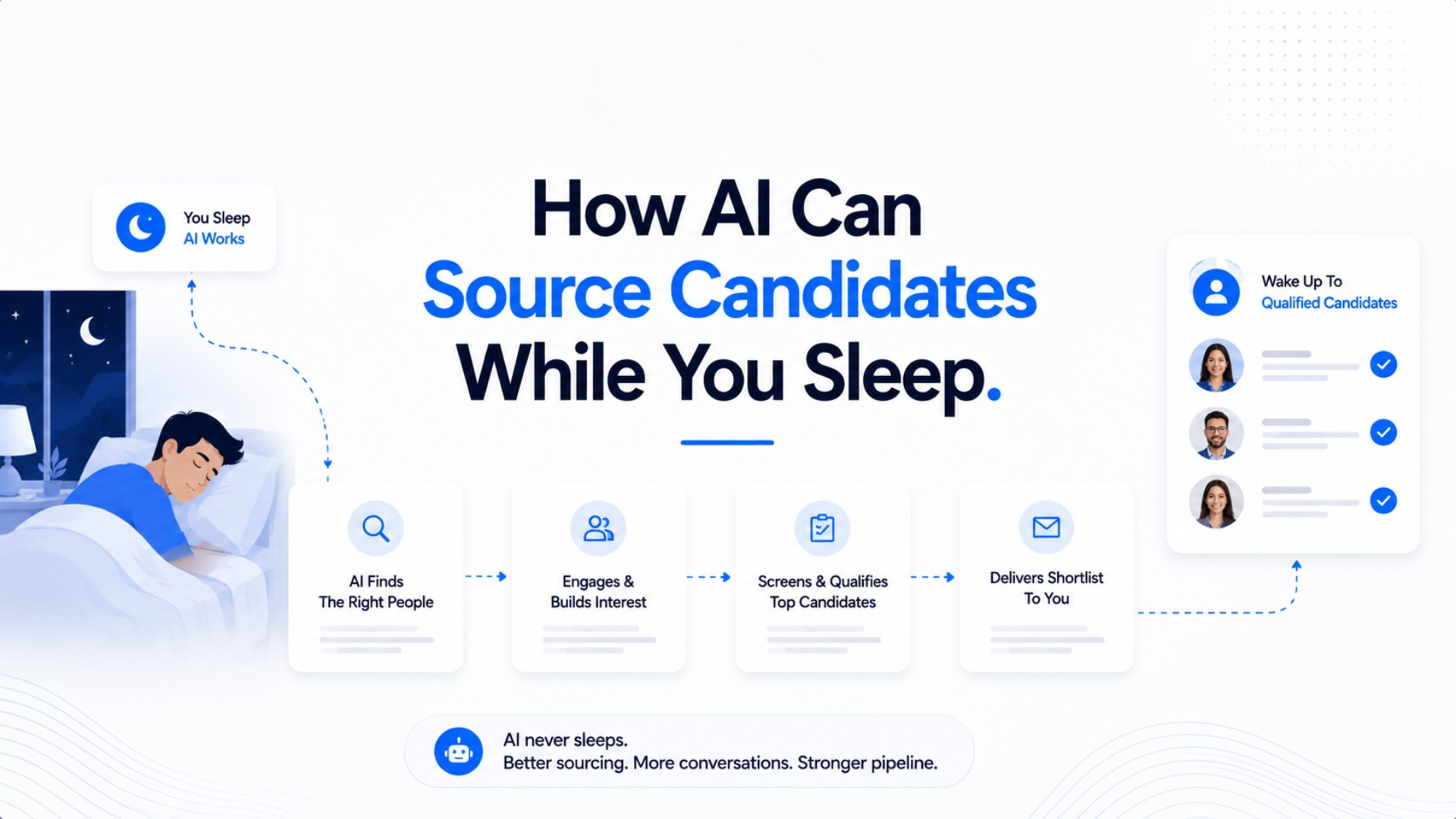
Imagine waking up on a Monday morning, opening your recruiting dashboard, and finding a shortlist of twelve highly qualified candidates who have been identified, scored, and ranked overnight. Not because another recruiter stayed late. Not because a sourcing agency charged you a retainer. But because an AI-powered talent intelligence platform was working while you slept, monitoring career signals, analyzing skill profiles, and surface-matching candidates against your open roles. This is not a hypothetical scenario. It is the daily reality for recruiting teams that have adopted always-on AI sourcing, and it represents a fundamental shift in how talent acquisition operates. According to SHRM's talent acquisition research, the most effective recruiting teams are increasingly adopting AI-powered continuous monitoring capabilities that operate around the clock, because the talent market does not pause when recruiters log off.
The concept of sourcing while you sleep is more than a catchy metaphor. It describes a genuine operational capability that changes the economics and effectiveness of candidate discovery. Traditional sourcing is a batch process: a requisition opens, a recruiter searches, candidates are identified, outreach begins, and the cycle repeats for each new role. This batch model means that between the moment a great candidate becomes available and the moment a recruiter finds them, hours or even days can pass. In a competitive talent market, that delay is often the difference between engaging a top candidate and losing them to a competitor who was faster. AI-powered always-on sourcing eliminates that delay by maintaining a continuous, real-time awareness of the talent market. This article explains the mechanics of always-on AI sourcing, the specific capabilities it delivers, and how recruiting teams can implement it without sacrificing quality or control.
The Talent Market Never Closes
Candidate activity does not follow a nine-to-five schedule. Professionals update their LinkedIn profiles at eleven in the evening. They push code to GitHub at two in the morning. They publish blog posts on Sunday afternoons and tweet about industry trends during their morning commute. They attend virtual conferences in different time zones and participate in open-source discussions at all hours. Every one of these activities is a signal that, if captured and analyzed in real time, can inform a sourcing decision. But traditional sourcing processes are fundamentally synchronous: the recruiter searches when they are working, and whatever happens in the talent market while they are not searching is simply missed. LinkedIn's recruiting resources have documented that a significant portion of candidate profile updates and activity signals occur outside of standard business hours, meaning recruiters who only source during the workday are operating with an incomplete picture of the market.
This asynchrony between recruiter work hours and candidate activity creates a persistent blind spot in the sourcing process. A candidate who updates their profile on Saturday evening with a new certification, a changed job title, or a new set of skills may signal openness to new opportunities. By the time the recruiter logs in on Monday morning and runs their search, that signal is already twenty-four hours old, and in twenty-four hours a lot can happen. Competitors with always-on monitoring capabilities may have already identified the candidate, crafted personalized outreach, and initiated contact. The recruiter operating on a synchronous schedule is perpetually one step behind. This is especially damaging for niche and technical roles where the qualified candidate pool is small and competition for each individual is intense. In these markets, a few hours of delay can mean the difference between engaging a top candidate and finding out they have already accepted another offer.
The always-on AI sourcing model eliminates this blind spot by decoupling candidate monitoring from recruiter work hours. The AI platform monitors the talent market continuously, twenty-four hours a day, seven days a week, across every time zone and data source it has access to. When a signal occurs, the platform captures it, analyzes it in the context of the candidate's full profile and the organization's open roles, and updates the candidate's ranking and recommendations accordingly. By the time the recruiter logs in, the intelligence has already been processed and the most relevant updates are surfaced immediately. This is one of the defining characteristics of an agentic AI recruiting platform: it operates autonomously, making observations and drawing conclusions without requiring a human to initiate or supervise each action. The recruiter's role shifts from running searches to reviewing and acting on intelligence that has already been gathered.
What Always-On AI Sourcing Actually Does
The capabilities of an always-on AI sourcing platform can be organized into four operational layers that work continuously in parallel. The first layer is signal monitoring. The platform
watches for changes across multiple data sources: profile updates on professional networks, new code commits and repository activity, publication of articles or research papers, conference speaking announcements, company news that may affect candidate availability such as funding rounds, layoffs, or leadership changes, and social media activity that indicates engagement level and career sentiment. Each signal is captured in real time and correlated with the candidate's existing profile to determine its significance. A profile update that adds a new skill is different from a profile update that changes a job title, and the platform treats them differently.
The second layer is skill and fit analysis. When new signals arrive, the platform updates each candidate's skill profile and re-evaluates their fit for open and anticipated roles. This is not a simple keyword match. It involves analyzing the new information in the context of the candidate's entire professional history, comparing it against role requirements using multi-dimensional scoring models, and adjusting the candidate's ranking in relevant talent pools. For example, if a candidate publishes a blog post about microservices architecture, the platform updates their skill profile to reflect demonstrated expertise in that domain, checks whether any open roles require that skill, and if so, adjusts the candidate's fit score and ranking for those roles. This continuous re-evaluation means that the talent pipeline is always current, never stale. Understanding why some AI recruiting tools have outdated candidate data is critical when evaluating always-on platforms, because the value of continuous monitoring depends entirely on the freshness and breadth of the underlying data sources.
The third layer is engagement signal detection. Not all candidates are equally reachable at all times, and the platform continuously analyzes behavioral patterns to identify when a candidate may be more receptive to outreach. Signals like increased profile views, new connections, updated 'Open to Work' status, recent conference attendance, and changes in posting frequency can all indicate shifting receptivity. The platform combines these signals into an engagement likelihood score that helps recruiters prioritize their outreach efforts. Rather than sending messages to a static list of candidates in arbitrary order, the recruiter can focus first on candidates whose signals suggest they are most likely to respond. Research from McKinsey's organizational insights shows that outreach timed to engagement signals produces response rates two to three times higher than untimed outreach, because the message arrives when the candidate is psychologically primed to receive it.
The fourth layer is pipeline management and alerting. The platform continuously evaluates the overall health and coverage of the recruiting pipeline for each open role, identifies gaps where more sourcing is needed, and proactively surfaces new candidates to fill those gaps. It can also generate alerts when significant events occur, such as a high-ranked candidate entering a new career signal that changes their availability outlook, or a competitor launching a hiring offensive that may affect the talent pool. This layer transforms the platform from a search tool into a strategic recruiting intelligence system that keeps the recruiting team informed and proactive rather than reactive. The distinction between AI sourcing and AI recruiting is relevant here: these four layers cover the full spectrum from continuous candidate
identification through engagement optimization, providing capabilities that span both sourcing and recruiting functions.
From Overnight Insights to Morning Action
The practical value of always-on AI sourcing is most visible in the recruiter's morning workflow. Instead of starting the day by running searches and reviewing a static list of candidates, the recruiter starts with a dynamically updated dashboard that highlights what has changed overnight. New candidates who match open roles have been identified and ranked. Existing candidates whose profiles have been updated with new skills, experiences, or signals have been re-scored. Engagement likelihood scores have been refreshed based on the latest behavioral data. Pipeline coverage gaps have been flagged with recommended candidates to fill them. The recruiter's first action of the day is not searching but acting: reviewing the intelligence, selecting the most promising candidates, and crafting or approving outreach. This shift from search to action is the single biggest productivity gain that always-on AI sourcing delivers.
The time savings are substantial. According to Gartner's HR trends research, recruiting teams using AI-powered continuous sourcing report spending sixty to seventy percent less time on candidate identification and initial screening, freeing that time for high-value activities like relationship building, candidate engagement, and hiring manager consultation. This reallocation of recruiter time from data gathering to strategic engagement is where the real ROI of always-on sourcing becomes apparent. Recruiters are not being replaced by AI. They are being freed from the low-value, repetitive work that has historically consumed the majority of their day, allowing them to focus on the human-centered activities that actually determine hiring outcomes. The recruiters who understand how many followups one hire needs know that engagement quality matters more than outreach volume, and always-on AI sourcing ensures that every hour of recruiter time is spent on high-quality engagement rather than manual searching.
The morning-action workflow also creates a competitive timing advantage. Because the platform has been monitoring the market overnight, the recruiter can be among the first to engage candidates who have signaled availability or updated their profiles. In competitive talent markets, this early-mover advantage is significant. A candidate who updated their profile on Sunday evening is far more likely to respond to a thoughtful, well-timed message on Monday morning than to a generic message that arrives on Wednesday after a dozen other recruiters have already reached out. This is the same dynamic that explains why referrals outperform cold outreach in conversion rates. Timing and relevance are the two most important factors in outreach success, and always-on AI sourcing optimizes both by ensuring that the recruiter has the right information at the right time.
Scaling Without Sacrificing Personalization
The most common concern about automated sourcing is that scaling up candidate identification means sacrificing the personalization that drives response rates. This concern is understandable but outdated. Modern AI sourcing platforms do not replace personalization. They enable it at scale. The intelligence that the platform gathers overnight, the skill profiles it constructs, the engagement signals it detects, and the fit scores it generates all serve as raw material for highly personalized outreach. When a recruiter sits down to write a message, they have access to a depth of candidate insight that would have taken hours of manual research to compile. The platform may even generate outreach recommendations that include specific signal points to reference, suggested framing based on the candidate's career trajectory, and optimal timing for sending.
This intelligence-augmented personalization is fundamentally different from the automated mass messaging that gives AI recruiting a bad reputation. Automated mass messaging takes a generic template and swaps in a candidate's name and company. Intelligence-augmented personalization takes a candidate's actual professional context and crafts a message that demonstrates genuine understanding of their work, their challenges, and their career direction. The difference in response rates is dramatic. However, this only works when the underlying intelligence is comprehensive and current. Organizations that add AI messaging tools on top of outdated or incomplete data often find they have more tools but the same hiring problems, because the intelligence layer is weak even if the messaging layer is sophisticated. Deloitte's talent research emphasizes that the most successful AI recruiting implementations invest in the intelligence foundation first and the automation layer second, because personalization without intelligence is just better-formatted spam.
The scaling advantage is particularly important for organizations with high-volume hiring needs or small recruiting teams. A team of three recruiters using always-on AI sourcing can effectively monitor and engage a talent market that would require fifteen or twenty recruiters to cover manually. This does not mean the AI is doing the recruiting. It means the AI is doing the time-consuming intelligence work, and the recruiters are doing what they do best: building relationships, assessing candidates, and closing offers. The recruiters who ask whether AI will replace their jobs should consider the flip side: recruiters who learn to work with always-on AI can produce the output of a much larger team, which makes them more valuable, not less. The key is evaluating AI sourcing tools on their ability to deliver genuine candidate intelligence, not just search automation.
The recruiting teams that adopt always-on AI sourcing early are building an advantage that compounds over time. Every night of monitoring adds to the platform's understanding of the talent market. Every candidate interaction improves the accuracy of its engagement predictions. Every hire validates or refines its fit-scoring models. This compounding intelligence creates a gap between early adopters and late adopters that is extremely difficult to close, because the early adopter's platform has been learning for months or years longer. Huntlo.ai provides this always-on intelligence engine out of the box. Its platform continuously monitors candidate signals across professional networks, open-source communities, publication
databases, and industry events, building and refreshing candidate profiles around the clock. Whether you are sourcing for niche technical roles or building pipeline for enterprise-scale hiring, Huntlo ensures that when you log in each morning, the best candidates are already waiting. The talent market never sleeps. With Huntlo, neither does your sourcing.