The way organizations evaluate candidates has not fundamentally changed in decades. A candidate submits a document that summarizes their professional history. A recruiter reads that document, looks for signals that match the job requirements, and makes a decision about whether to advance the candidate to the next stage. The document format has evolved from paper to PDF to online profile. The channel has evolved from mail to email to application portal. But the underlying logic, evaluating a static summary of a person’s career to predict their future performance, has remained essentially the same.
This approach was reasonable when it was the best available option. But it is no longer the best available option, and teams that continue to rely on it are operating at a significant disadvantage. The shift from resume screening to talent intelligence is not an incremental improvement. It is a generational change in how organizations understand and evaluate human capability. And it is being driven by platforms like Huntlo.ai which are building the infrastructure to make talent intelligence operational rather than aspirational.
Phase 1: The Resume Era, Where Screening Meant Reading
For most of the twentieth century, hiring was a manual, paper-based process. Resumes arrived by mail, were sorted by receptionists, and were read by recruiters who relied on experience and intuition to identify promising candidates. The evaluation criteria were informal and inconsistent, varying from one recruiter to another and from one Tuesday morning to the next. There was no scoring system, no standardized framework, and no way to audit whether the candidates who were advanced were actually the best available. The process worked, after a fashion, because the volume of applications was manageable and the competition for talent was less intense.
The limitations of this approach were obvious but tolerable. Screening speed was limited by how fast a human could read, and reading speed was limited by the need to make complex evaluative judgments about each candidate. Quality was limited by the evaluator’s expertise, mood, and the inevitable biases that influence human pattern recognition. And scale was limited by the fact that every additional candidate required additional human attention. These limitations were not considered problems. They were considered the inherent constraints of the hiring process, as fundamental and immutable as gravity.
The resume era persisted not because it was effective, but because there was no alternative. Organizations accepted high miss rates, slow time-to-hire, and inconsistent shortlists as the cost of doing business. The idea that you could evaluate thousands of candidates thoroughly and consistently was science fiction. The best you could do was hire more recruiters and hope that volume compensated for inconsistency. As we have noted in our analysis of why more tools often produce the same hiring problems, adding headcount to a broken process does not fix the process. It just makes the brokenness bigger.
Phase 2: The Keyword Era, Where Screening Meant Filtering
The first significant technological disruption to hiring came with applicant tracking systems and keyword-based screening. Suddenly, recruiters could define a set of terms and let software filter the incoming resumes automatically. Candidates who mentioned the right keywords advanced. Those who did not were rejected. It was faster, more consistent, and more scalable than manual review. According to SHRM’s analysis of talent acquisition technology, keyword screening reduced initial screening time by 60 to 80 percent when it was first widely adopted, and it remains the dominant screening method in most organizations today.
But keyword screening solved one problem and created several others. The most obvious is that keywords are a shallow signal of capability. A candidate who mentions “Python” five times on their resume is not necessarily a better Python developer than one who mentions it once but has actually built and shipped production systems. Keywords can be gamed, and candidates who understand how ATS systems work can optimize their resumes for keyword density rather than for accuracy. The result is a screening process that is fast but not intelligent, consistent but not meaningful, and scalable but not predictive.
The deeper problem with keyword screening is that it evaluates the wrong thing. It evaluates whether a candidate’s resume contains certain words, not whether the candidate possesses the underlying capabilities those words are supposed to represent. This distinction matters because the gap between what people write on resumes and what they can actually do is often wide. Research from McKinsey’s talent management insights has shown that traditional resume screening has a predictive accuracy of roughly 50 percent for job performance, which is only marginally better than random selection. That is not a system. That is a coin flip with extra steps.
Phase 3: The Intelligence Era, Where Screening Means Understanding
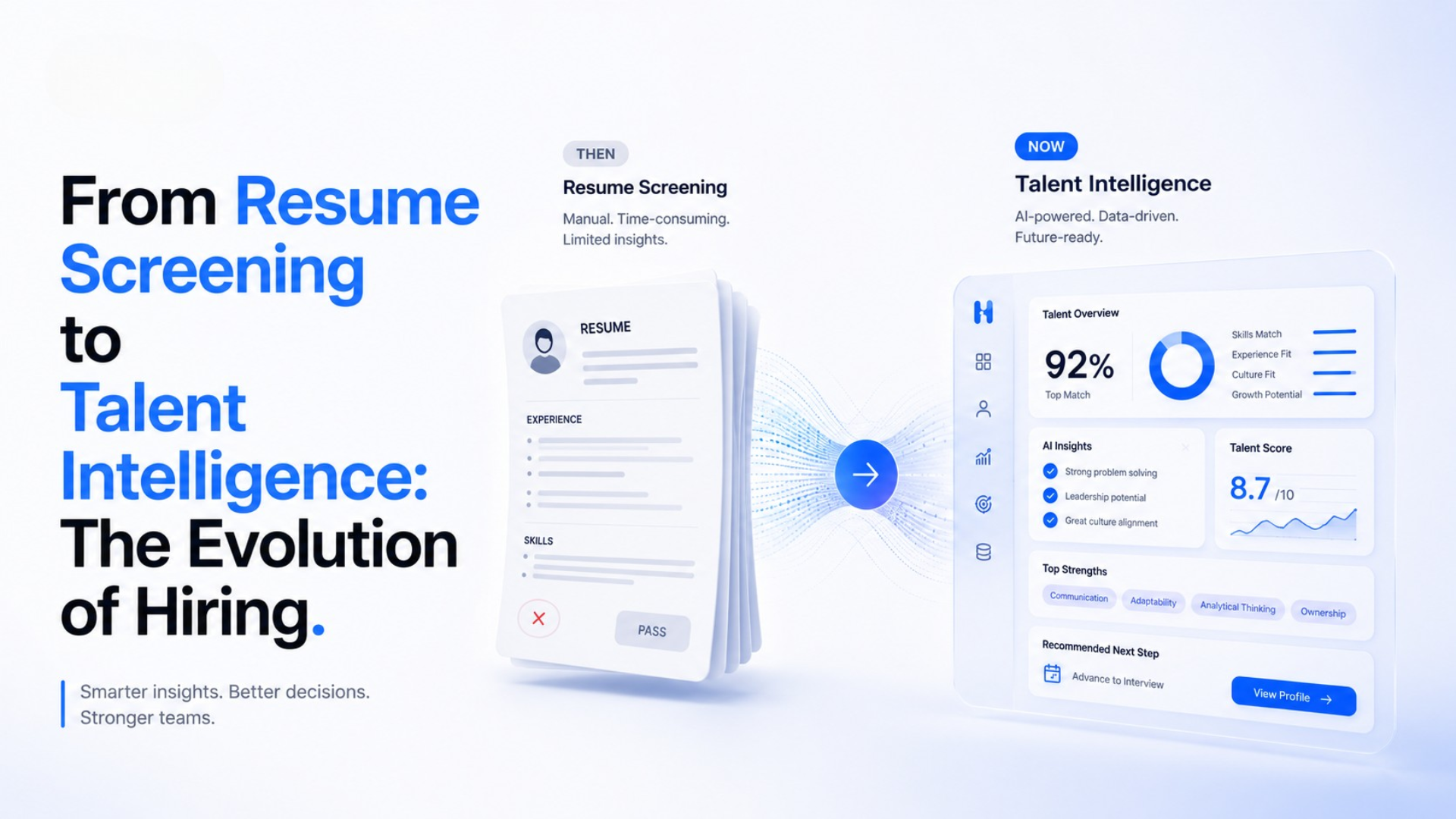
Talent intelligence is the systematic use of data, AI, and behavioral science to understand what candidates can actually do, how they are likely to perform in a specific role, and how they compare to each other on dimensions that predict success. It is not keyword matching with better marketing. It is a fundamentally different approach to candidate evaluation that starts from a different question. Instead of asking “does this candidate’s resume contain the right words,” talent intelligence asks “does this candidate’s demonstrated capability match what this role requires?” The difference between these two questions is the difference between screening and understanding. This is the shift that agentic AI recruiting platforms are designed to enable, and it is the shift that separates the most effective hiring organizations from the rest.
Talent intelligence works by building rich, multi-dimensional candidate profiles that go far beyond what a resume can capture. These profiles draw on work history, verified achievements, project outcomes, skills assessments, and in some cases AI-conducted interviews that evaluate communication, problem-solving, and role-specific competencies. Each data point is mapped to a competency framework that is specific to the open role, producing a detailed capability assessment that is far more predictive of job performance than any resume review could be.
The intelligence layer does not just evaluate individual candidates. It also identifies patterns across the entire candidate pool, revealing insights that are invisible at the individual level. Which skills are most correlated with success in this type of role? What career trajectories produce the strongest performers? Are there high-potential candidates being overlooked because their backgrounds do not match traditional profiles? These are questions that no individual recruiter can answer by reading resumes, but that an AI system analyzing thousands of data points can address with confidence. According to Gartner’s research on HR technology, organizations that have implemented talent intelligence capabilities report 30 to 50 percent improvements in quality of hire within the first year.
What Talent Intelligence Looks Like in Practice
A talent intelligence approach to screening changes every element of the process. Before a single candidate is evaluated, the hiring team defines a role-specific competency framework that identifies the capabilities the role requires, weighted by importance. This is not a job description rewritten as a checklist. It is a structured evaluation model that specifies what good looks like for this specific role, in this specific organization, at this specific time. The framework might include technical competencies, such as specific tools or methodologies, and behavioral competencies, such as communication style, leadership approach, or problem-solving orientation.
Once the framework is defined, every candidate is evaluated against it automatically. The AI system maps each candidate’s profile to the competency framework, producing a scored assessment that shows how well the candidate matches each requirement and where the gaps are. This is fundamentally different from keyword matching because it evaluates substance,
not surface. A candidate who has used a tool extensively in practice will score higher than one who has merely listed it on their resume, even if the second candidate’s resume is more keyword-optimized. This distinction between AI sourcing and AI recruiting, is critical here. Sourcing finds candidates. Talent intelligence evaluates them. Both are necessary, but evaluation is where the real value is created.
The output is not a binary yes or no. It is a ranked shortlist with transparent scoring that the recruiter can review, question, and adjust. The recruiter can see exactly why each candidate was scored the way they were, override the AI’s assessment based on context the algorithm cannot capture, and add their own evaluative input. This is the assist model in action: AI handles the volume and the consistency, and the human handles the judgment and the context. The result is a shortlist that is both data-driven and human-informed, which is exactly what hiring managers need. As we have discussed in our guide on evaluating AI recruiting tools, transparency and configurability are the features that separate platforms that actually improve hiring outcomes from those that merely automate existing problems.
The Data Foundation: Why Quality Input Determines Intelligence Output
Talent intelligence is only as good as the data that feeds it. This is both an obvious point and one that is frequently overlooked. An AI system evaluating rich, verified, multi-dimensional candidate data will produce dramatically better screening decisions than one evaluating traditional resumes alone. The difference is not marginal. It is the difference between a system that can assess actual capability and one that is guessing based on proxy signals. We have written extensively about the problem of outdated candidate data in AI recruiting tools, and the lesson is directly relevant here: investing in better data is the highest-leverage improvement most recruiting teams can make.
The most effective talent intelligence systems draw on multiple data types. Verified work history provides a factual baseline. Project portfolios and case studies demonstrate applied capability. Skills assessments, whether through AI-conducted interviews or structured evaluations, provide direct evidence of competency. Performance data from previous roles, where available, provides the strongest predictive signal of future performance. And behavioral signals from the candidate’s interactions throughout the hiring process, responsiveness, communication quality, and engagement level, provide additional context that enriches the overall assessment.
Building this data foundation requires investment, but it pays for itself quickly. According to Deloitte’s talent research, organizations that invest in enriched candidate data and talent intelligence platforms see return on investment within six to nine months, driven by faster time-to-hire, higher offer acceptance rates, and improved first-year retention. The companies that wait for the technology to be perfect before investing in better data will find that they have fallen behind competitors who started building their intelligence infrastructure years earlier. In a competitive talent market, the data advantage compounds over time.
From Screening to Strategy: How Talent Intelligence Changes the Recruiter’s Role
When screening is automated and intelligent, the recruiter’s role changes from operator to strategist. Instead of spending the majority of their time reading resumes and making binary advance-or-reject decisions, recruiters can focus on the work that actually requires human intelligence: advising hiring managers on role design, building relationships with high-potential candidates, identifying workforce gaps that need to be addressed proactively, and developing a talent acquisition strategy that aligns with business objectives. This is the evolution we have described in our discussion of whether recruiters should worry about AI replacing their jobs, and it is an evolution that makes recruiters more valuable, not less.
Talent intelligence also changes the relationship between recruiting and the rest of the business. When screening produces rich, data-driven candidate assessments, those assessments become valuable inputs for workforce planning, succession management, and organizational design. A talent intelligence platform can identify not just who the best candidates are for a specific role, but where the talent gaps are across the entire organization, which skills are becoming harder to find in the market, and what the competitive landscape for talent looks like. This strategic visibility is something that traditional resume screening never provided, and it transforms recruiting from a reactive, role-by-role function into a proactive, organization-wide capability.
The practical implication is that recruiting teams that embrace talent intelligence become strategic partners to the business rather than service providers filling requisitions. They can anticipate hiring needs, build talent pipelines before roles open, and provide data-driven advice on compensation, role design, and workforce strategy. This is the future of recruiting, and it is already here for organizations using niche and technical AI hiring tools that can evaluate specialized candidates with the depth and nuance those roles require. The transition from resume screening to talent intelligence is not just a technology upgrade. It is a fundamental change in what recruiting means and what recruiters can achieve.
Why Huntlo.ai Is the Talent Intelligence Platform for This Moment
Huntlo.ai was built to make the transition from resume screening to talent intelligence practical and immediate. The platform evaluates every candidate against role-specific competency frameworks, producing scored assessments that reflect demonstrated capability rather than keyword proximity. It draws on rich candidate data, including verified work history, project outcomes, and AI-conducted interviews, to build profiles that are far more predictive than traditional resumes. It provides full transparency into its scoring logic, so recruiters and hiring managers can understand and trust the results. And it continuously improves its evaluations based on hiring outcomes, creating a feedback loop that makes the system more accurate with every hire. Unlike the same tools producing the same problems, Huntlo represents a different approach: intelligence that compounds over time.
The evolution from resume screening to talent intelligence is not optional for organizations
that want to compete for top talent. The market is moving in this direction, and the teams that get there first will have a significant and sustained advantage. Whether that means knowing how many follow-ups one hire needs to convert a great candidate, or understanding why referrals outperform cold outreach and building those insights into your screening logic, talent intelligence turns hiring from a guessing game into a data-driven discipline. The resume served its purpose for a long time. Its time is over. The future belongs to intelligence.