Nadia is a senior product manager at a logistics startup. Last year, she was approached by two competitors for similar leadership roles. Company A had a polished careers page with employee testimonial videos, a culture deck, and a four-point-nine Glassdoor rating. Company B had a basic careers page with minimal content and an average Glassdoor rating. Based on branded content alone, Company A was the clear winner. Nadia engaged with both. Company A's recruiter sent a personalized first message, and Nadia responded. The screening call went well. Then the recruiter went silent for nine days. When they reappeared, the message was a generic scheduling link with no context. After the interview, Nadia waited eleven days for feedback with no communication. She withdrew. Company B's recruiter sent a thoughtful first message referencing a product launch Nadia had led. She responded. Every subsequent interaction was timely, informed, and personal. The recruiter provided interview preparation, followed up within hours of each round, and called personally to discuss the offer. Nadia
accepted Company B's offer. The company with the better employer brand lost. The company with the better candidate experience won. Nadia did not choose based on the brand the companies projected. She chose based on the brand they delivered.
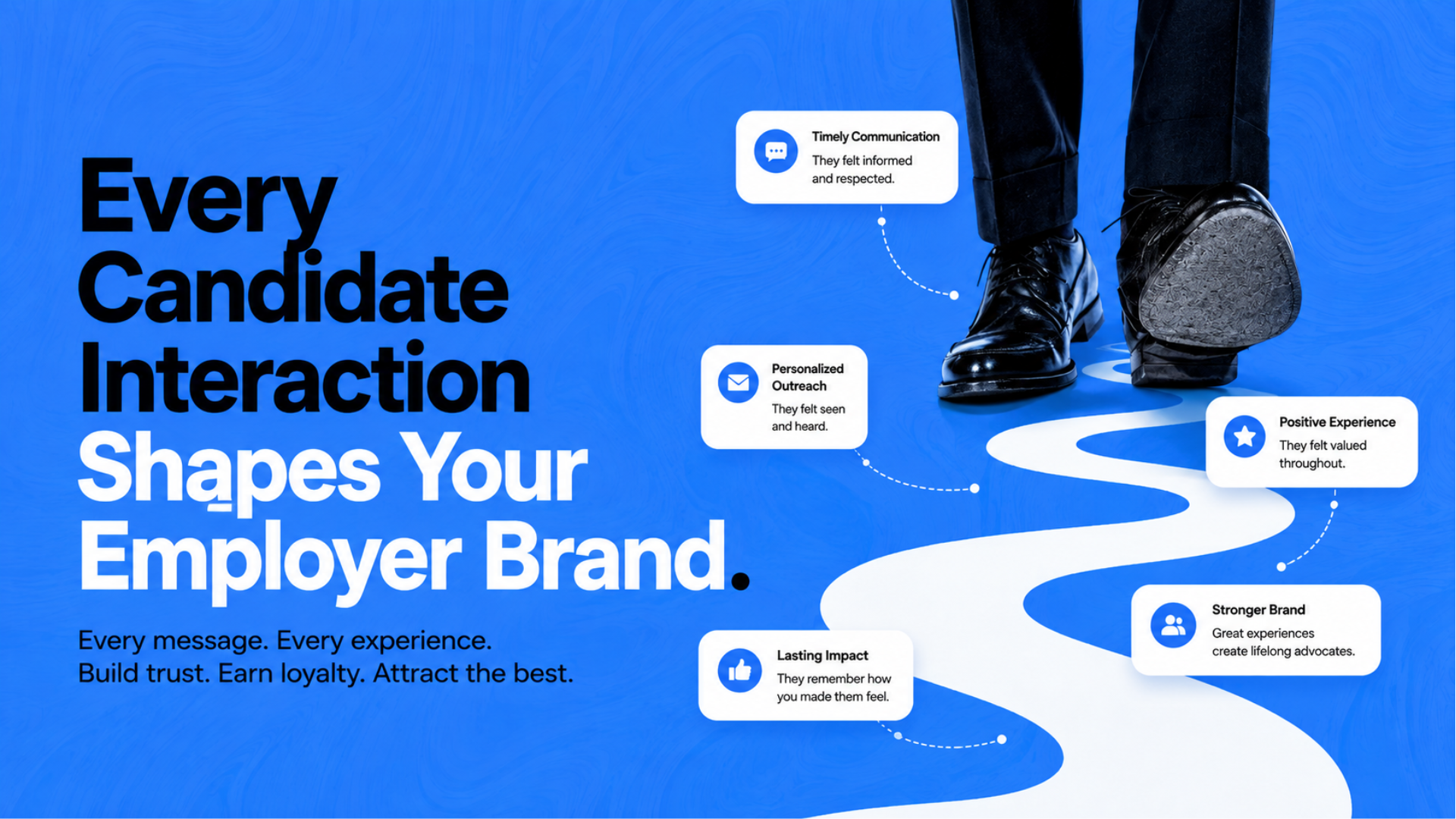
The disconnect between projected employer brand and experienced employer brand is one of the most costly blind spots in talent acquisition. Companies invest millions in employer branding, careers sites, social media campaigns, employee testimonials, and Glassdoor management, to project an image of the organization as a desirable place to work. These investments are not wasted, because they influence whether candidates consider the organization in the first place. But they represent the brand the company wants candidates to believe. The brand candidates actually believe is the one they experience directly during the hiring process. This experienced brand is built one interaction at a time, through every message the recruiter sends, every call they conduct, every update they provide or fail to provide, and every moment of timeliness or delay the candidate endures. According to SHRM's talent acquisition research, seventy-nine percent of candidates say that their direct experience with the recruiting team has a greater influence on their perception of the employer brand than any branded content, and sixty-eight percent say that a single negative recruiting interaction has permanently damaged their perception of an employer brand they previously viewed positively. These numbers reveal a fundamental truth: the recruiting team is the primary brand delivery mechanism, and every interaction they have with a candidate either builds or undermines the brand that the marketing team has spent months or years constructing. Understanding the difference between AI sourcing and AI recruiting is relevant here because sourcing is where the projected brand first encounters the candidate, but the recruiting interactions that follow are where the experienced brand is actually built. Huntlo's platform ensures that every interaction delivers on the brand promise by providing the intelligence and consistency needed to make each candidate touchpoint a brand-building experience rather than a brand-damaging one.
The Projected Brand vs. the Experienced Brand
The projected employer brand is the image the organization presents to the external world through controlled channels. It includes the careers page, job descriptions, social media content, employee testimonials, conference sponsorships, and review site management. This brand is designed, curated, and optimized to attract candidates. It is the organization at its best, presented under conditions the organization controls. The experienced employer brand is the image the candidate forms through their direct, personal interactions with the organization's recruiting process. It includes the timeliness and quality of the recruiter's messages, the transparency of the process, the professionalism of the interviews, and the responsiveness of the team at every stage. This brand is not designed or curated. It emerges naturally from the quality of the organization's recruiting operations. The gap between these two brands is where employer brand damage occurs. When the projected brand promises a collaborative, transparent culture and the experienced brand delivers slow responses, vague communication, and inconsistent engagement, the candidate does not conclude that the projected brand was
aspirational. They conclude it was deceptive, and the credibility loss is far greater than if the organization had made no brand promises at all. According to McKinsey's organizational insights, the projected-experienced brand gap is the single strongest predictor of negative Glassdoor reviews and peer-to-peer brand damage, because candidates who feel misled by the discrepancy between the brand they were sold and the experience they received are the most motivated to share their negative experience publicly, as a warning to other candidates.
The implication for recruiting organizations is clear: investing in the projected brand without investing equally in the experienced brand is not just inefficient. It is counterproductive, because a strong projected brand that is not supported by the experienced brand creates a credibility gap that actively damages the organization's reputation. A modest projected brand that is consistently exceeded by the experienced brand, on the other hand, creates a positive surprise effect that generates organic advocacy, as candidates share their unexpectedly positive experience with peers. The teams that simply add more tools without addressing this brand consistency challenge often discover they have more tools but the same hiring problems, because the tools optimize the projected brand, better job descriptions, wider distribution, and higher application volumes, without addressing the experienced brand that determines whether those candidates actually convert into hires. Research on how many followups one hire actually needs reveals an important brand dimension: every follow-up is a brand interaction, and the quality of that interaction shapes the candidate's evolving brand perception. A well-timed, personalized follow-up reinforces the projected brand promise. A delayed or generic follow-up undermines it. This is especially critical when hiring for niche and technical roles, where candidates are sophisticated consumers of employer brand signals and will immediately detect and penalize discrepancies between what the organization promises and what the recruiting team delivers. The experienced brand is built or broken at the individual interaction level, and every interaction counts equally in the candidate's mind.
The Recruiter as Brand Ambassador: The Most Underestimated Role in Hiring
The recruiting team is the primary brand delivery mechanism in talent acquisition, yet most organizations do not equip, train, or measure recruiters as brand ambassadors. This is a strategic oversight with significant consequences. The recruiter is the first human being from the organization that most candidates interact with. The tone, quality, and responsiveness of that interaction sets the candidate's expectation for every subsequent interaction, including the interactions they will have as an employee. A recruiter who communicates with clarity, warmth, and genuine interest creates a brand impression of an organization that values its people and operates with professionalism. A recruiter who communicates with delay, vagueness, and impersonality creates a brand impression of an organization that treats people as numbers. These impressions are durable, because they are formed through personal experience rather than through marketing content, and they are the most difficult impressions for competitors to replicate, because they require a genuine operational commitment to candidate experience that cannot be faked through branding. According to LinkedIn's recruiting resources, candidates who have a positive recruiting experience with a specific recruiter are sixty to seventy
percent more likely to recommend the organization to peers, and forty to fifty percent more likely to apply again for future roles, regardless of whether they were hired for the initial role they pursued. The recruiter's brand impact extends beyond the individual candidate to the candidate's entire professional network, because candidates share their recruiting experiences with peers, on social media and in private conversations, creating a brand halo or a brand shadow that influences future hiring outcomes for every subsequent role.
The recruiters asking whether AI will replace their jobs should recognize that the brand ambassador role makes them more strategically important, not less. The candidates who interact with AI chatbots and automated systems during the hiring process report significantly lower brand satisfaction than those who interact with human recruiters, even when the AI system is faster and more efficient, because the interaction lacks the warmth and authenticity that create positive brand impressions. The most effective model is one where AI supports the recruiter as a brand ambassador rather than replacing them. An agentic AI recruiting platform like Huntlo provides the recruiter with the intelligence, context, and operational support needed to deliver brand-consistent interactions at every touchpoint, while the recruiter provides the human judgment, empathy, and authenticity that transform a functional interaction into a brand-building one. The research on referred candidates provides the clearest evidence for this model. Data shows that referrals outperform cold outreach because the referring employee serves as a trusted brand ambassador who vouches for the organization based on their own experience. The recruiting team's ability to deliver an experience that confirms and extends this referral-based brand impression is what converts referred candidates at dramatically higher rates. Huntlo's platform gives every recruiter the tools to be an effective brand ambassador for every candidate, not just the ones they have time to invest in personally, by providing the consistent, informed, and timely engagement that builds the experienced brand candidates trust and remember.
The Seven Candidate Touchpoints That Shape Your Employer Brand
Every candidate interaction shapes the employer brand, but some touchpoints have a disproportionate impact because they occur at moments of heightened candidate attention and emotional engagement. The first touchpoint is the initial outreach message. This is the candidate's first direct experience of the organization's recruiting quality, and it sets the frame through which every subsequent interaction is evaluated. A message that demonstrates genuine knowledge of the candidate's background creates an immediate brand impression of an organization that pays attention and values individuals. A generic template creates the opposite impression, regardless of how well-crafted it is. The second touchpoint is the screening call or first conversation. This is where the candidate forms their most detailed impression of the recruiting team's professionalism, because the screening call is typically the first real-time, unscripted interaction. The third touchpoint is the communication between screening and interview. This is often the first gap where brand damage occurs, because the organization's focus shifts to internal coordination while the candidate waits without updates. The fourth touchpoint is the interview experience itself, which includes not just the content of the
interviews but the logistics, the preparation, the interviewer quality, and the timeliness of post-interview feedback. According to Gartner's HR trends research, the interview experience is the single most influential touchpoint for candidates who ultimately accept offers, because it is the most immersive and longest interaction they have with the organization, giving them the most data points on which to base their brand evaluation.
The fifth touchpoint is the post-interview communication, the feedback, timeline updates, and check-ins that maintain the candidate's engagement during the internal decision period. This is where the gap between the projected and experienced brand is most visible, because the organization is simultaneously promoting its candidate-centric culture through its employer brand while demonstrating a lack of candidate-centricity through communication silence. The sixth touchpoint is the offer presentation. The offer is not just a financial document. It is a brand statement. The way the offer is presented, the personalization, the transparency, the responsiveness to the candidate's questions, and the respect shown for the candidate's decision-making process, communicates more about the organization's culture than any careers page. A well-presented offer that addresses the candidate's specific priorities and concerns is a brand-reinforcing experience. A take-it-or-leave-it offer delivered after days of silence is a brand-damaging one. The seventh touchpoint is the pre-boarding period between acceptance and day one. This is the final brand touchpoint, and it is where the organization has the opportunity to reinforce the positive brand impression that led to acceptance or to undermine it through neglect. The quality of the candidate intelligence that informs each of these touchpoints is foundational. Teams that have encountered outdated candidate data in AI tools understand that a brand interaction based on stale context will feel hollow, because the personalization that signals genuine attention requires current, accurate information. When evaluating platforms, use the framework for evaluating an AI sourcing tool before buying to ensure that real-time intelligence and touchpoint-specific engagement support are core capabilities. Each of these seven touchpoints is an opportunity to build the experienced brand. Missing or underperforming at any one of them creates a brand gap that can undo the value of all the others.
Measuring and Managing Brand Impact Across the Candidate Journey
If every candidate interaction shapes the employer brand, then measuring the brand impact of candidate interactions should be a core recruiting capability. Yet most organizations have no systematic way to measure how their recruiting process is shaping their employer brand, either positively or negatively. The typical approach is to rely on lagging indicators, Glassdoor ratings, candidate satisfaction surveys sent after the process concludes, and anecdotal feedback from recruiters. These indicators are useful but insufficient, because they measure the brand outcome after it has already been shaped, rather than the interaction quality that shaped it. A more effective approach is to measure brand impact at the touchpoint level, tracking the quality and consistency of each of the seven touchpoints that shape the candidate's brand perception. This requires three capabilities. The first is touchpoint monitoring, the ability to track whether each candidate received a timely, personalized, and brand-consistent interaction at
each stage of the process. The second is gap detection, the ability to identify when a candidate has experienced a communication lapse or quality drop that could damage their brand perception. The third is candidate sentiment tracking, the ability to detect changes in the candidate's engagement level, responsiveness, and tone that indicate their brand perception is shifting. According to Deloitte's talent research, organizations that implement touchpoint-level brand measurement reduce their negative brand incidents, the specific interactions that damage the employer brand, by forty to sixty percent within six months, because the measurement creates accountability and enables real-time intervention before a negative experience becomes a negative brand impression shared with peers.
The operational challenge of implementing touchpoint-level brand measurement is that it requires continuous monitoring of every candidate's journey across all seven touchpoints, which is beyond what manual processes can sustain for anything other than a small number of priority candidates. This is where AI-powered engagement platforms provide transformative capability, by maintaining real-time awareness of every candidate's journey stage, tracking communication timing and quality, and alerting the recruiting team when a brand-damaging gap is developing. According to EY's technology insights, organizations that deploy AI-powered candidate engagement platforms with brand monitoring capabilities report twenty-five to thirty-five percent improvements in candidate-driven brand advocacy, meaning candidates who proactively recommend the organization to peers, and fifteen to twenty percent reductions in negative brand incidents, because the platform ensures that no candidate falls through the communication gaps that produce the most damaging brand experiences. Huntlo's platform delivers this capability by treating every candidate interaction as a brand-building opportunity and providing the monitoring, intelligence, and consistency infrastructure needed to ensure that every interaction reflects the employer brand the organization wants to project. Your employer brand is not what your careers page says. It is what your candidates experience. Huntlo ensures the two are the same. Start building your employer brand one interaction at a time with Huntlo.