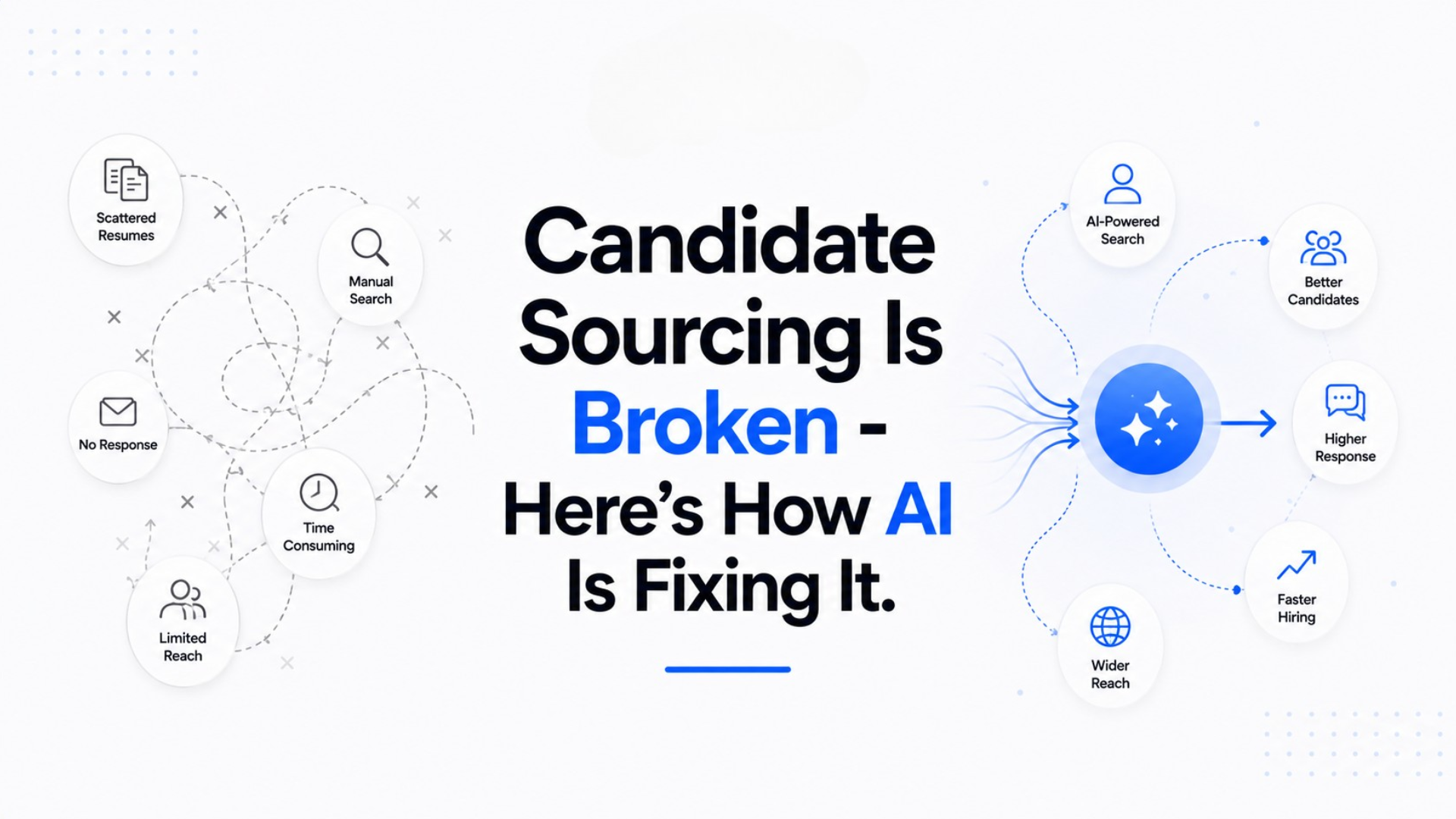
The brokenness of candidate sourcing manifests in five specific failures that have become so normalized that most recruiting teams accept them as inevitable rather than treating them as solvable problems. The first failure is redundancy. Multiple recruiters searching for the same type of role produce overlapping candidate lists, wasting effort and producing no incremental value. The second failure is superficiality. Keyword-based search evaluates candidates based on words in their profile rather than the depth and relevance of their actual experience. The third failure is staleness. Candidate data degrades rapidly, but most sourcing tools rely on periodic data pulls that are weeks or months old by the time a recruiter searches them. The fourth failure is reactivity. Sourcing begins only when a requisition opens, which means the recruiter is always starting behind competitors who have been building relationships in advance. The fifth failure is isolation. Sourcing is treated as a standalone activity disconnected from market intelligence, candidate relationship management, and strategic hiring planning. According to LinkedIn's talent solutions research, these five failures collectively account for an estimated forty to sixty percent of total recruiting waste, defined as effort that does not contribute to a successful hire. The broken recruiting process is not a marginal inefficiency. It is a structural failure that is costing organizations enormous amounts of money and recruiter time while producing mediocre hiring outcomes.
Failure One: Everyone Finds the Same Candidates
The most visible symptom of broken sourcing is the homogeneity problem. When every recruiter in the market uses the same platforms, the same search logic, and the same evaluation criteria, they inevitably produce the same candidate lists. The top of every search results page is populated by the same profiles, because those profiles are optimized for the exact keywords and titles that every recruiter is searching for. This creates a tragic dynamic for hiring quality: the candidates who appear at the top of search results are the most heavily recruited candidates in the market, which means they receive the most outreach, which means they are the least likely to respond, and the most likely to command premium compensation. The sourcing problems in recruiting start here, because the sourcing system funnels every recruiter toward the same small pool of over-recruited candidates while leaving the larger pool of equally qualified but less obviously discoverable candidates completely untouched. Understanding why more tools produce the same hiring problems, adding more search platforms does not solve the homogeneity problem because each new platform uses essentially the same keyword-matching logic. According to SHRM's talent acquisition research, the average senior-level candidate receives five to eight recruiter messages per week, and the candidates who appear at the top of standard search results receive two to three times that volume. The candidate sourcing inefficiency of chasing the same over-recruited candidates is enormous: high effort, low response rates, and frequent offer bidding wars that inflate compensation without improving candidate quality.
The homogeneity problem also creates a false sense of competitiveness. Recruiting teams believe they are competing for talent, but they are actually competing for attention from the same small group of candidates who are already overwhelmed with outreach. The real competitive opportunity, finding candidates that competitors cannot find, is invisible to teams that rely solely on standard search. Understanding AI recruiting for niche and technical roles, this problem is especially acute for specialized roles where the candidate pool is small and every obvious candidate is already being pursued by multiple recruiters simultaneously. The AI candidate sourcing solution to the homogeneity problem is semantic matching, which identifies candidates based on the meaning of their experience rather than the exact keywords in their profile, expanding the candidate pool to include qualified professionals who use different language to describe the same capabilities. Understanding why some AI recruiting tools have outdated candidate data, this expanded pool is only valuable when the data is fresh, because stale data about non-obvious candidates is worse than no data at all.
Failure Two: Data That Was Never Accurate Enough
The second fundamental failure of traditional sourcing is data quality. Candidate profiles on professional platforms are self-reported, which means they are incomplete, inconsistent, and optimized for the candidate own professional branding goals rather than for recruiter search accuracy. A candidate who describes their role as Head of Product might be doing the work of
a VP of Product. A candidate who lists ten programming languages might be proficient in three and familiar with seven. A candidate who has not updated their profile in eighteen months may have acquired entirely new skills and experiences that are not reflected in the searchable record. According to McKinsey's people organization insights, roughly thirty to forty percent of the information in standard candidate profiles is either outdated, incomplete, or misleading in ways that affect sourcing accuracy. The modern sourcing challenges are not primarily about finding more data. They are about finding better data, data that is verified, current, and comprehensive rather than self-reported, periodic, and partial.
The data quality problem also affects the most critical sourcing decision: whether to invest time in engaging a specific candidate. A recruiter who reads a stale profile and decides the candidate is not a fit is making a decision based on incomplete information. A candidate whose profile was last updated a year ago but who has since led a major product launch, acquired a critical new skill, or become open to relocation, is invisible to the recruiter working from the old data. The AI talent sourcing approach solves this problem by continuously refreshing candidate data from multiple sources, not just the self-reported profile but also public activity, professional contributions, and behavioral signals. This multi-source, continuously updated data provides a more accurate and more complete picture of each candidate than any self-reported profile can offer. Understanding the difference between AI sourcing and AI recruiting, the distinction between data sourcing, gathering and verifying candidate data, and candidate recruiting, engaging and converting candidates, is critical because the quality of the recruiting depends entirely on the quality of the underlying data. According to Deloitte's talent research, organizations that adopt continuously refreshed, multi-source candidate data report twenty-five to thirty-five percent higher shortlist accuracy than those relying on standard profile data, because the fresher, broader data set enables more accurate candidate assessment.
Failure Three: Starting from Zero Every Time
The third structural failure of traditional sourcing is its reactive nature. A requisition opens, and the sourcing process begins from nothing. The recruiter has no pre-existing knowledge of the candidate market for this specific role, no pre-identified candidates, and no pre-built relationships. Everything must be built from scratch under the pressure of a hiring manager who wants to see candidates immediately. This start-from-zero model has three consequences. First, it is slow, because building candidate knowledge takes time regardless of how skilled the recruiter is. Second, it is wasteful, because the knowledge built during this search is rarely captured and reused for future roles. When the next similar requisition opens, the recruiter starts from zero again. Third, it is stressful, because the recruiter is always operating under time pressure with incomplete information. The recruiting process automation that AI provides eliminates the start-from-zero problem by maintaining continuous candidate intelligence that persists across requisitions. The platform has been monitoring the talent market, identifying candidates, tracking engagement signals, and building pipeline long before the current requisition existed. When the role opens, the recruiter does not start from zero. They start from a position of intelligence and preparation.
The start-from-zero problem also prevents recruiting teams from developing the kind of deep market knowledge that produces strategic hiring advantages. A recruiter who sources from scratch for every role never develops the cumulative understanding of the talent landscape that comes from tracking the same candidate pool over months and years. The intelligent candidate discovery that AI provides accumulates this market knowledge over time, making every subsequent search smarter than the last. According to Gartner's HR trends research, AI-powered sourcing platforms that learn from historical hiring data improve their candidate ranking accuracy by fifteen to twenty percent with every quarter of use. Understanding what makes an AI recruiting platform agentic vs. just automated, the platforms that get smarter over time, rather than performing the same search with the same logic indefinitely, are the ones that will define the next generation of sourcing technology. Understanding how many follow-ups one hire actually needs, the accumulated intelligence also optimizes outreach cadence, because the platform learns how many touchpoints candidates in different segments typically require before engaging. Understanding why referrals outperform cold outreach, the AI-sourced candidates who have been warmed through prior platform interactions respond at rates closer to referral candidates than to cold-sourced candidates, because the intelligence the platform has gathered about them enables outreach that feels informed and relevant rather than generic and transactional.
How AI Rebuilds Sourcing From the Ground Up
AI is not patching the broken sourcing process. It is replacing it with a fundamentally different system that operates on different principles. The first principle is semantic understanding instead of keyword matching. AI evaluates candidates based on the meaning and context of their experience, not just the words in their profile. This means it can identify a candidate who has the right skills even when those skills are described in non-standard language, and it can assess the depth of a candidate experience rather than just checking for the presence of keywords. The second principle is continuous monitoring instead of periodic search. The AI platform tracks the talent market in real time, updating candidate profiles, detecting engagement signals, and adjusting rankings as new information becomes available. The third principle is predictive intelligence instead of reactive response. The AI uses historical patterns and current signals to predict which candidates will be most receptive, most qualified, and most likely to accept an offer for a given role. The AI replacing broken sourcing produces a system that is not just faster than traditional sourcing. It is different in kind, producing outcomes that traditional sourcing structurally cannot produce.
The fourth principle is personalized engagement at scale. Traditional sourcing produces candidate lists. AI sourcing produces candidate intelligence that enables personalized, context-rich outreach to every candidate on the list. The fifth principle is learning and improvement. The AI platform tracks the outcomes of every sourcing decision and engagement interaction, using the data to continuously improve its candidate rankings, outreach recommendations,
and pipeline management. According to LinkedIn's recruiting resources, AI-powered sourcing platforms that incorporate all five principles produce fifty to sixty percent higher recruiter productivity, thirty to forty percent faster time-to-shortlist, and fifteen to twenty percent higher quality-of-hire scores compared to traditional sourcing methods. For organizations evaluating an AI sourcing tool before buying, the presence of all five principles, semantic understanding, continuous monitoring, predictive intelligence, personalized engagement, and learning, should be the primary evaluation framework, because a platform that implements only some of these principles will produce only partial improvements. And for recruiters who wonder whether AI will replace their jobs, the answer is that AI will not replace recruiters who use it to do fundamentally better work. It will replace the broken sourcing process that has been wasting their time and talent for years.
How Huntlo.ai Is Rebuilding Sourcing the Right Way
Huntlo.ai is built on all five principles of AI-powered sourcing. The platform uses semantic matching to find qualified candidates that keyword searches miss, evaluating the meaning and context of candidate profiles rather than just matching words. It continuously monitors the talent market, refreshing candidate data from multiple sources and tracking engagement signals in real time. It provides predictive rankings that prioritize candidates based on their likelihood of responding and succeeding, not just on keyword relevance. It generates personalized outreach context for every candidate, enabling the recruiter to send messages that demonstrate genuine understanding of the candidate career and accomplishments. And it learns from every interaction and outcome, continuously improving its recommendations and rankings. The platform also supports AI recruiting for niche and technical roles, where the combination of semantic matching and continuous monitoring is especially valuable because the candidate pool is small, specialized, and rapidly changing.
For recruiting leaders who recognize that the old sourcing process is broken and that patching it with more tools will not fix it, Huntlo provides the complete AI-native platform that replaces broken sourcing with intelligent, continuous, and self-improving candidate discovery. The old way finds the same candidates everyone else finds. Huntlo finds the ones your competitors cannot see.