Priya checked her pipeline dashboard on Monday morning and felt the familiar sting. Eighteen candidates in active stages. Six marked no response for over a week. Three had confirmed phone screens and simply not shown up. Her hiring manager asked the same question he always asked: what is wrong with these candidates? But Priya had started asking a different question after three months of watching the same pattern repeat across every open role. What is wrong with our process? Because every single one of those ghosting candidates had been genuinely engaged at some point. They had responded to her first message within hours. They had asked thoughtful questions on the screening call. They had expressed real interest in the team and the challenges. Something happened after that initial engagement that turned a willing participant into a silent absence, and it was almost never the candidate who changed. It was the experience they received after saying yes.
The recruiting industry has a ghosting narrative, and it goes something like this: candidates today are flaky, unreliable, and lacking commitment. They express interest, engage in conversations, and then vanish without explanation. The narrative is pervasive, reinforced in LinkedIn posts, conference panels, and recruiter Slack channels. But it is also almost entirely wrong. Candidates do not ghost because they are inherently unreliable. They ghost because the recruiting process gave them a reason to disengage, and that reason was usually something the recruiting team had the power to prevent. According to SHRM's talent acquisition research, the primary reasons candidates stop responding are all within the recruiter's control:
slow follow-up, generic communication, lack of transparency about next steps, and failure to address concerns that the candidate raised during prior conversations. Ghosting is not a candidate problem. It is an engagement problem, and reframing it this way is the first step toward solving it.
Ghosting Is a Symptom, Not a Disease
In medicine, treating a symptom without addressing its underlying cause is considered malpractice. A doctor who prescribes pain medication for a broken leg without setting the bone will make the patient more comfortable temporarily but will have failed to solve the actual problem. Recruiting operates with the same flawed logic when it treats ghosting as the problem to solve rather than the symptom to investigate. Teams invest in reminder emails, automated nudges, and multi-channel outreach sequences designed to re-engage candidates who have already checked out. These tactics occasionally produce a response, but they do not address why the candidate disengaged in the first place, which means the same pattern will repeat with the next candidate and the one after that. The disease is poor engagement. Ghosting is just the most visible manifestation of that disease, the moment when the engagement deficit becomes so severe that the candidate stops communicating entirely.
The engagement failures that lead to ghosting follow predictable patterns, and those patterns are identifiable if you look at the candidate's experience from their perspective rather than the recruiter's. A candidate who receives a fast, personalized first message and then waits four days for a follow-up experiences a sharp drop in perceived organizational quality. A candidate who shares their career priorities during a screening call and then receives generic follow-up messages that ignore everything they said experiences a drop in perceived respect. A candidate who asks about team culture and receives a link to the company careers page experiences a drop in perceived competence. Each of these drops is small in isolation, but they accumulate across the hiring process until the candidate's overall impression shifts from interested to indifferent to gone. The recruiters who understand the difference between AI sourcing and AI recruiting recognize that sourcing creates the initial impression but recruiting, the ongoing engagement part, determines whether that impression survives. When the ongoing engagement is weak, ghosting is the natural and predictable result.
What Candidates Actually Experience Before They Disappear
To understand ghosting, you have to understand the candidate's experience in the days and weeks after their initial engagement. The typical sequence looks like this. The candidate responds to an outreach message, has a positive screening call, and expresses interest in learning more. They are told they will hear back within a few days with next steps. Three or four days pass with no communication. The candidate assumes the process has stalled or that the company is not seriously interested. On day five, they receive a generic follow-up that says nothing specific about their conversation. They respond politely but with less enthusiasm. Another week passes before the next touchpoint, which is another generic message asking if
they are still interested. By this point, the candidate has received messages from two other companies, one of which has already scheduled an interview. They stop responding to the original recruiter not because they made a deliberate decision to ghost, but because their attention has shifted to opportunities that demonstrated more consistent and respectful engagement. This sequence is not exceptional. It is the default experience for most candidates in most recruiting processes.
The critical insight is that ghosting is rarely a single dramatic event. It is the culmination of a series of small engagement failures that individually seem minor but collectively communicate a clear message to the candidate: this organization is not organized, this process is not a priority, and your participation is not valued. Each engagement failure, the delayed follow-up, the generic message, the unanswered question, the unclear timeline, adds weight to this message until the candidate's inclination to continue is outweighed by their frustration and indifference. This is why candidates who ghost often do so without any conscious decision to end the relationship. They simply stop prioritizing it, the same way a person stops returning calls from a service provider who has repeatedly disappointed them. The parallel to customer experience is instructive. Companies that deliver poor customer experiences do not usually lose customers in a single catastrophic failure. They lose them through a steady accumulation of small frustrations that eventually push the customer to a competitor. McKinsey's organizational insights have found that the same cumulative-friction model applies to candidate experience, and that the organizations with the lowest ghosting rates are those that manage the small interactions, the follow-up timing, the message quality, the transparency, with the same rigor they apply to the headline moments like interviews and offers.
The Specific Engagement Gaps That Drive Candidates Away
The engagement failures that produce ghosting can be organized into four categories, each of which is addressable with the right processes and technology. The first category is timing failures. These occur when the gap between the candidate's expression of interest and the recruiter's next meaningful interaction is too long. The threshold varies by candidate and role type, but research consistently shows that follow-ups arriving more than forty-eight hours after a candidate's last engagement see dramatically lower response rates. For passive candidates who were not actively looking, the window is even shorter, often twenty-four hours or less, because their initial responsiveness was driven by a moment of curiosity that fades quickly. The second category is relevance failures. These occur when the content of the follow-up does not reflect the substance of prior conversations. A candidate who discussed their interest in machine learning leadership roles receives a follow-up about a generic engineering position. A candidate who expressed concern about relocation receives no acknowledgment of that concern. These relevance failures tell the candidate that the recruiter was not listening, which destroys the trust that engagement depends on.
The third category is transparency failures. These occur when the candidate does not know what is happening, what comes next, or where they stand in the process. Candidates who are
left in the dark naturally assume the worst: that the company has found someone better, that the role has been put on hold, or that their candidacy was never seriously considered. This uncertainty is corrosive to engagement because it gives the candidate's imagination room to construct negative narratives that the recruiter could have prevented with a single proactive update. The fourth category is consistency failures. These occur when the quality of the candidate's experience varies dramatically across stages. A candidate who received a highly personalized, attentive outreach experience from the sourcer is handed off to a recruiter who sends template emails and forgets to follow up. Or a candidate who had an excellent interview with the hiring manager receives no communication for ten days while the team deliberates. These consistency failures are particularly damaging for niche and technical roles where candidates are evaluating the organization holistically and will interpret any inconsistency as a red flag about operational culture. According to LinkedIn's recruiting resources, candidates who experience at least two of these four engagement gap categories have a seventy percent probability of ghosting, compared to fewer than ten percent for candidates who experience none. The gaps are not rare edge cases. They are the norm in most recruiting processes, which is why ghosting is so common.
Why Blaming the Candidate Solves Nothing
The ghosting narrative serves a psychological function for recruiting teams. It externalizes the problem. If candidates are the issue, then the recruiting process itself does not need to change. The team just needs better candidates, more committed candidates, more professional candidates. This framing is comfortable because it requires no self-examination, no process redesign, and no investment in new capabilities. But it is also completely ineffective at reducing ghosting, because it does not address any of the actual causes. Teams that blame candidates for ghosting tend to respond with more aggressive follow-up tactics: more messages, more channels, more pressure. These tactics may occasionally produce a short-term response, but they actually increase long-term ghosting by making the remaining candidates feel harassed rather than valued. The candidate who receives three follow-up emails in two days, none of which reference their prior conversation, does not feel pursued in a good way. They feel spammed.
The alternative to the blame narrative is the engagement narrative, which starts from a fundamentally different premise: candidates want to engage. They responded to the first message for a reason. They took the screening call for a reason. They expressed interest for a reason. When they stop responding, it is because the process gave them a reason to stop, not because they were never serious in the first place. This reframing changes everything about how a team responds to ghosting. Instead of sending more generic messages, the team investigates what engagement gap caused the candidate to disengage and fixes it for future candidates. Instead of treating ghosting as an inevitable cost of doing business, the team treats it as a quality metric that reflects the health of their recruiting process. This is the approach used by teams that understand how many followups one hire actually needs, because they recognize that follow-up quality and timing are the primary variables that determine whether a
candidate stays engaged or ghosts. The teams that simply add more tools without changing their engagement philosophy often discover they have accumulated more technology but the same fundamental problems, a dynamic explored in the analysis of organizations with more tools but the same hiring problems. Tools cannot fix a philosophy problem. Engagement has to come first.
Rebuilding Engagement After It Breaks
Not all ghosting is permanent. Candidates who have stopped responding can often be re-engaged, but the approach matters enormously. The most common mistake is the generic check-in: a brief message asking if the candidate is still interested, with no new information, no acknowledgment of the gap in communication, and no indication that the recruiter understands why the candidate might have lost interest. These messages almost never work, because they confirm the candidate's existing impression that the recruiter is going through the motions rather than investing in the relationship. Effective re-engagement requires a fundamentally different approach. It starts with an honest acknowledgment of the gap and a genuine piece of new value. The message might share an update about the role that directly addresses something the candidate expressed interest in during their last conversation. It might introduce new information about the team, a recent project win, or a leadership change that makes the opportunity more compelling. It might proactively address a concern the candidate raised but that was never followed up on. The key is that the re-engagement message must demonstrate that the recruiter remembers the specific candidate, understands their priorities, and has something meaningful to offer.
This kind of targeted, contextual re-engagement is precisely what an agentic AI recruiting platform can provide at scale. The AI can review the full history of interactions with each silent candidate, identify the specific topics they engaged with most strongly, detect the point at which their engagement declined, and generate a re-engagement message that addresses the likely cause of their disengagement. The recruiter reviews the draft, adds personal context, and sends a message that feels like it was written by someone who actually knows and values the candidate, because it was, in effect, informed by everything the candidate ever shared. This capability is transformative for recruiting teams because it turns re-engagement from a low-percentage guessing game into a data-informed, high-precision activity. It also provides a feedback loop: if the AI detects that a large number of candidates are disengaging after a particular stage in the process, it can flag that stage for process review, enabling the team to fix the systemic engagement failure rather than treating each instance of ghosting as an isolated event. The recruiters who are concerned about whether AI will replace their jobs should note that this re-engagement capability does not replace the recruiter. It replaces the manual, unpersonalized blast approach that does not work anyway, freeing the recruiter to focus on the high-value relationship management that no AI can replicate.
The Anti-Ghosting Recruiting Playbook
Eliminating ghosting requires a systematic approach that addresses engagement at every stage of the hiring process. The first principle is speed. Every candidate who expresses interest should receive a substantive, personalized follow-up within twenty-four hours, and ideally within the same business day. This is non-negotiable. The second principle is relevance. Every follow-up must reference something specific from the prior conversation or provide new information that is directly relevant to the candidate's expressed interests and concerns. Template messages with variable substitution do not qualify as personalized. The third principle is transparency. Candidates should always know what happens next, what the timeline is, and where they stand. If the timeline changes, they should be proactively informed rather than left to wonder. The fourth principle is consistency. The quality of the candidate experience should be consistent across every stage and every person they interact with, from sourcer to recruiter to hiring manager. Gartner's HR trends research identifies these four principles as the foundation of what it calls candidate experience maturity, and organizations that implement all four consistently report ghosting rates below five percent, compared to industry averages of twenty-five to forty percent.
Implementing these principles at scale requires technology that can maintain context, detect signals, and generate personalized interactions across a large candidate pool. It also requires reliable, current candidate data, because engagement decisions based on stale or inaccurate information will miss the mark regardless of how well-designed the process is. Teams that have struggled with outdated candidate data in AI tools know that data quality is the foundation on which all engagement strategy rests. Before investing in engagement automation, organizations must ensure their data infrastructure is capable of supporting real-time, accurate candidate intelligence. When evaluating platforms, use a structured approach such as the framework for evaluating an AI sourcing tool before buying, applying the same rigor to engagement capabilities as you would to sourcing accuracy. The companies achieving the lowest ghosting rates are not relying on any single tactic or tool. They have built integrated engagement systems that combine the four principles with AI-powered execution. It is no coincidence that referrals outperform cold outreach so dramatically in reducing ghosting. Referrals enter the process with built-in engagement, because the referring employee has already provided the context, trust, and relevance that the four principles demand. AI-powered engagement systems aim to give every candidate the referral experience, and the organizations achieving this at scale are seeing transformative results. EY's technology insights report that enterprises with mature AI-driven candidate engagement programs have reduced ghosting by sixty to seventy percent while simultaneously improving offer acceptance rates, because the engagement infrastructure that prevents ghosting also builds the trust and enthusiasm that lead to accepted offers. Deloitte's talent research concludes that the organizations winning the war for talent are not those with the biggest sourcing budgets or the strongest employer brands. They are the ones that have made candidate engagement a system-level priority, measured it rigorously, and invested in the AI capabilities that make consistent, personalized engagement achievable at the scale modern recruiting demands.
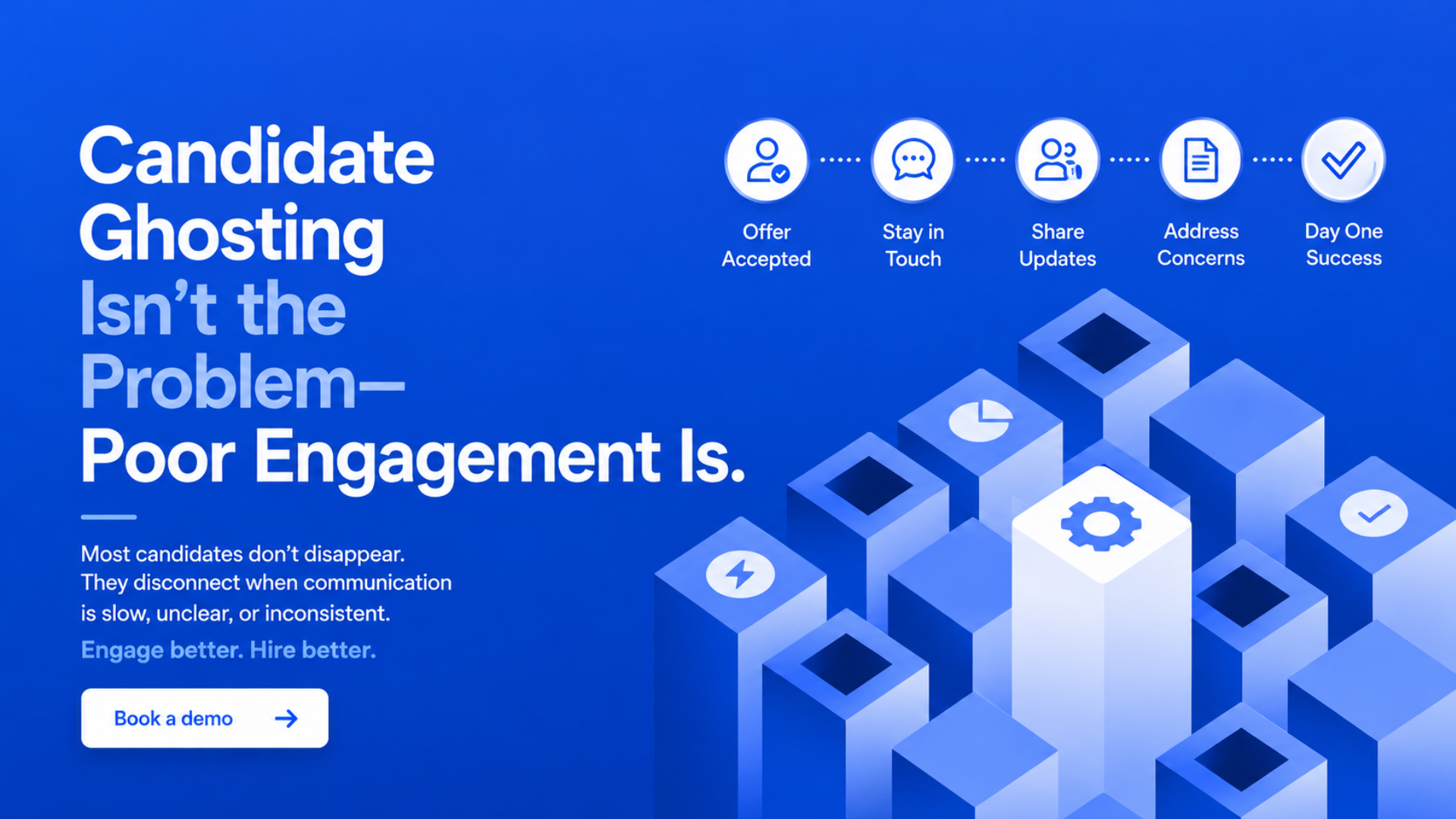
Ghosting is not a candidate problem. It never was. It is the predictable result of recruiting
processes that fail to maintain the engagement candidates need to stay connected and interested. The candidates who ghost are not unreliable. They are responding rationally to an experience that gave them decreasing reasons to continue. The solution is not to send more messages, apply more pressure, or write off ghosted candidates as uncommitted. The solution is to fix the engagement gaps that drive them away in the first place. Speed, relevance, transparency, and consistency are not aspirational goals. They are the minimum standard for any recruiting process that expects candidates to invest their time and attention. Huntlo.ai provides the intelligence layer that makes this standard achievable, detecting the engagement signals that predict ghosting, generating the personalized follow-ups that prevent it, and re-engaging silent candidates with the context and relevance that generic blasts cannot deliver. Stop blaming candidates for a problem your process created. Fix the process. Fix it with Huntlo.