The hiring manager kept asking the same question after every interview that ended without an offer. Why did they seem so disengaged? The recruiter, Tom, started tracking the pattern. Candidates arrived at the interview with their questions already prepared, their enthusiasm already calibrated, and their impression of the company already formed. The interview itself was not creating the engagement problem. It was revealing it. Tom traced the candidate journey backward and found the real story. Between the initial outreach and the first interview, candidates received an average of four messages from his team. Two were scheduling logistics. One was a template reminder. Only one contained any substance, and that one arrived three days late. The pre-interview experience was generic, slow, and impersonal. By the time candidates sat down with the hiring manager, they had already concluded that the company was disorganized and the role was not a priority. They showed up because they had committed to the interview, but their engagement had been eroded long before they walked through the door.
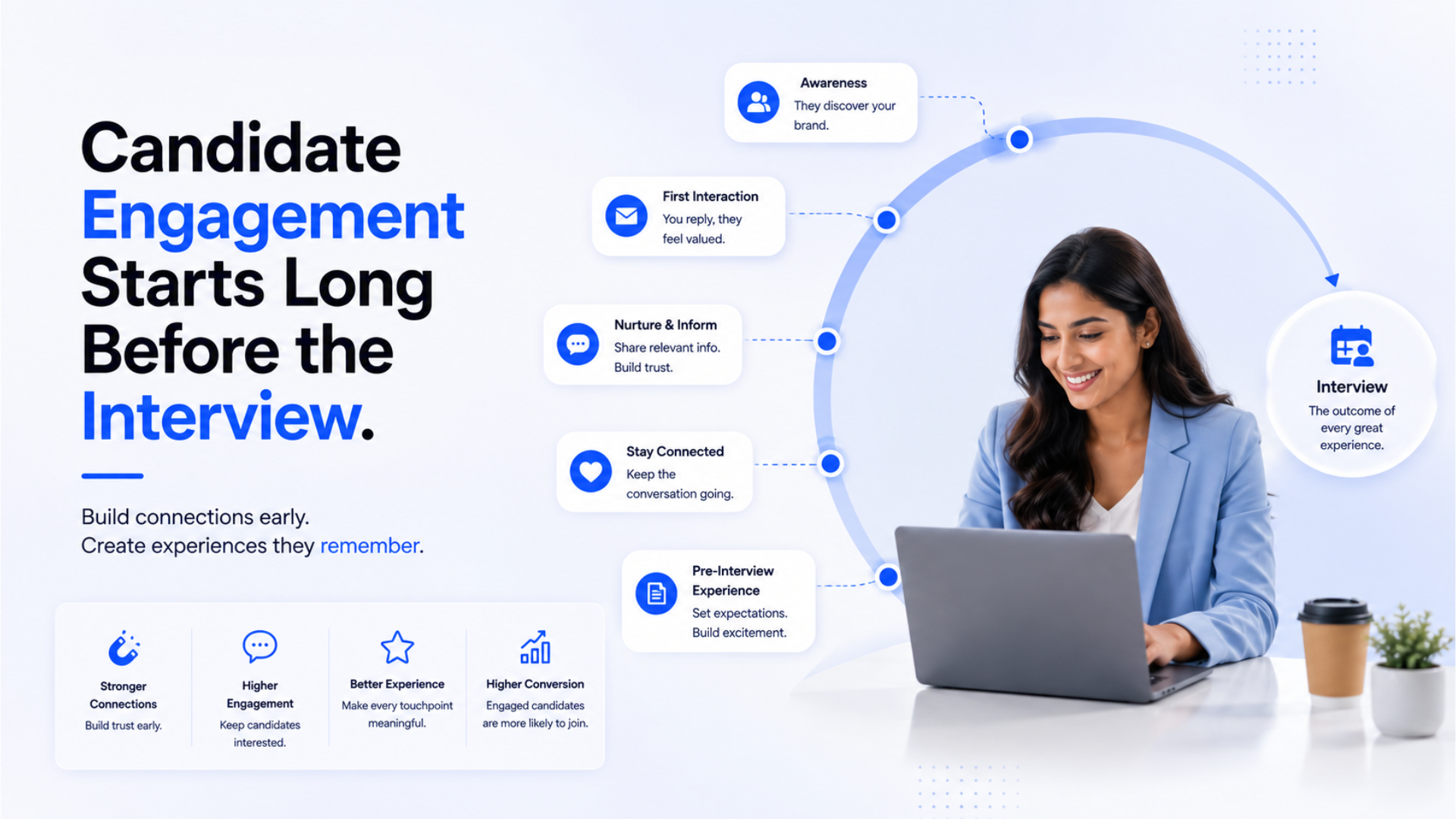
The pre-interview phase of recruiting, the period between first contact and first interview, is the most consequential and least managed stage of the entire hiring process. It is during this phase that the candidate forms their foundational impression of the organization, develops their initial level of trust in the recruiter, and decides, often subconsciously, how seriously they will take the opportunity. Despite this, most recruiting teams invest the vast majority of their engagement effort in the interview stage and beyond, focusing on interview preparation, debrief quality, and offer negotiation while treating the pre-interview phase as a logistical bridge to be crossed as efficiently as possible. This misallocation of engagement effort is one of the most expensive mistakes in talent acquisition, because the pre-interview phase is where the highest-leverage engagement interventions are possible. A candidate whose pre-interview
experience is fast, personalized, and informative arrives at the interview already favorably disposed, already trusting the recruiter, and already curious to learn more. A candidate whose pre-interview experience is slow, generic, and opaque arrives at the interview already skeptical, already comparing the opportunity unfavorably to alternatives, and already considering whether the process is worth continuing. According to SHRM's talent acquisition research, the pre-interview phase accounts for approximately sixty percent of the variance in candidate engagement level at the interview stage, making it by far the strongest predictor of how the interview will go and whether the candidate will continue.
The Pre-Interview Window: Where Opinions Are Actually Formed
Psychological research on first impressions provides a useful framework for understanding why the pre-interview phase is so powerful. When a person encounters a new entity, whether a person, an organization, or an opportunity, their brain rapidly forms an initial impression based on the limited information available. This initial impression serves as a filter for all subsequent information. Once the impression is formed, the brain interprets new information in a way that confirms the existing impression rather than challenging it. This confirmation bias means that a candidate who forms a positive pre-interview impression will interpret a mediocre interview more favorably than it deserves, while a candidate who forms a negative pre-interview impression will interpret an excellent interview more skeptically than it deserves. The interview does not reset the candidate's opinion. It is filtered through the opinion that was already formed. This is why two candidates can have the exact same interview experience and walk away with completely different impressions. The difference is not the interview. It is the pre-interview experience that shaped the lens through which the interview was evaluated.
The practical implication is that the pre-interview phase should be treated with the same care and intentionality that most teams currently reserve for the interview itself. Every message, every interaction, and every day of silence is either building a positive filter or a negative one. The recruiters who understand the difference between AI sourcing and AI recruiting apply this principle instinctively. Sourcing identifies candidates. The pre-interview phase is where the recruiting relationship begins, and the quality of that beginning determines everything that follows. According to McKinsey's organizational insights candidates who rate their pre-interview experience positively are three times more likely to accept an offer than those who rate it negatively, even when the interview experience and compensation are identical. The pre-interview phase is not a preamble to the real process. It is the most important part of the process, and it deserves the most investment, not the least. For teams competing for niche and technical roles where candidates often receive multiple interview invitations simultaneously, the pre-interview experience is often the deciding factor in which interview the candidate actually attends and how much energy they invest in preparing for it.
Your First Message Is Your First Impression
The first message a candidate receives from a recruiter is not just an invitation to connect. It is the candidate's first data point about the organization behind the opportunity, and candidates evaluate that data point with extraordinary precision. A first message that references the candidate's specific background, demonstrates knowledge of their field, and connects their experience to a concrete aspect of the role tells the candidate three things: this organization knows who I am, this role is relevant to my career, and the people here are professional enough to do their homework. A first message that is clearly a template, makes no reference to the candidate's background beyond their name and title, and could have been sent to anyone with a similar keyword match tells the candidate the opposite: this organization does not know me, this role may not be specifically right for me, and these recruiters are going through the motions. These impressions form within seconds of reading the message, and they are remarkably persistent. A candidate who received a generic first message will carry that negative initial impression through every subsequent interaction, requiring the recruiter to work significantly harder to overcome it. A candidate who received a personalized first message will extend the benefit of the doubt through minor process hiccups, because their foundational impression is positive.
The challenge is that most recruiters do not have time to research every candidate thoroughly before reaching out, especially when managing high-volume sourcing campaigns. This is where AI becomes transformative. An AI-powered platform can analyze a candidate's professional profile, identify the most relevant talking points, and generate a personalized first message draft in seconds, achieving a level of personalization that would take a human recruiter thirty to forty-five minutes per candidate. The recruiter reviews the draft, adds personal context, and sends a message that demonstrates genuine knowledge and interest. This capability does not just improve response rates. It fundamentally changes the candidate's first impression of the organization, creating a positive filter that benefits every subsequent interaction. It is no coincidence that referrals outperform cold outreach so consistently. A referred candidate's first interaction is inherently personalized because the referring employee provides context that the recruiter would otherwise have to research. AI first-touch personalization aims to give every candidate that same referral-quality first impression, regardless of how they entered the pipeline. Understanding how many followups one hire actually needs is important, but the quality of the first message shapes the candidate's receptivity to every follow-up that follows, making it the single highest-leverage touchpoint in the entire process.
The Screening Call: Engagement Make or Break
The screening call is the first live interaction between the recruiter and the candidate, and it is the moment where the pre-interview impression either deepens or fractures. Most screening calls follow a standard format: the recruiter confirms the candidate's background, asks about their current role and motivations, provides an overview of the position, and discusses basic logistics like compensation range and timeline. This format is efficient but often transactional. It gathers information without building a relationship, and it presents the opportunity without creating excitement. The candidates who arrive at the interview most engaged are those
whose screening calls felt like genuine conversations rather than checklist exercises. The difference is not in the questions asked but in how the recruiter listens and responds. A relational screening call is characterized by three behaviors. First, the recruiter asks a question and then explores the candidate's answer before moving on, demonstrating curiosity about the candidate as a person rather than as a credential. Second, the recruiter connects the role to the candidate's expressed priorities, showing that they listened and that the opportunity genuinely aligns with what the candidate cares about. Third, the recruiter provides information the candidate would not otherwise have, such as context about the team's challenges, the hiring manager's leadership style, or strategic initiatives that make the role more compelling than the job description alone suggests.
These three behaviors transform the screening call from a gatekeeping exercise into an engagement-building opportunity, and the impact on subsequent conversion rates is significant. Candidates who feel the screening call was a genuine conversation rather than a transactional screening are far more likely to invest energy in interview preparation, to speak positively about the opportunity to peers, and to maintain their engagement through the inevitable delays and uncertainties of the hiring process. However, delivering this quality of screening call consistently requires the recruiter to have deep context about the candidate before the call begins. They need to know the candidate's career trajectory, their recent projects, their likely motivations, and the specific aspects of the role that would resonate most. Gathering this context manually for every candidate is impractical at scale, which is why many screening calls default to the transactional format. An agentic AI recruiting platform can generate pre-call briefings that synthesize the candidate's profile into actionable insights, enabling the recruiter to conduct a relational screening call without hours of manual preparation. The teams that add technology without changing their conversational approach often find they have more tools but the same hiring problems, a pattern documented in the analysis of organizations with more tools but the same hiring problems. The AI provides the intelligence. The recruiter provides the human connection. Both are necessary, and neither is sufficient alone.
What Happens Between Contact and Interview Matters Most
The gap between the screening call and the first interview is where most pre-interview engagement strategies fail, and it is the period where the candidate's impression is most vulnerable. During this gap, the candidate is waiting. They have invested time in a screening call, expressed interest, and are now in a holding pattern while the organization coordinates schedules, collects internal feedback, or simply delays. During this waiting period, three things happen simultaneously. First, the candidate's initial enthusiasm decays naturally, as it does for any new interest that is not reinforced. Second, the candidate is exposed to competing opportunities, because the act of engaging with your organization has made them more visible to other recruiters and more open to exploring alternatives. Third, the candidate begins to form judgments about your organization based on how you handle the waiting period. A candidate who receives a thoughtful follow-up within twenty-four hours of the screening call, sharing relevant information about the team or addressing a topic they discussed, experiences the
waiting period as engaged attention. A candidate who waits five days with no communication and then receives a scheduling link experiences it as organizational indifference. The screening call may have been excellent, but the post-call silence undoes its impact.
Managing this gap effectively requires two capabilities: timely communication and relevant content. Timely communication means the candidate should hear from the recruiter within twenty-four hours of the screening call, and then at regular intervals until the interview is scheduled. These touchpoints do not need to be lengthy. A brief message referencing something specific from the conversation, sharing an article about a topic the candidate mentioned, or providing an update on the interview process, is sufficient to maintain the engagement that the screening call created. Relevant content means each touchpoint should add value rather than simply checking in. The candidate should feel that each message was written for them specifically, not sent from a template queue. This combination of timeliness and relevance is what maintains the candidate's positive pre-interview impression through the waiting period. According to LinkedIn's recruiting resources candidates who receive at least two substantive, personalized touchpoints between the screening call and the interview are sixty percent more likely to rate their pre-interview experience positively than those who receive only scheduling logistics. The recruiters who are concerned about whether AI will replace their jobs should recognize that AI's role in this phase is to ensure that every candidate receives this level of attention, not to replace the recruiter's voice with automation. The AI generates the context and the draft. The recruiter adds the personal touch that makes it genuine.
Why Most Engagement Strategies Start Too Late
The typical recruiting engagement playbook focuses heavily on the interview and post-interview stages. Interview preparation guides, candidate experience surveys, post-interview debriefs, and offer-stage nurturing are well-documented and widely implemented. The pre-interview phase, by contrast, is often treated as a logistical gap to be crossed rather than an engagement opportunity to be designed. This late-start approach has a structural cause. Most recruiting metrics measure outcomes that are visible in the later stages of the funnel: interview-to-offer conversion rate, offer acceptance rate, and time to fill. These metrics naturally focus leadership attention and recruiter effort on the stages they measure. Pre-interview engagement, by contrast, is harder to measure directly because its impact shows up later in the process as higher interview engagement, better offer acceptance rates, and more positive candidate feedback. The cause-and-effect relationship between pre-interview experience and these downstream outcomes is real but indirect, which makes it easy to overlook and harder to prioritize. The result is an engagement strategy that is heavily back-loaded, investing the most effort in the stages where the marginal impact is lowest and the least effort in the stage where the marginal impact is highest.
The organizations that have recognized this imbalance and shifted their engagement investment earlier in the funnel are seeing dramatic improvements in overall hiring outcomes. They are not spending more on engagement overall. They are spending it differently, moving effort
from post-interview nurturing, where candidates are already committed and engagement is relatively easy to maintain, to pre-interview engagement, where candidates are still evaluating and every interaction shapes their trajectory. This reallocation requires new metrics that capture pre-interview engagement quality, such as candidate response time to follow-ups, conversation depth scores from screening calls, and pre-interview candidate satisfaction checks. It also requires technology that can maintain personalized, timely communication during the pre-interview phase without requiring manual effort for every touchpoint. However, technology that operates on stale data will undermine rather than enhance pre-interview engagement. Teams that have experienced the problem of outdated candidate data in AI tools know that the AI's recommendations are only as good as the data they are based on. Before investing in pre-interview engagement technology, organizations should evaluate platforms using a structured framework such as the one for evaluating an AI sourcing tool before buying, ensuring that data freshness and real-time signal detection are core capabilities. Gartner's HR trends research identifies the shift from back-loaded to front-loaded engagement as one of the most significant trends in talent acquisition, because the organizations making this shift are achieving conversion rate improvements that their competitors cannot match through any amount of post-interview investment.
Designing a Pre-Interview Engagement System
Building a systematic approach to pre-interview engagement requires three components: a clear engagement standard, technology that makes the standard achievable, and measurement that ensures the standard is maintained. The engagement standard should specify the quality, timing, and content expectations for every pre-interview touchpoint. The first message should be personalized within four hours of candidate interest. The screening call should include at least two reference points to the candidate's specific background. Post-screening follow-up should arrive within twenty-four hours and include information relevant to the candidate's expressed interests. The interview scheduling process should include context about the interviewer, the format, and what the candidate should prepare. These standards create a consistent experience that builds trust and demonstrates organizational competence. The technology component should automate the information-gathering and draft-generation work that makes these standards achievable at scale, while leaving the recruiter in control of the final message. The measurement component should track pre-interview engagement metrics, such as response rates, response times, and conversation depth, as leading indicators that predict downstream hiring outcomes.
The organizations that have implemented all three components are seeing pre-interview engagement scores that are two to three times higher than industry averages, and the downstream impact on interview quality, offer acceptance rates, and time to fill is substantial. These organizations have recognized that the pre-interview phase is not a logistical bridge but a strategic opportunity, and they have invested accordingly. EY's technology insights report that enterprises with mature pre-interview engagement systems are achieving thirty to forty percent higher candidate-to-interview conversion rates, because candidates who experience
strong pre-interview engagement are far more likely to invest in the interview process and far less likely to withdraw before it begins. Deloitte's talent research concludes that the most successful recruiting organizations of the next decade will be those that master the pre-interview phase, treating it as the foundation of every hiring outcome rather than a preamble to the process that really matters. The interview is important. But the engagement that determines how the interview goes starts long before the candidate walks through the door. Build it right from the first message. Build it with Huntlo.
Candidate engagement is not something that switches on at the interview door. It is built, or destroyed, in every interaction that precedes it. The first message sets the impression. The screening call deepens or fractures it. The post-call follow-up sustains it or lets it decay. By the time a candidate arrives at their first interview, their engagement level has already been determined not by the opportunity itself but by the experience your team created in the days and weeks before. Most recruiting teams underinvest in this phase, treating it as logistics rather than relationship-building, and then wonder why candidates seem disengaged during interviews that should excite them. The answer is not a better interview process. It is a better pre-interview experience. Huntlo.ai provides the intelligence layer that makes pre-interview engagement systematic and scalable, from personalized first-touch messages to signal-based follow-up timing to context-rich screening call preparation. Stop starting the engagement race at the interview. Start it at the first message. Start it with Huntlo.