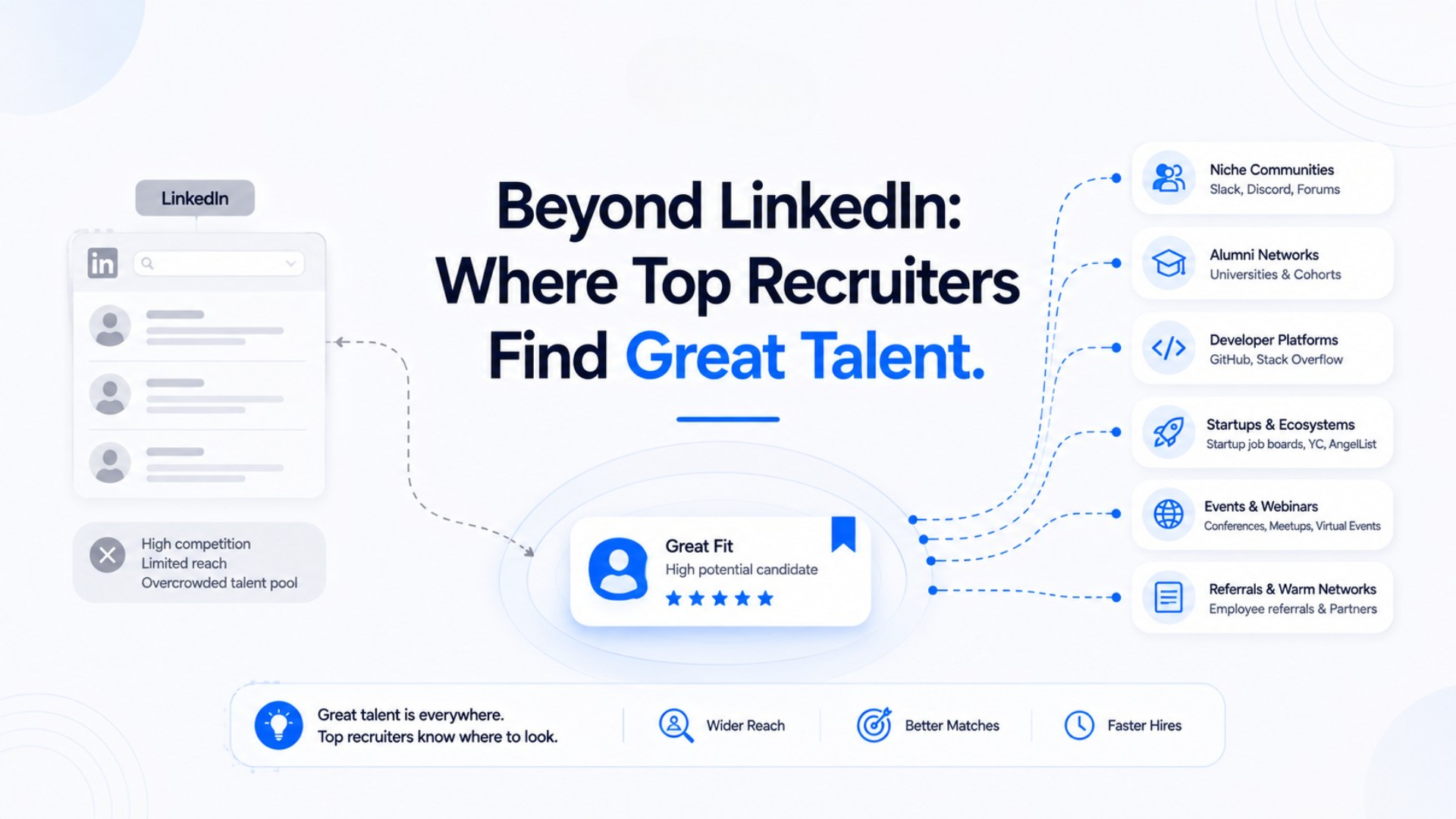
If you ask most recruiters where they find candidates, the answer is almost always the same: LinkedIn. And for good reason— LinkedIn has over a billion members, robust search functionality, and an InMail system designed specifically for recruiter outreach. But here is the problem that most recruiting teams refuse to acknowledge: if your primary sourcing strategy is the same platform that every other recruiter in the world is using, you are not sourcing. You are competing in the most crowded, most expensive, and most heavily fished talent pool in the industry. The candidates who are easiest to find on LinkedIn are also the candidates who receive the most outreach, which means your response rates are lower, your time-to-hire is longer, and your best candidates are already in conversation with your competitors before you even press send.
The recruiters who consistently land the best hires understand something that the majority do not: the most talented candidates are often the least visible on mainstream platforms. They are deeply embedded in niche professional communities, contributing to open-source projects, speaking at industry conferences, writing on specialized platforms, and building reputations in places that generic Boolean searches never reach. According to SHRM's talent acquisition research, the most effective recruiting teams source candidates from an average of six to eight distinct channels, while underperforming teams rely on one or two. The difference is not just volume— it is the quality and diversity of the candidate pipeline. This article explores the specific channels, communities, and AI-powered methods that top recruiters use to find exceptional talent that everyone else misses.
The Hidden Cost of LinkedIn-Only Sourcing
LinkedIn-only sourcing creates a set of compounding disadvantages that are easy to
underestimate. The first and most obvious is signal-to-noise ratio. Because every recruiter is searching the same database with similar keywords, the candidates who appear at the top of search results are the ones who are being contacted by dozens of recruiters simultaneously. These candidates have learned to ignore generic outreach, and even well-crafted messages get lost in the volume. LinkedIn's own recruiting resources acknowledge that InMail response rates have been declining steadily as candidate inboxes become increasingly saturated with recruiter messages, creating an environment where even strong outreach struggles to break through.
The second disadvantage is profile bias. LinkedIn profiles are self-reported and optimized for professional presentation, which means they emphasize broadly impressive credentials while often omitting the specific technical details, niche expertise, and unconventional career paths that distinguish truly exceptional candidates. A machine learning engineer who has made significant contributions to open-source projects may have a minimal LinkedIn presence because they invest their professional energy elsewhere. A startup founder who stepped back from a venture may list a gap on LinkedIn while being one of the most capable operators in their domain. McKinsey's organizational insights highlight that organizations relying on any single data source for talent intelligence consistently underestimate the available candidate pool by forty to sixty percent, because no single platform captures the full picture of professional capability.
The third disadvantage is competitive transparency. When you source exclusively from LinkedIn, your competitors can see exactly who you are looking at, who you are contacting, and what roles you are hiring for. Job postings, recruiter activity, and candidate engagement patterns are all visible to anyone with a LinkedIn Recruiter license. This transparency eliminates any element of surprise or first-mover advantage. By contrast, candidates discovered through niche communities, personal networks, or AI-powered talent intelligence platforms are effectively invisible to competitors who have not invested in those same channels. The recruiting teams that understand the difference between AI sourcing and AI recruiting know that sourcing is fundamentally about accessing candidate pools that competitors cannot easily reach, and LinkedIn is the opposite of that.
Open-Source Communities and Developer Platforms
For technical roles, open-source platforms are arguably the richest and most underutilized sourcing channel available. GitHub alone hosts over one hundred million developers, and the code they write, the issues they comment on, and the projects they maintain provide a more accurate picture of their technical capabilities than any resume could. A developer who has contributed significantly to a popular framework, maintained a widely-used library, or resolved complex architectural issues in a major open-source project has demonstrated exactly the kind of technical depth and problem-solving ability that hiring managers are looking for. This is especially true for niche and technical roles where LinkedIn profiles tend to be sparse and generic, but GitHub contributions reveal exceptional ability.
The challenge with open-source sourcing has traditionally been discoverability. Finding the right candidates requires understanding project ecosystems, evaluating contribution quality, and mapping technical skills to role requirements— tasks that are time-consuming and require domain expertise. This is where AI-powered talent intelligence platforms create a significant advantage. Rather than manually browsing repositories and trying to assess candidate quality from commit histories, an agentic AI recruiting platform can analyze millions of contributions across open-source ecosystems, identify candidates whose technical work aligns with specific role requirements, and surface them with contextual intelligence about their expertise, influence, and likely career trajectory. This transforms open-source communities from a promising but impractical sourcing channel into a systematic, scalable source of pre-qualified technical talent.
Beyond GitHub, platforms like Stack Overflow, GitLab, Bitbucket, and language-specific communities like PyPI, crates.io, and npm provide additional layers of technical candidate intelligence. Each platform captures different signals: Stack Overflow reveals teaching ability and depth of knowledge through answers, GitLab exposes enterprise contribution patterns, and package registries show library adoption and maintenance discipline. The recruiters who treat these platforms as a unified talent intelligence ecosystem rather than isolated tools are the ones who consistently find candidates that LinkedIn-only recruiters never see. Understanding why some AI recruiting tools have outdated candidate data is critical here, because open-source activity is continuous and real-time— platforms that only periodically scrape these sources will always be behind the curve.
Niche Professional Communities and Industry Forums
Every industry has professional communities where the most serious practitioners gather to share knowledge, debate ideas, and build their reputations. For designers, it is platforms like Dribbble, Behance, and specific Figma and Sketch communities. For data scientists, it is Kaggle competitions, specialized subreddits, and academic preprint servers like arXiv. For product managers, it is communities like Product School, Mind the Product, and Slack channels organized around specific product domains. For cybersecurity professionals, it is forums like Wilders Security, conference communities from DEF CON and Black Hat, and invitation-only groups where serious practitioners discuss emerging threats and defensive strategies. These communities are where candidates demonstrate their actual expertise, not their ability to optimize a LinkedIn profile.
The value of these communities extends beyond candidate identification. They provide rich contextual intelligence that transforms outreach quality. When a recruiter can reference a candidate's specific contribution to a community discussion, a competition they participated in, or a design challenge they submitted, the outreach message immediately stands out from the generic LinkedIn InMails the candidate receives daily. This is the same dynamic that explains why referrals outperform cold outreach— context and relevance create trust, and trust creates responses. Niche communities provide that context at scale for recruiters willing to invest the
time to participate in or monitor them.
The challenge, again, is scale. Monitoring dozens of niche communities, identifying promising candidates across all of them, and maintaining up-to-date intelligence on each candidate's activity is beyond what any individual recruiter can do manually. This is precisely the problem that AI-powered talent intelligence solves. By continuously monitoring community activity, analyzing contribution quality, and correlating community signals with career data from other sources, intelligence platforms can surface community-sourced candidates alongside candidates from traditional channels, giving the recruiter a single, unified pipeline that includes the best talent from every relevant source. Deloitte's talent research emphasizes that multi-channel sourcing strategies consistently outperform single-channel approaches by thirty to fifty percent in quality-of-hire metrics, because they access a more diverse and representative candidate pool.
Conference Networks, Academic Publications, and Thought Leadership
Conferences, academic publications, and thought leadership platforms represent a different category of sourcing channel— one that identifies candidates through their public intellectual contributions rather than their job search activity. A researcher who publishes influential papers at top-tier conferences has demonstrated expertise that no LinkedIn profile can capture. A practitioner who delivers keynote talks at industry events has communication skills and domain authority that make them exceptional candidates for leadership roles. An engineer who writes deeply technical blog posts about system design decisions provides more insight into their thinking and capabilities than any resume bullet point. These public contributions are signals of exceptional ability, and they are available to any recruiter who knows where to look.
The practical challenge is mapping these intellectual contributions to hiring needs. A researcher publishing in computational linguistics might be the perfect candidate for a natural language processing role, but only if the recruiter understands the connection between the research domain and the business need. Similarly, a conference speaker discussing distributed systems architecture might be ideal for a infrastructure engineering role, but only if the recruiter can assess the depth and relevance of their technical perspective. AI-powered platforms bridge this gap by analyzing publication and presentation content, mapping it to skill profiles and role requirements, and identifying candidates whose intellectual contributions align with specific hiring needs. This capability is especially valuable when organizations fall into the trap of having more tools but the same hiring problems— the issue is not a lack of data sources but a lack of intelligence that connects those sources to actual hiring decisions.
Thought leadership platforms like Medium, Substack, personal blogs, and industry-specific publications provide another rich layer of candidate intelligence. Candidates who consistently publish thoughtful content about their domain are demonstrating expertise, communication skills, and intellectual curiosity— qualities that predict success in almost any role. The recruiters who monitor these platforms and engage candidates around their published work
build relationships that feel like professional peer connections rather than recruiter transactions. This approach aligns with Gartner's HR trends on the shift from transactional to relational talent acquisition, where the recruiter-candidate relationship is built on shared professional interests rather than immediate hiring needs. The best candidates respond to recruiters who demonstrate genuine understanding of their work, and thought leadership engagement provides the perfect vehicle for that understanding.
AI-Powered Talent Intelligence: The Channel That Surfaces Candidates Everywhere
The most powerful sourcing channel is not a specific platform or community— it is the AI-powered talent intelligence layer that connects all of them. Rather than requiring recruiters to manually search LinkedIn, browse GitHub, monitor niche communities, and track conference speakers, a talent intelligence platform aggregates data from all of these sources into a unified, continuously updated candidate intelligence graph. It analyzes career trajectories, technical contributions, community activity, and behavioral signals to build comprehensive candidate profiles that no single platform could provide. It identifies candidates who match role requirements across all sources simultaneously, ranks them by fit and engagement likelihood, and surfaces the most promising ones with the contextual intelligence recruiters need to craft compelling outreach.
This is fundamentally different from the traditional multi-channel approach where a recruiter manually checks different platforms and tries to synthesize the results. In the traditional model, the recruiter is the integration layer, spending significant time navigating different interfaces, dealing with different data formats, and trying to maintain a coherent picture across multiple fragmented views. In the intelligence model, the platform is the integration layer, and the recruiter's role shifts from data gathering to strategic decision-making. Understanding how to evaluate an AI sourcing tool means assessing not just which data sources it covers but how effectively it synthesizes those sources into actionable candidate intelligence. A platform that simply aggregates data from multiple sources without intelligent analysis is just a bigger database— it does not provide the intelligence advantage that transforms sourcing outcomes.
The intelligence-first approach also solves the timing problem that plagues manual multi-channel sourcing. A candidate might be highly active on GitHub today, publish a blog post tomorrow, and give a conference talk next week. A manual sourcing process would catch whichever of these signals the recruiter happens to observe. An intelligence platform catches all of them, updates the candidate's profile in real time, and can even adjust outreach recommendations based on these evolving signals. This is why recruiters who use AI intelligence consistently outperform those who rely on manual search— they are not just searching more places, they are searching with a level of depth, breadth, and timeliness that manual effort cannot match. The recruiters who wonder whether AI will replace their jobs should recognize that the real competitive threat is not AI itself but other recruiters who use AI to source from channels that manual processes cannot effectively cover.
Building Your Multi-Channel Sourcing Engine
Transitioning from a LinkedIn-centric to a multi-channel sourcing approach does not require abandoning LinkedIn— it requires demoting it from your primary channel to one channel among many. The practical starting point is auditing your current sourcing results. How many of your recent hires came from LinkedIn versus other sources? What was the quality-of-hire difference between candidates sourced from different channels? How much time does your team spend on LinkedIn compared to the pipeline value it produces? These questions often reveal that LinkedIn produces a high volume of candidates but a lower average quality than niche channels, because the most talented candidates in any field are typically deeply embedded in domain-specific communities rather than optimizing their mainstream platform presence.
The next step is mapping your target talent profiles to the channels where those candidates are most active. Software engineers cluster on GitHub and Stack Overflow. Designers cluster on Dribbble and Figma communities. Data scientists cluster on Kaggle and arXiv. Sales professionals cluster on industry-specific Slack groups and professional associations. Each role type has its own channel topology, and the most effective sourcers map that topology systematically rather than relying on the one-size-fits-all approach of LinkedIn search. Understanding how many followups one hire actually needs— multi-channel candidates often require fewer follow-ups because the initial outreach is more relevant and contextual, leading to higher first-touch response rates and shorter overall engagement cycles.
The final step is investing in the intelligence infrastructure that makes multi-channel sourcing operational at scale. This means adopting a talent intelligence platform that can aggregate, analyze, and act on data from all relevant sources simultaneously, not just a collection of point tools that each cover a single channel. Huntlo.ai provides exactly this capability. Its intelligence engine continuously monitors candidate signals across professional platforms, open-source communities, publication databases, and niche forums, building comprehensive candidate profiles that go far beyond what any single source can provide. Whether you are hiring for mainstream roles or niche technical positions— Huntlo surfaces the right candidates from the right channels with the intelligence you need to engage them effectively. The recruiters who will win the talent war are not the ones who search hardest on LinkedIn. They are the ones who search smarter across every channel. And with Huntlo, that multi-channel intelligence is built in.