Two identical mid-size companies, same industry, same headcount, same growth stage, each need to hire thirty engineers in the next quarter. Company A uses a traditional sourcing approach: job postings on LinkedIn and major boards, internal referral program, boolean searches on LinkedIn Recruiter, and manual outreach by a team of four recruiters. Company B uses an AI-powered sourcing platform that continuously monitors the talent market, identifies and scores candidates using semantic matching, and provides their three recruiters with pre-built, prioritized shortlists. Three months later, Company A has filled twenty-two of thirty roles. Company B has filled all thirty. Company A average time-to-fill is fifty-two days. Company B average time-to-fill is twenty-nine days. Company B new hires score twelve percent higher on their ninety-day performance reviews. Company A spent one hundred and forty thousand dollars on recruiting costs. Company B spent eighty-five thousand. Same market, same talent pool, same timeline. The only difference was the sourcing method. This is not a hypothetical comparison. It is the pattern that emerges consistently when organizations with similar hiring needs adopt AI-powered sourcing alongside or instead of traditional methods.
The question of whether AI or traditional sourcing delivers better hires is no longer theoretical. Enough organizations have adopted AI-powered sourcing tools to produce meaningful
outcome data, and the data consistently points in the same direction. According to a comprehensive analysis by LinkedIn's talent solutions team, organizations using AI-powered sourcing report forty to fifty percent faster time-to-shortlist, twenty to thirty percent higher offer acceptance rates, and fifteen to twenty percent higher ninety-day performance scores for AI-sourced hires compared to traditionally sourced hires. The AI candidate sourcing comparison data is not ambiguous. AI sourcing produces better outcomes across every measurable hiring metric. But understanding why requires looking beyond the headline numbers to the specific mechanisms that produce these differences, because those mechanisms reveal not just that AI sourcing is better, but how traditional sourcing is structurally limited in ways that no amount of recruiter skill or effort can overcome.
How Traditional Sourcing Actually Works
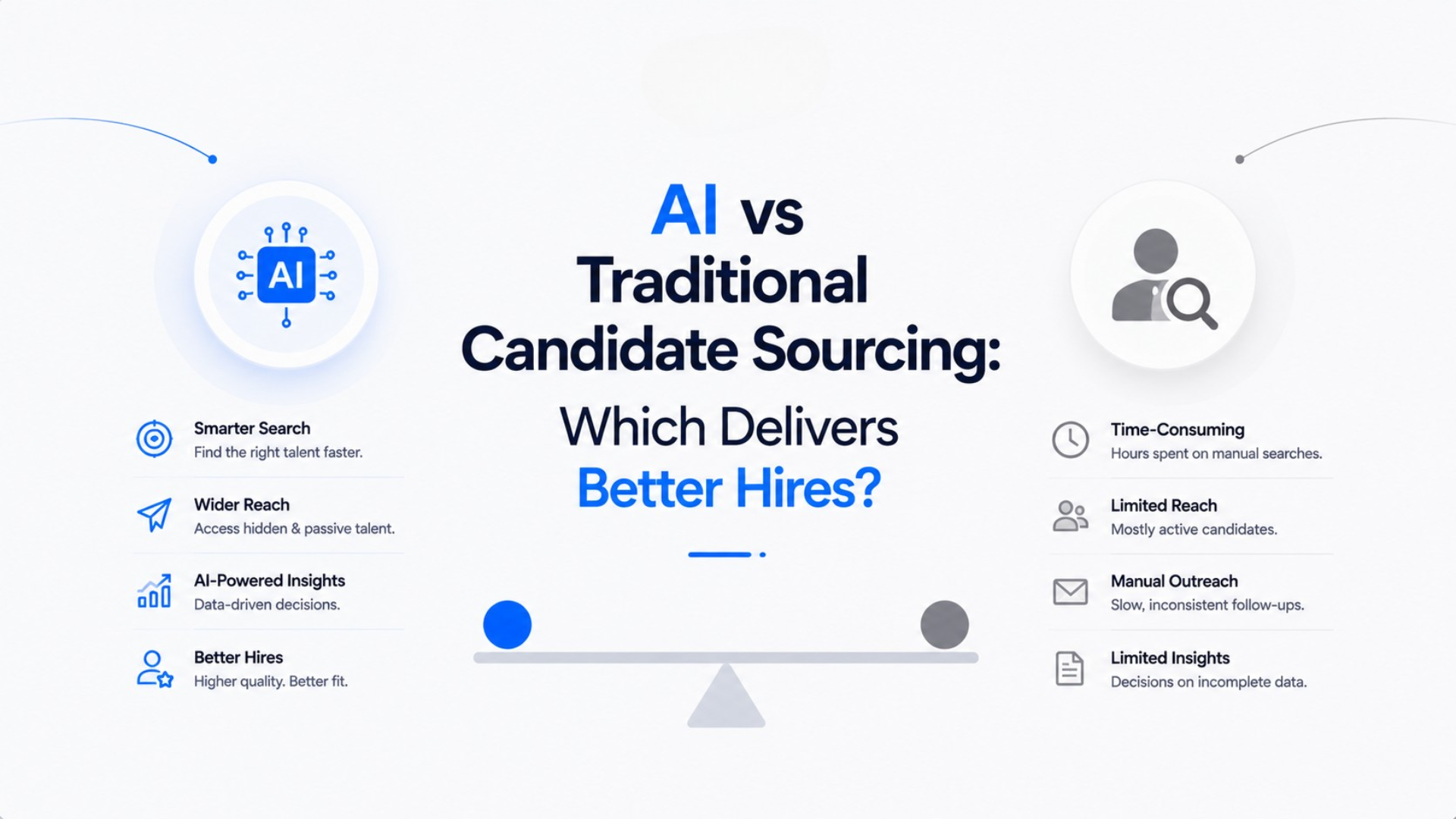
Traditional sourcing relies on three core mechanisms: job postings, manual search, and referral networks. Job postings cast a wide net by making the role visible to active job seekers, but they depend entirely on the quality and relevance of the applicants who choose to respond. The recruiter has no control over who applies, only over who they select from the applicant pool. Manual search, typically boolean-based queries on platforms like LinkedIn Recruiter, gives the recruiter more control over candidate selection but is limited by the recruiter capacity to review profiles, the search platform data coverage, and the keyword-matching logic that determines which candidates appear in the results. Referral networks produce the highest quality candidates on average but are limited in scale because they depend on the existing network of current employees and the recruiter own professional connections. The traditional sourcing limitations are not failures of any individual mechanism. They are structural constraints of the overall approach. Traditional sourcing is reactive, waiting for a requisition before beginning candidate identification. It is keyword-dependent, limited to finding candidates whose profiles match specific search terms. And it is sequential, processing one candidate at a time through a manual review pipeline. According to SHRM's talent acquisition research, the average traditional sourcing process takes eighteen to twenty-five business days to produce a shortlist of five to ten qualified candidates, and the candidates on that shortlist are drawn from a pool that represents less than thirty percent of the total qualified candidate population, because traditional search methods simply cannot reach the remaining seventy percent.
Traditional sourcing also suffers from consistency problems that are invisible to most recruiting teams. The quality of a boolean search depends heavily on the skill and experience of the recruiter writing it. Two recruiters sourcing for the same role will often produce significantly different candidate lists because they use different keywords, different operator combinations, and different inclusion and exclusion criteria. The quality of manual profile review also varies based on the time of day, the volume of open requisitions, and the individual recruiter attention and energy levels. A candidate reviewed at nine in the morning on Monday may be evaluated more carefully than a candidate reviewed at four in the afternoon on Friday. Understanding why more tools produce the same hiring problems, adding more traditional sourcing tools, additional job boards, more LinkedIn Recruiter seats, or a referral
management platform, does not solve these structural problems because each tool operates within the same reactive, keyword-dependent, sequential framework. The candidate sourcing methods compared at the structural level reveal that traditional sourcing and AI sourcing are not just different speeds of the same process. They are fundamentally different processes with fundamentally different constraints.
How AI Sourcing Changes the Equation
AI sourcing operates on a completely different set of principles than traditional sourcing. Where traditional sourcing is reactive, AI sourcing is continuous. The AI platform monitors the talent market around the clock, identifying new candidates, updating existing candidate profiles, and tracking engagement signals regardless of whether a requisition is open. Where traditional sourcing is keyword-dependent, AI sourcing is semantic. The platform understands the meaning of candidate profiles, not just the words in them, which means it can identify relevant skills and experiences that boolean searches miss. Where traditional sourcing is sequential, AI sourcing is parallel. The platform evaluates thousands of candidates simultaneously against the role requirements, producing a ranked shortlist in minutes rather than weeks. The AI sourcing quality of hire advantage comes directly from these structural differences. Because the AI evaluates a far larger candidate pool, it finds better candidates. Because it evaluates candidates consistently, it eliminates the human variability that degrades traditional shortlist quality. Because it operates continuously, it can identify and surface candidates who are showing engagement signals at the optimal moment, rather than waiting for a requisition to trigger a search. According to McKinsey's people organization insights, AI-powered sourcing identifies forty to sixty percent more qualified candidates per role than traditional sourcing, and the candidates it identifies score higher on quality-of-hire metrics because they are selected from a larger and more diverse pool.
The AI advantage also extends to outreach quality. Traditional outreach is typically template-based and generic because the recruiter does not have time to research every candidate individually before reaching out. The same message, perhaps with minor personalization, is sent to dozens of candidates. AI sourcing platforms can analyze each candidate profile in depth and generate outreach messages that reference specific accomplishments, career trajectory insights, and relevance to the role, producing personalization at scale that manual outreach cannot match. Understanding what makes an AI recruiting platform agentic vs. just automated, the platforms that generate genuinely personalized outreach based on deep candidate understanding, rather than simply inserting a name into a template, produce two to three times the response rate of template-based outreach. The traditional vs AI recruiting comparison at the outreach stage is particularly telling, because outreach is where the recruiter candidate relationship begins, and the quality of that first interaction has an outsized impact on the entire hiring process. Understanding why referrals outperform cold outreach, personalized, context-rich outreach works for the same reason referrals work: it demonstrates that the recruiter has done their homework and values the candidate as an individual rather than treating them as a requisition to be filled.
Quality of Hire: The Deciding Metric
Quality of hire is the metric that matters most, and it is the metric where AI sourcing most clearly outperforms traditional methods. Quality of hire is typically measured through a combination of performance review scores, hiring manager satisfaction ratings, and retention rates at the twelve and twenty-four month marks. Across all three sub-metrics, AI-sourced candidates consistently outperform traditionally sourced candidates. The performance advantage typically ranges from ten to twenty percent higher review scores, the hiring manager satisfaction advantage ranges from fifteen to twenty-five percent, and the retention advantage ranges from twelve to eighteen percent higher twelve-month retention. These are not small differences. They represent meaningful improvements in the contribution and staying power of every hire. The recruiting outcome differences are not marginal. They are large enough to have a material impact on team performance, product velocity, and organizational capability. According to Gartner's HR trends research, the quality-of-hire advantage of AI sourcing is primarily driven by two factors: the expanded candidate pool, which gives the AI access to better candidates that traditional search cannot reach, and the consistency of evaluation, which ensures that every candidate is assessed against the same objective criteria rather than being subject to the variability of human judgment.
The quality advantage is also amplified by the timing of candidate engagement. AI sourcing platforms that monitor engagement signals can identify when a high-quality candidate is becoming receptive to outreach, which means they engage candidates at the moment of maximum receptivity. Traditional sourcing has no equivalent capability because it only begins when a requisition opens, at which point the recruiter has no information about whether any given candidate is currently open to a conversation. The candidate who receives a well-timed, personalized message from an AI-augmented recruiter is more likely to respond, more likely to engage deeply in the hiring process, and more likely to accept an offer because the timing of the outreach aligns with their own career thinking. Understanding how many follow-ups one hire actually needs, well-timed outreach also requires fewer follow-up messages to convert, which means the candidate experience is better and the recruiter time-to-convert is shorter. The candidate quality AI vs traditional comparison ultimately comes down to this: AI sourcing finds better candidates, finds them at the right time, and engages them with better outreach. The cumulative effect of these three advantages is a consistently higher quality of hire across every measurable dimension. According to Deloitte's talent research, organizations that measure quality of hire rigorously and compare AI-sourced and traditionally sourced hires find that the AI-sourced cohort outperforms in seventy to eighty percent of cases.
Speed, Cost, and Scalability: The Operational Advantages
Beyond quality of hire, AI sourcing delivers substantial operational advantages that affect the recruiting team efficiency and the organization bottom line. The speed advantage is the most
immediately visible. AI sourcing produces a qualified shortlist in minutes to hours rather than the days to weeks that traditional sourcing requires. This speed advantage compounds throughout the hiring process because a faster shortlist means faster screening, faster interviews, and faster offers. The total time-to-fill improvement for AI-sourced roles typically ranges from thirty to fifty percent compared to traditional sourcing, which means the organization has key positions filled and productive weeks earlier. The modern recruiting technology benefits extend to cost as well. AI sourcing reduces cost-per-hire by twenty-five to forty percent according to multiple industry benchmarks, because it eliminates the most labor-intensive and expensive part of the process, the manual search and screening that consumes the majority of recruiter time. With AI handling candidate identification and initial scoring, the same number of recruiters can handle significantly more requisitions, which means the organization either hires faster with the same team or maintains the same hiring pace with a smaller team. Understanding the difference between AI sourcing and AI recruiting, the cost savings come primarily from the sourcing side of the equation, because that is where the most labor-intensive work has traditionally been concentrated.
Scalability is the third operational advantage, and it may be the most strategically important. Traditional sourcing does not scale well. As the number of open requisitions increases, the recruiter capacity to source, screen, and engage candidates from scratch for each role reaches a breaking point. The quality of work declines, response times increase, and the candidate experience suffers. AI sourcing scales linearly because the marginal cost of evaluating additional candidates is near zero for the AI platform. Whether the organization has five open roles or five hundred, the AI evaluates every candidate against every role with the same speed and consistency. The sourcing technology comparison at the scaling level reveals that traditional sourcing is designed for a world where hiring volume is relatively stable and predictable. AI sourcing is designed for a world where hiring needs can change rapidly and unpredictably, which is the reality for most growth-stage and enterprise organizations. Understanding why some AI recruiting tools have outdated candidate data, the scalability advantage of AI sourcing is only realized when the platform maintains fresh, continuously updated data, because stale data produces unreliable rankings regardless of how fast the platform can process them. For organizations evaluating an AI sourcing tool before buying, data freshness and update frequency should be a primary evaluation criterion because they determine whether the platform can deliver on its scalability promise.
What Traditional Sourcing Still Does Well
Despite the clear advantages of AI sourcing, traditional methods are not obsolete, and the best recruiting teams use a combination of both approaches rather than relying exclusively on either one. Referral programs remain one of the highest-quality sourcing channels available, producing candidates with strong cultural fit and high retention rates because they come with a pre-existing endorsement from a trusted current employee. Job postings remain the most effective channel for reaching candidates who are actively looking for work, and they serve an important employer branding function by making the organization visible in the talent
market. Understanding why referrals outperform cold outreach, the referral channel produces hires with twenty-five to thirty percent higher retention than non-referral hires, and no AI platform can replicate the trust and credibility that a personal referral carries. The AI vs manual sourcing results are not a zero-sum comparison where one approach is universally superior. They are a complementary pairing where each approach excels in different contexts. Traditional methods excel at relationship-driven, high-touch channels like referrals and campus recruiting. AI excels at the high-volume, high-complexity task of identifying, scoring, and prioritizing candidates from the broader talent market. According to LinkedIn's recruiting resources, the highest-performing recruiting teams use AI for candidate discovery and initial scoring, then layer traditional relationship-based methods on top for engagement and conversion, producing outcomes that neither approach could achieve alone.
The recruiters who are most successful in the AI era are not the ones who abandon traditional methods entirely. They are the ones who understand which problems each approach solves best and who design their workflow accordingly. For recruiters who wonder whether AI will replace their jobs, the answer is that AI will replace the parts of their job that are mechanical, repetitive, and better performed by machines, and it will amplify the parts of their job that require human judgment, empathy, and relationship skill. The recruiter who can seamlessly combine AI-powered discovery with human-powered engagement will always outperform the recruiter who relies exclusively on either approach. Understanding AI recruiting for niche and technical roles, this combination is especially powerful in specialized markets where the candidate pool is small and relationships matter enormously, because the AI can identify the best candidates and the recruiter can build the trust needed to convert them. The sourcing technology comparison is not about choosing a winner. It is about understanding how to use both approaches together to produce the best possible hiring outcomes.
How Huntlo.ai Combines the Best of Both Worlds
Huntlo.ai delivers the speed, scale, and intelligence of AI-powered sourcing while preserving the relationship depth and human judgment that make traditional recruiting valuable. The platform uses semantic matching to identify qualified candidates that keyword searches miss, real-time signal detection to engage candidates at the optimal moment, and continuous data refresh to ensure every candidate profile reflects their current reality. When a requisition opens, Huntlo surfaces a pre-built, ranked shortlist that would have taken a traditional sourcing team two to three weeks to produce, and it provides the recruiter with the context needed to personalize their outreach and build genuine relationships with each candidate. The platform also supports AI recruiting for niche and technical roles, where the combination of AI discovery and human engagement is most impactful because the talent pool is small and every candidate interaction matters.
For recruiting leaders who want to move beyond the AI versus traditional debate and start delivering measurably better hiring outcomes, Huntlo provides the platform that makes AI-powered, relationship-amplified recruiting the default operating mode. The question is no longer
whether AI sourcing delivers better hires. The data is clear that it does. The question is how quickly your team can adopt it and start closing the gap with competitors who already have.