Daniel Reeves, a talent acquisition director at a midsize enterprise software company, stared at his inbox on a Monday morning and counted fourteen unresolved scheduling threads spanning three time zones. Two candidates had sent follow-up emails over the weekend expressing concern about the pace of the process. A senior engineering hiring manager had changed his travel schedule without notifying the recruiting team, invalidating three confirmed interviews. Daniel had started the month with a clear pipeline and strong candidate interest, but scheduling logistics were systematically eroding both. He was not failing at recruitment. He was drowning in coordination. His experience is far from unusual. Across industries and company sizes, recruiters report that interview scheduling is the single most time-consuming administrative task they face, consuming twenty to thirty-five percent of their working hours on average. This is not a minor inefficiency. It is a structural constraint that limits recruiting capacity, slows hiring velocity, and directly contributes to candidate withdrawal. The emerging solution is the AI scheduling assistant, and understanding what it does, why traditional tools fall short, and how to implement it effectively is becoming essential knowledge for every recruiting leader.
What an AI Scheduling Assistant Actually Does
Daniel Reeves, a talent acquisition director at a midsize enterprise software company managing forty open requisitions across engineering, sales, and product teams, was spending roughly a third of each workday on interview scheduling logistics. His calendar was a patchwork of back-to-back coordination calls, email threads with hiring managers about availability, and frantic rescheduling exchanges triggered by last-minute conflicts. Daniel knew that every hour he spent on scheduling was an hour he could not spend on sourcing passive candidates,
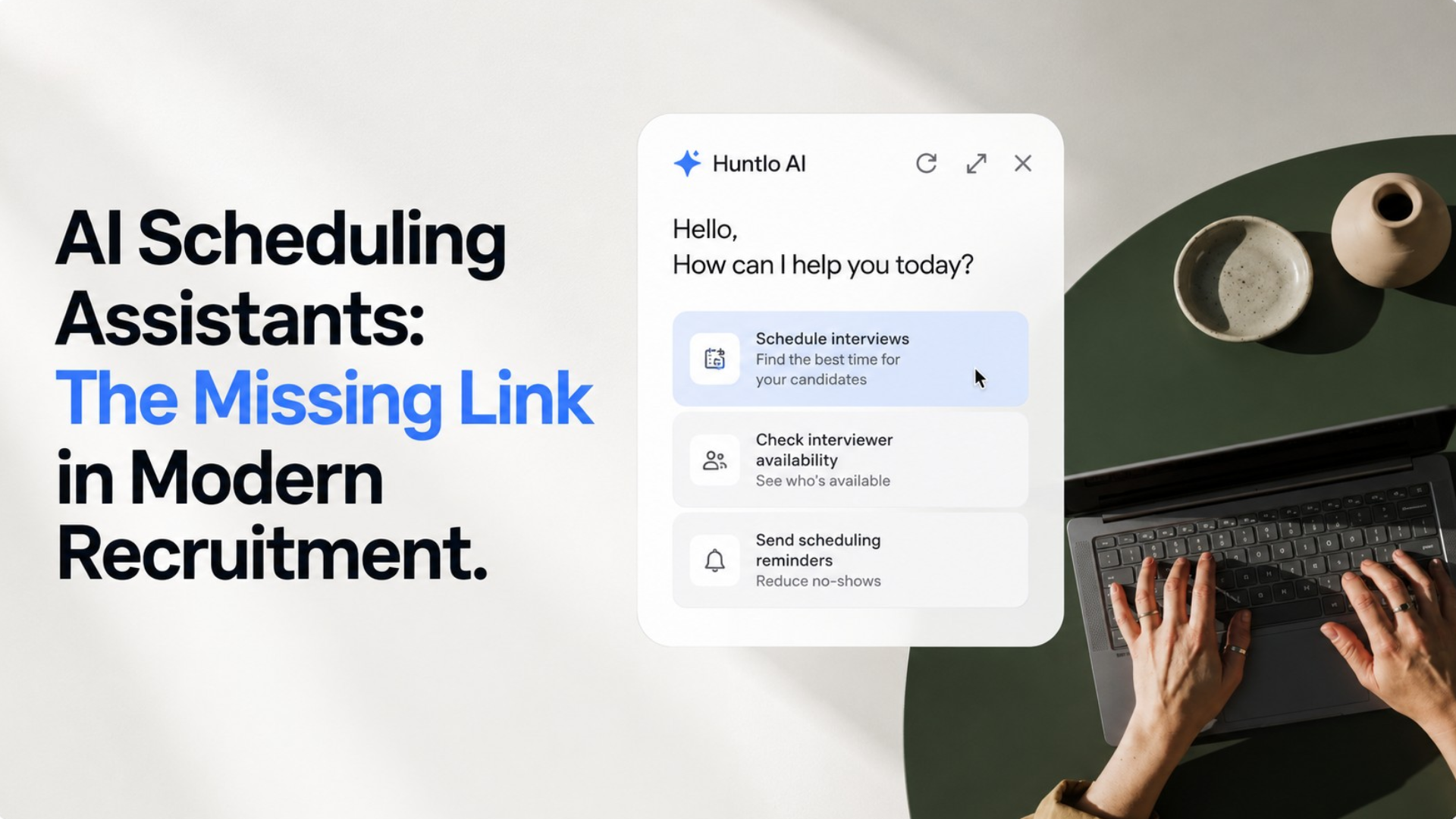
coaching hiring managers on assessment techniques, or building the strategic talent pipelines his leadership team expected. His situation is representative of a widespread but rarely discussed problem in talent acquisition: scheduling is the operational anchor that prevents recruiters from doing the work that actually drives hiring outcomes. The solution that is increasingly closing this gap is the AI scheduling assistant, a category of intelligent automation that handles the entire coordination process from initial availability detection through confirmed calendar invite, reducing what once took days to minutes.
An AI scheduling assistant operates as an autonomous agent within the hiring workflow. Unlike a basic calendar tool that simply displays free slots, an AI scheduling assistant evaluates the availability of all interview participants simultaneously, accounts for timezone differences, respects working-hour preferences, applies organizational scheduling policies, and presents candidates with confirmed or near-confirmed options rather than a list of open times that still require manual validation. According to SHRM research on talent acquisition technology adoption, organizations that have implemented AI scheduling assistants report an average reduction of sixty to eighty percent in the time required to move from interview decision to confirmed slot. This is not a marginal efficiency gain; it is a structural change in how the hiring pipeline operates, and it has cascading effects on every downstream metric from candidate experience to time-to-hire to offer acceptance rates.
The distinction between a basic scheduling tool and an AI scheduling assistant matters because many organizations invest in tools that automate only the surface level of the coordination problem while leaving the deeper complexity untouched. A true AI scheduling assistant operates as what industry analysts describe as an agentic AI recruiting platform, meaning it does not wait for human instructions at every step but instead makes decisions, resolves conflicts, and advances the process autonomously. It detects when an interviewer becomes unavailable and immediately identifies alternative options. It recognizes when a candidate has not responded within the expected window and triggers a follow-up sequence. It learns from scheduling patterns over time to propose increasingly optimal time slots. This level of autonomy is what transforms scheduling from a recruiter bottleneck into a self-service workflow that strengthens rather than strains the recruiting function.
Why Traditional Scheduling Tools Fall Short
The recruitment technology market is saturated with scheduling tools, yet scheduling remains one of the most persistent complaints among both recruiters and candidates. The reason is that most scheduling tools were designed to solve a narrow problem, such as displaying calendar availability or sending automated reminders, rather than addressing the full complexity of interview coordination. When an interview involves a single recruiter and a single candidate, almost any tool works. But real-world hiring processes routinely involve three, five, or even eight participants across multiple time zones, with different scheduling constraints, varying priorities, and last-minute changes that invalidate previously confirmed arrangements. Research from McKinsey on hiring process complexity has shown that coordination difficulty increases exponentially with each additional participant, and that tools designed for
simple two-party scheduling break down rapidly as complexity grows.
A second and equally important limitation of traditional tools is their inability to maintain real-time data accuracy across multiple calendar systems. When an interviewer updates their calendar in Outlook, Google Calendar, or an enterprise scheduling platform, that change must propagate to the scheduling tool immediately. If there is any lag, the tool will propose time slots that are no longer available, triggering rescheduling cycles that add days to the process and erode candidate confidence. This problem of outdated candidate or interviewer data is one of the most common and most damaging failure modes in interview scheduling, and it is particularly prevalent in organizations that rely on multiple disconnected tools rather than an integrated platform. The result is a scheduling experience that feels disorganized and unreliable to candidates, even when the underlying intent is to provide a smooth process.
The third limitation is the absence of intelligent escalation and recovery. When a conflict or cancellation occurs in a traditional scheduling workflow, the system typically notifies the recruiter and waits for manual intervention. The recruiter must then restart the coordination process, often from scratch, consuming additional hours and extending the hiring timeline. This is especially problematic when hiring for niche or technical roles where the candidate pool is small and every day of delay increases the risk that a qualified candidate will accept a competing offer. Traditional tools handle the happy path well but fail precisely when the candidate experience matters most: during the unexpected disruptions that define real-world hiring. The gap between what traditional tools promise and what they actually deliver is why organizations continue to struggle with scheduling despite significant technology investment.
How AI Scheduling Assistants Strengthen Every Stage of the Pipeline
The impact of an AI scheduling assistant extends far beyond the scheduling phase itself, influencing candidate experience, recruiter productivity, and pipeline health across every stage of the hiring process. At the top of the funnel, faster scheduling means candidates move from initial interest to first interview more quickly, reducing the window during which competing employers can make their move. According to LinkedIn talent solutions data, the speed of the scheduling process is one of the top three factors candidates cite when describing a positive hiring experience. When scheduling happens in minutes rather than days, candidates perceive the organization as responsive, organized, and respectful of their time, perceptions that directly influence offer acceptance rates and employer brand advocacy.
Mid-funnel, AI scheduling assistants reduce the follow-up burden that consumes so much recruiter capacity. When interviews are scheduled and confirmed automatically, recruiters do not need to send multiple messages to align availability, chase down interviewer responses, or manage rescheduling logistics. Analysis of follow-up dynamics in hiring reveals that a substantial proportion of recruiter communications are purely logistical rather than evaluative, and that eliminating these logistical messages frees significant capacity for the candidate relationship building and strategic pipeline work that actually improves hiring quality. Referral
candidates, who are among the highest-converting segments of any pipeline, benefit enormously from streamlined scheduling because their expectations are set by the personal endorsement of their referring colleague. Research on why referrals outperform cold outreach shows that the referral advantage depends on a consistently positive experience from first contact through offer, and scheduling friction at any point in that journey undermines the trust that makes referrals so valuable.
At the bottom of the funnel, the compounding effect of efficient scheduling becomes visible in core hiring metrics. Organizations that implement AI scheduling assistants consistently report reductions in time-to-hire, increases in offer acceptance rates, and improvements in candidate satisfaction scores. The connection between scheduling speed and hiring outcomes is not coincidental. It reflects a fundamental truth about competitive hiring: the organizations that move fastest and demonstrate the most operational professionalism are the ones that consistently attract and secure the best talent. However, achieving these results requires selecting the right tool and integrating it properly, a challenge that many organizations underestimate. Discussions about the difference between AI sourcing and AI recruiting highlight the same principle: technology delivers results only when it is embedded in a well-designed workflow rather than deployed as an isolated point solution. Many teams attempt to solve scheduling problems by adding more tools without addressing the underlying workflow fragmentation, and this approach consistently fails to deliver the expected improvements.
What to Look for in an AI Scheduling Assistant
Evaluating AI scheduling assistants requires the same disciplined approach that applies to any recruitment technology investment. The first and most important criterion is real-time calendar synchronization across all platforms used by your interview participants. If the assistant cannot maintain current availability data for every participant, it will propose invalid slots and trigger the rescheduling cycles it was supposed to eliminate. The second criterion is multi-participant conflict resolution. The assistant must be able to evaluate the availability of five or more participants simultaneously, account for timezone differences, and present viable options without requiring manual cross-referencing. Guidance on how to evaluate an AI sourcing tool before buying emphasizes that integration depth and real-time data quality are the two most reliable predictors of whether a tool will deliver its promised value in production, and these criteria apply equally well to scheduling assistants.
The third criterion is intelligent escalation and recovery. When a conflict or cancellation occurs, the assistant should automatically identify alternative options and re-engage participants without recruiter intervention. This capability is what distinguishes a truly intelligent assistant from a basic automation tool. The fourth criterion is candidate-facing experience. The scheduling interface that candidates interact with should be clean, intuitive, and available on mobile devices. It should allow candidates to select, confirm, or reschedule without requiring an email exchange or phone call. Gartner has reported that candidate-facing technology experience is an increasingly important factor in employer brand perception, and that organizations investing in seamless candidate interfaces see measurable improvements in application
completion rates and candidate satisfaction scores.
The fifth criterion is analytics and reporting. The assistant should provide visibility into scheduling performance metrics such as average time-to-schedule, rescheduling frequency, candidate withdrawal rates during scheduling, and interviewer utilization rates. These metrics enable continuous improvement and help build the business case for further investment. A common concern among recruiting leaders is whether AI scheduling will make the process feel impersonal or reduce the recruiter role. Research on whether recruiters should worry about AI replacing their jobs consistently shows that AI scheduling amplifies recruiter effectiveness rather than diminishing it. By handling the coordination mechanics, AI assistants free recruiters to invest more time in the candidate conversations and strategic planning that define high-quality hiring. The most successful implementations present automated scheduling as a convenience that enhances the human connection rather than replacing it.
Making the Transition From Manual to AI-Assisted Scheduling
Transitioning from manual scheduling to an AI-assisted workflow requires careful planning and change management, but the process is far simpler than most recruiting leaders expect. The first step is auditing your current scheduling performance to establish a baseline. Measure the average time from interview decision to confirmed slot, track how many scheduling-related emails each hire requires, and quantify the candidate withdrawal rate during the scheduling phase. These baseline metrics serve two purposes: they help you prioritize the problems that need solving, and they provide the comparison data you need to demonstrate ROI after implementation. According to Deloitte analysis of talent acquisition transformation, organizations that establish clear baseline metrics before implementing scheduling automation are significantly more likely to report successful outcomes and to sustain those improvements over time.
The second step is selecting a solution that integrates with your existing technology stack. Scheduling assistants that require recruiters to switch between multiple platforms or manually transfer data between systems will generate frustration rather than efficiency. The most effective implementations are those where the scheduling assistant operates within the workflow that recruiters already use, connecting to the applicant tracking system, calendar platforms, and communication channels without requiring manual intervention. EY research on hiring technology adoption has found that integration quality is the single strongest predictor of user adoption and measurable business impact. Organizations that prioritize seamless integration during the selection process achieve faster time-to-value, higher recruiter satisfaction, and better hiring outcomes than those that deploy tools requiring significant workflow changes.
The third step is phased rollout with continuous feedback. Start with a single team or job category, measure the impact against your baseline metrics, gather feedback from recruiters and candidates, and refine the configuration before expanding to the broader organization. This approach reduces risk, builds internal confidence, and creates internal advocates who can champion the technology across the recruiting function. For recruiting leaders like Daniel, the transition from manual scheduling to an AI-assisted workflow is not just an operational
improvement but a strategic repositioning of what the recruiting function can deliver. Every hour reclaimed from scheduling logistics is an hour that can be invested in the sourcing, relationship building, and strategic planning that drive long-term hiring excellence. The AI scheduling assistant is not replacing the recruiter. It is removing the barrier that has always prevented recruiters from performing at their full potential.