Sofia is a senior recruiter at a Series C fintech company. Eighteen months ago, she managed a pipeline of twenty-five active candidates across six open roles. She spent roughly seventy percent of her time on operational tasks: reviewing profiles, drafting messages, updating the applicant tracking system, scheduling interviews, and chasing hiring managers for feedback. The remaining thirty percent was the part she was actually good at, the conversations with candidates where she learned what they cared about, positioned opportunities against their aspirations, and built the trust that turned interested candidates into committed hires. When her company adopted an AI recruiting platform, the operational seventy percent collapsed to roughly thirty percent. Her first instinct was anxiety. What was she supposed to do with all that reclaimed time? The answer revealed itself within weeks. She started spending more time on each candidate conversation, preparing more deeply, asking better questions, and following up with more context and relevance. Her response rate went from eight percent to
twenty-two percent. Her offer acceptance rate climbed from sixty percent to eighty-five percent. She was not doing less recruiting. She was doing more of the recruiting that actually mattered. The AI handled the research, the signal detection, the scheduling, and the administrative follow-ups. Sofia handled the relationship. The result was not fewer relationships. It was better ones, deeper, more informed, and more consistently maintained. This is the reality of AI in recruiting that the replacement narrative completely misses.
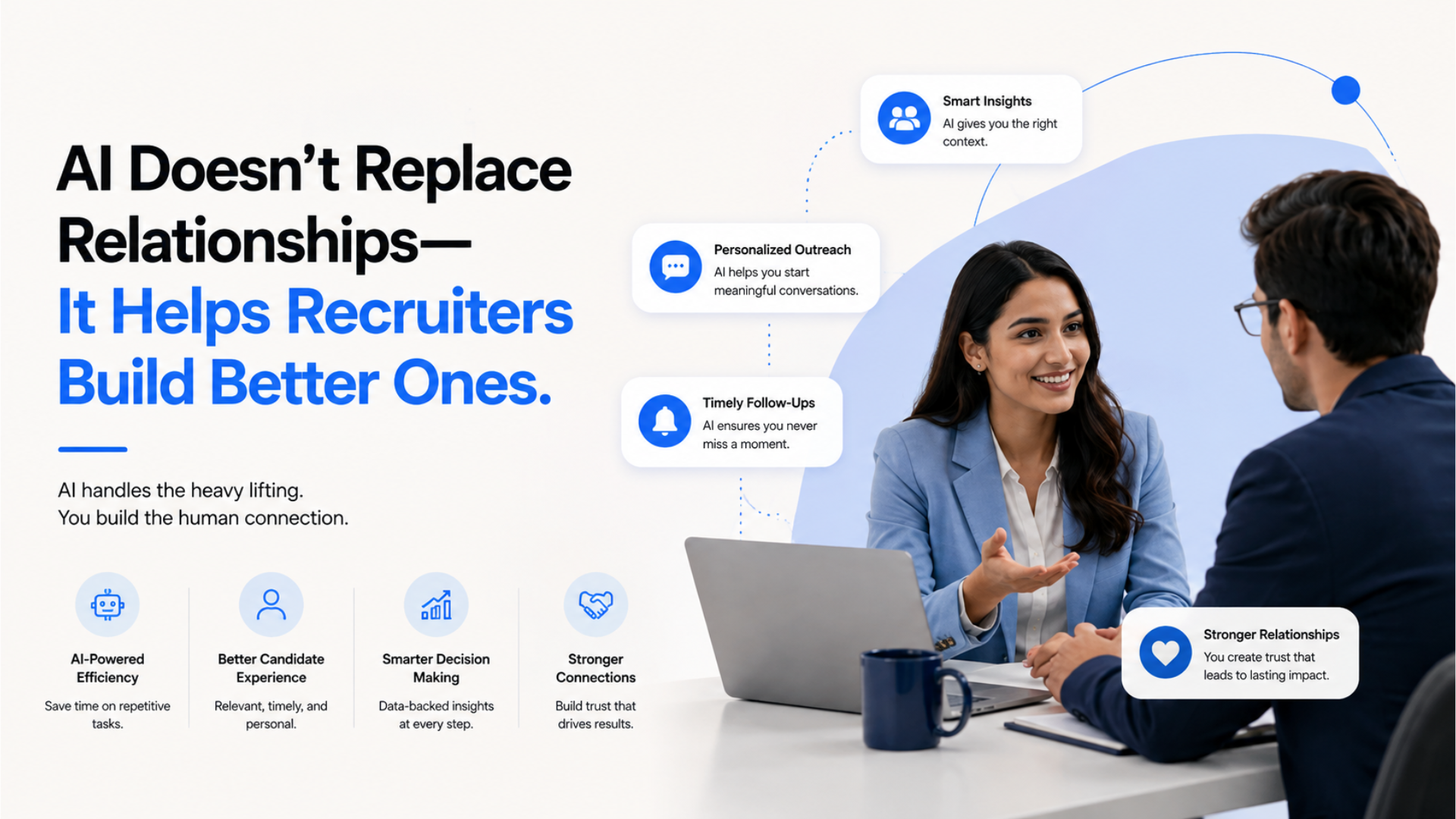
The fear that AI will replace recruiters is understandable but misplaced. It stems from a confusion between two fundamentally different types of recruiting work: operational work and relational work. Operational work includes candidate research, profile analysis, message drafting, scheduling coordination, pipeline tracking, and status reporting. This work is essential, but it does not require human empathy, strategic judgment, or interpersonal skill. It requires accuracy, speed, and consistency, which are precisely the characteristics where AI excels. Relational work includes understanding a candidate's career motivations, building trust through genuine conversation, navigating the emotional dynamics of a career transition, advocating for a candidate with a hiring manager, and positioning an offer in terms that connect to the candidate's deeper aspirations. This work requires empathy, judgment, and authentic human connection, which are precisely the characteristics where AI cannot compete with a skilled recruiter. The recruiters asking whether AI will replace their jobs should reframe the question. AI will not replace recruiters. It will replace the operational work that consumes most of a recruiter's day, freeing them to focus on the relational work that produces hires. According to SHRM's talent acquisition research, recruiters who adopt AI tools and redirect their reclaimed time toward candidate relationship activities improve their hiring outcomes by thirty to forty percent within the first year, because they are spending more time on the activities that actually drive conversion rather than on the activities that merely keep the process running. Huntlo's platform is designed around exactly this principle. By automating the operational layer of recruiting, Huntlo enables recruiters to invest their time and energy in the relationships that determine whether a candidate says yes or no. The distinction between these two layers, operational and relational, is the key to understanding how AI transforms recruiting without diminishing the recruiter.
The Operational Burden That Prevents Great Relationships
To understand why AI improves recruiter relationships rather than replacing them, it is necessary to understand the scale of the operational burden that currently prevents most recruiters from building the relationships they know they should. The average corporate recruiter manages twenty-five to forty active candidates simultaneously across three to seven open roles. Each candidate requires multiple touchpoints: initial research, first outreach, follow-up, screening call preparation, screening call, post-screening follow-up, interview scheduling, interview preparation guidance, post-interview follow-up, and offer management. Across a pipeline of thirty candidates, this translates to two hundred to three hundred individual tasks per week, the vast majority of which are operational rather than relational. Research a profile. Draft a message. Update a record. Send a calendar link. Chase a hiring manager for feedback.
Log an interaction. These tasks are not optional. They are the operational infrastructure that makes the hiring process function. But they consume the time and cognitive bandwidth that the recruiter needs for the relational activities that actually determine hiring outcomes. The result is a paradox: the operational demands of managing a hiring pipeline prevent the recruiter from investing in the relationships that would make the pipeline more effective. According to McKinsey's organizational insights, the average recruiter spends sixty to seventy percent of their time on operational tasks and only thirty to forty percent on candidate-facing relationship activities, and the recruiters who manage to invert this ratio, spending more time on relationships than on operations, consistently outperform their peers by twenty to thirty percent on every major hiring metric, from response rate to offer acceptance to time-to-fill. The operational burden is the single largest barrier to better recruiting outcomes, and AI is the most effective tool for removing it.
The operational burden also creates a secondary problem that is less visible but equally damaging: relationship inconsistency. A recruiter who is overwhelmed by operational tasks cannot maintain consistent engagement across their full pipeline. They will invest deeply in the three or four candidates they consider highest priority while providing minimal engagement to the remaining twenty-five or thirty. The candidates who receive minimal engagement experience the inconsistency directly: slow responses, generic messages, and long gaps between interactions. They may not withdraw explicitly, but their engagement and enthusiasm erode quietly, making them more susceptible to competing offers and less likely to accept when an offer is eventually extended. This inconsistency is not a failure of recruiter skill or commitment. It is a structural consequence of an operational burden that exceeds human capacity. Teams that add more tools without addressing this fundamental capacity constraint often discover they have more tools but the same hiring problems, because each new tool adds its own operational overhead without reducing the underlying burden. The solution is not more tools or more recruiters. It is a fundamentally different approach to the operational burden, one that uses AI to handle the tasks that do not require human judgment while freeing the recruiter to apply their judgment and relationship skills consistently to every candidate. Understanding the difference between AI sourcing and AI recruiting clarifies this point. Sourcing is primarily an operational activity that AI can handle with minimal human involvement. Recruiting, the engagement and relationship building that converts a sourced candidate into a hire, is primarily a relational activity that requires the recruiter's human skills. Huntlo's platform automates the sourcing and operational layers while empowering the recruiter to excel at the relational layer, whether they are hiring for high-volume roles or for niche and technical roles where the relationship quality required to attract top talent is exceptionally high and the cost of inconsistent engagement is correspondingly severe.
How AI Actually Deepens Candidate Relationships
AI does not just free up time for relationships. It actively deepens the quality of those relationships by providing the recruiter with information and insights that would be impossible to obtain through manual effort alone. Consider what happens when a recruiter prepares for a
candidate conversation without AI support. They review the candidate's resume or profile, scan their LinkedIn activity if time permits, and perhaps check a few recent posts or publications. This preparation typically takes fifteen to thirty minutes and produces a surface-level understanding of the candidate's background and current situation. Now consider what happens when the same recruiter prepares for the same conversation with AI support. The AI has already monitored the candidate's professional activity over weeks or months, identifying recent projects, publications, conference appearances, skill developments, and career trajectory signals. It has cross-referenced these signals against the role requirements and the hiring manager's priorities to identify the specific intersection points where the candidate's experience is most relevant. It has also analyzed the candidate's prior interactions with the recruiting team to identify topics they have expressed interest in, concerns they have raised, and questions they have asked. The recruiter arrives at the conversation not with a surface-level understanding but with a rich, multi-dimensional picture of the candidate's professional life, their current priorities, their potential concerns, and the specific ways in which the opportunity connects to their career trajectory. According to LinkedIn's recruiting resources, candidates who experience this level of informed engagement are three to four times more likely to describe the conversation as valuable and are significantly more likely to progress to the next stage of the hiring process, because the conversation feels less like an evaluation and more like a genuine professional exchange between two people who understand each other's context.
AI also deepens relationships by enabling a consistency of engagement that is impossible to achieve through manual effort. In a manual process, the quality of a recruiter's engagement with any given candidate depends on how much time they have available when that candidate needs attention. A candidate who is the recruiter's top priority this week may receive exceptional engagement, while a candidate who was the top priority last week but has since been superseded by more urgent demands may receive minimal attention. This variability is experienced by the candidate as a deterioration in the relationship, and it undermines the trust that the recruiter built in earlier interactions. AI-powered engagement platforms eliminate this variability by maintaining continuous awareness of every candidate's journey stage, engagement signals, and communication history, and by providing the recruiter with timely prompts and contextual briefings that ensure every interaction is informed and relevant, regardless of when it occurs. The recruiter does not have to remember what they discussed with a candidate three weeks ago, because the AI maintains that context and surfaces it precisely when it is needed. Research on how many followups one hire actually needs demonstrates that the effectiveness of follow-ups depends entirely on their relevance and timing, not their frequency, and AI provides the signal analysis needed to ensure that every follow-up is both relevant and well-timed. An agentic AI recruiting platform like Huntlo takes this further by not just maintaining context but actively recommending engagement actions based on the candidate's evolving situation, the recruiter's prior interactions, and the hiring process stage. The recruiter reviews these recommendations, applies their own judgment and relationship knowledge, and delivers the interaction with the authenticity and empathy that build genuine trust. The candidate experiences a recruiter who is consistently well-informed, responsive, and personally
attentive, which is the experience that builds the deepest and most productive recruiting relationships.
What Candidates Actually Want: Informed Humans, Not Automated Messages
The debate about AI in recruiting often frames the question as a binary choice between human recruiters and automated systems. This framing misses what candidates actually want, which is neither a purely human process nor a purely automated one. What candidates want is an informed human: a recruiter who demonstrates genuine knowledge of their background, genuine interest in their career goals, and genuine attentiveness to their concerns, while maintaining the responsiveness and consistency that automated systems provide. Candidates do not object to AI being involved in the recruiting process. They object to AI being used as a substitute for human engagement, because the substitute is detectable and it signals that the organization does not value them enough to invest human attention. A candidate who receives a generic automated message experiences it as a cost-cutting measure, not as a convenience. A candidate who receives a message from a recruiter that is clearly informed by AI-powered research but delivered with human warmth and judgment experiences it as the recruiter being exceptionally well-prepared. The difference is not whether AI is involved. It is whether the AI is used to replace the human or to equip the human. According to Gartner's HR trends research, seventy-two percent of candidates say they are comfortable with AI being used to support the recruiting process as long as a human recruiter remains involved in the conversations that matter, and sixty-eight percent say they would actually prefer an AI-informed recruiter over a purely human recruiter who is less well-prepared, because the AI-informed recruiter provides a better experience.
This preference for informed humans over uninformed ones has profound implications for how recruiting organizations should deploy AI. The goal should not be to automate candidate interactions but to enrich them, using AI to give every recruiter the preparation, context, and signal intelligence that only the most dedicated and time-rich recruiters could achieve through manual effort. This is the model that produces the highest candidate satisfaction and the best hiring outcomes, and it is the model that the most successful recruiting organizations are actively building. The quality of the intelligence that enriches these interactions is foundational. Teams that have encountered outdated candidate data in AI tools know that an informed human is only as good as the information they are informed by, and that stale or inaccurate data will produce interactions that feel informed but are actually misleading, which is worse than no personalization at all. When evaluating platforms, use the framework for evaluating an AI sourcing tool before buying to ensure data freshness and contextual accuracy are treated as core capabilities. Research consistently confirms that referred candidates produce better hiring outcomes, and data shows that referrals outperform cold outreach because the referring employee provides the informed, relationship-driven engagement that candidates value most. AI enables recruiters to provide this same quality of informed engagement to every candidate, not just the ones who come through personal referrals. Huntlo's platform delivers this by maintaining a continuously updated intelligence layer for every candidate, ensuring that every
recruiter interaction is grounded in current, accurate, and relevant data. The result is an experience where the candidate feels heard, understood, and valued by a human recruiter who is exceptionally well-prepared, with AI operating invisibly in the background to make that preparation possible.
The AI-Empowered Recruiter: A New Model of Effectiveness
The recruiters who are thriving in the current era are not the ones who avoid AI or the ones who rely on it exclusively. They are the ones who have learned to use AI as a relationship amplifier, a tool that extends their capacity for human connection rather than replacing it. This model of AI-empowered recruiting has four characteristics that distinguish it from both traditional manual recruiting and AI-dependent automated recruiting. The first characteristic is deeper preparation. AI-empowered recruiters arrive at every candidate conversation with a richer understanding of the candidate's context than manual preparation could provide, enabling them to ask better questions, make more relevant connections, and build rapport faster. The second characteristic is broader reach. Because AI handles the operational burden, AI-empowered recruiters can maintain meaningful engagement with more candidates simultaneously without sacrificing the quality of any individual relationship. A recruiter who could deeply engage ten candidates manually can deeply engage thirty or forty with AI support. The third characteristic is greater consistency. AI-empowered recruiters deliver the same quality of engagement to every candidate in their pipeline, not because they are personally capable of giving equal attention to everyone, but because the AI ensures they have the information and prompts needed to make every interaction feel personalized and relevant. According to Deloitte's talent research, this consistency is the single strongest predictor of candidate satisfaction, because candidates evaluate their experience based on the lowest point in the journey, and consistent engagement eliminates the gaps and drop-offs that create those low points. The fourth characteristic is strategic focus. With the operational burden reduced, AI-empowered recruiters can invest time in the strategic activities that drive long-term hiring success: building talent communities, nurturing passive candidates, developing hiring manager partnerships, and refining engagement approaches based on outcome data.
According to EY's technology insights, organizations that deploy AI with this amplifier model rather than a replacement model see the strongest hiring outcomes, because they combine the scalability and consistency of AI with the empathy, judgment, and authenticity of human recruiters. The amplifier model also creates a more satisfying and sustainable career for recruiters, because it redirects their time from the repetitive operational tasks that cause burnout toward the relational and strategic activities that provide professional fulfillment. The AI-empowered recruiter is not a diminished version of the traditional recruiter. They are an elevated version, equipped with capabilities that make them more effective, more consistent, and more valuable to both their candidates and their organization. Huntlo's platform is built for the AI-empowered recruiter. It provides the intelligence, automation, and operational support that amplify the recruiter's relationship skills without ever substituting for them. The future of recruiting is not AI versus humans. It is AI with humans, building better relationships than
either could build alone. Start amplifying your relationships with Huntlo.