You spent a week identifying the right person. You crafted a personalized message that referenced their recent work. They responded within hours. You scheduled a call, prepared thoroughly, and had what felt like a genuinely promising conversation. They asked insightful questions about the team, the technical challenges, and the growth trajectory. You walked away thinking this one was real. Then you sent the follow-up email on Friday as promised, and nothing arrived back. Not a polite decline. Not a request for more time. Just silence. By the following Wednesday, you sent a second note. Still nothing. Two weeks later, you noticed they updated their LinkedIn to a new role at a competitor. The most painful part is not that you lost the candidate. It is that you had them, and the pipeline broke somewhere between the conversation and the hire. This scenario plays out thousands of times every day across the recruiting industry, and it represents the single largest source of preventable hiring failure.
The disconnect between a promising first conversation and a vanished candidate is not random. It follows predictable patterns, and those patterns have identifiable causes. Most recruiters blame the candidate: they were not really interested, they got a better offer, they changed their mind. But the data tells a different story. In the majority of cases, the candidate was genuinely interested at the time of the conversation. They disengaged afterward because the recruiting process failed to maintain the momentum and trust that the initial conversation created. According to SHRM's talent acquisition research, candidate dropout between the first conversation and the offer stage accounts for nearly forty percent of all hiring failures in professional roles, making it the most expensive and most addressable leak in the recruiting funnel.
The Momentum Gap Between Call and Follow-Up
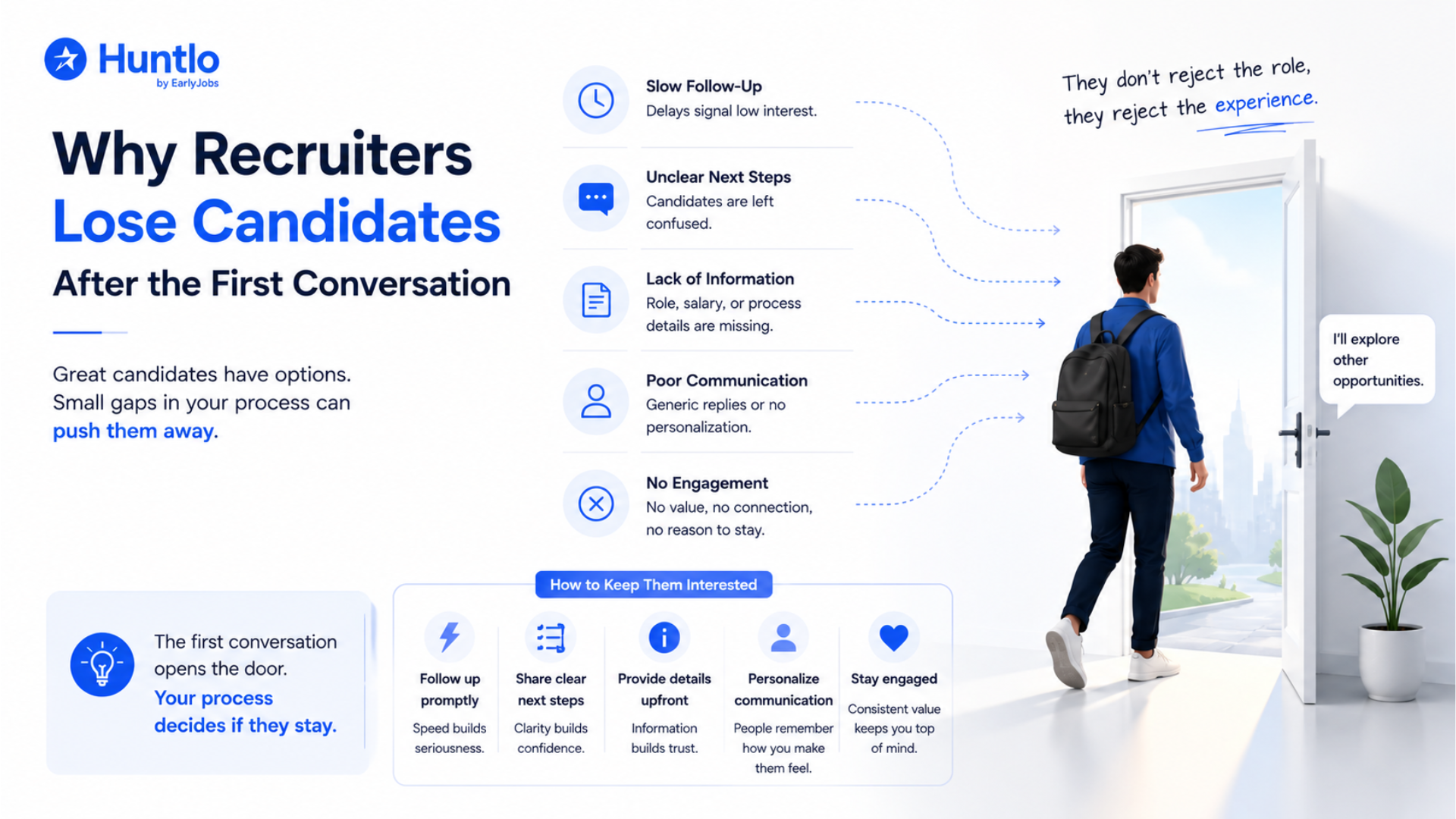
The first and most common reason candidates disengage is a momentum gap: a period of silence between the initial conversation and the next meaningful interaction. The recruiter had the candidate's attention and interest during the call, but then days pass before the next touchpoint. During that gap, the candidate's professional life continues. A project deadline hits. Their manager assigns them something new. A colleague mentions an interesting opportunity at another company. By the time the recruiter's follow-up arrives, the emotional connection and urgency that existed during the call have faded, and the email feels like it belongs to a different conversation that happened in a different context. The candidate does not respond because the moment has passed, not because they lost interest.
The solution is not simply to follow up faster, although speed helps. The solution is to design a follow-up cadence that maintains the connection without creating pressure. A brief same-day message thanking the candidate for their time and highlighting one specific thing from the conversation keeps the interaction fresh. A second touchpoint two to three days later with relevant information, a team update, an article about a topic they mentioned, or a clarification about the role, provides value and demonstrates that the recruiter was genuinely listening. This structured cadence is what separates high-conversion recruiting from the 'send and hope' approach that loses most candidates. Understanding how many followups one hire actually needs is essential, but the quality and timing of each follow-up matter more than the raw count. A well-timed, relevant touchpoint preserves the relationship. A generic check-in email destroys it.
Selling the Job Instead of Understanding the Candidate
Many recruiters lose candidates in the first conversation by treating it as a sales call rather than a discovery conversation. The recruiter arrives with a set of talking points about the company, the role, and the benefits package, and they deliver those points regardless of what the candidate actually cares about. The candidate listens politely, asks a few questions, and ends the call feeling like they were pitched to rather than understood. They have no incentive to continue the process because the recruiter has given them no reason to believe that this opportunity is specifically right for them as opposed to any other opportunity they might be considering.
The most effective first conversations follow a different structure. They begin with genuine curiosity about the candidate's current situation, career aspirations, and what would motivate a move. The recruiter listens more than they talk, and when they do share information about the role, they frame it in terms of how it connects to what the candidate has expressed. This approach builds trust and gives the candidate confidence that the recruiter is invested in their success, not just in filling a slot. According to LinkedIn's recruiting resources, candidates who feel heard and understood during the first conversation are three times more likely to advance
to the next stage than those who feel sold to. The recruiters who understand the difference between AI sourcing and AI recruiting apply this principle systematically: sourcing identifies the candidate, but recruiting, the human conversation part, is about understanding and connecting. When that understanding is absent, candidates disengage.
The Black Hole Between Recruiting Stages
Candidates do not exist in a vacuum. While they are moving through your hiring process, they are often moving through other companies' processes as well. The average passive candidate who engages with a recruiter is simultaneously evaluating two to four opportunities. In this competitive context, any period of uncertainty or silence is an opportunity for a competitor to gain ground. The most damaging version of this is what recruiters call the black hole: a period after the first conversation where the candidate has no visibility into what happens next. They do not know the timeline. They do not know who they will speak with next. They do not know where they stand. This uncertainty erodes confidence and creates the perception that the organization is either disorganized or not seriously interested.
Eliminating the black hole requires setting clear expectations during and immediately after the first conversation. Before the call ends, the recruiter should communicate the next steps with specificity: who the candidate will hear from, what the next conversation will cover, and when it will happen. After the call, the recruiter should follow through on that timeline precisely. If the timeline shifts, the recruiter should proactively communicate the update rather than waiting for the candidate to ask. This transparency is especially critical for niche and technical roles where candidates often receive multiple competing opportunities and have little patience for opaque processes. McKinsey's organizational insights have found that organizations providing clear stage-by-stage communication to candidates reduce dropout rates by twenty-five to thirty-five percent, because candidates who understand the process are far less likely to disengage due to uncertainty.
Generic Follow-Ups That Signal Low Interest
The follow-up messages that recruiters send after the first conversation are among the most important communications in the entire hiring process, yet they are also among the most neglected. Most follow-ups fall into one of two categories: the status update, which tells the candidate nothing they do not already know, or the enthusiasm check, which asks if they are still interested without providing any new reason to be. Both types signal to the candidate that the recruiter is going through the motions rather than investing in the relationship. A candidate who received a thoughtful, personalized first message and a genuine, curious conversation receives a generic follow-up and immediately recalibrates their perception of both the recruiter and the opportunity.
Effective follow-ups share three characteristics. They are specific, referencing something concrete from the conversation or providing new information relevant to the candidate's
expressed interests. They are valuable, giving the candidate something they did not have before, whether that is insight about the team, context about a business challenge, or an answer to a question they raised. And they are purposeful, advancing the process in a tangible way rather than simply checking in. This is one reason referrals outperform cold outreach throughout the hiring lifecycle. A referred candidate receives context-rich, personalized communication at every stage because the referrer provides the recruiter with the raw material for specific, valuable follow-ups. AI-powered platforms can replicate this personalization at scale by capturing conversation insights and generating follow-up recommendations that maintain the quality of a referral-style interaction. Organizations that add tools without this intelligence often find they have more tools but the same hiring problems, because the follow-ups remain generic regardless of how many tools are involved.
Failing to Address Candidate Concerns Early
Almost every candidate who engages in a first conversation has concerns they have not voiced. They may be worried about relocation, uncertain about the team's stability, skeptical about the company's growth prospects, or concerned about compensation alignment. These concerns do not disappear just because the candidate did not raise them. They persist and grow during the silence between interactions, eventually becoming reasons to withdraw. The recruiter who fails to surface and address these concerns early is allowing silent objections to accumulate until they become insurmountable. By the time the candidate finally voices their hesitation, often by simply stopping communication, it is too late to address it effectively.
The best recruiters proactively identify and address concerns during the first conversation and in the follow-up sequence. They ask direct questions: 'What would make you hesitate about a move like this?' or 'What is the most important thing you need to understand before taking the next step?' These questions signal that the recruiter is genuinely interested in the candidate's decision-making process, not just in advancing them through the funnel. They also provide critical intelligence that shapes every subsequent interaction. If a candidate's primary concern is team stability, the follow-up should include information about team tenure, retention rates, and leadership continuity. If the concern is growth potential, the follow-up should include examples of career progression within the team. This concern-aware approach transforms the recruiting process from a one-size-fits-all pipeline into a personalized engagement experience. Gartner's HR trends research identifies proactive concern resolution as one of the highest-impact practices in candidate experience, because it directly addresses the emotional factors that drive most dropout decisions.
The Recruiter Vanishes After the Hiring Manager Call
A surprisingly common pattern is the recruiter who is highly engaged through the sourcing and initial conversation stages but becomes invisible once the candidate enters the interview loop. The hiring manager takes over the conversation, the recruiter steps back, and the candidate feels abandoned by the person who originally built the relationship. This handoff failure
is particularly damaging because it happens at the stage where the candidate is making their most important evaluation of the organization. They are meeting the team, assessing the culture, and deciding whether this is a place they want to work. The recruiter who disappears at this moment sends a clear signal: you were important enough to source, but not important enough to stay with.
The solution is for the recruiter to remain a consistent presence throughout the entire process, not just the sourcing phase. Before each interview, the recruiter should provide context about the interviewer, the format, and what the conversation will cover. After each interview, the recruiter should debrief with the candidate, gather their impressions, address any new concerns, and communicate the next steps. This ongoing presence serves a practical function, keeping the candidate informed and engaged, and a psychological function, demonstrating that the organization values the candidate as a person, not just as a hiring metric. The recruiters who worry about whether AI will replace their jobs should note that this relationship-management function is precisely the kind of high-value work that AI amplifies rather than replaces. An agentic AI recruiting platform handles the operational coordination, scheduling, and information gathering so the recruiter can focus on the human connection that keeps candidates engaged through every stage. Deloitte's talent research confirms that candidates who experience consistent recruiter engagement through the interview stage are forty percent more likely to accept an offer than those who feel handed off and forgotten.
Losing a candidate after the first conversation is not a candidate problem. It is a process problem. The gap between interest and engagement is where most hiring failures happen, and it is entirely within the recruiter's control to close that gap. Structured follow-up cadences, discovery-driven conversations, transparent stage communication, concern-aware engagement, and consistent presence through the interview loop, these are the practices that keep candidates moving. Huntlo.ai provides the intelligence engine that powers every one of these practices, from evaluating an AI sourcing tool that delivers genuine talent intelligence to the follow-up workflows that maintain momentum at every stage. Stop losing candidates you already won. Build a process that keeps them. Build it with Huntlo.