Most recruiters have a sourcing strategy. They know which platforms to search, what Boolean strings to use, and how to structure their outreach sequences. But very few recruiters have a talent intelligence strategy, and the distinction is critical. A sourcing strategy answers the question: how do I find candidates? A talent intelligence strategy answers a broader and more powerful set of questions: what is happening in the talent market, where are the best candidates clustered, what are their motivations and likely trajectories, which competitors are hiring aggressively, and how should all of this information shape my approach to each individual role? According to SHRM's talent acquisition research, fewer than fifteen percent of recruiting teams have a formalized talent intelligence strategy, yet the ones that do report measurably better outcomes across every key metric: pipeline quality, time-to-fill, diversity of candidate slates, and hiring manager satisfaction.
The gap between having a sourcing strategy and having an intelligence strategy is the gap between reactive and proactive recruiting. A sourcing strategy tells you how to respond when a requisition lands on your desk. An intelligence strategy means you have been monitoring the talent market, building relationships, and accumulating knowledge before the requisition ever existed. When the role opens, you are not starting from zero. You are drawing on months of accumulated intelligence about the candidates, companies, and market dynamics that are relevant to that specific hire. This article explains what a talent intelligence strategy includes, why it has become essential for every recruiter, and how to build one using AI-powered tools that make intelligence-gathering scalable and continuous rather than episodic and manual.
What Talent Intelligence Strategy Actually Means
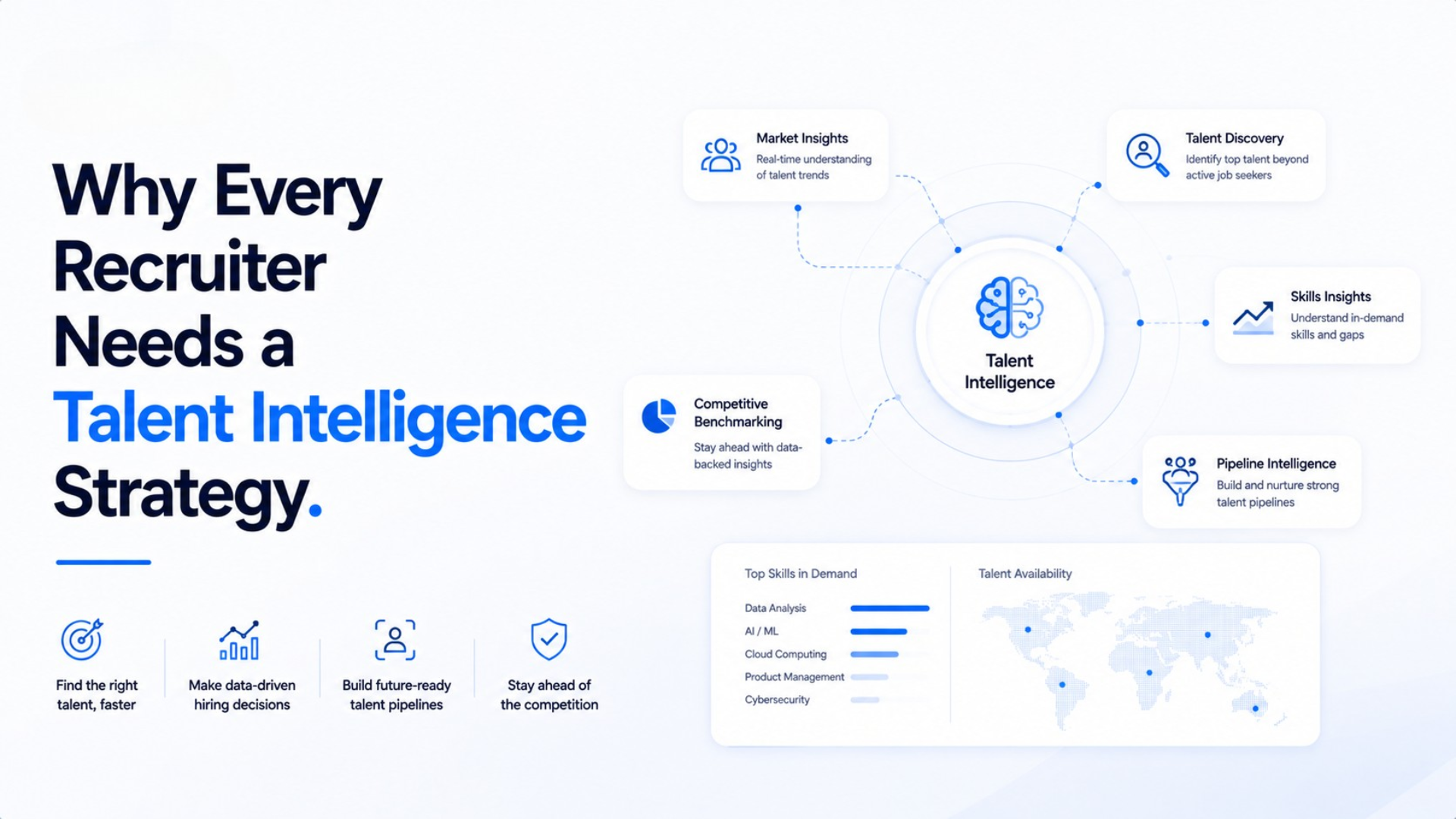
A talent intelligence strategy is a structured approach to collecting, analyzing, and acting on information about the external talent market. It operates across three levels that build on each
other. The first level is candidate intelligence: deep, continuously updated knowledge about individual candidates, including their skills, career trajectories, professional activity, and engagement signals. This is the most granular level and the one that most directly improves day-to-day sourcing outcomes. When a role opens, candidate intelligence means you already have a prioritized shortlist rather than starting from scratch. The second level is market intelligence: knowledge about the talent landscape as a whole, including skill availability by geography, compensation trends, competitive hiring activity, and emerging talent clusters. Market intelligence informs strategic decisions about where to hire, how to position your employer brand, and what to expect in terms of candidate availability and competition. McKinsey's organizational insights consistently show that organizations with strong market intelligence make better workforce planning decisions and experience less volatility in their hiring outcomes.
The third level is predictive intelligence: the ability to forecast future talent market conditions based on historical patterns and real-time signals. Predictive intelligence can identify which skills will become scarce in the coming quarter, which companies are likely to experience talent turnover, and which candidates in your pipeline are approaching career inflection points where they may become more receptive to new opportunities. Together, these three levels create a comprehensive picture of the talent market that transforms every aspect of the recruiting process, from pipeline building to candidate engagement to hiring manager advisory. The distinction between these levels matters because many organizations that believe they have talent intelligence are actually operating only at the first level. They have candidate data, but they lack the market context and predictive capability that turn candidate data into strategic advantage. Understanding the difference between AI sourcing and AI recruiting is relevant here because a talent intelligence strategy encompasses both: sourcing intelligence identifies candidates, while recruiting intelligence determines how and when to engage them for maximum impact.
The Cost of Operating Without Intelligence
Recruiting without a talent intelligence strategy is like navigating without a map. You can still reach your destination, but the journey will be longer, more expensive, and more uncertain. The most visible cost is time. Without pre-built candidate intelligence, every requisition triggers the same cycle: define search parameters, run queries, review results, shortlist candidates, and begin outreach. This reactive cycle typically takes one to two weeks before the first candidate conversation occurs, and in competitive markets that delay means the best candidates have already been engaged by competitors who started earlier. Gartner's HR trends research has found that organizations with formal talent intelligence strategies reduce their average time-to-first-engagement by forty to fifty percent, because intelligence-gathering happens continuously rather than being triggered by individual requisitions.
The less visible but more damaging cost is quality degradation. When recruiters operate without market intelligence, they make sourcing decisions based on incomplete information. They
may focus on talent pools that are easily accessible but not necessarily optimal. They may overlook entire segments of the candidate market because they lack visibility into those segments. They may misjudge candidate fit because they do not have the market context to evaluate whether a candidate's background represents genuine strength or the appearance of strength. For example, a recruiter without market intelligence might deprioritize candidates from lesser-known companies, unaware that those companies are recognized within the industry as talent powerhouses. This kind of contextual blind spot is especially problematic for niche and technical roles where the most talented candidates often come from non-obvious sources that only deep market knowledge can reveal.
There is also a strategic cost to operating without intelligence: the inability to advise hiring managers effectively. When a hiring manager asks 'where should we look for this role?' or 'what compensation range should we target?' or 'how long will this search take?', a recruiter without intelligence can only offer generic benchmarks or guesses. A recruiter with a talent intelligence strategy can answer with data: the specific companies and communities where the best candidates are concentrated, the compensation ranges that top candidates are currently commanding, and the competitive intensity that will affect timeline and strategy. This advisory capability transforms the recruiter's relationship with hiring managers from a transactional service provider to a strategic talent partner. The recruiters who understand how many followups one hire needs have operational intelligence. The ones who understand what the talent market looks like, where it is heading, and how to position their organization within it have strategic intelligence. Both are necessary, but strategic intelligence is what separates good recruiters from indispensable ones.
Building Your Talent Intelligence Framework
Building a talent intelligence strategy does not require a large team or a massive budget. It requires a structured framework and the right technology to execute it. The framework has four components. The first component is data sources. A comprehensive talent intelligence strategy draws from multiple data categories: professional platforms like LinkedIn, technical platforms like GitHub and Stack Overflow, publication databases and conference programs, company data including funding events and organizational changes, and market data including compensation surveys and talent supply reports. No single source provides a complete picture, which is why organizations that rely on a single platform for their talent intelligence consistently produce inferior results. Understanding why some AI recruiting tools have outdated candidate data is essential when designing your data strategy, because intelligence quality depends entirely on data breadth, depth, and freshness.
The second component is analytical models. Raw data without analysis is just noise. A talent intelligence strategy needs models that can extract meaningful patterns from the data: skill inference models that identify capabilities candidates have not explicitly listed, fit-scoring models that rank candidates against specific role requirements, engagement prediction models that estimate the likelihood a candidate will respond to outreach, and competitive intelligence
models that map competitor hiring activity and its implications for your talent pipeline. These models do not need to be built from scratch. AI-powered talent intelligence platforms provide them as built-in capabilities. The key is ensuring that the platform you choose offers models that are sophisticated enough to produce actionable insights rather than just rankings. Evaluating an AI sourcing tool should always include testing the quality of its analytical outputs against real hiring outcomes, not just reviewing feature lists.
The third component is action workflows. Intelligence without action is just information. The framework needs defined workflows that translate intelligence into recruiting activity: how candidate intelligence triggers outreach, how market intelligence informs role design and compensation strategy, how predictive intelligence shapes pipeline planning, and how competitive intelligence adjusts sourcing priorities. These workflows ensure that intelligence flows from the platform to the recruiting team's daily activities rather than sitting unused in dashboards. The fourth component is feedback loops. A talent intelligence strategy improves over time only if the outcomes of intelligence-driven decisions are fed back into the system. Every hire, every rejection, and every candidate interaction provides data that refines the analytical models and improves future intelligence. An agentic AI recruiting platform incorporates these feedback loops automatically, continuously learning from outcomes to produce more accurate intelligence over time. Without feedback loops, intelligence degrades as the market changes and the platform's understanding falls behind reality.
From Individual Skill to Organizational Capability
The most effective talent intelligence strategies are not dependent on individual recruiter expertise. They are embedded in the organization's technology, processes, and culture. When intelligence resides in a single recruiter's head, it leaves when that recruiter leaves. When it is embedded in an AI-powered platform, it persists, compounds, and is accessible to every member of the recruiting team. This transition from individual skill to organizational capability is what makes talent intelligence strategically valuable rather than just operationally useful. Deloitte's talent research emphasizes that organizations achieving the best talent outcomes are those that have institutionalized their intelligence capabilities through technology and process, rather than relying on the expertise of individual team members who could depart at any time.
Institutionalizing intelligence also addresses the scalability problem. Even the most knowledgeable recruiter has limits on how many markets, roles, and candidates they can track simultaneously. An AI-powered platform has no such limits. It can monitor dozens of talent markets, track thousands of candidates, and analyze millions of data points continuously, providing every recruiter on the team with the same depth of intelligence regardless of their individual experience or tenure. This democratization of intelligence means that a new recruiter can be productive faster, because they have access to the same market knowledge and candidate insights that a ten-year veteran would have accumulated through years of experience. However, organizations that add intelligence tools without changing their processes often find
they have more tools but the same hiring problems, because the intelligence is available but not integrated into the team's actual workflow. The technology must be paired with process changes that ensure intelligence is consulted, applied, and updated as a routine part of every sourcing and engagement decision.
The cultural component is equally important. A talent intelligence strategy only works if the recruiting team believes in data-informed decision-making and is willing to trust platform recommendations over gut instinct. This requires training, coaching, and visible success stories that demonstrate the value of intelligence-driven recruiting. When recruiters see that candidates surfaced by the intelligence platform convert at higher rates than candidates found through traditional search, skepticism gives way to adoption. When hiring managers receive better shortlists and faster fills because the recruiting team is using market intelligence to shape their strategy, the organizational case for investment becomes self-reinforcing. The recruiters who worry about whether AI will replace their jobs should recognize that the real risk is being on a team that fails to adopt intelligence capabilities while competitors do. Intelligence-amplified recruiters are more effective, more strategic, and more valuable to their organizations. The ones who refuse to adapt will find their roles increasingly limited to the low-value tasks that AI handles better.
A talent intelligence strategy is not a project with a start and end date. It is an ongoing operational commitment that improves with every data point, every hiring decision, and every market shift. The organizations that start building their intelligence capabilities now will have a compounding advantage over those that delay, because intelligence accumulates. Every month of monitoring adds to the platform's understanding of the talent market. Every candidate interaction refines its predictions. Every hire validates or improves its models. Huntlo.ai provides the intelligence engine that makes this strategy operational from day one. Its platform combines candidate, market, and predictive intelligence in a single, continuously updated system that gives every recruiter the strategic insight they need. Whether you are building intelligence from scratch or scaling an existing program, whether you are hiring for specialized technical roles or enterprise-wide positions, Huntlo turns talent market data into recruiting advantage. The recruiters who will lead the next decade of talent acquisition are not the ones who search hardest. They are the ones who think smartest. Build your intelligence strategy. Build it with Huntlo.