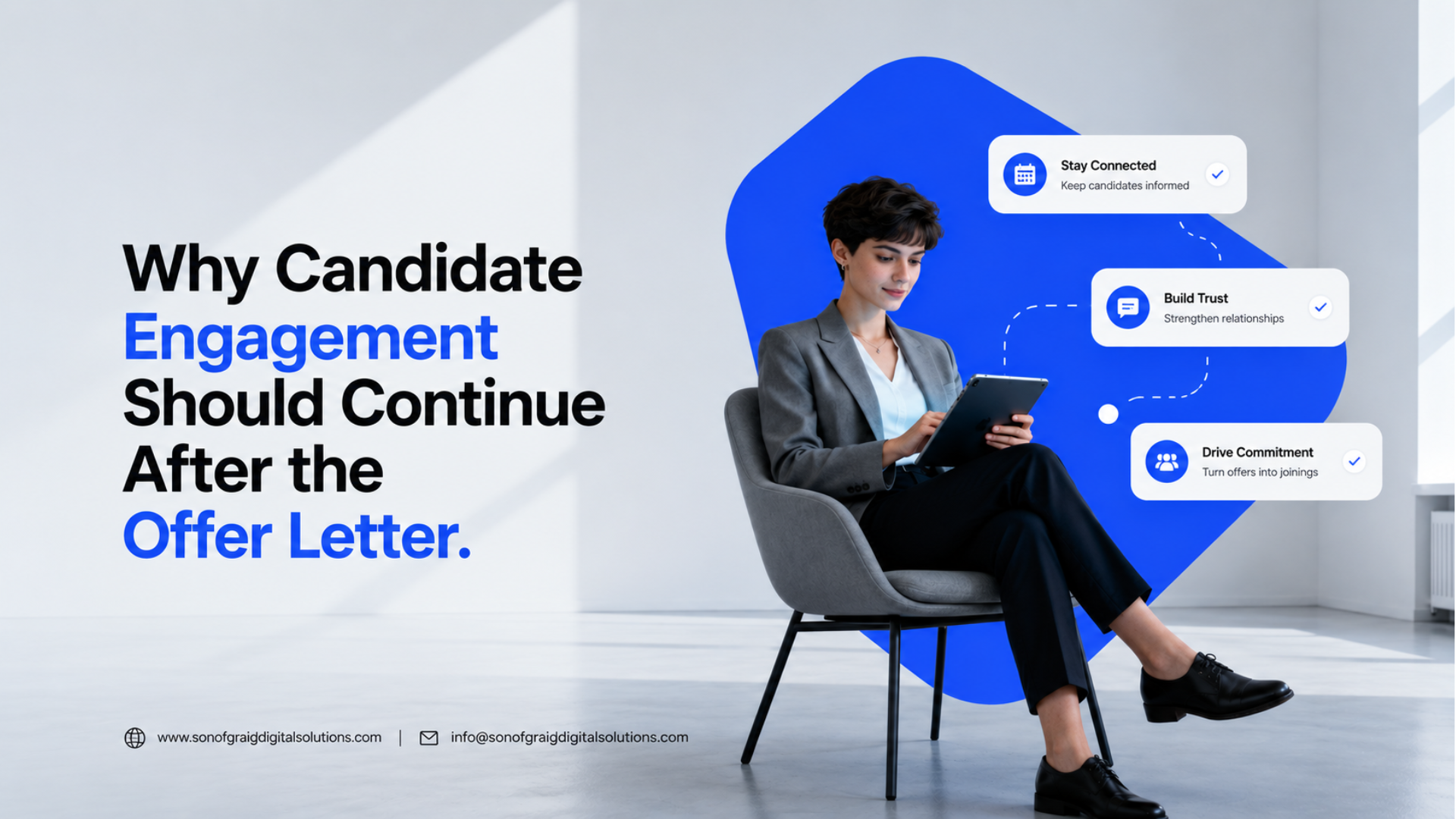
The offer letter is signed. The recruiter updates the status to filled. The hiring manager returns to their day job. The candidate, who was treated with care, urgency, and personal attention for weeks, suddenly enters a period of complete silence. No check-in calls. No team introductions. No updates about the role, the project, or the company. The candidate who was courted like a valued partner is now treated like a confirmed transaction. And this shift, from engagement to silence, is the single most expensive mistake in modern recruiting.
The data is unambiguous. Between ten and twenty percent of accepted offers never convert into actual hires, and the primary driver is not counteroffers, competing opportunities, or candidate indecision. It is the communication vacuum that follows the offer. Candidates do not withdraw because they found something better. They withdraw because the organization that was so eager to hire them stopped showing interest the moment they said yes. This is not a candidate problem. It is a process problem. And as we have explored in our analysis of why more tools produce the same hiring problems, adding technology to a process that fundamentally stops at the wrong point will not fix it. The process itself needs to extend beyond the offer.
The Offer Is Not the Finish Line
The conventional recruiting funnel treats the offer as the terminal event. Candidates enter at the top, progress through screening, interviewing, and evaluation, and exit at the bottom when they accept an offer. The funnel is measured, optimized, and reported on up to this point, and then it stops. But the offer is not the finish line. It is the starting line of the most dangerous phase of the entire hiring process. The candidate has not joined yet. They have merely agreed to join, and agreement is not the same as arrival. The period between agreement and arrival is the phase where the most hiring losses occur, and it is the phase that
receives the least investment, the least attention, and the least measurement. An AI ATS that tracks the full candidate lifecycle, from first contact through day one, reveals the true shape of the funnel. When you extend the funnel to include post-offer stages, you discover that the biggest drop-off is not between application and screening, or between screening and interview. It is between offer acceptance and joining day.
The reason this blind spot persists is structural. Most recruiting teams are measured on offer acceptance rate, not joining rate. The recruiter’s incentive is to get the signature and move on. The hiring manager’s incentive is to close the requisition and return to operational work. Neither party has a clear mandate or a measurable incentive to maintain engagement after the offer is signed. The candidate, who was the center of attention during the interview process, becomes nobody’s responsibility once the contract is signed. This is not a failure of individual recruiters or hiring managers. It is a failure of the process design, and it can only be fixed by redesigning the process to include the post-offer phase as a formal, measured, and resourced stage of the hiring journey.
What Happens When Engagement Stops
When a candidate who has been receiving regular, personalized communication suddenly hears nothing after signing the offer, they experience a jarring shift in treatment. During the interview process, they were responded to within hours. They received detailed answers to their questions. They were made to feel important and valued. After the offer, the communication drops to near zero. This contrast is not just noticeable. It is alarming. The candidate’s immediate interpretation is that the organization’s interest in them was purely transactional, driven by the need to fill a role rather than a genuine desire to bring them onto the team. And once a candidate begins to question the organization’s motivation, every doubt they had about the role, the culture, or the decision itself gets amplified.
The silence also creates an information vacuum that candidates fill with worst-case scenarios. They start reading Glassdoor reviews they had not checked before. They search for former employees on LinkedIn and ask about their experience. They revisit the job description and second-guess whether the role is what they thought it was. Each of these activities generates new information, and much of it is negative, because former employees are more likely to leave reviews when they are unhappy. The candidate who was confident and excited on offer day becomes anxious and uncertain by week two, and there is no counterweight from the prospective employer to push back against the doubt. This is why the problem of outdated candidate data in AI recruiting tools, matters even after the offer is signed. The organization needs current, accurate intelligence about the candidate’s mindset, concerns, and engagement level to intervene effectively, and that intelligence can only come from ongoing communication.
The Psychology of the Post-Offer Window
Understanding why post-offer engagement matters requires understanding what happens
psychologically when someone accepts a new job. The moment of offer acceptance is typically the emotional peak of the entire hiring process. The candidate feels wanted, validated, and excited about the future. But this peak is followed by a natural emotional decline. The excitement fades. Reality sets in. The candidate starts thinking about what they are giving up, their current colleagues, their familiar routine, their accrued benefits and seniority, rather than what they are gaining. Behavioral economists call this the endowment effect: people value what they already have more than what they might have, and the act of giving something up feels like a loss. The post-offer window is when this loss aversion is at its strongest, because the candidate has committed to the loss but has not yet received the benefits of the new role. Understanding how many follow-ups one hire actually needs, and maintaining a consistent cadence of engagement during this vulnerable period, is the most effective way to counteract the natural psychological pull toward staying put.
There is also a social dimension to the post-offer psychology. When candidates tell their friends, family, and colleagues about the new job, they receive a range of reactions. Some are supportive and celebratory. Others raise concerns about the company’s stability, the commute, or the wisdom of leaving a secure position. Each concerned question adds weight to the candidate’s internal doubt. And because the prospective employer has gone silent, there is no positive counter-narrative to offset the skepticism. The candidate is surrounded by voices questioning their decision, with no voice defending it. This is precisely the environment in which AI recruitment automation, proves its value. Automated engagement sequences ensure that the candidate continues to receive positive, informative, and reassuring communication from their future employer, even when the recruiting team is busy with other priorities. The automation does not replace the human touch. It ensures that the human touch happens consistently and on schedule.
What Post-Offer Engagement Actually Looks Like
Effective post-offer engagement is not about sending generic check-in emails every few days. It is about creating a structured sequence of meaningful touchpoints that keep the candidate connected to the organization, informed about what to expect, and reinforced in their decision. The first touchpoint should come within twenty-four hours of acceptance: a personal call or message from the hiring manager expressing genuine excitement and welcoming the candidate to the team. This sets the tone for the entire post-offer period and communicates that the candidate’s decision was the right one. In the first week, the candidate should receive an introduction to their future teammates, either through a group email, a social call, or an informal invitation to a team event. In the second week, the candidate should receive a detailed first-week agenda that shows exactly what each day will look like. In the third week, the focus shifts to practical logistics: benefits information, IT setup details, and any relocation support the candidate needs.
Each of these touchpoints serves a dual purpose. It provides the candidate with useful information that reduces uncertainty, and it gives the recruiting team an opportunity to gauge the candidate’s level of engagement and identify any emerging concerns. When a candidate who
was asking detailed questions about the role starts giving one-word answers, that is a signal. When a candidate who responded within hours starts taking a day to reply, that is a signal. These signals are easy to miss when you are managing the process manually, but a candidate pipeline software system that tracks engagement metrics in real time makes them impossible to ignore. The system flags the at-risk candidate, recommends an intervention, and ensures that the right person follows up at the right time. According to Gartner’s research on HR trends, organizations that implement structured post-offer engagement with real-time risk monitoring reduce pre-joining drop-offs by up to thirty-five percent.
The Business Case for Sustained Engagement
The financial case for post-offer engagement is straightforward. The average cost of a lost hire at the post-offer stage includes the full cost of the preceding recruiting process plus the cost of restarting the search from scratch. For most roles, this amounts to five thousand to fifteen thousand dollars per lost candidate, and significantly more for senior or specialized positions. An automated hiring platform that maintains post-offer engagement as part of its standard workflow costs a fraction of this amount. The return on investment is not marginal. It is transformational. A recruiting team that loses fifteen percent of its accepted candidates to no-shows and drop-outs is effectively spending fifteen percent more per hire than necessary. If the team makes fifty hires per year at an average cost of eight thousand dollars per hire, the annual waste from post-offer losses alone is sixty thousand dollars, a figure that would fund a substantial investment in engagement technology many times over.
Beyond the direct financial cost, there are cascading effects that compound the damage. Every no-show means a longer time-to-fill for the affected role, which means delayed projects, overworked teams, and missed revenue targets. It means the hiring manager loses confidence in the recruiting function, which leads to more conservative hiring decisions and longer interview processes in the future. It means the candidate’s professional network hears about the failed start, which damages the employer brand in ways that are difficult to quantify but very real. And it means the recruiting team spends a disproportionate amount of time on rework, filling the same role multiple times, rather than on strategic activities like building talent pipelines and improving the candidate experience. Modern recruiting software, that covers the full candidate lifecycle from sourcing through day one, is the tool that breaks this cycle. According to McKinsey’s people and organization insights, organizations that invest in post-offer engagement technology report not just lower no-show rates but higher new-hire satisfaction, faster time-to-productivity, and stronger hiring manager confidence in the recruiting function.
How to Build a Post-Offer Engagement System
Building a post-offer engagement system requires three components: a defined process, the right technology, and clear ownership. The process defines what happens at each stage of the post-offer journey, who is responsible for each activity, and what the escalation triggers are. The technology automates the scheduling, tracking, and monitoring of every touchpoint,
ensuring that the process is executed consistently regardless of volume. And the ownership model ensures that every accepted candidate has a designated point of contact who is accountable for their experience from offer to day one. This three-component model is what distinguishes an agentic AI recruiting platform from a merely automated one, and it is the difference between a system that maintains engagement through design and one that relies on individual recruiter heroics.
The technology component deserves particular attention, because the right technology does not just automate existing activities. It enables new activities that were previously impossible at scale. Real-time engagement monitoring, for example, requires tracking every candidate interaction across multiple channels, email, phone, messaging, and calculating responsiveness metrics continuously. Predictive risk scoring requires a behavioral model trained on historical data about which engagement patterns correlate with successful joins and which correlate with drop-outs. And automated escalation requires workflow logic that routes at-risk candidates to the right person, with the right context, at the right time. None of these capabilities are available in a traditional ATS or a standalone email automation tool. They require a platform that was designed from the ground up to manage the full candidate journey, including the post-offer phase. As we have discussed in our analysis of the difference between AI sourcing and AI recruiting, it is in the relationship management phase, the phase that extends well beyond the offer, that AI delivers the greatest value relative to manual processes.
The ownership model is the component that most organizations get wrong. In the typical structure, post-offer engagement is nobody’s explicit responsibility. The recruiter owns the process up to the offer. The HR team owns onboarding after day one. The gap between these two ownership boundaries is where candidates fall through the cracks. The solution is to assign a designated post-offer owner for every accepted candidate, someone whose specific responsibility is the candidate’s experience from signature through arrival. This person does not need to handle every touchpoint themselves. They need to ensure that every touchpoint happens, that the candidate’s concerns are addressed, and that any risk signals are escalated and resolved. Whether referrals outperform cold outreach, or not, every candidate deserves this level of attention during the most vulnerable phase of their hiring journey.
Why Huntlo.ai Makes Post-Offer Engagement Effortless
Huntlo.ai was designed with the explicit understanding that the hiring process does not end when the candidate says yes. The platform’s engagement engine maintains a structured, personalized sequence of touchpoints throughout the entire post-offer period, from the moment of acceptance through the first day on the job. The system uses the intelligence gathered during the sourcing and interview phases to personalize every interaction, so the candidate’s post-offer experience reflects the specific things that matter to them rather than a generic template. Real-time engagement monitoring identifies at-risk candidates before they withdraw, and automated escalation ensures that the right person intervenes at the right time. When evaluating an AI recruiting tool before buying, the most important question is whether the platform treats the post-offer phase as a core part of the process or an afterthought. Huntlo
treats it as the core.
For recruiting teams that understand that the offer is the beginning of the relationship, not the end, Huntlo provides the technology, the workflow, and the intelligence to maintain that relationship through the most critical phase of the hire. One where every candidate feels valued from first contact through day one. One where AI enhances the recruiter’s judgment, rather than replacing it, ensuring that the human touch that keeps candidates committed is delivered consistently and at scale. The recruiting teams that invest in post-offer engagement today will have a significant competitive advantage in the talent market of tomorrow, because they are building the kind of candidate experience that turns acceptances into actual employees, and employees into long-term contributors.