Screening is the most consequential stage of the hiring funnel, and it is the one most recruiting teams treat as an afterthought. Sourcing gets the attention because it is visible and creative. Interviewing gets the attention because it involves hiring managers and candidates face to face. But screening, the stage where the vast majority of candidates are either advanced or eliminated, is usually handled through a combination of resume skimming, keyword filtering, and intuition. The result is a process that is slow, inconsistent, and deeply vulnerable to bias.
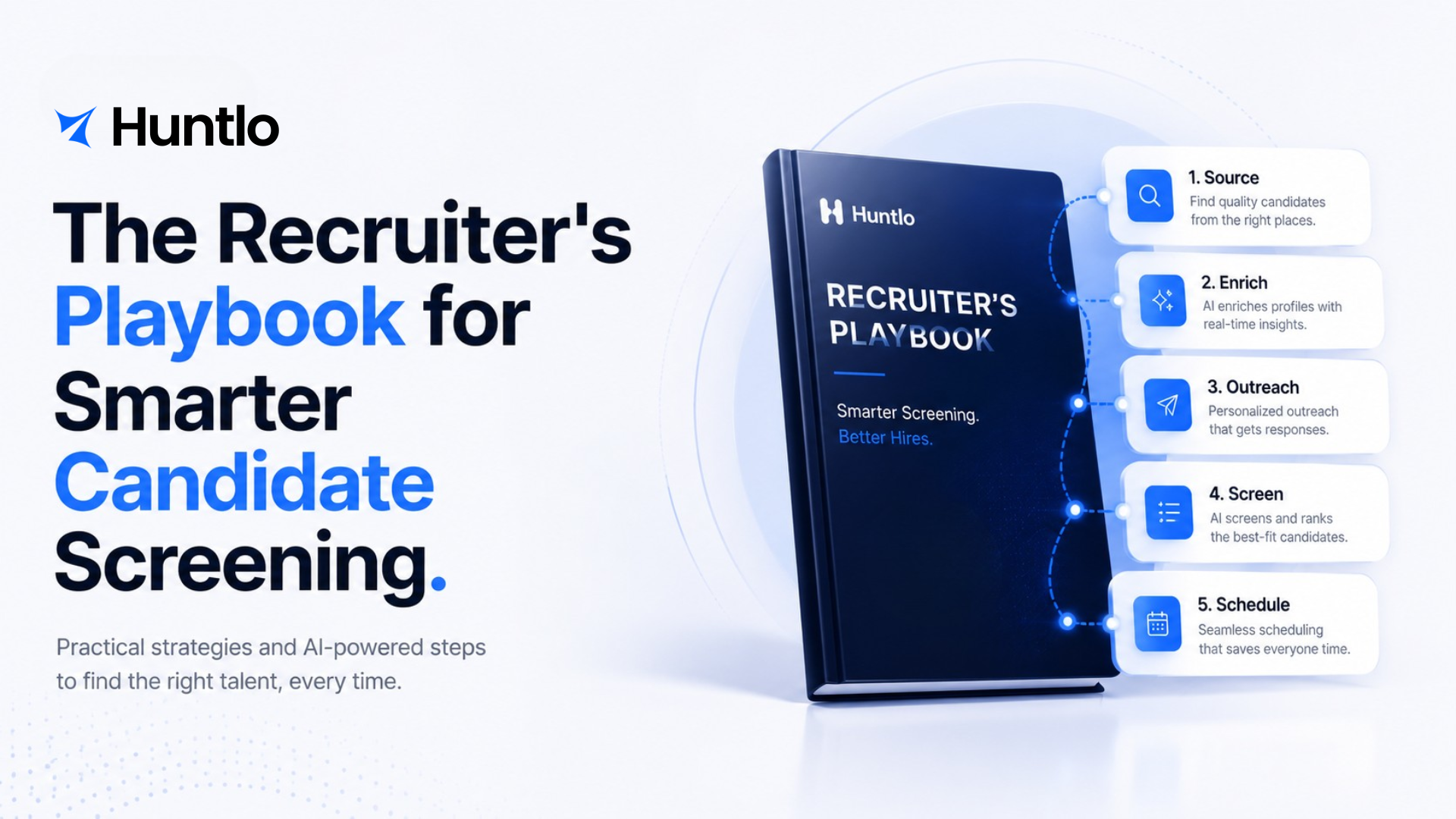
This playbook is designed to change that. It is not a theoretical framework or a list of aspirational best practices. It is a practical, step-by-step guide to building a screening process that is faster, more consistent, and more predictive of actual hiring outcomes. The core idea is straightforward: your screening process should evaluate what candidates can do, not what they look like on paper. And the technology you use, whether that is an agentic AI recruiting platform or a structured evaluation framework, should amplify your judgment rather than replace it. Here is how to build that process.
Step 1: Define What “Qualified” Actually Means Before You Screen a Single Resume
The single most common screening failure is not a tool problem or a volume problem. It is a criteria problem. Most hiring teams begin screening without a clear, shared definition of what qualified looks like for the specific role they are filling. They have a job description, which is usually a wish list of skills and experiences assembled by committee, but they do not have a ranked set of evaluation criteria that distinguishes between essential requirements and nice-to-have attributes. Without this distinction, every screening decision is subjective by default.
The fix is to build a role-specific evaluation framework before the first resume arrives. Start by identifying the three to five competencies that are genuinely predictive of success in the role. These are not generic qualities like “strong communication skills” or “self-starter
mentality.” They are specific, observable capabilities that can be assessed from a candidate’s work history. For a software engineer, it might be experience shipping production code in a specific stack. For a sales director, it might be demonstrated quota attainment over multiple consecutive quarters. For a product manager, it might be evidence of shipped features that measurably moved user engagement metrics.
This discipline of defining criteria before screening has a second benefit that most teams overlook: it makes your screening consistent across reviewers. When three different recruiters are evaluating candidates for the same role, they should all be applying the same standards. Without a predefined framework, each recruiter develops their own implicit criteria, and the shortlist that emerges reflects the average of three different sets of biases rather than a coherent evaluation standard. This is one of the reasons why more tools often produce the same hiring problems: the tools change, but the lack of clear criteria underneath them does not.
Step 2: Separate Signal from Noise in Candidate Profiles
Once you have clear criteria, the next challenge is extracting the signals that matter from the noise that does not. A typical resume contains dozens of data points, and most of them are irrelevant to whether the candidate can do the job. Company names, job titles, education credentials, and certification badges are all easy to read, but they are proxy signals. They tell you where the candidate has been, not what they have done. The signals that actually predict performance, such as the scope and impact of a candidate’s contributions, the complexity of the problems they have solved, and the trajectory of their growth, are harder to extract and require more careful evaluation.
This is where AI screening tools create the most value. A well-designed AI system can parse a candidate’s full profile, including work history, project descriptions, and verified achievements, and map those data points to your role-specific evaluation criteria. It does not just scan for keywords. It assesses whether the candidate’s demonstrated capabilities align with what the role requires. As we have discussed in our analysis of the difference between AI sourcing and AI recruiting, this distinction between surface-level matching and deep capability assessment is what separates useful technology from expensive noise.
The practical implication for recruiters is simple: stop reading resumes top to bottom and start reading them with specific questions in mind. For each candidate, ask: what evidence exists that this person can do the three to five things this role requires? How strong is that evidence? Is it demonstrated through measurable outcomes, or is it merely claimed through job titles and bullet points? This shift from passive reading to active interrogation of candidate profiles is the single most impactful change a recruiter can make to their screening process, and it costs nothing to implement.
Step 3: Build a Scoring System That Works at Scale
Reading resumes with intention is effective for small volumes, but it does not scale. When a role attracts 300 or 500 or 2,000 applications, individual recruiters cannot give each profile
the attention it deserves. The standard response to volume is to tighten filters, which means more qualified candidates get excluded, or to speed up, which means screening quality degrades. Both responses are bad. The right response is to build a scoring system that can be applied consistently regardless of volume.
A scoring system does not need to be complex. It needs to be clear, consistent, and tied to your predefined criteria. Assign each of your three to five core competencies a weight that reflects its importance to the role. Then evaluate each candidate against each competency on a simple scale, perhaps one to five. The total score gives you a ranked shortlist that reflects your actual priorities, not your unconscious biases. According to SHRM’s guidance on talent acquisition, structured evaluation systems consistently outperform unstructured screening in both quality of hire and diversity of shortlists.
The challenge with manual scoring systems is that they are slow and tedious, which means recruiters abandon them as soon as volume increases. This is exactly where AI screening platforms deliver the most value. An AI system can apply your scoring framework to every candidate automatically, producing a ranked shortlist in minutes rather than days. But the AI needs to be configured correctly, which is why we published a guide on how to evaluate an AI sourcing tool before buying. The evaluation should focus on whether the tool allows you to define custom criteria, adjust weights, and inspect the reasoning behind each score. If it does not, it is a black box that will produce the same inconsistent results you were trying to escape.
Step 4: Automate the Volume, Own the Judgment
The division of labor between AI and human judgment is the most important architectural decision in a modern screening process. Get it wrong, and you either waste human expertise on mechanical tasks or delegate critical judgment to an algorithm. Get it right, and you get the best of both: the consistency and speed of AI evaluation combined with the nuance and context awareness that only experienced recruiters can provide.
The right division is this: let AI handle the initial triage. Every candidate who applies should be evaluated against your scoring framework automatically. The AI should produce a ranked list that separates clearly qualified candidates from clearly unqualified ones, with a middle band that requires human review. Recruiters should spend their time on that middle band, where their judgment adds the most value, and on the top-ranked candidates, where they can add relationship-building and candidate engagement. This is the model that Huntlo.ai was built to support, and it reflects a fundamental principle: automation should handle what is routine, and humans should handle what is not.
This approach also addresses one of the most common concerns recruiters have about AI, which is whether it will replace their jobs. The answer, for screening at least, is no. AI replaces the part of the job that recruiters least enjoy and are least good at: high-volume, low-judgment resume triage. It preserves and amplifies the part of the job where recruiters create the most value: building relationships with candidates, advising hiring managers on fit and potential, and making the nuanced judgment calls that require human context. Far from
making recruiters redundant, this model makes them more effective and more strategically valuable to their organizations.
Step 5: Audit Your Shortlists for Bias and Gaps
No screening process is complete without an audit step. After the AI has produced its ranked shortlist and before it reaches the hiring manager, a recruiter should review it with two questions in mind. First, does the shortlist reflect the diversity of the applicant pool? If women made up 40 percent of applicants but only 15 percent of the shortlist, something in the evaluation criteria or the data is producing a biased outcome. Second, are there any qualified candidates who were scored lower than expected, and if so, why? This review does not need to take long, but it needs to happen every time. Research from McKinsey’s people and organization practice, has shown that companies that regularly audit their hiring funnels for bias at every stage consistently outperform those that do not.
The audit step serves a second purpose that is equally important. It helps you identify gaps in your evaluation criteria. If you repeatedly find that candidates with non-traditional backgrounds are being scored lower despite having relevant experience, it may mean your criteria are inadvertently weighted toward traditional credentials. Adjusting those weights, adding new competency categories, or refining how the AI interprets certain types of experience can improve the quality and fairness of future shortlists. This is a continuous improvement cycle, and it only works if someone is actively looking at the data.
It is also worth examining whether the candidate data itself is introducing bias. If your screening relies on resumes that are already incomplete or outdated, the AI will produce unreliable scores regardless of how well your criteria are defined. We have written extensively about the problem of outdated candidate data in AI recruiting tools, and the lesson applies here: your screening process is only as good as the data that feeds it. Investing in richer, more current candidate data, through AI voice interviews, skills assessments, or structured profile enrichment, pays dividends in screening accuracy.
Step 6: Turn Screening into a Feedback Loop
The final step in building a smarter screening process is the one that most teams skip entirely: connecting screening outcomes back to screening criteria. When a candidate who was shortlisted turns out to be a poor hire, what does that tell you about your evaluation framework? When a candidate who was screened out goes on to perform exceptionally well at a competitor, what does that tell you about the criteria that eliminated them? These are uncomfortable questions, but they are the only way to improve. According to Gartner’s research on HR trends, the most effective talent acquisition teams treat every hiring outcome as a data point that feeds back into their process design.
The feedback loop should operate at two levels. At the macro level, track the correlation between screening scores and on-the-job performance for every hire over the past twelve months. If high-screening-score hires consistently outperform low-screening-score hires, your
criteria are working. If the correlation is weak or nonexistent, your criteria need revision. At the micro level, review specific screening decisions that turned out to be wrong. Was a strong candidate screened out because a key competency was missing from the evaluation framework? Was a weak candidate advanced because a credential proxy inflated their score? These specific cases are the most valuable data you have for improving your process.
This feedback loop is also where the difference between AI sourcing and AI recruiting becomes practically important. Sourcing tools find candidates. Recruiting tools evaluate them, track the outcomes of those evaluations, and improve over time. A platform that only identifies potential candidates but does not help you assess and learn from their performance is only solving half the problem. For teams that want a complete solution, the distinction between sourcing and recruiting intelligence is not academic. It determines whether your screening process gets better with every hire or stays the same regardless of how much data you accumulate. As we have noted, the difference between AI sourcing and AI recruiting, is the difference between a tool that finds candidates and a system that helps you understand them.
Step 7: Measure What Matters, Not What Is Easy
Most recruiting teams measure screening productivity in terms of time-to-shortlist and resumes reviewed per hour. These are easy metrics to track, but they measure throughput, not quality. A recruiter who screens 200 resumes in an afternoon and produces a mediocre shortlist is not more productive than one who screens 50 with the help of AI and produces an exceptional one. The metrics that matter are quality of shortlist, diversity of shortlist, and the correlation between screening assessments and eventual hiring outcomes. According to Deloitte’s talent insights, organizations that shift their recruiting metrics from activity-based to outcome-based measures see significant improvements in both efficiency and hiring quality.
Quality of shortlist can be measured by tracking what percentage of shortlisted candidates advance to the offer stage, what percentage of offers are accepted, and how hired candidates perform during their first year. Diversity of shortlist should be tracked across multiple dimensions and compared to the demographics of the applicant pool, not to arbitrary targets. And the screening-to-performance correlation, the most important metric of all, requires a systematic effort to collect performance data on new hires and compare it to their screening assessments. None of these metrics are difficult to implement, but they require a commitment to measuring outcomes rather than activities.
The other metric that matters is candidate experience. Screening is the candidate’s first significant interaction with your hiring process, and a slow, opaque, or disorganized screening experience damages your employer brand. LinkedIn’s recruiting resources, have consistently shown that candidates who have a positive screening experience are more likely to accept offers and more likely to refer others, even if they are not selected themselves. Speed, transparency, and respect for the candidate’s time are not just nice to have. They are competitive
advantages in a market where top candidates have multiple options.
Why Huntlo.ai Is the Screening Playbook in Practice
Everything described in this playbook, from predefined criteria to automated scoring to continuous feedback loops, is what Huntlo.ai does by design. The platform evaluates every candidate against role-specific competency frameworks that you define and control. It produces ranked shortlists with transparent scoring so you can see exactly why each candidate was included. It audits its own outputs for bias and flags potential gaps in diversity. And it connects screening outcomes back to performance data so your process improves with every hire. Unlike tools that add complexity without solving the underlying problem, Huntlo was built to eliminate the friction that slows recruiting teams down, not add to it.
For recruiters who are tired of screening thousands of resumes by hand, watching great candidates fall through the cracks, and defending subjective shortlist decisions to hiring managers, Huntlo offers a different way to work. One where screening is fast, consistent, and tied to what actually predicts job performance. One where referrals still outperform cold outreach, but your screening process is strong enough to find great candidates through every channel. The playbook is here. The technology to execute it exists. The only question is whether your team is ready to use it.