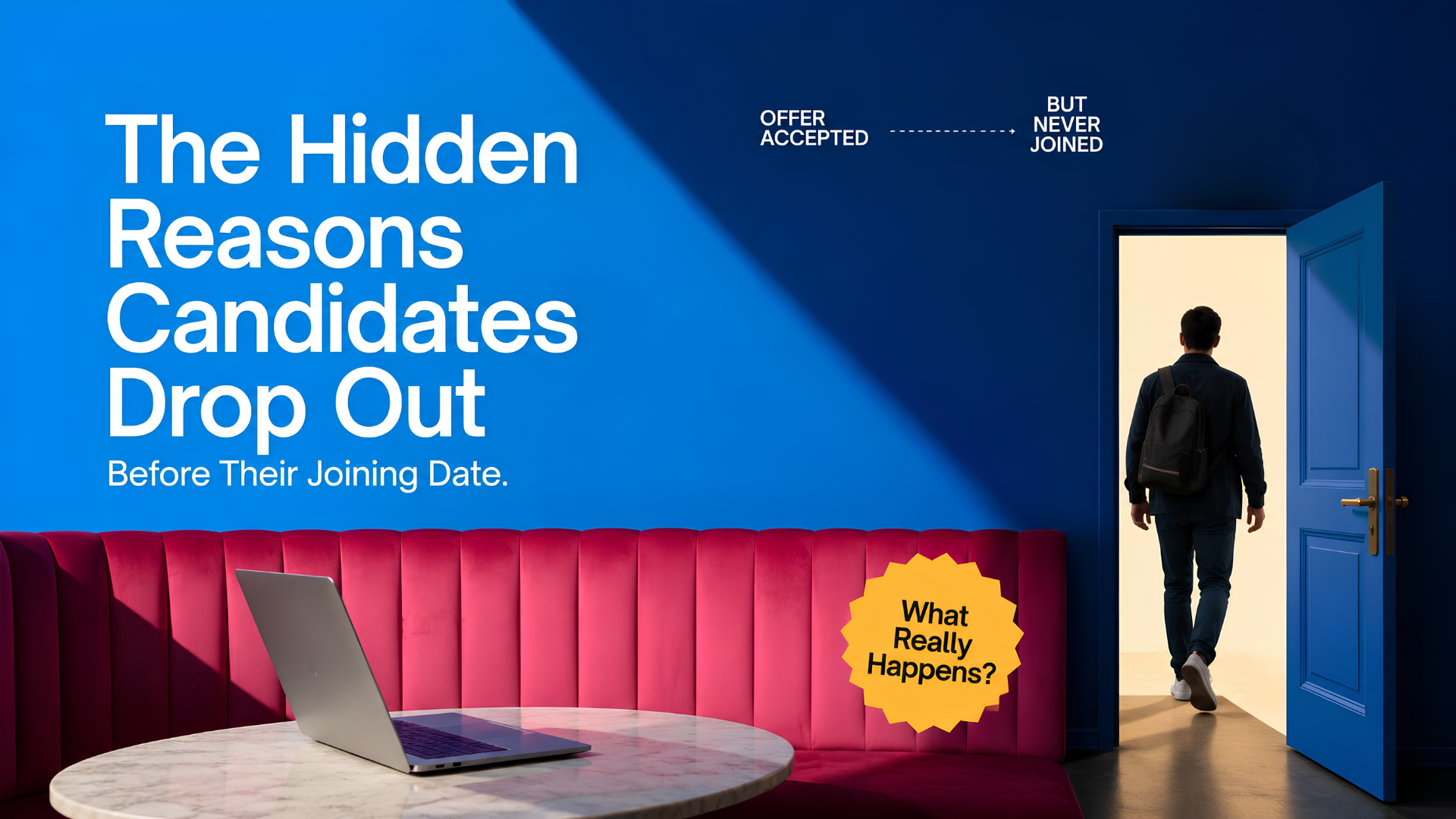
Your candidate signed the offer letter. The hiring manager celebrated. You updated the tracker, notified the team, and moved on to the next open requisition. Then, anywhere from a few days to a few weeks before the joining date, the message arrives. They are not coming. Sometimes there is an explanation, a counteroffer, a family emergency, a change of heart. More often, there is nothing at all. The candidate simply stops responding and vanishes from the process.
This is not a rare edge case. Research consistently shows that between ten and twenty percent of accepted offers fail to convert into actual hires, and the number is even higher in competitive markets. The financial cost is enormous, but the strategic cost is worse. Every dropped candidate represents a lost investment in sourcing, screening, and interviewing that must be repeated from scratch. And as we have noted in our exploration of why more tools produce the same hiring problems, the solution is not adding another tool to a process that is fundamentally broken during its most critical phase. The solution is understanding why candidates actually leave and fixing those root causes.
The Drop-Off Problem Nobody Wants to Talk About
Most recruiting teams track offer acceptance rate as a key metric, but almost none track offer-to-join conversion rate. This blind spot means that organizations genuinely do not know how many candidates they are losing after the offer is signed. The problem is compounded by the fact that when a candidate drops out, the default response is to blame the candidate rather than examining the process. They were not committed. They used the offer as leverage. They got a better deal elsewhere. While these explanations are sometimes true, they are almost never the complete picture. According to SHRM’s talent acquisition resources, the
organizations with the lowest drop-off rates are not the ones that offer the highest salaries. They are the ones that maintain the strongest candidate engagement between offer acceptance and day one.
The gap between acceptance and joining is the most dangerous phase of the entire hiring process, and it is the phase that receives the least attention. During the interview stage, candidates are treated with care and urgency. During the offer stage, there is excitement and momentum. But once the contract is signed, the energy evaporates. The recruiter pivots to the next candidate. The hiring manager returns to operational work. The candidate enters a period of limbo where they are neither an active candidate nor an actual employee, and nobody takes ownership of their experience during this vulnerable window.
The Psychology of Post-Offer Buyer’s Remorse
The single most common hidden reason candidates drop out is buyer’s remorse, the psychological discomfort that follows any significant decision. Research in behavioral economics has shown that decision-related anxiety peaks not before the decision is made, but after it. Once a candidate signs an offer, their brain shifts from evaluation mode to doubt mode. They start questioning whether they made the right choice, whether the new role will match their expectations, whether they will fit in with the team, and whether the culture will be what the interviewers described. This anxiety is entirely normal, but it is also entirely destructive if left unaddressed. The longer the gap between acceptance and start date, the more time doubt has to grow. This is why understanding how many follow-ups one hire actually needs is critical. The answer is more than most teams realize, and the period between offer and joining is when those follow-ups are most important.
The notice period creates a particularly toxic environment for buyer’s remorse because the candidate is still physically embedded in their current job. They attend team meetings, have lunch with colleagues, and experience the familiar rhythms of their existing workplace. At the same time, their future workplace is an abstraction. They have visited the office once or twice, met a handful of people, and received a written description of the role. The contrast between the tangible present and the uncertain future naturally amplifies doubt. Candidates do not compare the new opportunity against some objective standard. They compare it against the comfort and certainty of what they already have, and comfort almost always wins in the short term.
There is also a social dimension to post-offer regret. When candidates tell their friends, family, and colleagues about the new job, they receive a range of reactions. Some are supportive. Others raise concerns: is the company stable, is the commute manageable, what if the role is not what they promised? Each concerned question adds weight to the candidate’s internal doubt. And because the candidate has no ongoing relationship with their future employer during this period, there is no counterweight to push back against the doubt. This is exactly the gap that AI for recruiters is designed to fill. Modern AI platforms can monitor engagement signals and trigger proactive outreach when a candidate’s responsiveness declines, catching
doubt before it turns into withdrawal.
The Competing Offer That Arrives During the Waiting Period
A strong candidate who accepts your offer is almost certainly being evaluated by other companies simultaneously. The hiring process is not a sequential pipeline. It is a parallel one. A candidate who impressed your interviewers has likely impressed other interviewers as well, and the timelines of competing processes rarely align perfectly. It is entirely common for a candidate to accept your offer on Monday and receive a competing offer, sometimes with better compensation or a faster start date, on Wednesday. The longer your notice period, the greater the probability that a competing offer will arrive and disrupt your hire. According to LinkedIn’s recruiting research, candidates who receive multiple offers are three times more likely to back out of an accepted offer than those who receive only one.
The counteroffer from the current employer is a special case of the competing offer problem, and it is one of the most misunderstood dynamics in recruiting. Conventional wisdom says that candidates who accept counteroffers will leave within six months anyway, so recruiters should not worry about them. This is a dangerous myth. The reality is that many candidates who accept counteroffers stay for years, and the organization that lost them has no realistic path to recovery. The more effective approach is to identify counteroffer risk during the interview process itself. Candidates who are running away from something, a bad manager, a toxic team, a stagnant career, are far more susceptible to counteroffers than candidates who are running toward something specific at your organization. This is one reason why referrals outperform cold outreach, because referred candidates typically have a stronger intrinsic motivation and a pre-existing connection to the company’s mission.
When the Role or Team Changes After Acceptance
Organizational changes are a fact of corporate life, but they are devastating when they affect a candidate who has already signed an offer. A reorg that changes the reporting structure, a budget cut that alters the role’s scope, or a hiring manager’s departure can transform a job the candidate was excited about into one they no longer recognize. Candidates almost never communicate this concern directly. Instead, they simply go silent and eventually withdraw. The problem is that the recruiting team often does not learn about these organizational changes until after the candidate has already decided to leave. This is where hiring automation software that includes change-impact alerts can make a real difference, flagging when organizational shifts might affect candidates in the pipeline.
Even smaller changes can trigger doubt. The job description said one thing, but during a pre-boarding call the candidate learns the role has been expanded to include responsibilities they did not anticipate. The team they were told they would join has been restructured. The project they were excited about has been deprioritized. Each of these discrepancies, even if minor, chips away at the candidate’s confidence that the organization knows what it is doing. And each discrepancy is entirely preventable if the recruiting team maintains tight coordination
between the hiring function and the business. As we have explored in our discussion of whether AI will replace recruiting jobs, the value of a recruiter is not in processing transactions but in maintaining the human judgment that prevents these disconnects between what was promised and what is delivered.
The Information Candidates Discover After Saying Yes
Once a candidate accepts an offer, their relationship with the prospective employer changes. They move from being an evaluator to being an incoming member, and their information-seeking behavior shifts accordingly. They start reading Glassdoor reviews they had not checked before. They search for former employees on LinkedIn and ask about their experience. They look up the company in the news. They check social media for red flags. Any of these channels can surface information that undermines the positive impression built during the interview process. A single negative Glassdoor review about the hiring manager can undo weeks of positive engagement. The issue of outdated or inaccurate candidate data in AI tools is related but different: here, the problem is not that the company’s data about the candidate is wrong, but that the candidate’s data about the company is suddenly more complete, and more negative, than it was during the interview.
The solution is not to try to suppress negative information, which is impossible in the age of social media and employer review sites. The solution is to address concerns proactively before the candidate finds them on their own. If the hiring manager has mixed reviews, the recruiter should acknowledge this candidly during the interview process and provide context. If the company has gone through a difficult period, that context should be shared openly. Transparency does not scare away good candidates. It builds trust. And trust is the single most important factor in whether a candidate shows up on day one. This is the fundamental difference between an agentic AI recruiting platform and a merely automated one, and it applies as much to the post-offer phase as it does to sourcing and screening.
How to Build a Safety Net That Catches At-Risk Candidates
Preventing pre-joining drop-off requires a systematic approach, not individual heroics. The first component is recruiter outreach automation that maintains a consistent cadence of communication throughout the notice period. This does not mean sending generic automated emails. It means creating a structured sequence of meaningful touchpoints: a personal call from the hiring manager in week one, an invitation to connect with future teammates in week two, a detailed first-week agenda in week three, and a final check-in two days before the start date. Each touchpoint serves a dual purpose: it provides the candidate with useful information, and it gives the recruiting team a chance to gauge the candidate’s level of enthusiasm and commitment.
The second component is a talent pipeline management system that tracks engagement signals in real time. When a candidate who was responding within hours starts taking twenty-four hours to reply, that is a signal. When a candidate who was asking detailed questions
about the role starts giving one-word answers, that is a signal. When a candidate cancels or reschedules a pre-boarding call, that is a signal. These signals are easy to miss when you are managing dozens of candidates manually, but they are trivial to detect with the right technology. According to Gartner’s research on HR trends, organizations that implement engagement-signal monitoring reduce pre-joining drop-off by up to thirty-five percent, because they can intervene early, before the candidate’s doubt has crystallized into a decision to withdraw.
The third component is a dedicated pre-boarding owner, someone on the recruiting or HR team whose specific responsibility is the candidate experience between offer and day one. This person should have the authority and the tools to resolve issues quickly. If the candidate has questions about benefits, the pre-boarding owner connects them with the right person immediately. If the candidate is nervous about the commute, the pre-boarding owner arranges a trial commute or a remote start option. If the candidate’s start date needs to be adjusted for personal reasons, the pre-boarding owner works with the hiring manager to accommodate the request. The goal is to improve candidate response rate during the notice period by making every interaction with the future employer feel personal, responsive, and supportive. As we have discussed in our analysis of the difference between AI sourcing and AI recruiting, the recruiting phase is where relationship management determines outcomes, and the post-offer period is the most relationship-intensive phase of all.
Why Huntlo.ai Helps You Prevent Pre-Joining Drop-Offs
Huntlo.ai was designed with a clear understanding that the hiring process does not end when the candidate says yes. The platform’s engagement engine maintains continuous, personalized contact with every accepted candidate throughout the notice period, ensuring that no candidate enters the communication black hole that leads to ghosting. The system tracks responsiveness, identifies decline patterns, and alerts the recruiting team when intervention is needed. Every touchpoint is informed by the intelligence gathered during the sourcing and interview phases, so the engagement feels relevant and personal rather than generic and automated. When evaluating an AI recruiting tool before buying, the ability to maintain post-offer engagement should be a primary selection criterion, because it is the phase where the most hiring losses occur.
For recruiting teams that are tired of losing great candidates after the offer is signed, Huntlo provides a fundamentally different approach. One where the post-offer period is treated as the highest-stakes phase of the hiring process, because it is. One where every candidate receives the consistent, attentive engagement that prevents doubt from becoming withdrawal. And one where the entire candidate journey, from first contact through first day, is connected, tracked, and optimized by AI that understands not just what to do, but when to do it and why.