When Priya Sharma presented her quarterly hiring report to the executive committee at her healthcare technology company, she did not lead with the metrics that recruiters typically highlight. She did not talk about time to fill, cost per hire, or candidate satisfaction scores, although those numbers had improved. Instead, she presented a financial impact analysis showing how the AI recruiting platform her team had deployed eighteen months earlier had contributed directly to revenue and strategic objectives. The platform had reduced average time to fill critical engineering and product roles from sixty-seven days to thirty-one days, accelerating three product launches by an average of six weeks each and generating approximately four point two million dollars in incremental first-year revenue. The platform had improved quality of hire by eighteen percent, correlating with a twelve percent reduction in first-year turnover and one point eight million dollars in annual replacement cost savings. The platform had enabled her team of twelve recruiters to manage the same volume that previously required twenty-two recruiters, allowing her to redeploy ten FTE equivalents to strategic talent initiatives that had been underfunded. The total documented financial impact was nine point four million dollars in eighteen months, against a total investment of eight hundred twenty thousand dollars. The return on investment was not marginal. It was transformative, and it changed how the executive committee thought about recruiting technology as a cost center versus a value driver.
Revenue Acceleration Through Faster Time to Productivity
The most significant but least measured source of enterprise value from AI recruiting platforms is revenue acceleration. Every unfilled position represents a gap in the organization's
capacity to execute its strategy, and the financial cost of that gap is directly measurable in delayed revenue, missed market opportunities, and competitive disadvantage. When a critical sales role remains unfilled for sixty days, the organization loses not only the revenue that the salesperson would have generated but also the pipeline momentum and customer relationships that decay during the vacancy. When a critical engineering role remains unfilled, the organization delays product releases, accumulates technical debt, and risks losing market position to competitors who ship faster. When a critical leadership role remains unfilled, the organization stalls strategic initiatives, loses organizational momentum, and creates decision-making bottlenecks that cascade across the business. AI recruiting platforms reduce time to fill by thirty to fifty percent compared to traditional recruiting processes, which translates directly into faster capacity restoration and earlier revenue realization. The financial impact of this acceleration is often the single largest component of the total value an AI recruiting platform delivers, but it is the component most commonly omitted from ROI calculations because it requires connecting recruiting outcomes to business outcomes, a connection that most recruiting teams do not quantify.
Quantifying the revenue impact of faster hiring requires a straightforward calculation that any organization can perform. The first input is the average fully loaded cost of the role, meaning salary, benefits, and overhead, which represents the daily cost of the vacant position to the organization. The second input is the time to fill reduction achieved by the AI recruiting platform, measured in days. The third input is the revenue multiplier, which estimates how many dollars of revenue the role supports per dollar of compensation. For revenue-generating roles like sales, the multiplier is often three to five times compensation. For product and engineering roles, the multiplier is estimated based on the revenue impact of faster product delivery, typically one point five to three times compensation. For leadership roles, the multiplier is estimated based on the strategic impact of faster decision-making, typically two to four times compensation. Multiplying these three inputs, daily role cost times days saved times revenue multiplier, produces a revenue impact estimate that is conservative, because it does not account for the compounding effects of faster hiring on team productivity, project timelines, and market positioning. According to McKinsey, organizations that quantify the revenue impact of faster hiring using this methodology consistently find that revenue acceleration accounts for forty to sixty percent of the total financial value generated by AI recruiting platforms, making it the largest single value driver and the most compelling argument for platform investment from a CFO perspective.
The revenue acceleration value is not evenly distributed across all roles. It is concentrated in the roles where the cost of vacancy is highest and where the AI recruiting platform's time-to-fill improvement is most significant. Critical roles, defined as positions that directly impact revenue generation, product delivery, or strategic execution, typically represent twenty to thirty percent of total hiring volume but sixty to seventy percent of the total revenue impact of faster hiring. This concentration means that the ROI of an AI recruiting platform is disproportionately driven by its effectiveness on critical roles, which is why platforms that can demonstrate superior performance on high-priority, hard-to-fill positions deliver significantly
higher enterprise value than platforms that perform well on high-volume, lower-complexity roles. The practical implication for enterprise buyers is that platform evaluation should weight critical role performance heavily, because the enterprise value of the platform depends more on how well it fills the ten most important roles per quarter than on how efficiently it processes hundreds of routine requisitions. agentic AI platforms vs automated ones explains why agentic AI platforms that autonomously manage the full recruiting workflow for critical roles deliver disproportionate revenue acceleration, because the autonomous management eliminates the human coordination delays and handoff gaps that are the primary drivers of extended time to fill on complex, high-priority positions. AI tools for niche technical roles demonstrates why platforms with deep expertise in specific talent segments, such as technical or healthcare recruiting, generate higher revenue acceleration for critical roles in those segments, because the specialized AI models and candidate pools produce faster and more accurate matches for the roles where revenue impact is highest.
Cost Reduction Across the Hiring Lifecycle
Cost reduction is the most visible and most frequently cited source of value from AI recruiting platforms, but the full scope of cost reduction extends well beyond the direct savings on recruiter headcount or agency fees. The complete cost reduction picture includes five distinct categories: direct recruiting labor cost savings from higher recruiter productivity, agency and search firm fee reduction from improved direct sourcing capability, cost-per-hire reduction from process efficiency, first-year turnover cost reduction from better quality of hire, and administrative overhead reduction from workflow automation. Each of these categories represents a measurable financial benefit that contributes to the total cost reduction value of the platform. Direct recruiting labor cost savings occur when the AI platform enables each recruiter to manage more requisitions, more candidate interactions, and more hiring processes simultaneously. A recruiter who manages fifteen active requisitions with traditional tools can typically manage thirty to forty-five requisitions with an AI-native platform, because the platform automates sourcing, screening, scheduling, and candidate communication tasks that previously consumed the majority of the recruiter's time. This productivity improvement means the organization can achieve the same hiring output with fewer recruiters, or achieve more hiring output with the same recruiter headcount, either of which produces a direct labor cost saving.
Agency and search firm fee reduction is often the second-largest cost reduction category for organizations that rely on external recruiting partners for difficult-to-fill roles. The standard agency fee is twenty to thirty percent of the placed candidate's first-year base salary, which means a single senior engineering placement through an agency can cost forty to seventy-five thousand dollars in fees. AI recruiting platforms reduce agency dependence by improving the organization's direct sourcing capability, enabling internal recruiters to identify, engage, and pre-qualify candidates that previously required an agency's network and expertise. Organizations that deploy AI recruiting platforms typically report a thirty to fifty percent
reduction in agency spend within the first year, because the platform enables internal teams to fill a significant portion of the roles that were previously sent to agencies. For an organization spending two million dollars annually on agency fees, this reduction translates to six hundred thousand to one million dollars in direct cost savings, which alone often exceeds the total cost of the AI recruiting platform. According to SHRM, the average enterprise organization spends fifteen to twenty-five percent of its total recruiting budget on external agency and search firm fees, and AI recruiting platforms that reduce this dependence by even thirty percent generate savings that represent five to eight percent of the total recruiting budget, a figure that is immediately visible on the P and L and easily attributable to the platform investment.
The cost reduction from improved quality of hire is the most underestimated category, because the savings are indirect and accumulate over time rather than appearing as a single line-item expense reduction. A poor-quality hire costs the organization in multiple ways: the direct cost of the hiring process itself, which must be repeated; the onboarding and training investment, which is lost; the productivity gap during the new hire's tenure, which represents underperformance relative to expectations; the management time spent on performance issues, which diverts leadership attention; and the eventual replacement cost, which includes all of the above expenses a second time. The total cost of a poor-quality hire is typically estimated at thirty to fifty percent of the role's first-year compensation for individual contributor roles and one hundred to two hundred percent for senior and leadership roles. AI recruiting platforms improve quality of hire by using AI-powered screening and evaluation to assess candidate fit more accurately than traditional resume review and unstructured interviews. The improvement in quality of hire, typically measured as a reduction in first-year turnover or an increase in twelve-month performance ratings, translates directly into cost avoidance that compounds with every hiring cycle. According to Deloitte, organizations using AI recruiting platforms report a twelve to twenty percent reduction in first-year turnover and a fifteen to twenty-five percent reduction in time-to-productivity for new hires, because the platforms' AI-powered screening and matching capabilities produce better candidate-role fits that translate into faster ramp-up, higher performance, and longer tenure. why AI tools have outdated candidate data explains why platforms relying on static candidate data produce lower quality of hire than platforms with continuously updated, interaction-rich candidate profiles, because the dynamic data captures current skills, availability, and engagement signals that predict on-the-job success more accurately than static resume data.
Risk Mitigation and Compliance Value
AI recruiting platforms generate enterprise value through risk mitigation that is often undervalued in ROI calculations but represents a meaningful financial benefit for organizations operating in regulated industries or high-litigation-risk environments. The three primary risk categories that AI recruiting platforms address are compliance risk, including adverse impact and discrimination claims; operational risk, including hiring mistakes that create business
disruption; and reputation risk, including negative candidate experiences that damage the employer brand. Compliance risk is particularly significant for organizations subject to equal employment opportunity regulations, both in the United States and internationally. AI recruiting platforms that incorporate bias detection, structured evaluation criteria, and audit-ready documentation reduce the organization's exposure to discrimination claims by ensuring that candidate evaluation is consistent, evidence-based, and defensible. When a hiring decision is challenged, the platform provides a documented record of the evaluation criteria applied, the candidate's scores on each criterion, and the objective basis for the hiring decision, which is far more defensible than the subjective notes and inconsistent evaluations that characterize traditional recruiting processes. The financial value of this compliance protection is measured in avoided legal costs, regulatory penalties, and settlement expenses, which can range from tens of thousands of dollars for a single claim to millions of dollars for a class action or systemic enforcement action.
Operational risk mitigation addresses the cost of hiring mistakes that create business disruption. A bad hire in a safety-critical role, such as a healthcare professional, a transportation operator, or a manufacturing supervisor, can create liability exposure, regulatory violations, and safety incidents that cost the organization far more than the hiring decision itself. AI recruiting platforms reduce this operational risk by improving the accuracy and consistency of candidate evaluation, particularly for roles where technical competence, certifications, and experience are critical safety factors. The platform can verify credential claims, assess technical knowledge through AI-powered screening, and flag candidates whose profiles indicate potential risk factors that a human reviewer might miss. The financial value of operational risk mitigation is difficult to quantify precisely because it involves events that might not occur, but risk-adjusted calculations that multiply the probability of a hiring-related incident by the potential cost of that incident consistently show that the expected value of risk mitigation is significant for organizations in high-consequence industries. According to EY, organizations in regulated industries that deploy AI recruiting platforms with built-in compliance and verification capabilities report twenty-five to forty percent reduction in hiring-related compliance incidents and thirty to fifty percent reduction in time spent on audit preparation, because the platform's structured evaluation processes and comprehensive documentation reduce both the likelihood of compliance failures and the cost of demonstrating compliance when audits occur.
Reputation risk mitigation addresses the financial impact of negative candidate experiences on the employer brand and the organization's ability to attract talent in the future. In competitive talent markets, the candidate experience directly affects the organization's ability to recruit top talent, because candidates share their experiences on employer review platforms, social media, and professional networks. A recruiting process that is slow, unresponsive, or poorly communicated creates negative candidate experiences that reduce the organization's applicant quality and increase its cost per hire over time, because the employer brand deterioration makes it harder to attract passive candidates and increases the reliance on paid sourcing channels. AI recruiting platforms improve the candidate experience by providing faster
response times, more personalized communication, and more transparent process management than human recruiters can consistently deliver at scale. The financial value of reputation risk mitigation is measured in improved applicant quality, reduced sourcing costs, and higher offer acceptance rates, all of which contribute to lower total recruiting cost and better hiring outcomes over time. how many follow-ups one hire needs illustrates how AI-driven candidate communication, including timely and relevant follow-up sequences, directly improves candidate experience metrics and reduces the negative brand impact of ghosting and unresponsive communication patterns that erode employer brand equity. Gartner reports that organizations using AI recruiting platforms with automated candidate communication capabilities see fifteen to twenty-five percent improvement in candidate Net Promoter Score and ten to fifteen percent improvement in offer acceptance rates, because the consistent, responsive communication that AI enables creates a positive candidate experience that strengthens the employer brand and reduces the cost of attracting top talent in subsequent hiring cycles.
Strategic Capability Building and Talent Intelligence
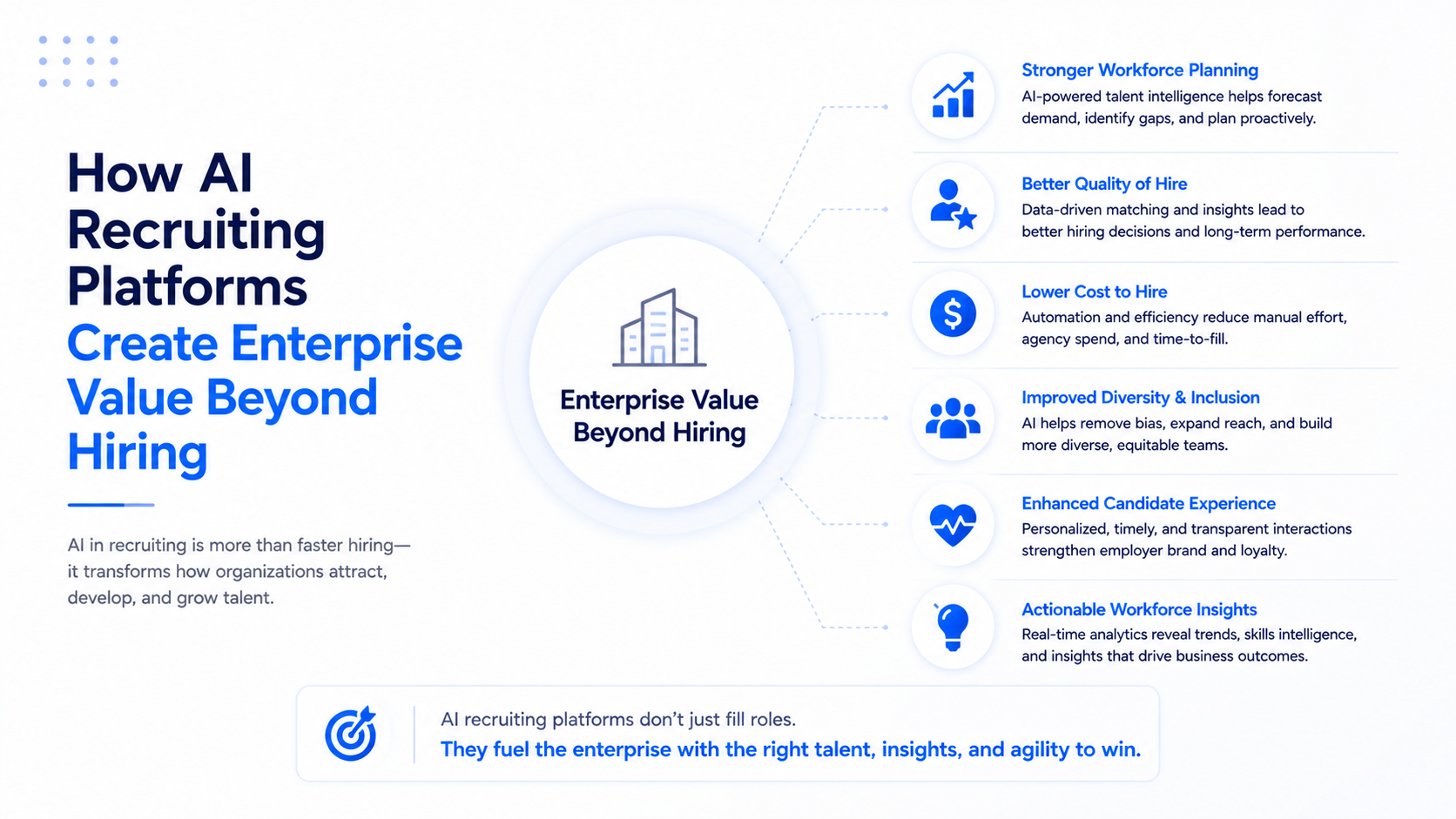
Beyond the directly quantifiable financial benefits, AI recruiting platforms create enterprise value by building strategic capabilities that improve the organization's talent decision-making over time. The most significant of these capabilities is talent intelligence, the ability to use labor market data and internal hiring analytics to inform business strategy. AI recruiting platforms generate talent intelligence as a byproduct of their core operations. Every sourcing search, candidate interaction, screening result, and hiring outcome produces data that the platform can analyze to identify patterns, trends, and insights that inform both recruiting strategy and broader business decisions. For example, the platform can identify which skills are becoming harder to hire, enabling the organization to adjust its talent development and acquisition strategy before the skill shortage becomes critical. It can identify which sourcing channels produce the best candidates for specific roles, enabling more efficient allocation of sourcing investment. It can identify salary and compensation trends in the talent markets where the organization competes, enabling more competitive and cost-effective compensation planning. It can identify geographic talent concentration patterns that inform location strategy for new offices or development centers. These talent intelligence insights have strategic value that extends well beyond the recruiting function, because they inform business decisions about product development, market entry, organizational design, and competitive positioning.
The strategic capability value of AI recruiting platforms also manifests in the form of improved workforce planning. Workforce planning, the process of forecasting future talent needs based on business strategy and growth projections, has historically been a manual, periodic exercise conducted annually or semi-annually using spreadsheet models and consultant-delivered analyses. AI recruiting platforms transform workforce planning from a periodic exercise into a continuous, data-driven process by combining the organization's internal hiring data, such as time to fill by role category, quality of hire by source, and turnover patterns, with external labor market data, such as talent supply trends, salary benchmarks, and
competitor hiring activity. This combination of internal and external data enables the platform to generate continuously updated workforce forecasts that are more accurate, more granular, and more actionable than the annual projections produced by traditional workforce planning processes. The financial value of improved workforce planning is measured in reduced overstaffing costs from more accurate demand forecasts, reduced understaffing costs from earlier identification of talent gaps, and reduced contingency hiring costs from better anticipation of seasonal or project-driven hiring needs. According to LinkedIn, organizations that use AI recruiting platforms for continuous workforce planning report fifteen to twenty percent improvement in forecast accuracy and ten to fifteen percent reduction in unplanned hiring costs, because the platform's real-time labor market intelligence enables the organization to anticipate and prepare for talent needs rather than reacting to them after they become urgent.
The third strategic capability is the redeployment of recruiting resources from operational tasks to strategic initiatives. When AI recruiting platforms automate the operational aspects of recruiting, sourcing, screening, scheduling, and candidate communication, the recruiters and recruiting leaders whose time was consumed by these tasks become available for higher-value strategic work. This strategic work includes building talent pipelines for critical future roles, developing diversity and inclusion recruiting strategies, strengthening the employer brand, building relationships with key talent communities, and partnering with business leaders on workforce strategy. In most organizations, these strategic activities are consistently underfunded because the recruiting team's time is consumed by operational demands. AI recruiting platforms create the capacity for strategic work by eliminating the operational bottleneck, which means the organization gets both better operational recruiting performance and stronger strategic talent capability from the same team. The financial value of this redeployment is measured in improved talent pipeline quality, reduced reliance on expensive reactive hiring, and stronger alignment between talent acquisition and business strategy. how to evaluate an AI sourcing tool explains why organizations that redeploy recruiting resources from operational tasks to strategic talent initiatives achieve higher long-term recruiting performance, because the strategic investments in pipeline building, employer branding, and talent community development compound over time and reduce the organization's dependence on expensive, reactive hiring approaches. AI sourcing vs AI recruiting demonstrates how AI platforms that unify sourcing and recruiting create additional strategic value by providing a single, integrated view of the talent market that enables more informed strategic decisions about where to invest sourcing effort, which talent segments to prioritize, and how to allocate recruiting resources for maximum strategic impact.
Quantifying Total Enterprise Value and Building the Business Case
Building a comprehensive business case for an AI recruiting platform requires quantifying the total enterprise value across all four value dimensions: revenue acceleration, cost reduction, risk mitigation, and strategic capability building. The revenue acceleration value is calculated
by multiplying the daily cost of critical vacant roles by the number of days saved through faster time to fill and by the revenue multiplier that connects role capacity to business output. The cost reduction value is the sum of direct labor savings, agency fee reduction, cost-per-hire improvement, turnover cost avoidance, and administrative overhead reduction. The risk mitigation value is the expected cost of avoided compliance incidents, operational failures, and reputation damage, calculated using probability-weighted risk models. The strategic capability value is more difficult to quantify but can be estimated as the value of improved workforce planning accuracy, reduced unplanned hiring costs, and the financial impact of strategic talent initiatives that were previously unfunded. When these four value dimensions are aggregated, the total enterprise value of an AI recruiting platform typically ranges from three to eight times the total investment in the platform over a three-year period, depending on the organization's hiring volume, the criticality of the roles being filled, and the effectiveness of the platform in reducing time to fill and improving quality of hire.
The business case presentation should be structured around the value dimensions that matter most to the specific audience. For CFOs and finance leaders, the revenue acceleration and cost reduction dimensions are most compelling, because they connect directly to P and L impact and can be modeled with reasonable precision. For CHROs and HR leaders, the quality of hire improvement and strategic capability building dimensions are most compelling, because they connect to the talent outcomes and organizational capabilities that HR is accountable for delivering. For CEOs and board members, the total enterprise value picture is most relevant, because it connects the platform investment to the organization's strategic execution capability. The key to a compelling business case is specificity: using the organization's actual hiring data, actual role costs, and actual time-to-fill metrics to build value estimates that are grounded in the organization's reality rather than industry averages. Industry benchmarks are useful for validating the reasonableness of the estimates, but the business case is most persuasive when it is built from the organization's own data, because it eliminates the objection that the estimates are theoretical or based on other organizations' experiences. According to Gartner, AI recruiting platform business cases that use organization-specific data to model value across at least three of the four value dimensions achieve approval rates twenty-five to thirty-five percent higher than business cases that rely solely on industry benchmarks and feature comparisons, because decision-makers are more confident in projections derived from their own operational data.
The final element of the business case is the competitive benchmark that answers the question of what happens if the organization does not invest in an AI recruiting platform. Competitors who adopt AI recruiting platforms will fill critical roles faster, hire better talent, and spend less per hire than organizations that rely on traditional recruiting processes. Over time, this compounding advantage translates into faster product delivery, stronger customer relationships, and better organizational performance. The cost of not investing is not zero. It is the gradual widening of the talent acquisition gap between the organization and its competitors, a gap that becomes increasingly difficult and expensive to close as early adopters accumulate the data advantages and recruiter capability improvements that compound with platform
usage. The competitive benchmark turns the AI recruiting platform from a cost item into a strategic investment, because it reframes the decision from whether to spend money on a new tool to whether to invest in maintaining competitive parity in talent acquisition. For organizations in talent-intensive industries, where the quality and speed of hiring directly determine the quality and speed of business execution, this reframing is often the most powerful element of the business case, because it connects the platform investment to the organization's competitive position rather than just its recruiting efficiency. why referrals outperform cold outreach shows how AI platforms that manage referral programs alongside external recruiting create additional enterprise value by activating the highest-quality, lowest-cost sourcing channel, because referred candidates have higher conversion rates, faster time to fill, and longer tenure than candidates from any other source, and AI platforms can scale referral program management in ways that manual processes cannot. more tools same hiring problems explains why the enterprise value of a unified AI platform is significantly higher than the combined value of multiple point solutions, because the unified data model and integrated AI optimization create cross-functional value, such as using screening data to improve sourcing and using sourcing data to improve workforce planning, that fragmented tool stacks cannot replicate.