Your candidate signed the offer. Your dashboard shows a green checkmark. Your hiring manager is planning the welcome lunch. Everything looks perfect, except for the statistic that most recruiting teams refuse to measure: the percentage of accepted offers that never become actual employees. Across industries, between ten and twenty percent of candidates who sign offer letters do not show up on their joining date. For competitive roles, the number is even higher. And while most recruiting leaders can quote their offer acceptance rate to two decimal places, almost none can tell you their joining rate with any precision at all.
The gap between acceptance and arrival is not just a measurement problem. It is a financial, operational, and strategic problem that costs organizations thousands of dollars per lost hire and weeks of delayed productivity. Yet most recruiting teams treat this gap as unavoidable, a cost of doing business that cannot be systematically addressed. AI is proving that assumption wrong. The same technology that has transformed sourcing, screening, and interview scheduling is now being applied to the final and most expensive stage of the hiring process: getting the candidate from offer acceptance through the front door on day one. And as we have discussed in our analysis of why more tools produce the same hiring problems, the key is not adding another standalone tool. It is deploying AI that is deeply integrated into the full candidate journey.
The Metric That Matters More Than Offer Acceptance Rate
Offer acceptance rate is the metric that recruiting teams celebrate. Joining rate is the metric that determines whether any of that celebration was justified. The two numbers are not the same, and the gap between them represents the actual return on your recruiting investment. A team that extends twenty offers and gets fifteen acceptances has a seventy-five percent acceptance rate, which sounds strong. But if only twelve of those fifteen actually join, the joining rate is sixty percent, and the effective yield on the entire sourcing-to-offer pipeline is also
sixty percent, regardless of how impressive the top-of-funnel metrics look. Understanding how many follow-ups one hire actually needs is part of the answer, but the bigger insight is that joining rate should be the primary metric by which recruiting effectiveness is judged, not acceptance rate.
The reason most teams do not track joining rate is that their systems do not support it. The typical ATS marks a requisition as filled the moment the offer is accepted, which means there is no systematic mechanism for tracking whether the candidate actually arrives. This is a structural blind spot that hiring analytics platform technology is specifically designed to address. Modern analytics platforms can track the full candidate lifecycle from first contact through day one, identifying not just how many candidates drop out, but exactly where and why they drop out. According to SHRM’s talent acquisition research, organizations that implement full-lifecycle analytics are three times more likely to improve their joining rates year over year compared to those that only measure up to offer acceptance.
How AI Identifies At-Risk Candidates Before They Withdraw
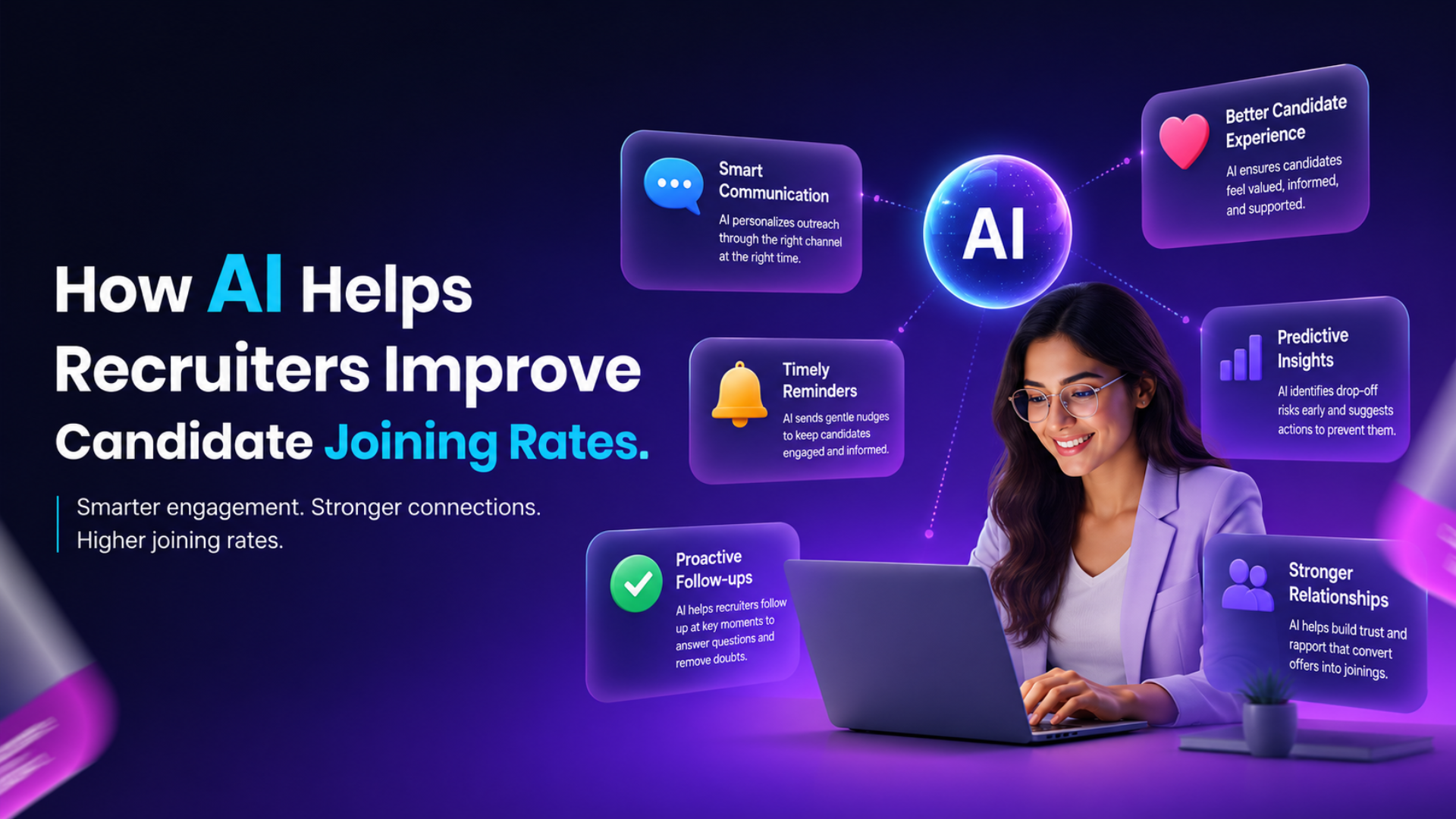
The most powerful application of AI in the post-offer phase is not automating emails or scheduling calls. It is identifying which candidates are at risk of dropping out before they have made the decision to withdraw. Human recruiters can manage relationships with five or ten candidates in the post-offer stage at a time, and even then, they rely on gut feel and personal experience to identify warning signs. AI can monitor hundreds of candidates simultaneously and detect risk signals that are invisible to even the most experienced recruiter. These signals include changes in response time, declining email engagement, shortened or vague replies to check-in messages, rescheduling or canceling pre-boarding activities, and reduced activity on professional networks related to the new employer. Each of these signals on its own is easy to dismiss. Together, they form a pattern that AI can detect with high accuracy.
The intelligence required to detect these patterns depends entirely on the quality of the underlying data. An AI hiring platform that has tracked the candidate’s engagement from the first outreach through the final interview has a rich behavioral profile to work with. It knows the candidate’s typical response time, their level of question-asking, their engagement pattern during the interview process, and their emotional trajectory from first contact to offer acceptance. When post-offer behavior deviates from this established baseline, the AI can flag the candidate as at-risk and recommend a specific intervention. This is why the issue of outdated candidate data in AI recruiting tools is so consequential. If the AI’s understanding of the candidate is based on stale or incomplete data, its risk predictions will be inaccurate, and the recommended interventions will miss the mark.
Automating the Post-Offer Engagement Sequence
Manual post-offer engagement does not scale, and it does not need to. The activities that keep candidates connected to their future employer between acceptance and day one are predictable, repeatable, and highly structured. They include personal welcome calls from the
hiring manager, introductions to future teammates, sharing updates about projects or company news, providing practical information about the first week, and conducting regular check-ins to address any emerging concerns. The content of each touchpoint should be personalized, but the sequence and timing can be systematized. When you automate recruiter tasks like scheduling, reminders, and follow-up triggers, you free the recruiter to focus on what only a human can do: having genuine, empathetic conversations with candidates who need reassurance.
The architecture of an effective post-offer engagement sequence looks like this. The AI creates a personalized engagement plan for each accepted candidate based on their role, their location, their profile, and the intelligence gathered during the interview process. The plan includes a mix of human-led and system-led touchpoints, each with a specific purpose and a recommended cadence. The AI handles the scheduling and tracking of every touchpoint, sends reminders to the responsible person when action is needed, and escalates to the recruiting team if a touchpoint is missed or a candidate becomes unresponsive. This is the operational model that an agentic AI recruiting platform provides: not just automation of individual tasks, but intelligent orchestration of a multi-week engagement process that adapts to each candidate’s needs. According to Gartner’s research on HR trends, organizations that deploy AI-orchestrated post-offer sequences reduce candidate drop-off by up to forty percent compared to those relying on manual processes.
Using Predictive Signals to Prevent Drop-Offs
Beyond identifying at-risk candidates, AI can predict which candidates are likely to face specific challenges and intervene proactively. A candidate who is relocating for the role is statistically more likely to experience cold feet as the move approaches. A candidate who is leaving a long-tenured position is more likely to be affected by counteroffers and emotional ties to their current team. A candidate whose notice period is longer than four weeks is more likely to be contacted by competing employers. An AI hiring platform that incorporates these predictive models can trigger targeted interventions before the risk materializes. The relocating candidate receives proactive support with logistics. The long-tenure candidate receives extra touchpoints designed to reinforce their motivation. The long-notice-period candidate receives strategic engagement that maintains excitement over an extended timeline.
The predictive capability also extends to organizational factors. If the hiring manager who conducted the interviews is leaving the company before the candidate’s start date, the AI can flag this as a critical risk and recommend an immediate intervention, such as a call from the incoming manager or a senior leader. If the team structure has changed since the interviews, the AI can recommend a transparency conversation that addresses the change directly rather than letting the candidate discover it on their own. This level of anticipatory engagement is impossible to deliver at scale without AI, and it represents the most impactful application of technology in the post-offer phase. As we have explored in our discussion of the difference between AI sourcing and AI recruiting, it is in the recruiting phase, the relationship management phase, that AI delivers the greatest value relative to manual processes, because
relationship management at scale is precisely the problem that AI solves best.
Why AI-Powered Communication Beats Manual Check-Ins
Manual check-ins from recruiters during the post-offer phase are well-intentioned but fundamentally limited. A recruiter managing fifteen open requisitions with multiple candidates in the post-offer stage at any given time simply cannot maintain the frequency and quality of communication that keeps candidates engaged. Touchpoints get skipped, conversations get rushed, and the candidate’s experience degrades precisely when it matters most. AI changes this equation entirely. By handling the scheduling, tracking, and content suggestion for every touchpoint, AI ensures that speed up hiring does not come at the cost of candidate experience. The process moves faster because the system handles the operational burden, but the candidate’s experience actually improves because nothing falls through the cracks.
The communication advantage of AI goes beyond consistency. AI can personalize the content of each touchpoint based on the candidate’s specific concerns, motivations, and context in ways that a time-pressed recruiter cannot. A candidate who expressed concern about work-life balance during interviews receives information about flexible work policies. A candidate who was excited about a specific project receives an update on that project’s progress. A candidate who is relocating receives neighborhood guides and school district information. This level of personalization at scale is what separates a modern recruiting tech stack from a legacy one. And it is what transforms the post-offer phase from a period of anxiety and silence into a period of building genuine connection. According to McKinsey’s people and organization insights, personalized post-offer engagement is the single strongest predictor of joining rate, stronger than compensation, stronger than brand reputation, and stronger than the candidate’s initial excitement about the role.
There is also a cultural dimension to AI-powered communication that is often underestimated. When candidates receive consistent, thoughtful communication from their future employer throughout the notice period, they form an impression about what it will be like to work there. If the communication is warm, responsive, and personal, they assume the culture will be the same. If the communication is sparse, generic, and bureaucratic, they assume the culture will match. In this sense, the post-offer experience is not just a retention strategy. It is a culture preview. And candidates who like the preview are far more likely to show up for the full experience. As we have noted in our analysis of whether referrals outperform cold outreach, candidates who have a positive pre-hire experience, whether through a referral relationship or through AI-managed engagement, are consistently more likely to convert into actual employees.
Why Huntlo.ai Turns Joining Rate Into a Competitive Advantage
Huntlo.ai was built with a clear understanding that the hiring process does not end at the offer. The platform’s AI engine monitors every accepted candidate’s engagement in real time, detects risk signals before they become withdrawals, and orchestrates a personalized
post-offer engagement sequence that keeps candidates connected, informed, and excited from acceptance through day one. The system integrates risk prediction, communication orchestration, and full-lifecycle analytics into a single platform, so recruiting teams have complete visibility into their joining rate and the factors that influence it. When evaluating an AI recruiting tool before buying, the ability to demonstrate measurable improvement in joining rate is the ultimate proof that the platform delivers real value, not just faster processes.
For recruiting teams that are ready to stop losing great candidates in the gap between offer and arrival, Huntlo provides the technology, the intelligence, and the workflow to make joining rate a strength rather than a weakness. One where every accepted candidate receives the engagement they need to follow through. One where AI enhances rather than replaces the recruiter’s judgment, combining the empathy of human connection with the consistency and scale of artificial intelligence. And one where the recruiting team can finally measure, and improve, the metric that matters most: not how many offers were accepted, but how many new hires actually walked through the door.