In 2019, the outreach channel question barely existed. You sent a LinkedIn message or an email, and that was the playbook. By 2023, WhatsApp had entered the chat—literally—for markets like India, Southeast Asia, and Latin America. Now, heading into the second half of 2026, the channel landscape has fragmented further, and recruiters who are still defaulting to a single channel are leaving enormous response potential on the table. The data is clear: candidates have strong preferences about where they want to be reached, and those preferences are not uniform. They vary by seniority, geography, industry, and even the stage of the hiring process.
This article is not about declaring a single winner among email, LinkedIn, WhatsApp, and SMS. That would be reductive and, frankly, wrong. Instead, it is about understanding when each channel outperforms the others, which candidate segments respond where, and how to build a channel strategy that adapts to the candidate rather than forcing the candidate to adapt to you. According to LinkedIn’s Talent Solutions research on candidate engagement patterns, response rates can vary by as much as 5–8× across channels for the same candidate profile, depending on geography and seniority. That is not a marginal improvement—it is the difference between a pipeline that works and one that does not.
The recruiters who are winning in 2026 are not the ones with the best templates on the best channel. They are the ones who understand that channel selection is itself a form of personalization—and that the right channel, combined with the right message, creates a compounding effect on response rates that no amount of template optimization can match.
Email: Still the Workhorse, But Losing Ground in Key Segments
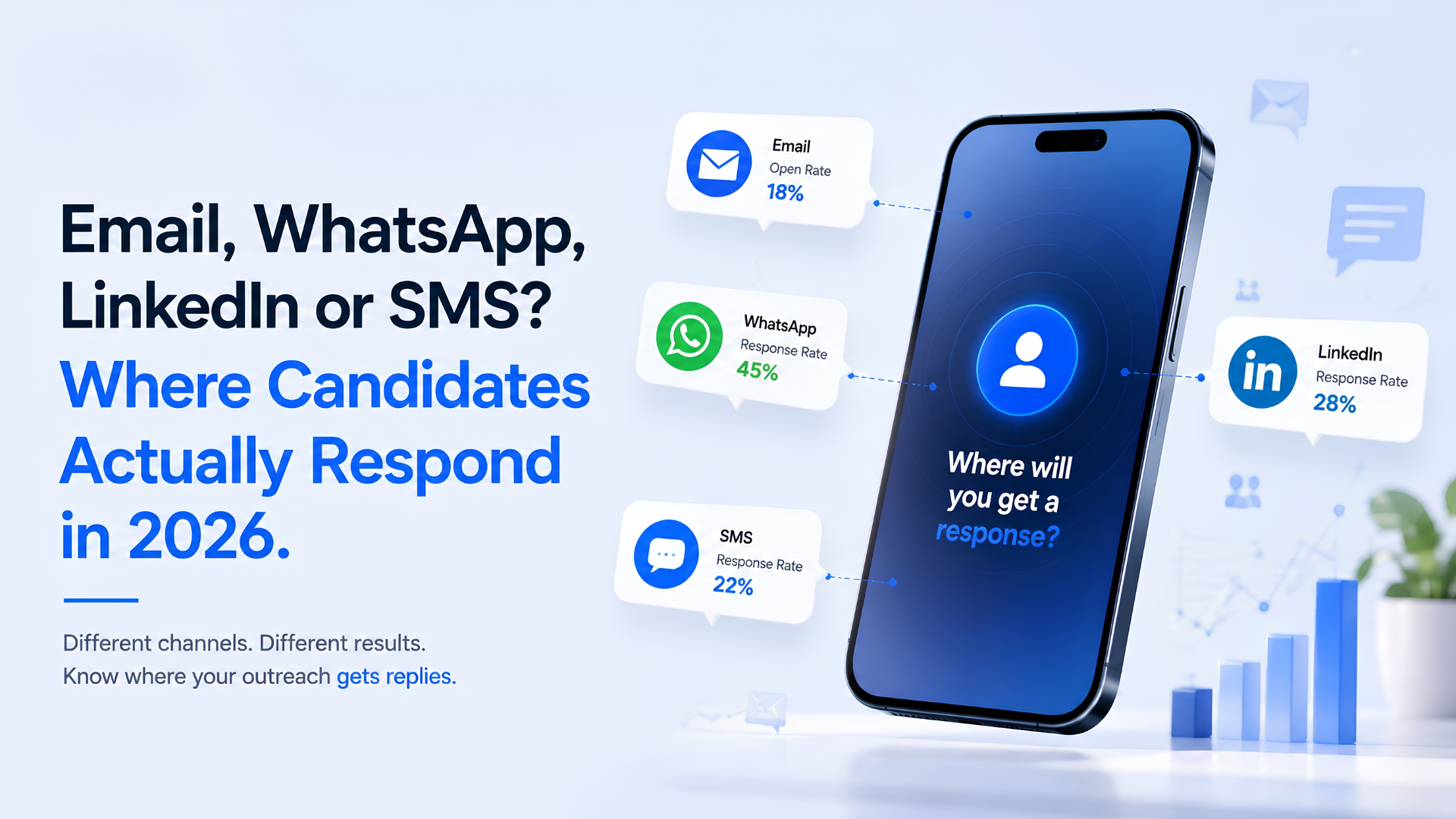
Email remains the most widely used outreach channel in recruiting, and by raw volume, it still generates the largest number of replies. But volume and efficiency are different things. In 2026, the average recruiter email open rate for candidate outreach has settled around 35–42%, with response rates hovering between 3–8% for cold outreach and 12–18% for warm or referral-sourced contacts. Those numbers are not bad, but they represent a steady decline from 2022 levels, driven by two compounding factors: inbox fatigue and the rise of AI-generated outreach that has made candidates more skeptical of anything that looks templated.
Where email still dominates is in formal, senior-level outreach—particularly for candidates in enterprise, finance, consulting, and legal sectors. These candidates check email professionally, expect formal communication, and often view messages on other channels as presumptuous. A well-crafted email to a VP of Engineering at a Fortune 500 company still outperforms a LinkedIn InMail or WhatsApp message for initial contact. The key word is "well-crafted." Generic emails in these segments are ignored at even higher rates than in the general population, because senior candidates have zero tolerance for anything that signals the recruiter did not do their homework.
The hidden problem with email in 2026 is deliverability. Spam filters have become more aggressive, and recruiter-sent emails—particularly from mass-outreach tools—are increasingly landing in promotions or spam folders. As we discussed in our analysis of why referrals outperform cold outreach, warm introductions bypass the deliverability problem entirely because the candidate recognizes the sender. Cold email, by contrast, is fighting an uphill battle against both human indifference and algorithmic filtering. The recruiters who succeed with email in 2026 are treating it as a premium channel: fewer sends, higher quality, more research per message.
LinkedIn: The Professional Default That Is plateauing
LinkedIn InMail has been the recruiter's weapon of choice for over a decade, and it still serves a critical function. It is the only channel where the candidate's professional context—their current role, recent activity, mutual connections—is immediately visible to the recruiter before they send. That context advantage is real and valuable. In 2026, however, LinkedIn response rates have plateaued at roughly 10–15% for InMails from first-degree connections and 3–7% for outreach to candidates outside the sender's network.
The plateau is happening for a specific reason: candidates are receiving more InMails than ever. LinkedIn's own growth in the recruiting space, combined with the proliferation of automated outreach tools that use the LinkedIn API, has turned the platform into a crowded marketplace. The average passive candidate in a tech hub now receives 5–12 recruiter InMails per week. At that volume, even a good message gets lost in the noise. Candidates have developed a coping mechanism: they scan the first line, and if it looks like a pitch, they archive it without reading further. Sound familiar? It should—it is the same dynamic that killed email's effectiveness for cold outreach, just delayed by a few years.
Where LinkedIn still excels is in mid-career and early-career segments, particularly for candidates who are actively or semi-actively open to opportunities. These candidates often check LinkedIn daily, use it as a professional identity platform, and are more receptive to recruiter contact there than on any other channel. The difference between AI sourcing and AI recruiting becomes relevant here: sourcing tools can identify candidates on LinkedIn efficiently, but the outreach quality on that same platform is what determines whether those identified candidates actually respond. The platform gives you the audience; your message earns the reply.
WhatsApp: The Channel That Changed Everything in Non-Western Markets
If you recruit in India, Brazil, Nigeria, Indonesia, or the Philippines—markets that collectively represent a massive and growing share of the global tech workforce—WhatsApp is not an alternative channel. It is the primary channel. In India alone, an estimated 85–90% of candidate outreach for tech roles below the senior leadership level happens on WhatsApp. The response rates tell the story: recruiters reporting 25–40% response rates on WhatsApp for mid-level technical roles, compared to 5–10% on email for the same profiles. That is not a small advantage; it is a transformational one.
The reason WhatsApp works in these markets is cultural, not technological. In many regions, WhatsApp is the default communication platform for both personal and professional interactions. Candidates expect to receive messages there, they respond quickly, and the conversational nature of the medium means that a recruiting outreach feels less like a cold pitch and more like a natural interaction. The psychological barrier to engagement is simply lower. A candidate who would ignore a LinkedIn InMail might respond to a WhatsApp message within minutes because the medium itself signals informality and accessibility.
The challenge with WhatsApp is scale and compliance. Manual WhatsApp outreach does not scale—you cannot send 200 personalized WhatsApp messages per day as a human recruiter. And automated WhatsApp outreach exists in a regulatory gray area in many jurisdictions, particularly under data protection frameworks like GDPR and India’s DPDP Act. As our article on recruiting compliance differences across regions explores in detail, the compliance landscape for messaging-based outreach is evolving rapidly, and recruiters need to stay ahead of it. The recruiters who are winning on WhatsApp in 2026 are using AI to draft personalized first messages and then managing the conversation manually from that point—getting the efficiency of automation without crossing into unsolicited bulk messaging.
SMS: The High-Intent Channel Most Recruiters Ignore
SMS is the most polarizing channel in recruiting outreach. Candidates either respond within minutes or they never respond at all. There is very little middle ground. In 2026, SMS response rates for candidate outreach average 15–22%, but that average masks enormous variance. For candidates who have opted in to hearing from recruiters—through job fairs, career events, talent communities, or previous interactions—SMS response rates can exceed 35%.
For truly cold SMS outreach to numbers that candidates have not shared for professional purposes, response rates drop below 2%, and the risk of damaging your employer brand or violating telecom regulations increases sharply.
The strategic value of SMS lies in its urgency and brevity. A text message is, by definition, short. It forces the recruiter to be concise, which paradoxically improves message quality. When you have 160 characters to make an impression, you cannot waste words on filler. The best SMS outreach in 2026 looks nothing like a job pitch squeezed into a text. It looks like a quick, relevant, personalized note: "Hi Sarah, noticed your talk at ReactConf last week—the architecture decisions you described are exactly what we are tackling at [Company]. Open to a quick chat?" That message works because it is specific, respectful of the candidate's time, and easy to respond to with a simple yes or no.
SMS also excels at a specific point in the hiring funnel: the follow-up. After an initial connection has been made on LinkedIn or email, a well-timed SMS—perhaps a day before a scheduled call, or as a quick confirmation—dramatically reduces no-show rates and keeps the candidate engaged. As we covered in our piece on how many follow-ups one hire actually needs, the majority of successful placements require multiple touches across multiple channels, and SMS is uniquely effective as a high-signal, low-friction touchpoint. The key is using it at the right moment, not as a first-contact channel for cold candidates.
The Channel-by-Seniority Matrix: What the Data Actually Shows
The most useful way to think about channel selection is not as a universal ranking but as a matrix that maps channels to candidate segments. The data from 2025–2026 recruiting benchmarks, combined with insights from platforms like LinkedIn and employer feedback, reveals a clear pattern that smart recruiters are already using to guide their channel strategy.
For C-suite and senior leadership candidates (VP and above), email remains the dominant first-contact channel, with LinkedIn as a secondary option for warming up the relationship. WhatsApp and SMS are generally inappropriate for first contact at this level, though they may become relevant later in the process for logistics. For mid-career professionals (5–15 years of experience), the picture is more nuanced: email and LinkedIn perform roughly equally in Western markets, while WhatsApp dominates in South and Southeast Asian markets. For early-career candidates (0–5 years of experience), WhatsApp leads in emerging markets, LinkedIn leads in Western markets, and email is a distant third everywhere.
The matrix also shifts by industry. In technology and startups, WhatsApp acceptance has crept into senior levels—particularly in markets like India and Brazil where startup culture has normalized informal communication. In financial services and healthcare, email maintains its dominance even for mid-level roles, because regulatory expectations and professional norms favor documented, formal communication. The takeaway is that channel strategy should be a first-class decision in your outreach workflow, not an afterthought. As McKinsey’s talent research has consistently shown, the organizations that treat channel
selection as a strategic variable—not a default setting—outperform their peers in both time-to-hire and candidate quality metrics.
Multi-Channel Orchestration: The Real Competitive Advantage
Knowing which channel works for which candidate is valuable. But the real advantage in 2026 belongs to recruiters who can orchestrate multiple channels in a single hiring workflow. Here is what that looks like in practice: a recruiter identifies a strong candidate through sourcing, sends an initial LinkedIn connection request with a brief, personalized note, follows up with an email two days later that adds a new piece of context, and then, if the candidate has shared their phone number through a previous event or community, sends a single WhatsApp or SMS message a week later to re-engage. Each touchpoint is on a different channel, adds new value, and respects the candidate's preferred communication style.
The challenge is that multi-channel outreach at scale is extraordinarily difficult to manage manually. Each channel has its own format conventions, tone expectations, and timing rhythms. A message that works on LinkedIn will feel stiff on WhatsApp. A WhatsApp-style message sent over email will look unprofessional. The recruiter needs to not only choose the right channel but also adapt the message to that channel’s norms. This is where the distinction between agentic AI and simple automation becomes critical. Simple automation sends the same message template across every channel, which is worse than not being multi-channel at all. Agentic AI understands that a LinkedIn message should reference the candidate's recent post, an email should be more formal and detailed, a WhatsApp message should be conversational and brief, and an SMS should be 160 characters of pure relevance.
There is also a sequencing dimension. The order in which you use channels matters. Starting with LinkedIn—where the candidate can see your profile before responding—builds familiarity that makes a subsequent email or WhatsApp message feel less cold. Starting with WhatsApp—which is inherently more intrusive—without any prior relationship is risky in most markets. The best multi-channel sequences start with the lowest-commitment channel and escalate to more personal ones as the relationship develops. As we noted in our article on more tools, same hiring problems, adding more channels without a strategic sequence is just more of the same problem. The sequence is the strategy.
How Huntlo Adapts Channel Strategy to the Candidate
Huntlo was built with channel intelligence as a core capability, not an afterthought. When the platform generates outreach for a candidate, it does not just personalize the message—it selects the optimal channel based on the candidate’s location, seniority, industry, and the available contact information. A senior finance leader in New York gets a formal, detailed email. A mid-level developer in Bangalore gets a concise, conversational WhatsApp message. The same candidate intelligence that drives message personalization also drives channel selection, because the two are inseparable.
Crucially, Huntlo also handles the message format adaptation that multi-channel outreach demands. A LinkedIn InMail generated by Huntlo reads like it was written by a recruiter who lives on LinkedIn—because it references the candidate’s activity and uses the platform’s conversational norms. An email from the same system reads like a professional correspondence, with appropriate structure and depth. A WhatsApp message is brief, informal, and action-oriented. This format awareness is what separates genuinely agentic AI recruiting platforms from the template-blasting tools that give multi-channel outreach a bad name. And because Huntlo continuously validates candidate contact data, you are never sending messages to outdated phone numbers or emails that would waste your outreach and damage your reputation.
The result is a channel strategy that is not just multi-channel but intelligent-channel. Instead of spraying every candidate across every available platform, Huntlo concentrates your outreach where it will have the most impact, with messages adapted to each channel’s strengths. For recruiting teams operating across markets and seniority levels, this channel intelligence is not a nice-to-have—it is the difference between a outreach strategy that scales and one that simply generates more noise.
Related reading:
Why Referrals Outperform Cold Outreach | Recruiting Compliance: India vs. USA vs. UK | AI Sourcing vs. AI Recruiting: What Is the Difference?