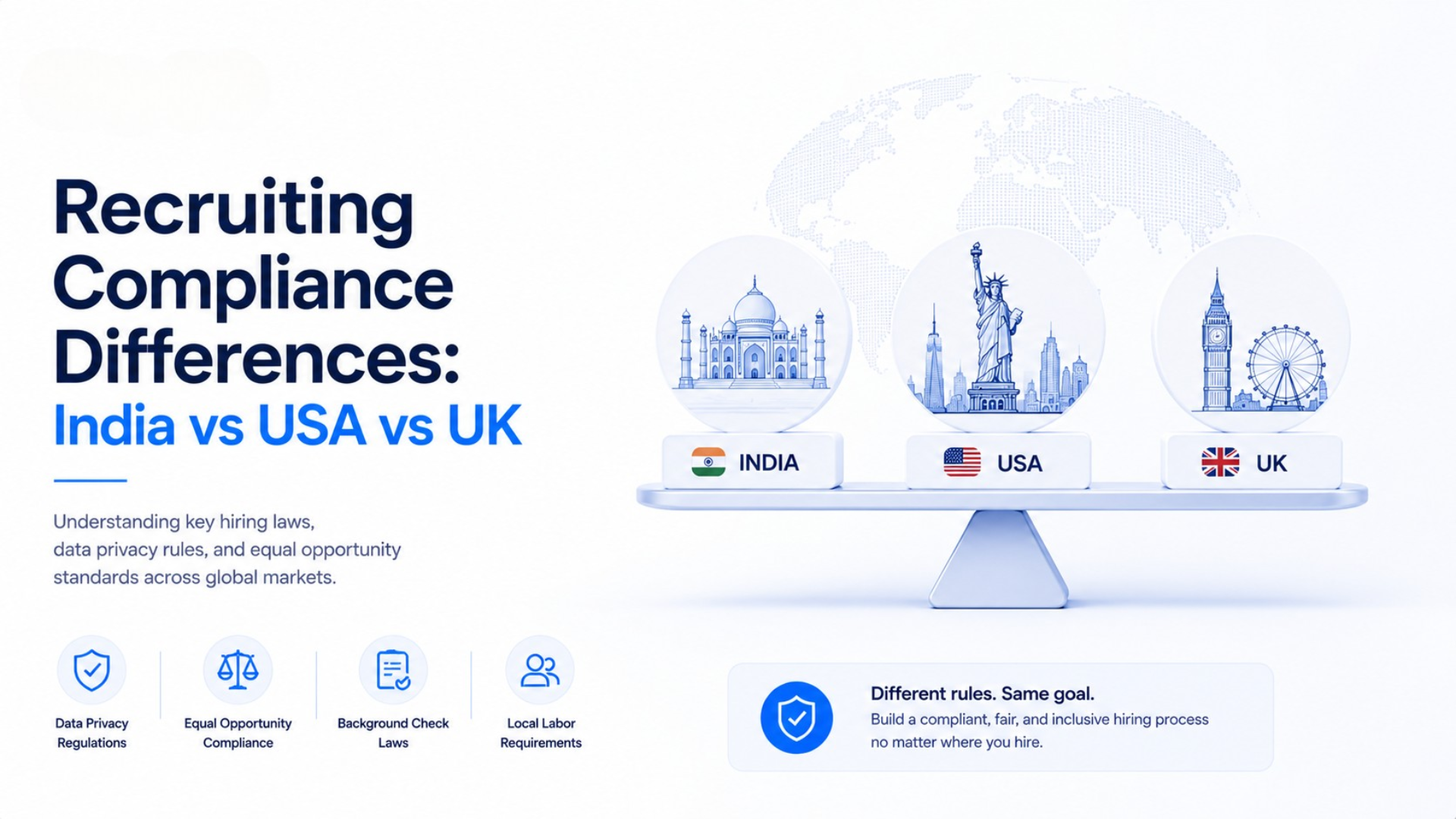
Cross-border recruiting has never been more common. Indian staffing agencies place candidates in the US and UK. American companies hire directly from India's engineering talent pool. British firms outsource recruitment processes to Indian operations. In each of these scenarios, recruiters must navigate the compliance requirements of multiple jurisdictions simultaneously, and the differences between those frameworks are far greater than most recruiters realize.
The consequences of getting compliance wrong are serious and getting more serious. India's Digital Personal Data Protection Act 2023 introduced personal data protection requirements with penalties reaching ₹250 crore (approximately $30 million). The United States is rapidly expanding AI-specific hiring regulations at both federal and state levels. The United Kingdom, post-Brexit, is developing its own data protection and AI regulatory framework that diverges from the EU in important ways. For recruiting organizations that operate across these markets, compliance isn't a checkbox exercise — it's an ongoing operational requirement that affects how you source, how you screen, how you store candidate data, and what technology you can legally use.
Data Protection and Candidate Privacy
Data protection is the foundation of recruiting compliance in all three countries, but the specific requirements and their enforcement differ dramatically.
India: The Digital Personal Data Protection Act (DPDPA) 2023
India's DPDPA 2023 represents the country's first comprehensive personal data protection law, and it has significant implications for how recruiting technology handles candidate information. The Act establishes a consent-based framework where data collection requires the individual's informed consent, data must be used only for the purpose for which it was collected, and data must be deleted once the purpose is fulfilled.
For recruiters, this means that candidate data sourced from job boards, professional networks, or public profiles must still comply with DPDPA consent requirements when stored in a recruiting database or CRM. The Ministry of Electronics and Information Technology (MeitY) has issued implementation rules that clarify how these requirements apply to commercial data processing, including recruiting activities.
Key compliance requirements for recruiters under DPDPA include obtaining clear consent from candidates before storing their data, providing candidates with the ability to access, correct, and delete their data, implementing reasonable security measures to protect candidate information, and ensuring that data is not retained beyond the period necessary for the recruiting purpose. The Act also includes restrictions on cross-border data transfers, requiring that candidate data transferred outside India must go to countries or entities that provide an "adequate level of data protection" as determined by the Indian government.
According to NASSCOM's analysis of DPDPA implications for the IT-BPM sector, staffing agencies and IT recruiters are among the most affected by the Act because of the volume of personal data they process and the cross-border nature of their operations. Agencies that place Indian candidates in US or UK roles must ensure that data transfers to foreign clients comply with DPDPA restrictions.
United States: A Patchwork of Federal and State Laws
The United States does not have a single federal data protection law equivalent to India's DPDPA or the UK's data protection framework. Instead, candidate data privacy is governed by a patchwork of federal and state laws that vary by jurisdiction, creating a compliance environment that the International Association of Privacy Professionals (IAPP) describes as the most complex in the world.
At the federal level, the Fair Credit Reporting Act (FCRA) governs how employers use third-party background check reports in hiring decisions. If a recruiter or employer uses a consumer reporting agency to conduct background checks — which is standard practice for most professional roles in the US — FCRA requires written candidate consent before obtaining the report, disclosure of the report contents to the candidate before any adverse action, and specific notice requirements if the background check results in a hiring rejection.
At the state level, an increasing number of states have enacted comprehensive data privacy laws that affect recruiting. California's Consumer Privacy Act (CCPA) and its successor, the California Privacy Rights Act (CPRA), give California residents the right to know what personal data is collected about them, the right to request deletion, and the right to opt out of data sales. Similar laws in Virginia, Colorado, Connecticut, and other states create overlapping obligations for recruiters who source candidates nationally.
For AI recruiting tools specifically, several states have enacted or proposed laws regulating AI use in hiring. New York City's Local Law 144, which took effect in July 2023, requires employers using AI-powered employment decision tools to conduct annual bias audits and provide candidates with notice that AI is being used. Colorado's AI Act and Illinois' Artificial Intelligence Video Interview Act impose additional requirements on AI-assisted hiring processes.
The practical implication for recruiters using AI sourcing tools is significant. According to the Equal Employment Opportunity Commission (EEOC), which has issued guidance on AI and algorithmic discrimination in hiring, employers remain legally responsible for the hiring decisions their tools produce, even when those decisions are substantially influenced by AI algorithms. This means recruiters must be able to explain and defend how their AI tools evaluate candidates.
United Kingdom: GDPR and the Emerging UK Framework
The United Kingdom's data protection framework is built on the UK General Data Protection Regulation (UK GDPR), which mirrors the EU's GDPR in most respects but with some UK-specific variations following Brexit. The UK GDPR is enforced by the Information Commissioner's Office (ICO), which has been active in issuing guidance on AI and recruitment.
Under UK GDPR, candidates are "data subjects" with rights including the right to be informed about how their data is processed, the right to access their data, the right to rectification, the right to erasure (the "right to be forgotten"), the right to restrict processing, and the right to data portability. For recruiters, this means maintaining transparent data processing records, responding to candidate data access requests within one month, and having clear data retention and deletion policies.
The UK is also developing its own AI regulation framework. The UK government's AI White Paper takes a principles-based approach to AI regulation, relying on existing regulators (including the ICO and the Equality and Human Rights Commission (EHRC)) to enforce AI-related requirements within their domains. For recruiters, this means that AI sourcing and screening tools must comply with both data protection requirements (enforced by the ICO) and anti-discrimination requirements (enforced by the EHRC).
Anti-Discrimination and Equal Opportunity Laws
Each country has distinct anti-discrimination frameworks that directly affect how recruiters write job descriptions, screen candidates, and make hiring decisions.
India: Constitutional Provisions and Special Legislation
India's anti-discrimination framework is rooted in the Constitution of India, which prohibits discrimination on grounds of religion, race, caste, sex, or place of birth. Several specific laws extend these protections into the employment context. The Equal Remuneration Act, 1976 mandates equal pay for men and women performing the same work. The Rights of Persons with Disabilities Act, 2016 requires employers to provide reasonable accommodations and reserves a percentage of government jobs for persons with disabilities.
Caste-based discrimination is a uniquely Indian compliance concern. While the Constitution prohibits caste discrimination, the practice persists in some hiring contexts, particularly in the private sector where enforcement is less rigorous than in government hiring. According to the Indian Staffing Federation (ISF), staffing agencies must implement explicit anti-discrimination policies that address caste, religion, gender, and disability, and must document their screening and selection processes to demonstrate compliance.
India also has specific requirements for employing women, including maternity benefit provisions under the Maternity Benefit (Amendment) Act, 2017, which provides 26 weeks of paid maternity leave. While this primarily affects employers rather than recruiters, staffing agencies that provide contract staffing must factor these requirements into their client proposals and candidate counseling. The creation of jobs for women and part time jobs for women involves specific compliance considerations around working conditions, safety provisions, and anti-harassment protections under the Sexual Harassment of Women at Workplace Act, 2013.
United States: EEOC and Expanding State Protections
The US anti-discrimination framework is anchored by Title VII of the Civil Rights Act of 1964, enforced by the Equal Employment Opportunity Commission. Title VII prohibits employment discrimination based on race, color, religion, sex, and national origin. Additional federal laws extend protections to age (the Age Discrimination in Employment Act), disability (the Americans with Disabilities Act), genetic information (the Genetic Information Nondiscrimination Act), and pregnancy (the Pregnancy Discrimination Act).
What makes US anti-discrimination compliance particularly challenging for recruiters is the expansion of protected categories at the state and local level. According to the National Conference of State Legislatures, over 20 states and 200 local jurisdictions have enacted protections beyond federal law, covering categories including sexual orientation, gender identity, marital status, political activity, and salary history. California's Fair Employment and Housing Act (FEHA) is notably broader than federal law, covering additional categories and applying to smaller employers.
For AI recruiting tools, the anti-discrimination implications are profound. The EEOC's 2023 guidance on AI and algorithmic fairness makes clear that employers can be held liable for discriminatory outcomes produced by AI tools, even if the discrimination was unintentional. This means that if an AI sourcing tool's matching algorithm systematically deprioritizes candidates of a certain race, gender, or age — even if the algorithm wasn't explicitly designed to do so — the employer using that tool can face an EEOC investigation and potential liability.
For recruiters using AI tools, this creates a compliance obligation to: audit AI tool outputs for potential bias patterns, maintain human oversight over AI-influenced hiring decisions, document the rationale for hiring decisions that involve AI-assisted screening, and be prepared to explain to regulators how AI tools contributed to specific hiring outcomes. Platforms like Huntlo that provide transparent, explainable AI screening — where the candidate's responses and the AI's assessment are documented and reviewable — support this compliance requirement more effectively than "black box" AI tools that can't explain their recommendations.
United Kingdom: The Equality Act 2010
The UK's primary anti-discrimination law is the Equality Act 2010, which consolidates and extends previous anti-discrimination legislation. The Act protects individuals from discrimination based on nine "protected characteristics": age, disability, gender reassignment, marriage and civil partnership, pregnancy and maternity, race, religion or belief, sex, and sexual orientation.
The Equality Act applies to all stages of the employment process, including job advertisements, candidate sourcing, screening, interviewing, and selection. The Equality and Human Rights Commission's Employment Statutory Code of Practice provides detailed guidance on compliance, and UK courts have been willing to impose significant penalties for violations.
For recruiters, the Equality Act has specific implications for job descriptions (which cannot specify preferences based on protected characteristics except where a genuine occupational requirement exists), candidate screening (which must not use criteria that disproportionately exclude candidates with protected characteristics), and AI tool selection (which must be evaluated for potential discriminatory impact). The EHRC's guidance on AI and discrimination in recruitment emphasizes that employers have the same legal responsibility for AI-assisted decisions as for human-made decisions.
AI-Specific Hiring Regulations
As AI becomes more prevalent in recruiting, all three countries are developing regulations specific to AI-assisted hiring.
India: Emerging AI Governance Framework
India does not yet have specific legislation governing AI use in recruiting, but the NITI Aayog's National Strategy for AI and the Department of Telecommunications' AI governance guidelines are laying the groundwork for future regulation. The DPDPA's consent and purpose limitation requirements apply to AI-processed candidate data, and the broader principles of non-discrimination in the Constitution apply to AI-assisted hiring decisions.
For practical purposes, Indian recruiters using AI tools should ensure that candidate data used for AI training or processing has appropriate consent, that AI screening criteria do not incorporate discriminatory factors (caste, religion, gender), and that candidates are informed when AI is used in the screening process. The Reserve Bank of India's guidelines on technology adoption also affect recruiting in the financial services sector, where AI use in hiring may be subject to additional regulatory scrutiny.
United States: Rapidly Expanding AI Hiring Regulations
The US is at the forefront of regulating AI in hiring, with a growing number of federal and state requirements. The most significant existing regulations include:
New York City Local Law 144 requires bias audits of automated employment decision tools, published summary results, and candidate notification before AI tools are used in hiring. The law applies to employers and employment agencies operating in New York City and has become a de facto standard that many employers adopt nationally.
Illinois' Artificial Intelligence Video Interview Act requires employers to notify candidates before using AI to analyze video interviews, obtain consent, and share the AI analysis with candidates on request. Maryland's similar law covers the use of facial recognition technology in hiring.
Colorado's AI Act requires "deployers" of high-risk AI systems — including employment AI — to implement reasonable care to protect against algorithmic discrimination, conduct impact assessments, and provide consumers with the right to appeal AI-driven decisions. California's proposed SB 1047 and similar bills in other states suggest that AI hiring regulation will continue to expand.
At the federal level, the EEOC has issued guidance on AI discrimination, and the Department of Labor has begun examining AI's impact on workforce discrimination. President Biden's 2023 Executive Order on AI directed federal agencies to develop guidelines for AI use in hiring, and these guidelines are expected to influence private-sector practices.
United Kingdom: Principles-Based AI Regulation
The UK's approach to AI regulation in hiring is more flexible than the US's prescriptive state-level laws. The UK government's pro-innovation AI regulation framework establishes five cross-sectoral principles — safety, transparency, fairness, accountability, and contestability — and relies on existing regulators to enforce them within their domains.
For recruiting, this means the ICO enforces data protection aspects of AI hiring, the EHRC enforces anti-discrimination aspects, and the Employment Tribunal system adjudicates disputes. The UK approach offers flexibility but less certainty than the US state-level requirements, as the exact compliance standards are still being developed through regulatory guidance and case law.
The ICO's guidance on AI and data protection emphasizes that organizations using AI in hiring must conduct Data Protection Impact Assessments (DPIAs), ensure human oversight of AI-assisted decisions, and be able to explain AI decisions to candidates who request information about how their data was processed.
Background Check and Verification Requirements
The background check process — a standard part of recruiting in all three countries — has different regulatory requirements in each jurisdiction.
India
Indian background checks are less formalized than in the US or UK but are increasingly important, particularly for IT and financial services hiring. According to the National Crime Records Bureau (NCRB), criminal record checks are available but not centralized in a way that allows instant verification. Most Indian employers use third-party verification agencies that conduct education verification, employment history verification, address verification, and criminal record checks through local police authorities.
There is no Indian equivalent of the US FCRA that specifically regulates the background check process in employment. However, the Indian Contract Act, 1872 and the Information Technology Act, 2000 provide legal frameworks that affect how background check data is collected, stored, and shared. The DPDPA 2023 will further regulate how personal data collected during background checks is processed and retained.
United States
The US has the most regulated background check environment for recruiting. The Fair Credit Reporting Act (FCRA) governs every aspect of the background check process when conducted by a third-party consumer reporting agency. Under FCRA, employers must obtain written candidate consent before obtaining a background check, provide candidates with a copy of the report and a summary of their rights before taking adverse action, and follow specific timing requirements for adverse action notices.
State laws add additional requirements. California's Investigative Consumer Reporting Agencies Act (ICRAA) and Ban the Box laws — now enacted in 37 states — restrict when employers can ask about criminal history during the hiring process. For recruiters, these laws mean that background check timing and content must be carefully managed to avoid compliance violations.
United Kingdom
The UK's background check system is anchored by the Disclosure and Barring Service (DBS), which provides criminal record checks at three levels: basic, standard, and enhanced. DBS checks are mandatory for roles involving children, vulnerable adults, or certain regulated activities, and are commonly requested for other professional roles as well.
Under the Rehabilitation of Offenders Act 1974, individuals with spent convictions are generally not required to disclose them to employers, with exceptions for certain roles. The UK GDPR also applies to background check data, requiring that the collection and processing of criminal record data meets specific legal conditions.
Recruiter Licensing and Agency Regulations
Staffing agencies and recruiters face different licensing requirements in each country.
India
India does not have a unified national recruiter licensing system, but several state-level regulations affect staffing agencies. The Contract Labour (Regulation and Abolition) Act, 1970 regulates contract staffing, requiring registration with state labor authorities for agencies providing contract labor. The Inter-State Migrant Workmen Act, 1979 imposes additional requirements on agencies that recruit workers from one state for employment in another — a common scenario for agencies supplying labor from states like Bihar, Uttar Pradesh, and Odisha to industrial centers in Gujarat, Maharashtra, and Karnataka.
The Private Security Agencies (Regulation) Act, 2005 requires licensing for agencies providing security personnel. Several states have introduced or are considering licensing requirements for staffing agencies more broadly, and the Ministry of Labour and Employment has drafted model regulations for the staffing industry that may be adopted by states.
United States
Recruiter licensing in the US is primarily a state-level requirement, and the requirements vary dramatically by state. According to the American Staffing Association (ASA), approximately 30 states have some form of staffing agency regulation, but the scope and enforcement vary widely. Some states require staffing agencies to obtain a license or registration, maintain specific financial reserves, provide written agreements to temporary workers, and comply with wage payment requirements.
The National Labor Relations Act (NLRA) and state labor laws affect how staffing agencies classify and manage temporary and contract workers. Joint employer liability — where both the staffing agency and the client company can be held liable for employment law violations — is a significant compliance concern. The Department of Labor's guidance on joint employment has been evolving, and recent interpretations have expanded the circumstances under which client companies can be considered joint employers.
United Kingdom
The UK has a relatively streamlined regulatory environment for recruitment agencies, governed primarily by the Employment Agencies Act 1973 and the Conduct of Employment Agencies and Employment Businesses Regulations 2003. These regulations require agencies to provide specific information to workers and hirers, prohibit certain practices (such as charging fees to work-seekers for finding them employment), and maintain records of their activities.
The GLA (Gangmasters and Labour Abuse Authority) licenses agencies in certain sectors — agriculture, horticulture, shellfish gathering, and food processing — where labor exploitation risks are highest. The Recruitment & Employment Confederation (REC) provides a voluntary code of practice that many UK agencies follow, and compliance with the REC Code is increasingly expected by clients.
How AI Sourcing Tools Must Adapt to Multi-Jurisdictional Compliance
For recruiting organizations that operate across India, the US, and the UK, AI sourcing tools must support compliance across all three regulatory environments simultaneously. This creates specific technical and operational requirements that not all AI recruiting tools meet.
Data Residency and Storage Controls
Candidate data collected in India must comply with DPDPA restrictions on cross-border data transfers. Candidate data collected in the UK must comply with UK GDPR requirements, including data subject rights. Candidate data collected in the US must comply with state-specific privacy laws like CCPA and CPRA. For a single AI sourcing tool to serve a cross-border recruiting operation, it needs configurable data residency controls that allow different data handling rules for different jurisdictions.
Huntlo's architecture supports these requirements through webhook-based data flows that give organizations control over where and how candidate data is stored and processed. Organizations that need to maintain Indian candidate data on Indian servers, US candidate data in the US, and UK candidate data under UK GDPR can configure their integrations accordingly.
Audit Trails and Explainability
US AI hiring regulations (NYC Local Law 144, Colorado AI Act, EEOC guidance) and UK GDPR requirements both demand that AI-assisted hiring decisions be auditable and explainable. Recruiters must be able to demonstrate what criteria the AI used, how candidates were scored, and whether any discriminatory patterns exist in the outcomes.
Huntlo's conversational AI screening produces documented conversation records that serve as an audit trail. Every candidate interaction is logged, every screening question and response is recorded, and every AI assessment is traceable to specific candidate inputs. This documentation supports compliance requirements far more effectively than AI tools that produce a single score without explaining how it was derived.
Consent Management
DPDPA (India), UK GDPR, and US state privacy laws all require consent for data collection and processing. AI sourcing tools used in cross-border recruiting need to support consent management workflows — obtaining consent at the point of data collection, recording consent status, and honoring withdrawal of consent.
Anti-Discrimination Safeguards
AI matching and screening algorithms must be designed to avoid discriminatory outcomes. This means not using protected characteristics as matching criteria, testing for disparate impact across demographic groups, and providing human oversight mechanisms that allow recruiters to override AI recommendations when bias is suspected.
Practical Compliance Checklist for Cross-Border Recruiters
For recruiting teams operating across India, the US, and the UK, here are the essential compliance practices:
Maintain separate compliance protocols for each jurisdiction, even if your recruiting process is unified. A single global policy won't adequately address the specific requirements of each country's legal framework.
Document your AI tool usage. Record which AI tools are used at each stage of the hiring process, what data they process, and how they contribute to hiring decisions. This documentation is essential for regulatory inquiries and litigation defense.
Conduct regular bias audits of AI tool outputs. Check whether candidates from different demographic groups are being sourced, screened, or selected at comparable rates. The EEOC and the UK EHRC both expect employers to proactively monitor for AI bias.
Stay current on regulatory changes. AI hiring regulations are evolving rapidly in all three countries, and compliance requirements that don't exist today may be enacted tomorrow. Subscribe to regulatory updates from the EEOC, ICO, and MeitY, and review your compliance posture quarterly.
Choose AI tools that support compliance. Platforms like Huntlo that provide documented screening processes, explainable AI outputs, configurable data handling, and webhook-based integration flexibility make cross-border compliance significantly more manageable than "black box" tools that can't adapt to different regulatory environments.
Train your recruiters on compliance requirements. Technology alone doesn't ensure compliance — your recruiters need to understand what they can and can't do in each jurisdiction, how to handle candidate data appropriately, and when to escalate compliance concerns.
Compliance in cross-border recruiting is complex, but it's not optional. The organizations that get it right — through a combination of the right tools, the right processes, and the right knowledge — will be the ones that build sustainable recruiting operations across India, the US, the UK, and beyond. Those that cut corners will face regulatory consequences that can destroy reputations and businesses.
Related Topics
Over-Automating Outreach: When AI Sourcing Hurts Your Brand
AI Sourcing Tool Comparison Framework: 10 Criteria That Matter
AI Recruiting Software for Staffing Firms: Complete Guide (2026)