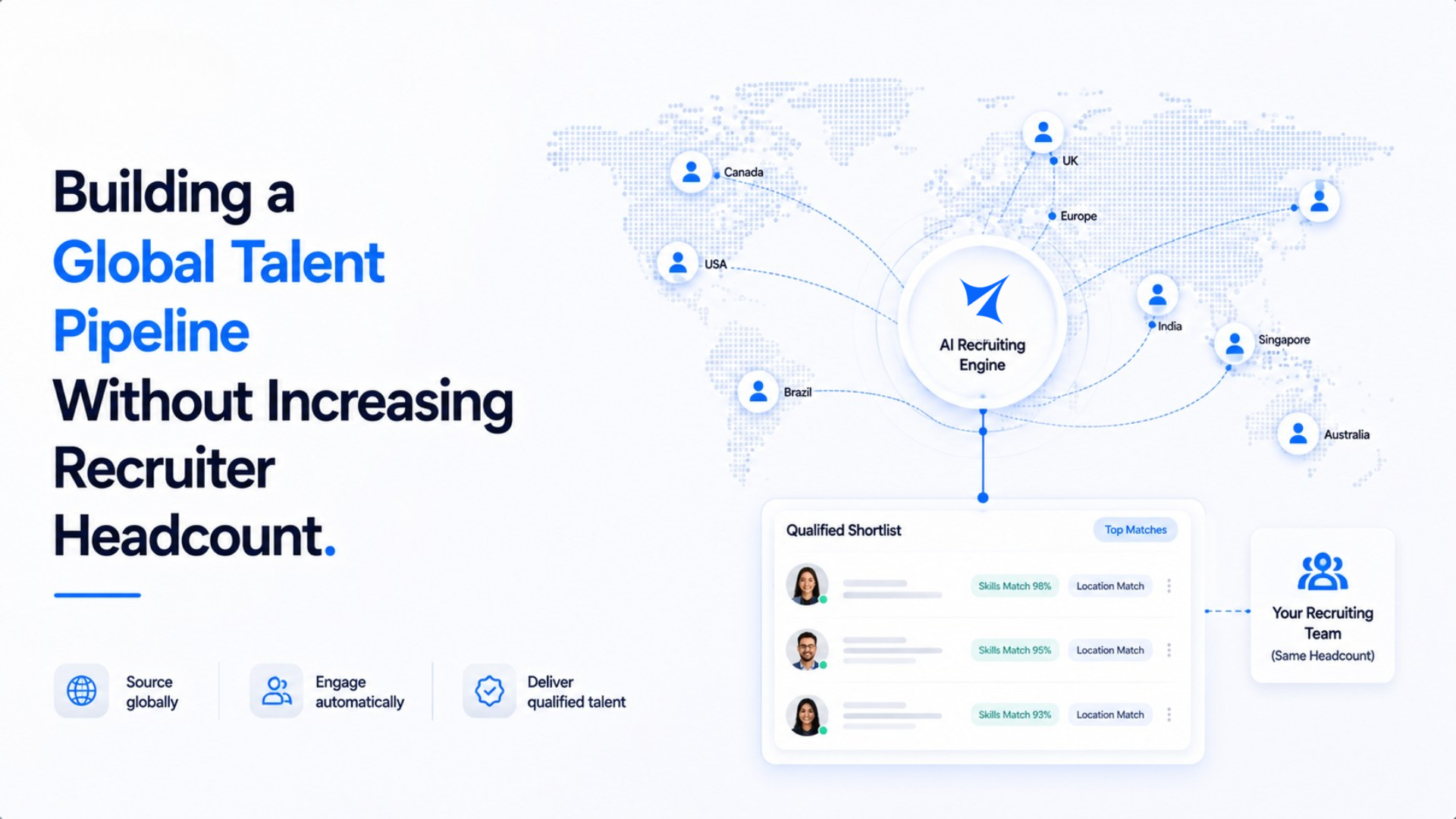
Every recruiting leader has faced the same equation: more hiring demand plus the same recruiter headcount equals burned-out teams and unfilled roles. The traditional solution is to hire more recruiters, but that solution is expensive, slow to implement, and scales linearly while hiring demand often scales exponentially. When the hiring mandate expands from a single region to multiple countries or continents, the headcount-based model becomes completely unsustainable. You would need recruiters in every target market, each with local language capabilities, market knowledge, and professional networks. The cost and coordination overhead would be enormous. Yet the talent opportunity is real and compelling: the best candidates for your most critical roles may not live in your city, your country, or even your time zone. According to SHRM's talent acquisition research, organizations that successfully access global talent pools report significantly better quality-of-hire and time-to-fill outcomes than those confined to local markets. The question is not whether to go global but how to do it without breaking the recruiting budget.
The answer lies in a fundamental shift from headcount-dependent recruiting to intelligence-amplified recruiting. Instead of adding recruiters to cover more geography, you add AI-powered talent intelligence that multiplies the reach and effectiveness of the recruiters you already have. A single recruiter with an AI platform that monitors global talent markets, identifies candidates across regions, and provides localized engagement intelligence can effectively cover a geographic scope that would otherwise require a team of five or more. This is not about replacing recruiters with automation. It is about giving every recruiter the intelligence tools to operate at a scope and scale that human effort alone cannot achieve. This article explores the specific strategies, capabilities, and implementation steps that make global pipeline
building possible without increasing headcount.
Why Headcount Is the Wrong Lever for Global Scaling
The instinct to add headcount when hiring demand increases is understandable but misguided for several reasons. First, recruiter hiring is itself a slow and resource-intensive process. By the time you identify, recruit, onboard, and ramp up new recruiters, the hiring demand that justified the addition may have shifted. Second, recruiter effectiveness has a long tail. A new recruiter takes three to six months to become fully productive, and even experienced recruiters joining a new organization need time to learn the company's culture, hiring manager preferences, and role requirements. Third, headcount scaling creates coordination overhead that grows faster than the actual output. A team of three recruiters can coordinate informally. A team of fifteen requires structured processes, management layers, and communication systems that consume a significant portion of the added capacity. McKinsey's organizational insights have found that the marginal productivity of each additional recruiter decreases as team size grows, because coordination costs increase while individual focus and autonomy decrease.
The fourth and most important reason is that the bottleneck in global recruiting is not recruiter labor. It is market knowledge, data access, and the intelligence to act on both. A recruiter based in New York who needs to source candidates in Berlin, Bangalore, and Sao Paulo faces enormous information asymmetries. They do not know which local companies produce the best talent, which professional communities are most active, what compensation expectations are realistic, or what cultural nuances affect candidate engagement. Adding more recruiters based in New York does not solve this problem. What solves it is an AI platform that has already mapped the talent landscape in each target market, identified the companies and communities where top candidates cluster, and provides localized intelligence that helps the recruiter engage effectively regardless of geography. Understanding the difference between AI sourcing and AI recruiting is essential in a global context, because sourcing candidates across multiple markets requires intelligence that spans borders, languages, and professional cultures in ways that manual recruiting processes simply cannot.
The financial case for intelligence over headcount is straightforward. The fully loaded cost of a professional recruiter in a major market ranges from one hundred thousand to one hundred fifty thousand dollars per year when accounting for salary, benefits, tools, and overhead. An AI-powered talent intelligence platform typically costs a fraction of that per recruiter seat while providing capabilities that would otherwise require multiple additional headcount. The ROI is not theoretical. Organizations that have adopted AI-amplified recruiting report being able to increase their pipeline coverage by three to five times without adding recruiters, because the platform handles the most time-consuming aspects of candidate identification and initial assessment. Gartner's HR trends research projects that by 2027, over sixty percent of mid-to-large enterprises will rely on AI-powered talent intelligence as their primary mechanism for scaling recruiting capacity, up from less than twenty percent in 2024.
How AI Eliminates the Geography Barrier
The most immediate barrier to global talent sourcing is geographic data access. A recruiter searching for candidates in a market they are not familiar with does not know where to look, which platforms are most relevant, or how to interpret the signals they find. Professional networks that dominate in one region may be irrelevant in another. In some markets, candidates are most active on local professional platforms rather than global ones. In others, the richest talent signals come from academic institutions, government databases, or industry-specific communities that are invisible to recruiters operating from outside the region. An AI-powered talent intelligence platform eliminates this barrier by aggregating data from region-specific sources, normalizing candidate profiles across different formats and conventions, and presenting a unified view of the global talent market regardless of where the recruiter is sitting.
Language is another barrier that AI effectively removes. Multilingual NLP capabilities allow the platform to analyze candidate profiles, publications, and professional activity in multiple languages and present the insights in the recruiter's preferred language. A recruiter in London can evaluate a candidate profile from Tokyo that includes publications in Japanese, community contributions in English, and a work history documented in both languages. The platform extracts the relevant skills, experience, and signals regardless of the source language and presents them in a format the recruiter can act on immediately. This capability is especially valuable for niche and technical roles where the best candidates may be active in non-English-language communities, and their most impressive work may be documented in their native language. Without AI-powered language processing, these candidates would be invisible to English-speaking recruiters.
Time zone management is the third geographic barrier that AI addresses. When a recruiting team sources candidates across multiple time zones, the logistics of scheduling outreach, follow-ups, and interviews become complex. AI platforms solve this by optimizing send times for each candidate's local time zone, tracking candidate availability windows, and managing follow-up sequences that account for time zone differences. This ensures that a candidate in Singapore receives outreach at the optimal local time, not at a time that is convenient for the recruiter but inconvenient for the candidate. The platform can also stagger outreach sequences across regions, so candidates in different time zones are being engaged at their optimal times simultaneously. Understanding how many followups one hire needs is important in any context, but in global recruiting it is especially critical because time zone misalignment can add days to each follow-up cycle if not managed intelligently. An agentic AI recruiting platform handles this automatically, ensuring that global outreach maintains the same cadence and responsiveness as local sourcing.
Always-On Pipeline Building Across Every Region
One of the most powerful advantages of AI-powered global sourcing is the ability to build
pipeline continuously across every target region without requiring the recruiting team to be actively working in each market. The platform monitors talent signals across all configured regions twenty-four hours a day, seven days a week, building and refreshing candidate profiles regardless of when the recruiting team is online. A candidate in Seoul who updates their profile at midnight local time is captured and analyzed in real time. A software engineer in Warsaw who pushes a significant code commit at three in the morning their time is noticed and their fit score updated. A product leader in Lagos who publishes a thought leadership article on Saturday afternoon is added to relevant talent pools immediately. This always-on capability means that global pipeline building happens continuously, not just during the recruiter's working hours.
The practical impact is that when a recruiter logs in each morning, they have a comprehensive update on candidate activity across all target regions, not just the ones they had time to search manually. New candidates are surfaced with full intelligence profiles. Existing candidates have updated scores based on recent activity. Pipeline coverage metrics show which regions and roles have strong candidate depth and where gaps exist that require attention. This is fundamentally different from the traditional model where a recruiter dedicates specific blocks of time to searching each regional market and whatever happens between those searches is simply missed. LinkedIn's recruiting resources report that global recruiting teams using AI-powered continuous monitoring identify thirty to fifty percent more qualified candidates per region than teams relying on periodic manual search, because the continuous model captures signals that the batch model would miss.
Always-on pipeline building also provides a strategic early-warning capability for global talent markets. The platform can detect shifts in talent availability before they become obvious. A spike in profile updates from employees of a specific company in a target market may signal an impending talent exodus. A sudden increase in candidates from a particular region matching your role requirements may indicate a localized skill surplus. A decrease in candidate engagement signals from a market you have been sourcing from may indicate increased competition or changing market conditions. These strategic insights allow the recruiting team to adjust their global sourcing strategy proactively rather than reacting to changes after they have already affected pipeline quality. However, this intelligence is only valuable when the underlying data is current. Understanding why some AI recruiting tools have outdated candidate data is especially important in global sourcing, where data freshness across multiple regions and languages is harder to maintain and more critical to get right.
Amplifying Recruiter Productivity with AI
The core promise of AI-amplified global recruiting is that each recruiter can produce significantly more value without working more hours. This productivity amplification manifests in several concrete ways. The first is identification speed. Without AI, a recruiter sourcing candidates in an unfamiliar market might spend several hours researching companies, communities, and platforms before identifying their first viable candidate. With AI, that same recruiter
can access a pre-built, continuously refreshed talent pool for that market within minutes. The platform has already identified, profiled, and ranked candidates based on the role requirements, so the recruiter's first action is evaluation rather than searching. The time savings per market are enormous, and they multiply across every region the team covers.
The second amplification is assessment depth. When a recruiter reviews a candidate in an unfamiliar market, they often lack the context to evaluate the candidate's profile accurately. Is a particular company known for strong engineering? Is a specific university program well-regarded in its field? Is a candidate's job title at a regional company equivalent to a similar title at a global firm? An AI platform that has been analyzing career trajectories and company profiles across the market can provide this context automatically, flagging candidates who come from high-quality talent environments and noting when a title may understate or overstate a candidate's actual scope. This contextual intelligence means that recruiters can evaluate global candidates with the same confidence they bring to local candidates, which directly improves hiring decision quality. Deloitte's talent research emphasizes that the organizations achieving the best global hiring outcomes are those that invest in contextual market intelligence, not just candidate identification tools, because context is what transforms a candidate list into actionable hiring intelligence.
The third amplification is engagement quality. AI-powered platforms generate personalized outreach recommendations for each candidate, including specific signal points to reference, suggested framing based on career context, and optimal timing based on behavioral analysis. This means the recruiter can send highly relevant, well-timed messages to candidates in any market without spending hours researching each one individually. The result is higher response rates and more productive initial conversations, which translates to faster pipeline velocity and better conversion from identification to hire. This intelligence-augmented engagement is far more effective than the generic, template-based outreach that most recruiters default to when they are stretched thin across multiple markets. However, organizations that simply add more tools without integrating their workflow often find they have more tools but the same hiring problems, because the tools operate in isolation rather than as a unified intelligence system. The recruiters who worry about whether AI will replace their jobs should recognize that in global recruiting, AI is not replacing recruiters. It is making a small team globally competitive.
The ultimate transformation that AI-powered global sourcing enables is the evolution of the recruiter's role from a market-specific operator to a global talent advisor. Instead of being limited to sourcing candidates in markets they know personally, recruiters with AI intelligence can operate effectively across any market the platform covers. They become strategic advisors who can advise hiring managers on global talent availability, recommend market-specific sourcing strategies, and make data-driven trade-off decisions about where to focus recruiting effort. This elevated role is more strategically valuable, more professionally satisfying, and more resistant to automation than the traditional sourcing role. Evaluating an AI sourcing tool for global capability means assessing not just how many regions it covers but how deeply it
understands each market and how effectively it translates that understanding into actionable recruiting intelligence. Huntlo.ai provides this global intelligence engine out of the box. Whether you are expanding into new markets, hiring for specialized technical roles across borders, or simply building a more resilient and diverse talent pipeline, Huntlo gives your existing recruiting team the intelligence to operate globally without adding a single headcount. The future of recruiting is not bigger teams. It is smarter teams. And Huntlo makes every recruiter a global recruiter.