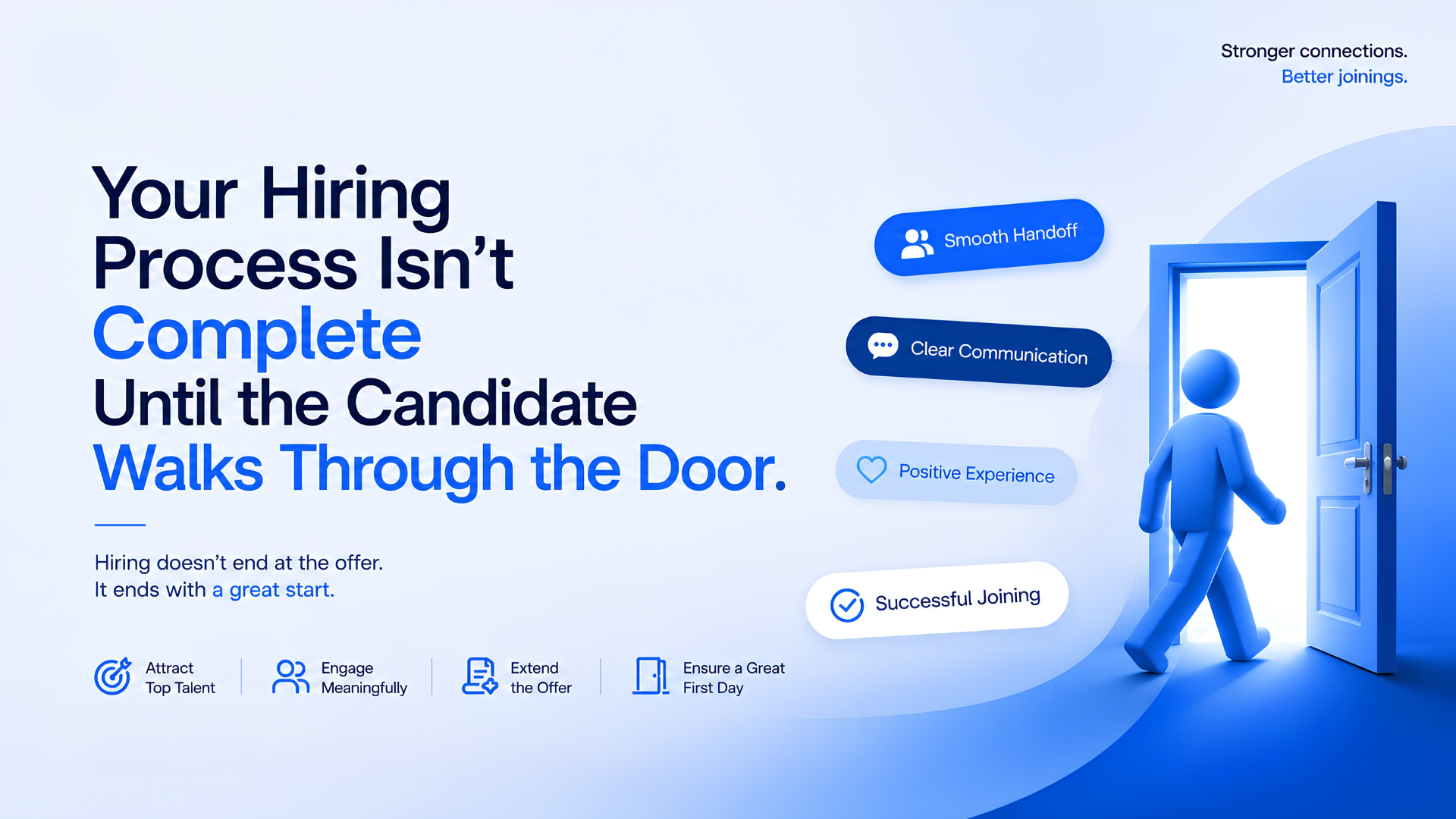
Your applicant tracking system shows the requisition as closed. The offer was accepted fourteen days ago. The recruiter has moved on. The hiring manager has stopped checking in. The onboarding team has not yet been engaged because, in your organization, onboarding starts on day one, not before. Meanwhile, your candidate is sitting in their current office, listening to their manager make a case for staying, being courted by their teammates who want them to remain, and wondering why the company they were so excited to join has gone completely silent. Your hiring process, by every metric your organization tracks, is complete. Your candidate's experience of the hiring process is very different. They feel abandoned, uncertain, and increasingly receptive to the retention efforts of their current employer. The hiring process is not complete until the candidate walks through the door. Everything before that is a half-finished process that can still fall apart at any moment.
This is not a philosophical argument. It is a practical one, grounded in data and financial consequences. Across industries, between fifteen and twenty-five percent of accepted offers never convert to actual starts. The recruiting function spends enormous effort and budget getting to the point of offer acceptance, and then walks away, leaving the most vulnerable phase of the entire process unmanaged. The result is a preventable failure rate that costs the average mid-size organization hundreds of thousands of dollars per year in wasted recruiting spend, extended vacancies, and lost productivity. According to SHRM’s talent acquisition research, the post-offer phase represents the highest-risk, lowest-investment stretch of the entire hiring journey, and it is where the greatest improvement opportunity exists for virtually every recruiting team. Redefining the hiring process completion to include the post-offer phase is not a change in semantics. It is a change in operational reality that drives measurable
improvements in every metric the business actually cares about.
The False Finish Line: Why Offer Acceptance Is Not the End
The convention of treating offer acceptance as the end of the hiring process is so deeply embedded in recruiting practice that most practitioners do not question it. The applicant tracking system marks the requisition as closed. The recruiter's performance is evaluated on offers accepted. The hiring manager considers the role filled. The organization's recruiting metrics, time to fill, cost per hire, offer acceptance rate, all stop counting at the moment the candidate says yes. But this convention is not based on evidence or business logic. It is based on historical habit and system design limitations. Applicant tracking systems were built to manage the front-end process, and their data models reflect that bias. Recruiting metrics were defined in an era when post-acceptance drop-offs were considered unavoidable, and they have not been updated. The result is a collective delusion: the organization believes the hiring process is complete when it is, in fact, only two-thirds complete. The end-to-end hiring process, viewed from the candidate's perspective, has three phases. The first phase is the courtship phase, from first contact through offer acceptance, where the organization works to convince the candidate to say yes. The second phase is the commitment phase, from offer acceptance through the start date, where the organization works to ensure the candidate's decision holds. The third phase is the integration phase, from day one through the first ninety days, where the organization works to ensure the candidate becomes a productive, committed employee. All three phases are part of the hiring process. All three determine the ultimate outcome: a productive hire. The fact that most organizations only manage the first phase is the single largest source of preventable hiring failure. According to McKinsey’s people organization insights, organizations that manage all three phases as a unified process achieve twenty to thirty percent higher new-hire retention at the twelve-month mark, because the candidate's experience is consistent, continuous, and supportive across the entire journey.
The false finish line also creates a dangerous information asymmetry. During the courtship phase, the organization controls the information environment. The candidate's primary source of information about the new role, the team, and the company is the recruiting team. During the commitment phase, the information environment shifts. The candidate is still at their current employer, surrounded by colleagues who are actively making the case for staying. The new employer, having declared the process complete, has gone silent. The current employer, motivated by the prospect of losing a valued team member, is communicating with urgency, warmth, and specificity. The candidate is receiving a steady stream of positive messaging from their current employer and silence from their future employer. Over the course of a two or three week notice period, this information asymmetry systematically tilts the candidate's emotional calculus back toward staying. The organization that treats the hiring process as complete at offer acceptance is ceding the commitment phase to the candidate's current employer by default. This is the opposite of candidate arrival assurance, and it is entirely preventable.
Redefining the Hiring Process: A Three-Phase Model
Redefining the hiring process to include the post-offer phase requires a simple but fundamental shift in how the organization defines the process boundaries, assigns ownership, and measures success. The full-cycle recruiting ownership model has three principles. The first principle is that the hiring process does not end until the candidate has completed their first day of work. The recruiter, or a designated post-acceptance owner, remains accountable for the candidate's experience and outcome through the start date. The second principle is that the post-offer phase is a managed process with its own objectives, activities, and metrics, not an unstructured waiting period. The third principle is that the transition from recruiting to onboarding is a seamless handoff, not a gap, with complete information transfer and no loss of candidate context. Implementing these three principles requires changes in four areas. The first area is metrics. The joining rate, the percentage of accepted offers that convert to actual starts, becomes a primary metric alongside offer acceptance rate. This creates accountability for the commitment phase and makes post-acceptance drop-offs visible and measurable. The second area is process. A documented, repeatable post-offer engagement process is defined, with clear objectives for each week of the notice period, assigned responsibilities for each stakeholder, and escalation protocols for at-risk candidates. The third area is technology. A platform that spans the entire candidate journey, from sourcing through onboarding, provides the communication orchestration, risk monitoring, and measurement infrastructure needed to manage the commitment phase at scale. The fourth area is culture. The recruiting team’s self-image shifts from ‘we close offers’ to ‘we produce hires,’ and the organization’s expectation shifts accordingly. According to LinkedIn’s recruiting resources, organizations that implement all four changes see a fifteen to twenty-five percentage point improvement in joining rate within the first year, because the changes address the root causes of post-acceptance failure rather than treating the symptoms.
The post-offer hiring pipeline is not a new concept, but it has never been treated with the same rigor as the front-end pipeline. Front-end pipeline management includes stage-by-stage conversion rates, time-in-stage metrics, and activity volume tracking. The same discipline, applied to the post-offer phase, would include offer-to-start conversion rate, time from acceptance to risk-signal identification, and post-offer touchpoint completion rate. These metrics transform the commitment phase from a black box into a visible, manageable process. They also create the feedback loop that drives continuous improvement: when a specific type of intervention correlates with higher joining rates, the process can be adjusted to include that intervention for every candidate. Understanding how many follow-ups one hire actually needs, becomes a data-driven question rather than a matter of recruiter intuition, and the answer becomes a process standard rather than an individual preference.
Who Owns the Post-Offer Phase?
The most common question when organizations redefine the hiring process to include the post-offer phase is: who owns it? In most organizations, the answer is ambiguous, and that
ambiguity is the root cause of the neglect. The recruiter believes their job is done at offer acceptance. The hiring manager believes their job is done at offer approval. The onboarding team believes their job starts on day one. The result is a gap in ownership that leaves the candidate without a clear point of contact during the most vulnerable phase of their transition. The most effective ownership model depends on the organization's size and structure, but three models have proven successful. The first model is recruiter ownership, where the recruiter remains the primary point of contact through the start date. This model works well for smaller teams or organizations with lower hiring volumes, because it preserves the relationship the recruiter has built with the candidate during the courtship phase. The second model is a dedicated preboarding specialist, a role that sits between the recruiting team and the onboarding team and is responsible for managing every accepted candidate through the notice period. This model works well for larger organizations with higher hiring volumes, because it provides dedicated capacity without burdening the recruiter. The third model is shared ownership, where the recruiter manages the first week after acceptance, the hiring manager manages the middle of the notice period, and the onboarding specialist manages the final week before the start date. This model works well when hiring managers are willing to invest time in the post-acceptance phase, because it distributes the workload and gives the candidate multiple connections within the organization. According to Gartner’s HR trends analysis, the specific model matters less than the clarity of ownership. Organizations where the post-offer phase has a clearly designated owner, regardless of which model they use, achieve consistently higher joining rates than organizations where ownership is ambiguous, because clarity of ownership drives accountability, and accountability drives execution.
The ownership question also intersects with the technology question. If the post-offer phase is owned by the recruiter, the technology must be integrated into the recruiter's workflow, not deployed as a separate system. If the post-offer phase is owned by a preboarding specialist, the technology must provide the specialist with the same candidate intelligence that the recruiting team gathered during the courtship phase. If the ownership is shared, the technology must coordinate across multiple stakeholders, ensuring that each person has the information they need at the moment they need it. This is the capability that distinguishes an agentic AI recruiting platform from a collection of point solutions: the ability to maintain a unified candidate record across multiple owners and multiple phases, ensuring continuity of experience even when responsibility changes hands. As we have discussed in our analysis of the difference between AI sourcing and AI recruiting, the most effective recruiting technology supports the full lifecycle of the candidate relationship, not just the transactional phases that are easiest to automate.
The Financial Impact of a Complete Hiring Process
The financial case for redefining the hiring process to include the post-offer phase is straightforward and significant. Consider an organization that hires three hundred people per year with an average cost per accepted offer of eight thousand dollars and a joining rate of eighty percent. This means that sixty accepted offers per year never convert to starts, representing
four hundred eighty thousand dollars in direct recruiting waste. If a complete hiring process, one that manages the post-offer phase with the same rigor as the front-end process, improves the joining rate from eighty percent to ninety percent, the organization saves two hundred forty thousand dollars per year in direct recruiting costs. When the indirect costs of extended vacancies are included, hiring manager time, team productivity loss, and delayed project timelines, the total savings typically range from five hundred thousand to one million dollars per year. The investment required to achieve this improvement is modest relative to the return. The primary costs are in process design, which is a one-time investment; in technology, which is typically a subscription cost that is a small fraction of the recruiting budget; and in training, which is a one-time or annual cost. According to Deloitte’s talent research, the ROI on investing in a complete hiring process typically exceeds five hundred percent in the first year, because the cost of the failure being prevented, post-acceptance drop-offs, is so much larger than the cost of the intervention. As we have explored in our analysis of why more tools produce the same hiring problems, the organizations that achieve the highest ROI are not the ones that spend the most on technology. They are the ones that invest in the process and measurement changes that make the technology effective.
The Complete Process in Practice: A Week-by-Week Framework
Organizations that redefine their hiring process to include the post-offer phase need a practical framework for execution. The most effective approach is a week-by-week structure that ensures every accepted candidate receives a progressively deepening experience throughout the notice period. This structure is not rigid. It is adapted to each candidate's risk profile and notice period length. But it provides a reliable baseline that ensures no critical touchpoint is missed. According to Gartner’s HR trends analysis, organizations that implement a structured week-by-week post-offer framework achieve joining rates that are twenty to thirty percentage points higher than organizations that rely on ad hoc recruiter-initiated contact, because the framework ensures consistency across every candidate regardless of recruiter workload or individual skill level.
Why Huntlo.ai Delivers a Hiring Process That Ends at the Right Place
Huntlo.ai is built on the principle that the hiring process is not complete until the candidate walks through the door. The platform provides a unified candidate journey that spans from first contact through day one, with no gaps, no handoff failures, and no loss of candidate context. Every candidate's motivations, concerns, and decision-making context, captured during the courtship phase, drives the post-offer engagement strategy. The system orchestrates communication across all stakeholders, monitors risk in real time, and measures the joining rate with full segment-level drill-down. Huntlo ensures that outdated candidate data in AI recruiting tools never undermines the post-offer experience, because every interaction is based on fresh, continuously updated intelligence about the candidate's current state. For recruiting leaders who are ready to redefine their hiring process to include the commitment phase, Huntlo provides the technology, the workflow, and the measurement to make it happen at any
scale. The platform ensures that why referrals outperform cold outreach is understood not as a channel advantage but as a relationship continuity advantage, because every candidate, regardless of source, receives a post-offer experience that maintains the connection built during the courtship phase. And for organizations evaluating their technology options, understanding how to evaluate an AI sourcing tool before buying, means asking whether the platform manages the hiring process through the candidate's arrival, or whether it stops at the offer acceptance like every other tool on the market.
The hiring process is complete when the candidate walks through the door, settled in, confident, and ready to contribute. Not before. Every day between the signed offer and that moment is part of the process, and every one of those days is an opportunity to reinforce the candidate's decision or to let it erode. The organizations that treat the post-offer phase as part of the hiring process do not just get more candidates to show up. They get candidates who arrive confident, connected, and ready to contribute from the first day. That is the outcome the business actually needs, and it is the outcome that a complete hiring process delivers.