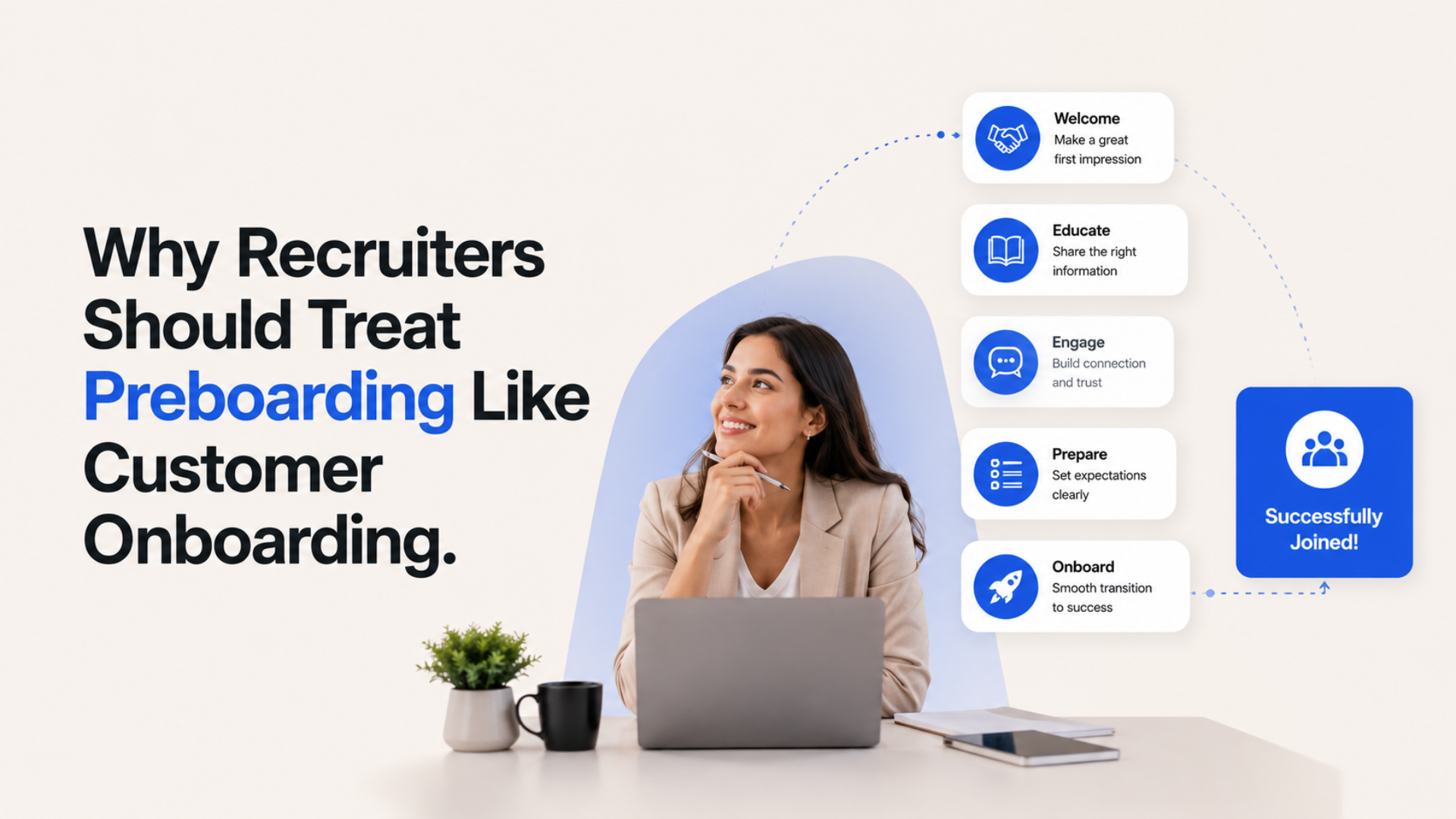
A SaaS company would never let a new customer sign a contract and then go silent for three weeks. There would be a welcome email within minutes, a kickoff call within days, a curated resource library, a dedicated success manager, and a milestone-based plan that guides the customer from signing to first value. The entire process is designed to reinforce the buying decision, build momentum, and ensure the customer never questions whether they made the right choice. Now consider what happens in most recruiting organizations after a candidate accepts an offer. The recruiter sends a congratulatory email, HR sends a benefits enrollment link, and then, silence. For two to four weeks, the candidate hears nothing meaningful from the organization they just committed to. That silence is not just a missed opportunity. It is an active risk to the hire.
The parallel between customer onboarding and candidate preboarding is not metaphorical. It is structural. Both involve a person who has made a commitment, a organization that needs that person to succeed, and a vulnerable transition period where the person is most likely to change their mind. According to SHRM’s talent acquisition research, between ten and twenty percent of accepted candidates withdraw before their start date, and the primary driver is not competing offers or counter-offers from current employers. It is disengagement during the preboarding window. The candidate feels forgotten, second-guesses their decision, and ultimately backs out. This is the same dynamic that customer success teams have spent decades learning to manage, and recruiting teams can apply those lessons directly.
What Customer Onboarding Gets Right That Preboarding Gets Wrong
Customer onboarding teams operate with a fundamentally different mindset than most recruiting teams. They understand that the sale is not complete when the contract is signed. The sale is complete when the customer achieves their first meaningful outcome with the product.
Everything between signing and that first outcome is designed to build confidence, reduce friction, and create a sense of progress. They assign a dedicated person, the customer success manager, who owns the relationship during this critical phase. They create a structured sequence of touchpoints, each with a specific objective. They measure engagement and intervene when signals indicate risk. And they personalize the experience based on what they learned during the sales process. As McKinsey’s people organization research, has shown, organizations that apply this level of intentionality to any transition phase, whether it is a customer adopting a product or a candidate joining a company, see dramatically higher conversion and satisfaction rates.
Preboarding, by contrast, is typically treated as an administrative afterthought. The recruiter moves on to the next requisition. The hiring manager returns to their day job. HR sends forms and links. No single person owns the candidate’s experience during this phase. The touchpoints that do exist, benefits enrollment, IT setup, policy acknowledgments, are transactional and impersonal. They communicate bureaucracy, not excitement. They tell the candidate that the organization’s enthusiasm ended the moment they signed the offer. This is the structural gap that preboarding software is designed to fill. By providing a centralized platform that owns the preboarding workflow, assigns responsibilities, automates touchpoints, and tracks engagement, it transforms preboarding from an administrative dead zone into a strategic capability that protects the hiring investment.
The Customer Onboarding Framework Applied to Preboarding
The most effective customer onboarding frameworks share four elements that map directly to the preboarding challenge. The first element is a defined ownership model. In customer onboarding, a single person, the customer success manager, is accountable for the customer’s experience from signing to first value. In preboarding, the equivalent is a single owner, typically the recruiter or a dedicated preboarding specialist, who is accountable for the candidate’s experience from offer acceptance to day one. This ownership is not about doing everything personally. It is about ensuring that everything gets done, that nothing falls through the cracks, and that the candidate has a single point of contact who can address any concern. Without this ownership, preboarding becomes a shared responsibility, which in practice means it becomes nobody’s responsibility.
The second element is a milestone-based sequence. Customer onboarding does not send random communications. It follows a structured sequence where each touchpoint builds on the previous one and moves the customer closer to a specific milestone. The same approach works for preboarding. The first milestone is emotional commitment, achieved through a personal welcome from the hiring manager within twenty-four hours of acceptance. The second milestone is social connection, achieved through an introduction to the candidate’s future teammate or onboarding buddy. The third milestone is practical readiness, achieved through a clear, personalized agenda for the first week. The fourth milestone is confidence reinforcement, achieved through a check-in call in the final days before the start date. Each milestone has a trigger, an owner, and a success criterion. This is the essence of onboarding automation,
the ability to define these milestones once and execute them consistently for every candidate, regardless of volume.
The third element is personalized content. Customer onboarding teams know that a generic welcome email is worth less than a personalized one that references the customer’s specific goals, use case, and buying criteria. The same principle applies to preboarding. A candidate who expressed excitement about a specific project during the interview should receive information about that project, not a generic overview of the company. A candidate who has questions about remote work policy should receive a proactive message addressing that topic, not a link to a hundred-page employee handbook. A candidate experience platform enables this personalization at scale by using the intelligence gathered during the interview process to tailor every preboarding touchpoint to the individual candidate’s interests, concerns, and motivations.
The fourth element is risk detection and intervention. Customer success teams monitor engagement signals, login frequency, support ticket volume, and usage patterns to identify customers who are at risk of churning. They intervene proactively before the customer reaches the point of cancellation. Preboarding needs the same capability. When a candidate’s response time increases, when they stop engaging with preboarding content, or when they ask questions that signal doubt, the system should flag the risk and trigger an intervention from the right person, whether that is the recruiter, the hiring manager, or a senior leader. Understanding how many follow-ups one hire actually needs, and calibrating the intervention to the candidate’s risk level, is what separates organizations that lose candidates during preboarding from those that consistently convert accepted offers into day-one arrivals.
Why the Notice Period Is the Danger Zone
The notice period, typically two to four weeks between offer acceptance and start date, is the most dangerous phase of the entire hiring funnel. During this period, the candidate is still embedded in their current job, still interacting with colleagues who may encourage them to stay, and still susceptible to counter-offers from their current employer. Meanwhile, their future employer, the one they just committed to, is often providing the least engagement of any point in the entire relationship. This asymmetry is the root cause of most preboarding drop-offs. The current employer is actively demonstrating value, offering promotions, and appealing to loyalty. The future employer is sending password reset links and tax forms. According to LinkedIn’s recruiting insights, candidates who report a positive, engaging preboarding experience are four times less likely to accept a counter-offer from their current employer during the notice period.
The solution is not to match the current employer’s financial incentives, which is often impossible and always unsustainable. The solution is to match and exceed their emotional engagement. During the notice period, the candidate needs to feel that their future team is excited about their arrival, that their role is meaningful and well-defined, and that the organization they are joining is the kind of place where they will grow and thrive. This requires a
coordinated communication cadence that involves the recruiter, the hiring manager, and the candidate’s future teammates. It requires content that is substantive, project updates, team news, relevant industry insights, not just administrative reminders. And it requires a hiring process automation system that orchestrates this cadence across multiple stakeholders, tracks the candidate’s engagement, and escalates when risk signals appear. The notice period is not a waiting game. It is the most critical phase of the hiring process, and it demands the same level of strategic investment that organizations pour into sourcing and interviewing.
Personalization at Scale: The Technology Enabler
The reason most recruiting teams do not treat preboarding like customer onboarding is not that they do not understand the value. It is that they cannot execute it manually at the volume their organization requires. An enterprise recruiting team that extends fifty offers per month cannot personally manage a structured, personalized preboarding sequence for each candidate without technology. The coordination across recruiters, hiring managers, HR operations, and IT provisioning is too complex, the timing too precise, and the volume too high for any manual process to sustain. This is where recruitment automation platform technology becomes the critical enabler. It automates the workflow orchestration, the touchpoint scheduling, the engagement tracking, and the risk escalation, freeing recruiters to focus on the high-value human interactions that technology cannot replace.
The most effective preboarding automation does not replace human interaction. It enables it. By handling the logistical coordination, the scheduling, the reminders, and the administrative tasks, it ensures that recruiters and hiring managers have the time and bandwidth to invest in the personal touchpoints that matter most: the welcome call from the hiring manager, the introduction to the future teammate, the check-in when the candidate seems uncertain. As we have explored in our analysis of why more tools produce the same hiring problems, the issue is never the absence of individual tools but the absence of a system that integrates them into a coherent workflow. A preboarding platform that connects communication, task management, engagement monitoring, and risk detection into a single, unified workflow is the difference between a preboarding experience that feels orchestrated and one that feels abandoned.
Personalization also requires good data. The preboarding experience should be informed by everything the organization learned about the candidate during the interview process: their career motivations, their concerns about the role, the topics that excited them, and the questions they asked. When this intelligence is captured and made available to the preboarding workflow, every touchpoint can be tailored to the individual candidate. The candidate who asked about learning and development opportunities receives a curated overview of the organization’s L&D programs. The candidate who expressed concern about work-life balance receives a message from a team member about how the team manages workload. This level of personalization is what transforms preboarding from a generic administrative process into a relationship-building experience. And it is what separates organizations that lose candidates during the notice period from those that understand the difference between AI sourcing and AI recruiting, which is ultimately about building and maintaining candidate relationships, not
just finding them.
Measuring Preboarding the Way Customer Teams Measure Onboarding
Customer success teams measure everything. Time to first value, activation rate, engagement score, support ticket volume, and net promoter score are all tracked in real time and used to optimize the onboarding experience. Recruiting teams, by contrast, rarely measure the preboarding phase at all. They track time-to-fill and cost-per-hire, which measure the process up to offer acceptance. They track quality-of-hire and retention, which measure the process after joining. But the phase in between, the phase where candidates are most at risk, is a measurement vacuum. According to Gartner’s HR trends analysis, fewer than twenty percent of enterprise recruiting teams track acceptance-to-joining conversion as a formal metric, which means they cannot diagnose where drop-offs occur, why they occur, or whether their interventions are working.
The minimum viable measurement framework for preboarding includes four metrics. First, acceptance-to-joining conversion rate, the overall percentage of accepted candidates who arrive on day one. Second, stage-by-stage conversion, which shows where in the preboarding process candidates are dropping out. Third, touchpoint engagement rate, which measures how actively candidates are interacting with preboarding content and communications. Fourth, candidate sentiment score, a qualitative measure gathered through brief check-in surveys that captures the candidate’s confidence and excitement level at key milestones. When these metrics are tracked through a centralized platform, the recruiting team gains the visibility it needs to identify problems, test solutions, and continuously improve. This data-driven approach to preboarding is what an agentic AI recruiting platform provides: not just automation, but adaptive intelligence that learns from every candidate interaction and continuously optimizes the preboarding experience.
Building a Preboarding System That Scales
A preboarding process that works for one team or one recruiter is not a scalable process. Scalability requires three things: standardization, adaptability, and technology. Standardization means that every candidate goes through the same milestone-based sequence with the same quality bar, regardless of role, level, or location. Adaptability means that the content and cadence within that sequence can be calibrated for different candidate segments. A senior executive relocating from another city needs a different preboarding experience than a junior hire joining the local office. A candidate in a high-demand role needs more touchpoints and more competitive reassurance than a candidate in a role with less market competition. As Deloitte’s talent research, notes, the organizations that scale hiring processes most effectively build a core process with configurable parameters, not a rigid one-size-fits-all procedure.
Technology is the enabler that makes both standardization and adaptability possible at enterprise scale. A platform that manages the entire preboarding workflow, from trigger to
escalation to measurement, across hundreds of simultaneous candidates, is not a luxury. It is the only way to deliver a consistent, high-quality preboarding experience when the volume and complexity of enterprise hiring make manual coordination impossible. The platform must integrate with existing HR systems, support multiple communication channels, and provide the real-time visibility that recruiting leaders need. It must also handle the risk of outdated candidate data in AI recruiting tools, because preboarding personalization is only as good as the data it is based on. Stale data produces generic communications that undermine the very relationship they are meant to strengthen.
Why Huntlo.ai Delivers the Preboarding Experience Candidates Expect
Huntlo.ai provides the integrated preboarding platform that recruiting teams need to treat every accepted candidate like a valued new customer. The system automates the milestone-based preboarding workflow, from the immediate post-acceptance welcome through the notice-period engagement cadence to the final-week ramp and day-one confirmation. Every touchpoint is personalized based on the intelligence gathered during the interview process, ensuring that candidates receive relevant, timely, and genuinely engaging content rather than generic administrative emails. The AI engine monitors engagement signals in real time, predicts which candidates are at risk, and prompts the appropriate stakeholder to intervene before a withdrawal occurs.
For recruiting teams that are ready to stop losing accepted candidates to a preventable gap in their process, Huntlo provides the technology, the workflow, and the intelligence to build a preboarding experience that matches the standard set by the best customer onboarding teams. One where referrals outperform cold outreach, not because of the referral channel itself, but because every candidate, regardless of source, receives the same high-quality, customer-grade preboarding experience. And one where evaluating an AI recruiting tool before buying means looking beyond sourcing and screening capabilities to ask a more important question: does this platform own the candidate experience all the way from first contact to day one?