Two recruiters at the same staffing firm placed candidates in similar roles at the same client during the same quarter. Both had offer acceptance rates above ninety percent. But when the quarter ended, one recruiter had a joining rate of ninety-two percent and the other had a joining rate of seventy-four percent. The eighteen-percentage-point gap was not explained by candidate quality, role difficulty, or market conditions. It was explained by what the two recruiters did between the moment the candidate signed the offer and the moment the candidate walked through the client's door. The first recruiter maintained a structured, consistent connection with every candidate throughout the notice period. The second recruiter sent a welcome email on day one, checked in once during the notice period, and otherwise moved on to the next requisition. The first recruiter's candidates felt valued, informed, and excited about starting. The second recruiter's candidates felt forgotten, uncertain, and vulnerable to counteroffers and competing opportunities. The difference was not talent or effort. It was the discipline to stay connected until day one.
The pattern holds across industries, geographies, and role levels. Recruiters who maintain an intentional connection with their candidates through the post-offer phase consistently achieve joining rates that are fifteen to twenty-five percentage points higher than recruiters who treat the signed offer as the finish line. According to SHRM's talent acquisition resources, the correlation between recruiter post-offer engagement and joining success is one of the strongest
and most consistent findings in recruiting research, stronger than the correlation between sourcing method and joining success, and stronger than the correlation between interview quality and joining success. Yet the behavior that produces this advantage, staying connected with the candidate between offer acceptance and day one, is one of the least taught, least measured, and least rewarded skills in the recruiting profession. The recruiter connection through offer to start is the single most impactful thing a recruiter can do to protect the value of every placement they make, and it requires no special tools, no advanced training, and no additional budget. It requires only the discipline to do it.
What Staying Connected Actually Looks Like
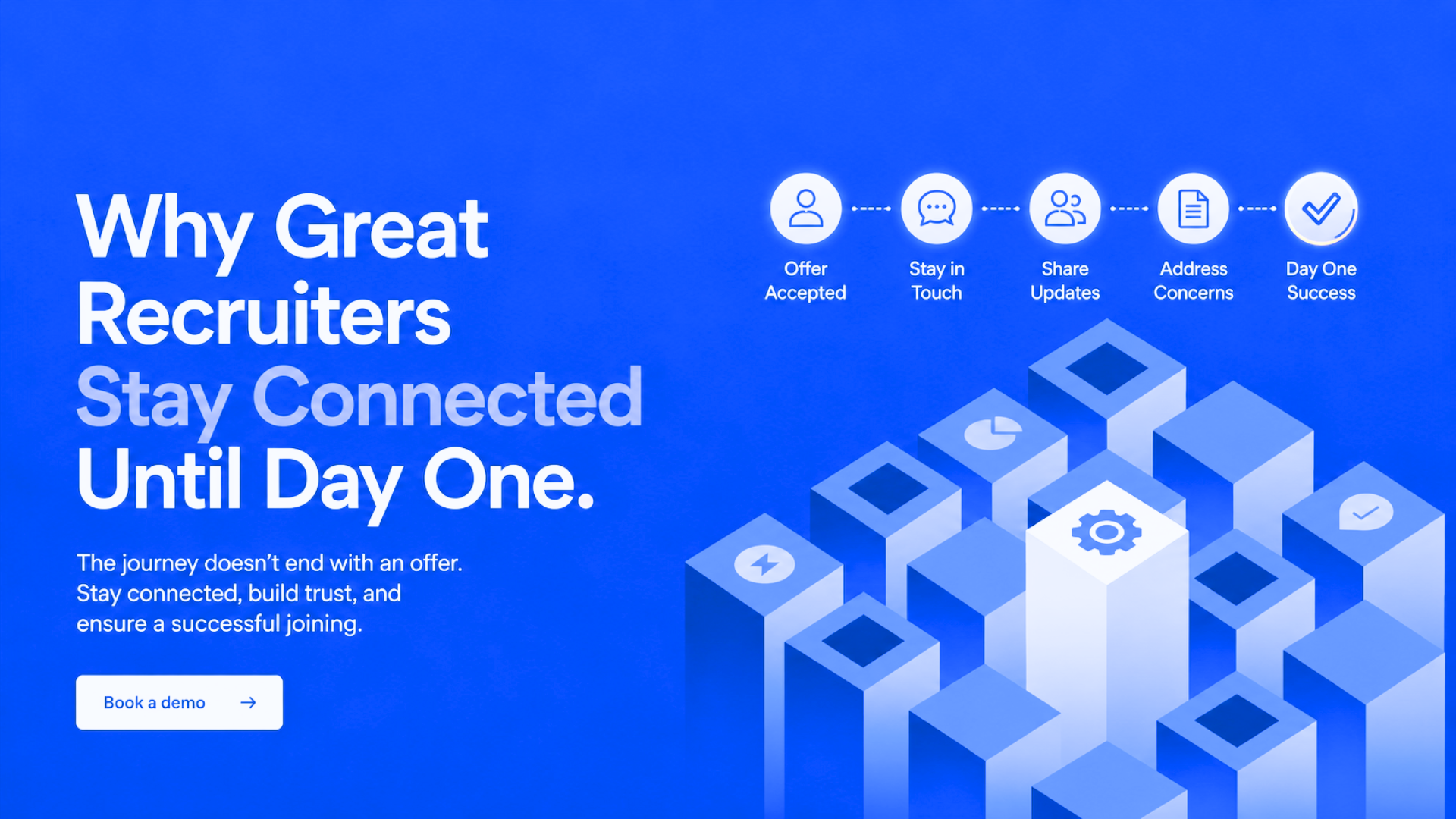
Staying connected until day one is not about sending more emails. It is about maintaining a meaningful, purposeful relationship with the candidate during the most vulnerable phase of their transition. Great recruiters do this through a deliberate sequence of touchpoints, each serving a specific function in the candidate's journey. The first touchpoint is the immediate post-acceptance celebration. Within hours of the candidate signing, the great recruiter makes a personal call or sends a personalized message that conveys genuine excitement and reinforces the candidate's decision. This is not a template. It references specific things the candidate said during the interview process, specific aspects of the role that the candidate was excited about, and specific reasons why the recruiter believes the candidate will thrive. The second touchpoint is the counteroffer preparation briefing. Before the candidate resigns, the great recruiter provides a structured conversation about what to expect during the resignation, including common counteroffer tactics and specific language for declining them. Understanding how many follow-ups one hire actually needs, the timing of this briefing is critical: it must happen before the resignation, not after, because the candidate's ability to resist a counteroffer depends on their psychological preparation, not their willpower.
The third touchpoint is the hiring manager introduction. Within the first week after offer acceptance, the great recruiter facilitates a personal conversation between the candidate and the hiring manager that goes beyond logistics and builds a human connection. This is the moment when the candidate's abstract commitment to the organization becomes a concrete commitment to a specific person. The fourth touchpoint is the team integration outreach. The great recruiter arranges for the candidate to have an informal conversation with a future teammate or the designated onboarding buddy, creating a second relationship anchor that makes the candidate's departure from their current role feel more concrete and their arrival at the new role feel more real. The fifth touchpoint is the mid-notice-period check-in. Roughly halfway through the notice period, the great recruiter reaches out to assess the candidate's state, address any emerging concerns, and provide any new information about the role, the team, or the organization. According to McKinsey's people organization insights, candidates who receive all five of these touchpoints are four times more likely to join compared to candidates who receive only a welcome email and a start-date reminder. This is the essence of post-offer recruiter presence: not more communication, but the right communication at the right time, each touchpoint building on the last to create a cumulative sense of connection, confidence,
and commitment.
Why Most Recruiters Disconnect After the Offer
If staying connected is so effective, why do most recruiters disconnect? The answer is not that they do not care about their candidates. The answer is that the systems they work within do not reward, measure, or support post-offer engagement. The first systemic barrier is the metric structure. Recruiters are measured on placements made, offers accepted, and time to fill. None of these metrics account for what happens after the offer is signed. A recruiter who spends four hours per week managing the post-offer experience will see no improvement in their reported metrics, because the metrics stop counting at the point of offer acceptance. The rational response is to invest time in activities that are measured, which means sourcing and screening, not post-offer engagement. The second barrier is workload pressure. Most recruiters are managing twenty to thirty simultaneous requisitions, and the operational model treats the post-offer phase as available capacity for the next requisition. According to Gartner's HR trends analysis, the average recruiter's caseload has increased by forty percent over the past five years, while the expected post-offer engagement has remained constant, creating an impossible arithmetic: more candidates in the pipeline means less time per candidate in the post-offer phase.
The third barrier is technology limitation. Most applicant tracking systems and recruiting platforms are designed to manage the front-end process. They have robust functionality for sourcing, screening, and interview scheduling, but minimal functionality for post-offer engagement, risk monitoring, or joining rate measurement. Without technology support, the recruiter who wants to stay connected must do so entirely through manual effort, tracking touchpoints in spreadsheets, monitoring engagement signals by memory, and relying on their own discipline to maintain consistency. This is not sustainable at scale, and most recruiters eventually abandon the effort. As we have explored in our analysis of why more tools produce the same hiring problems, adding more front-end sourcing tools does not solve this problem, because the bottleneck is not in finding candidates but in keeping them. The organizations that overcome these three barriers are the ones that address them simultaneously: adopting joining rate as a primary metric, adjusting workload expectations to account for post-offer responsibilities, and deploying technology that makes post-acceptance recruiter availability scalable and systematic rather than dependent on individual recruiter discipline.
The Psychology of Staying Connected
The reason staying connected works is not complicated. It works because the post-offer period is a psychologically fragile time for the candidate, and the recruiter's continued presence provides the stability, reassurance, and information that the candidate needs to maintain their commitment. Four psychological mechanisms explain the effect. The first mechanism is commitment reinforcement. Every meaningful interaction with the recruiter during the post-offer period deepens the candidate's psychological investment in the decision. This is consistent
with cognitive dissonance theory: the more the candidate engages with the new organization, the stronger their internal justification for the decision becomes. The second mechanism is uncertainty reduction. The post-offer period is filled with uncertainties about the role, the team, the culture, and the logistics of the transition. The recruiter who proactively provides information and answers questions reduces these uncertainties before they metastasize into doubts and withdrawals. The third mechanism is social belonging. The candidate is leaving one social group, their current workplace, and joining another. The recruiter who facilitates early connections with future colleagues helps the candidate feel that they already belong to the new group, reducing the social cost of departure and increasing the perceived benefit of arrival.
The fourth mechanism is trust accumulation. Every interaction in which the recruiter follows through on a commitment, provides accurate information, or demonstrates genuine care for the candidate's well-being adds to a reservoir of trust that sustains the candidate's commitment through moments of doubt. When a counteroffer arrives, or when a friend questions the decision, or when the candidate has a bad day at their current job and considers staying, that reservoir of trust is what prevents the withdrawal. The candidate does not stay because the offer was good. They stay because the recruiter earned their trust and they do not want to betray that trust. According to LinkedIn's recruiting resources, the recruiter-candidate bond post offer is the single strongest psychological predictor of joining success, more powerful than compensation, more powerful than role attractiveness, and more powerful than the candidate's initial level of excitement. The bond is not accidental. It is the cumulative product of every interaction the recruiter has with the candidate, and it is strongest when the recruiter continues investing in the relationship through the post-offer period rather than abandoning it at the moment of offer acceptance.
How AI Amplifies the Recruiter's Connection
The challenge of staying connected is not knowing what to do. It is doing it consistently for every candidate, regardless of caseload size. A great recruiter with five candidates can stay connected through sheer discipline. The same recruiter with twenty-five candidates cannot, because there are not enough hours in the week. AI solves this problem by handling the structural elements of post-offer engagement, communication scheduling, information delivery, and stakeholder coordination, while preserving the recruiter's ability to invest personally in the moments that matter most. The AI system ensures that every candidate receives the five critical touchpoints at the right time, with content that is personalized to their situation. It monitors engagement signals and alerts the recruiter to candidates whose behavior suggests disengagement. It coordinates the hiring manager introduction, the team integration outreach, and the mid-notice-period check-in, prompting each stakeholder at the optimal moment and tracking whether the interaction has occurred. According to Deloitte's talent research, recruiters who work with AI-powered post-offer tools maintain the same quality of connection with twenty candidates that they previously could only maintain with five, and their joining rates reflect the improvement.
The AI system does not replace the recruiter's personal touch. It creates the conditions for the recruiter to apply their personal touch more effectively by handling the operational burden of maintaining consistency across a large caseload. The recruiter still makes the personal calls, has the meaningful conversations, and provides the emotional support that builds trust. But the AI system ensures that no candidate is forgotten, no touchpoint is missed, and no warning signal is overlooked. Understanding the difference between AI sourcing and AI recruiting, the organizations that achieve the highest joining rates are the ones that combine AI's operational consistency with the recruiter's human warmth, creating a day-one recruiter engagement experience that is both systematic and personal. As we have discussed in our analysis of why referrals outperform cold outreach, the quality of the human relationship is what ultimately determines whether a candidate stays connected, and AI's role is to ensure that every candidate has the opportunity to build that relationship with their recruiter, regardless of how busy the recruiter is.
Why Huntlo.ai Helps Every Recruiter Stay Connected
Huntlo.ai provides the complete post-offer engagement platform that makes the great recruiter's discipline available to every member of the recruiting team. The system builds a personalized engagement plan for every candidate at the moment of offer acceptance, orchestrates the five critical touchpoints with the right content at the right time, monitors engagement signals in real time, and alerts the recruiter to candidates who need personal attention. Every recruiter, regardless of experience level or caseload size, has access to the same engagement orchestration engine, the same risk intelligence, and the same stakeholder coordination tools, ensuring that every candidate receives a consistently excellent post-offer experience. Huntlo ensures that outdated candidate data in AI recruiting tools never undermines the recruiter's connection strategy, because every recommendation is based on fresh, continuously updated intelligence about the candidate's current state.
For recruiting leaders who want their teams to stay connected with every candidate until day one, Huntlo provides the technology, the workflow, and the measurement to make it systematic and scalable. And for organizations evaluating their options, understanding how to evaluate an AI sourcing tool before buying, means asking whether the platform supports the recruiter's post-offer engagement or whether it stops at the offer acceptance like every other tool on the market. As we have explored in our analysis of what makes an AI recruiting platform agentic vs. just automated, the great recruiters of the future will not be defined by their sourcing skills alone but by their ability to stay connected with every candidate from the first conversation through day one, supported by AI that makes this level of personal attention possible at scale.