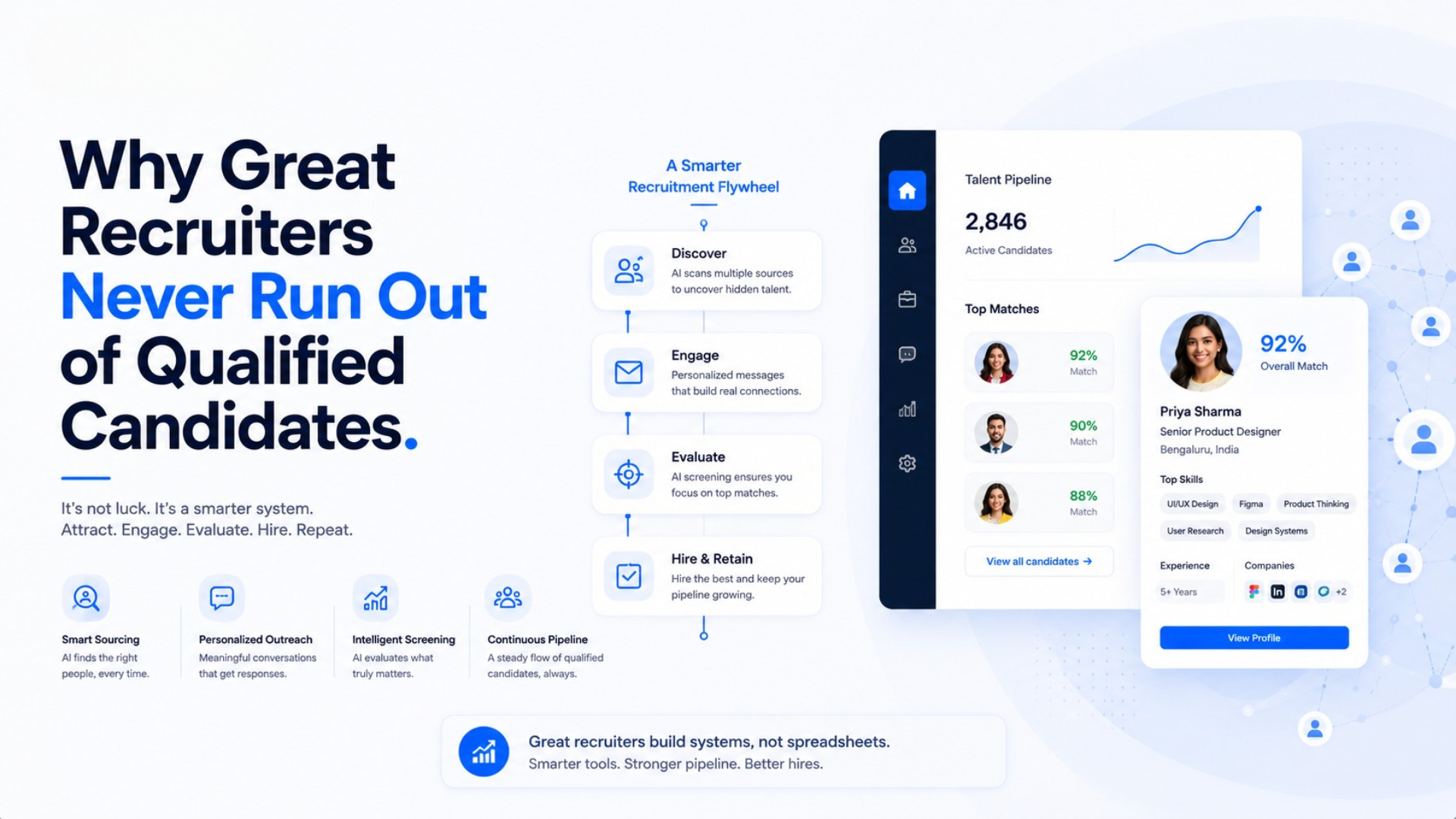
Two recruiters at the same company are given identical senior engineering roles to fill. Recruiter A spends the first three days sourcing from LinkedIn, job boards, and a purchased database, sends forty messages, receives four responses, and schedules two calls. Recruiter B has five qualified candidates in conversation by the end of day one, three of whom were identified before the requisition even opened. Recruiter A starts every search from zero. Recruiter B starts every search from a position of strength. The difference is not talent, effort, or luck. It is system. Recruiter B has built a talent pipeline, a living, continuously refreshed network of qualified candidates who know them, trust them, and are willing to engage. Recruiter A relies on reactive sourcing, hoping that the right person happens to be active at the right time. In a market where the best candidates are rarely looking, the recruiter with the pipeline always wins.
This pattern is not limited to engineering. According to data from LinkedIn's talent solutions resources, recruiters who maintain an active pipeline fill roles forty to sixty percent faster than those who rely exclusively on reactive sourcing, and they report significantly lower levels of hiring stress and burnout. The reason is straightforward: a pipeline turns recruiting from a reactive, start-from-scratch activity into a proactive, always-on process where candidates are identified, engaged, and warmed before a specific role exists. The qualified candidate pool maintenance is not a nice-to-have skill for elite recruiters. It is the foundational practice that separates sustainable, high-performing recruiting from the feast-or-famine cycle that characterizes most recruiting teams.
The Reactive Sourcing Trap
Most recruiting teams operate in a fundamentally reactive mode. A requisition opens, the recruiter sources candidates from scratch, sends outreach, waits for responses, screens respondents, and eventually fills the role. When the next requisition opens, the process repeats from the beginning. This approach has three critical weaknesses. The first weakness is time. Reactive sourcing is slow because it depends on candidate availability at the moment of outreach. The best candidates, the ones who are already employed and performing well, are the least likely to respond to cold outreach, which means the recruiter spends most of their time pursuing candidates who are actively looking, and actively looking candidates are a subset that every other recruiter is also pursuing. According to SHRM's talent acquisition research, the average time-to-fill for reactively sourced roles is sixty-three percent longer than for roles filled through pipeline or network-based sourcing. The second weakness is quality. The candidates who respond to cold outreach are not necessarily the strongest candidates for the role. They are the most responsive candidates, and responsiveness is a different quality than competence. The recruiting pipeline that works prioritizes quality over availability, ensuring that the recruiter has access to strong candidates regardless of their current job search status.
The third weakness is sustainability. Reactive sourcing is not scalable. As the number of open requisitions increases, the recruiter's ability to source, screen, and engage candidates from scratch for each role reaches a breaking point. The recruiter becomes a bottleneck, hiring managers become frustrated, and the quality of outreach declines as the pressure to fill roles forces the recruiter to cut corners on personalization and research. The result is a vicious cycle: lower quality outreach produces lower response rates, which produces fewer candidates, which increases the pressure, which further degrades outreach quality. Understanding why more tools produce the same hiring problems, the solution is not to add more sourcing tools or send more messages. The solution is to change the fundamental model from reactive to proactive, from starting each search at zero to starting each search with a pre-built, continuously maintained pool of qualified candidates.
Building a Candidate Pipeline Before You Need It
The proactive recruiter pipeline is built through a sustained practice of candidate identification, engagement, and relationship maintenance that operates independently of open requisitions. The recruiter identifies talented professionals in their domain, engages them with relevant and valuable content and conversation, and maintains the relationship over time through periodic, non-transactional touchpoints. When a requisition eventually opens that matches the candidate profile, the recruiter already has a warm relationship with multiple qualified candidates and can move quickly to introduce the opportunity. This approach mirrors the way the best sales professionals manage their pipelines: they do not wait for a customer to walk in the door before starting to build relationships. They cultivate prospects continuously so that when buying intent emerges, they are already the trusted advisor. According to McKinsey's people
organization insights, the pipeline approach produces candidates who are three times more likely to accept an offer and thirty percent more likely to remain at the company after twelve months, because the relationship with the recruiter has already established a foundation of trust.
Building the pipeline requires discipline and a long-term perspective. The recruiter must invest time in engaging candidates who may not become hires for months or even years. They must resist the pressure to treat every interaction as a transaction and instead focus on building genuine professional relationships. The continuous candidate sourcing strategy includes regular market mapping to identify emerging talent, attending industry events and conferences to build face-to-face relationships, sharing relevant content and insights that demonstrate expertise and keep the recruiter top-of-mind, and providing value to candidates even when there is no active role to discuss. A recruiter who sends a candidate an article about a technology trend relevant to their career, without any pitch attached, is investing in a relationship that will pay dividends when the timing is right. Understanding how many follow-ups one hire actually needs, the pipeline approach reduces the number of cold follow-ups required because many of the candidates in the pipeline are already warm.
The Intelligence Advantage: Knowing More Than Job Titles
Great recruiters never run out of candidates because they know more about the candidate market than their competitors do. They do not rely on job titles and keyword matches to identify talent. They understand career trajectories, skill adjacencies, and the signals that indicate a candidate may be open to a conversation. A recruiter who only knows job titles sees a senior software engineer and moves on. A recruiter who understands career trajectories sees a senior software engineer who has been in the same role for four years, who has recently started contributing to open-source projects in a new technology stack, and who has attended two conferences on machine learning, and recognizes that this candidate may be ready for a career move into an AI-focused role. The talent pipeline management that great recruiters practice is built on this depth of understanding, and it allows them to see qualified candidates where other recruiters see only mismatched job titles.
This intelligence advantage also extends to understanding the signals that indicate a candidate may be receptive to outreach. A candidate who has updated their LinkedIn profile in the past thirty days, who has started following companies in a new industry, or who has recently changed their profile summary to emphasize different skills, may be signaling openness to a change. A candidate who has been with their current company for more than five years, who has not been promoted in the past two years, or whose company has recently announced layoffs or restructuring, may be more receptive to a conversation than a candidate who appears stable and satisfied. According to Gartner's HR trends research, recruiters who use behavioral and contextual signals to prioritize their outreach achieve two to three times the response rate of recruiters who rely on keyword matching alone. Understanding why some AI recruiting tools have outdated candidate data, the intelligence advantage requires access to fresh,
continuously updated candidate data, not static profiles from months ago.
Turning Every Interaction into Pipeline Fuel
The recruiters who never run out of candidates treat every candidate interaction, whether it results in a hire or not, as an opportunity to strengthen their pipeline. A candidate who is not right for the current role but is strong in general becomes a pipeline candidate for future roles. A candidate who declines an offer because the timing is wrong becomes a relationship to maintain for when the timing changes. A candidate who is not selected after an interview becomes someone who has already been vetted and who can be re-engaged for a future opportunity without starting the screening process from the beginning. The candidate pool regeneration practice means that no candidate interaction is wasted. Every conversation, every assessment, and every piece of candidate intelligence becomes a permanent asset in the recruiter pipeline.
This approach requires a fundamental shift in how recruiters think about their work. Most recruiters measure their success by the number of hires they make. Pipeline-focused recruiters measure their success by the strength and depth of their candidate network, knowing that hires are a natural byproduct of a strong pipeline. They track metrics like pipeline size, engagement rate, time-to-engage (how quickly they can mobilize qualified candidates for a new role), and pipeline conversion rate (what percentage of pipeline candidates become hires when a matching role opens). These metrics are more predictive of long-term recruiting success than any single hire metric, because they measure the recruiter capacity to produce results consistently, not just once. According to Deloitte's talent research, organizations that measure and incentivize pipeline-building behavior in their recruiting teams reduce their average time-to-fill by forty-five percent and increase their offer acceptance rate by twenty-five percent, because the recruiters are building durable capability rather than chasing individual hires.
The Role of Technology in Pipeline Recruiting
Building and maintaining a talent pipeline at scale requires technology. A recruiter who manages fifteen open requisitions and maintains relationships with two hundred pipeline candidates cannot do it all with spreadsheets and memory. They need a platform that tracks candidate interactions, monitors engagement signals, triggers follow-up reminders, and surfaces the right candidates at the right time based on current requisition needs. This is where AI-powered recruiting platforms make a fundamental difference, not by replacing the recruiter judgment but by amplifying it. The AI system handles the operational complexity of pipeline management, monitoring hundreds of candidates across multiple dimensions, so the recruiter can focus on the human interactions that build trust and create relationships. The sustainable talent acquisition strategy is one where technology manages the data and the recruiter manages the relationships, and the combination produces a pipeline that is always warm, always current, and always ready.
The technology also enables a critical capability that manual pipeline management cannot: predictive identification. An AI system that has been tracking candidate behavior patterns, career progression, and engagement history can predict which candidates in the pipeline are most likely to be receptive to a specific opportunity before the recruiter reaches out. This predictive capability transforms the pipeline from a passive database into an active, intelligent sourcing engine that continuously identifies the best candidates for emerging roles. Understanding the difference between AI sourcing and AI recruiting, the technology that enables pipeline recruiting does not just find candidates. It understands them well enough to predict their readiness, their fit, and their likelihood of engagement. As we have explored in our analysis of what makes an AI recruiting platform agentic vs. just automated, the platforms that provide this level of intelligence are the ones that will define the next generation of recruiting technology.
How Huntlo.ai Keeps Your Pipeline Always Full
Huntlo.ai provides the complete pipeline management platform that enables recruiters to build, maintain, and leverage a qualified talent pipeline for every role and every domain. The platform continuously monitors the candidate market, identifies emerging talent, tracks engagement signals, and maintains fresh intelligence on every candidate in the pipeline. When a requisition opens, Huntlo surfaces the most qualified, most receptive candidates from the existing pipeline and recommends new candidates who match the role requirements, so the recruiter starts every search from a position of strength rather than from zero. The platform ensures that outdated candidate data in AI recruiting tools, never undermines pipeline quality, because every candidate profile is continuously refreshed with the latest available intelligence.
For recruiting leaders who want to build a team that never runs out of qualified candidates, Huntlo provides the technology, the workflow, and the measurement to make pipeline recruiting the default operating mode. And for organizations evaluating their options, understanding how to evaluate an AI sourcing tool before buying, means asking whether the platform maintains a living pipeline or whether it treats every search as a one-time event. And for recruiters who wonder whether AI will replace their jobs, the answer is that AI will replace recruiters who start from zero every time, not recruiters who build pipelines that make them indispensable.