The hiring funnel has many stages, but one of them matters more than all the others combined. It is not the job description, which determines who applies but not who gets hired. It is not the interview process, which evaluates a shortlist that has already been shaped by an earlier filter. It is not the offer negotiation, which determines whether a candidate accepts but only after they have been selected. The stage that has the largest impact on the quality of every hire is the screening stage, the point at which the organization decides which candidates from a potentially large pool are worth further evaluation and which are not. Despite this outsized importance, screening is the stage that receives the least deliberate design, the least investment in methodology, and the least measurement of outcomes.
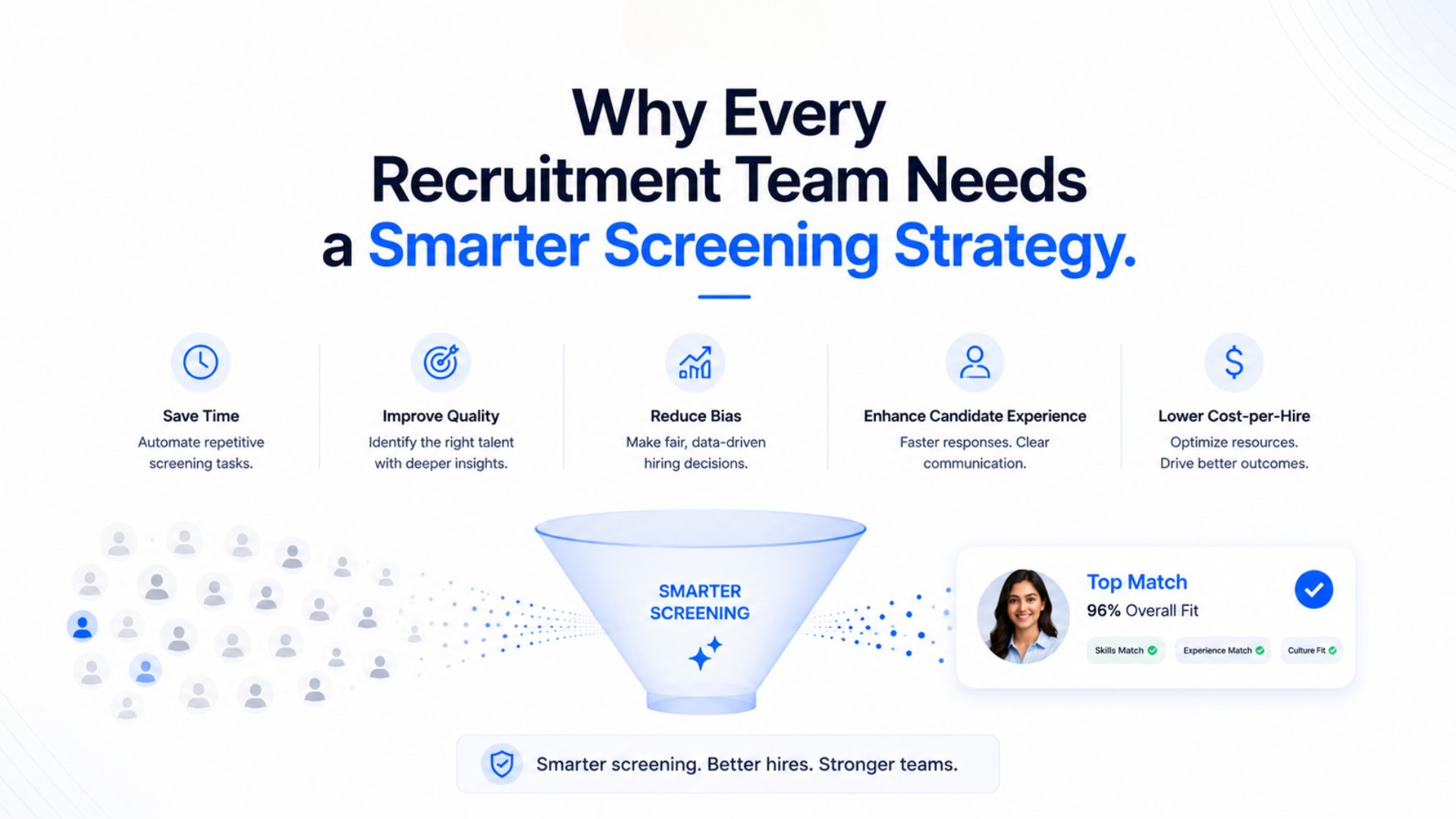
This article makes the case that every recruitment team, regardless of size, industry, or hiring volume, needs a smarter screening strategy. It is not a question of having the budget for AI tools or the technical sophistication to deploy them. It is a question of recognizing that the screening stage is where the most consequential decisions in the hiring process are made, and that the methods most teams currently use to make those decisions are demonstrably inadequate. A smarter screening strategy does not require a complete transformation of your recruiting operation. It requires a specific set of changes to how the screening stage works, and those changes produce improvements that compound across every downstream stage of the funnel. The teams that make these changes will hire better. The teams that do not will continue to lose their best candidates to competitors who screen more intelligently, a dynamic that accelerates as the talent market tightens and the competition for strong candidates intensifies.
Screening Is Where the Best Candidates Are Lost
The most expensive hiring mistake an organization can make is not a bad hire. It is the great candidate who was never identified. A bad hire can be managed through performance management, additional training, or eventual separation. A missed great candidate represents a
permanent opportunity cost: the contribution they would have made, the problems they would have solved, and the competitive advantage they would have created, all of which accrue to a competitor instead. The screening stage is where these losses occur, because it is the stage where the decision is made to advance or reject each candidate, and the methods used to make those decisions determine how many great candidates survive the filter.
The research on screening accuracy is sobering. Studies of resume-based screening consistently show that the false-negative rate, the proportion of strong candidates who are incorrectly rejected, ranges from 40% to 60% depending on the role and the screening method. This means that for every ten genuinely strong candidates in the pool, four to six are screened out before they ever reach the interview stage. These are not marginal candidates who might or might not have been good hires. They are candidates who would have performed well, but who were rejected because the screening method failed to identify their capability. The reasons are well-documented: keyword filters that miss candidates who describe their skills differently, credential thresholds that filter out non-traditional backgrounds, time pressure that degrades evaluation accuracy, and cognitive biases that systematically distort how recruiters assess candidate quality.
The practical consequence of a high false-negative rate is that your hiring outcomes are determined more by the quality of your screening method than by the quality of your candidate pool. A team with access to excellent candidates but a poor screening method will produce worse hires than a team with access to average candidates but an excellent screening method. This is why the distinction between an agentic AI recruiting platform and a merely automated one matters so much. The agentic platform applies intelligent evaluation that reduces the false-negative rate by identifying strong candidates who would be missed by keyword-based methods. The automated platform just processes more candidates through the same flawed filter. According to McKinsey’s talent acquisition research, organizations that reduce their screening false-negative rate by even 20% see significant improvements in quality-of-hire, because the additional strong candidates who survive the screening filter are disproportionately likely to be the candidates who perform best after being hired.
The Compounding Cost of a Poor Screening Strategy
A poor screening strategy does not just produce a weak shortlist. It produces a cascade of downstream costs that compound across the entire hiring funnel. The first cost is interview waste. When the shortlist contains candidates who looked good on paper but lack the deeper capabilities the role requires, the interviewing team spends hours evaluating candidates who should not have been advanced. Each interview consumes the time of the interviewer, the hiring manager, and often additional team members. In a team of five interviewers spending one hour per interview on ten candidates, the direct time cost is fifty hours of senior staff time. When a significant proportion of those candidates are poorly matched to the role, a substantial portion of that time is wasted.
The second cost is slower time-to-fill. When the screening process produces shortlists that
require multiple rounds of interviews to identify the right candidate, because the initial shortlist was not accurate enough to make a confident decision, the hiring timeline extends. Each additional round of interviews adds days or weeks to the process, during which the best candidates in the pipeline are being courted by competing employers. According to LinkedIn’s annual hiring statistics, the candidates who drop out during extended hiring processes are disproportionately the high-quality candidates who have multiple competing offers. The third cost is reputation damage. Candidates who are interviewed after being poorly screened report a negative candidate experience when the interview questions reveal a mismatch between their actual capabilities and what the screening process suggested. These candidates share their experience, and the organization’s employer brand suffers.
The fourth and most insidious cost is the opportunity cost of the candidates who were never identified. Every time a poor screening strategy rejects a strong candidate, the organization loses the potential contribution that candidate would have made. Over dozens or hundreds of hires per year, this opportunity cost dwarfs the direct costs of interview waste and extended timelines. It is also the cost that is least visible, because the organization never knows which candidates it lost. The candidates who were rejected do not report back. They simply accept offers elsewhere. The organizations that understand these compounding costs are the ones that invest in smarter screening, because they recognize that the ROI of better screening is not measured in time saved. It is measured in hiring outcomes that are fundamentally better: stronger performers, faster fills, better retention, and a candidate experience that attracts rather than repels top talent. As we have discussed in our analysis of why referrals outperform cold outreach, the true cost of poor screening is almost always larger than it appears, because the most damaging costs are the ones that are never measured. The teams that continue to tolerate these costs are the teams that will find it increasingly difficult to compete for talent as the market tightens.
What a Smarter Screening Strategy Looks Like
A smarter screening strategy is built on five principles. The first is structured evaluation against role-specific criteria. Before screening begins, the recruiting team defines two to three must-have competencies that are genuinely predictive of success in the role, three to five important-but-not-essential skills, and a set of positive differentiators. These criteria become the framework for every evaluation decision, ensuring that the screening process is calibrated to the role rather than to a generic template. The second principle is multi-signal evaluation. Instead of relying solely on the resume, a smarter screening process draws on professional profiles, career trajectory data, domain-specific evidence, and work samples to build a richer and more accurate picture of each candidate.
The third principle is data freshness. Because candidate profiles change over time, every screening evaluation should be based on the most current available data. Real-time data enrichment, verifying and updating candidate information at the point of evaluation rather than relying on cached profiles, is a non-negotiable requirement for accurate screening. As we have examined in our analysis of The third principle is data freshness. Because candidate
profiles change over time, every screening evaluation should be based on the most current available data. Real-time data enrichment, verifying and updating candidate information at the point of evaluation rather than relying on cached profiles, is a non-negotiable requirement for accurate screening. As we have examined in our analysis of why some AI recruiting tools have outdated candidate data, screening against stale data introduces a systematic error that undermines even the most carefully designed evaluation framework. The fourth principle is consistency. Every candidate should be evaluated against the same criteria with the same scoring methodology, producing rankings that are comparable across the entire pool regardless of when or by whom they were reviewed. The fifth principle is continuous improvement. The screening process should track the correlation between its assessments and downstream hiring outcomes, using that data to refine its criteria and improve its accuracy over time. According to SHRM’s research on structured hiring, organizations that implement all five of these principles see 25% to 40% improvements in quality-of-hire within the first year, with the improvement compounding as the system accumulates more outcome data.
Why AI Is the Enabler, Not the Strategy Itself
There is an important distinction that many recruiting teams miss when they think about upgrading their screening process. AI is not a screening strategy. It is an enabler that makes a smarter screening strategy achievable at the scale that modern recruiting requires. The five principles described in the previous section, structured evaluation, multi-signal assessment, data freshness, consistency, and continuous improvement, are the strategy. AI is the technology that allows that strategy to be executed across hundreds or thousands of candidates without sacrificing the quality of each individual evaluation. Without AI, these principles can be applied to ten or twenty candidates per role. With AI, they can be applied to every candidate in the pool.
This distinction matters because it determines how you evaluate screening technology. The question is not whether the platform uses AI. Virtually every screening vendor now claims to use AI. The question is whether the platform implements the five principles of smarter screening. Does it apply structured, role-specific criteria, or does it use generic keyword matching? Does it evaluate multiple signals with current data, or does it screen against cached resumes? Does it produce consistent, calibrated scores across the entire pool, or does its accuracy vary by volume? Does it learn from outcomes, or does it produce the same quality of assessment indefinitely? These are the questions that distinguish platforms that will transform your hiring outcomes from platforms that will produce more tools and the same hiring problems. The platform that implements the full strategy is the platform that delivers the full benefit. According to Gartner’s HR technology research, the AI screening tools that deliver the strongest ROI are the ones that combine all five principles into a coherent system, because the value of each principle is amplified when it operates in concert with the others.
The Competitive Necessity of Smarter Screening
The case for a smarter screening strategy is no longer theoretical. The organizations that have
adopted intelligent screening methods are already outperforming their competitors in the competition for talent, and the gap is widening. As more organizations deploy AI screening platforms, the candidates who are most in demand, the ones with multiple competing offers and the shortest decision windows, are being identified and engaged first by the organizations with the fastest and most accurate screening processes. The organizations that are still screening by keyword are not just losing these candidates. They are often not even knowing they existed, because the candidates were filtered out before anyone on the recruiting team had a chance to review them.
This dynamic is particularly acute for niche and technical roles, where the best candidates are often passive, not actively applying, and can only be identified through proactive evaluation of their professional footprint. A screening strategy that only evaluates candidates who apply through standard channels misses the strongest candidates in the market. A smarter screening strategy that can evaluate both active applicants and passive prospects on the same criteria, using the same scoring methodology, ensures that the shortlist reflects the best available candidates regardless of how they entered the pipeline. This is also the distinction between AI sourcing and AI recruiting: sourcing finds candidates, and recruiting evaluates them. A smarter screening strategy requires both capabilities in an integrated system. According to Deloitte’s human capital research, the organizations that combine intelligent sourcing with intelligent screening report 40% to 60% improvements in the quality of their candidate shortlists, because they are evaluating a broader and more representative pool of talent with a more accurate evaluation methodology.
How Huntlo Provides the Smarter Screening Strategy Every Team Needs
Huntlo implements all five principles of a smarter screening strategy in a single, integrated platform. It applies structured, role-specific evaluation criteria that are calibrated to maximize the correlation between screening scores and job performance. It evaluates candidates on multiple signals, including career trajectory, demonstrated impact, domain expertise, and real-time enriched profile data. It produces consistent, calibrated scores across the entire candidate pool, ensuring that the ranking reflects genuine differences in candidate quality. And its outcome feedback loop continuously improves screening accuracy by connecting assessments to downstream hiring performance. Huntlo is not just a screening tool. It is a complete screening strategy, implemented in software and available to any recruiting team. When you are evaluating an AI screening tool, the question to ask is whether it delivers a smarter screening strategy or just faster keyword matching. Huntlo delivers the strategy. According to LinkedIn’s talent solutions research, the recruiting teams that adopt AI-native screening platforms like Huntlo report 50% to 70% reductions in time-to-shortlist with significant improvements in quality-of-hire. Every recruitment team needs a smarter screening strategy. Huntlo is how they get it.