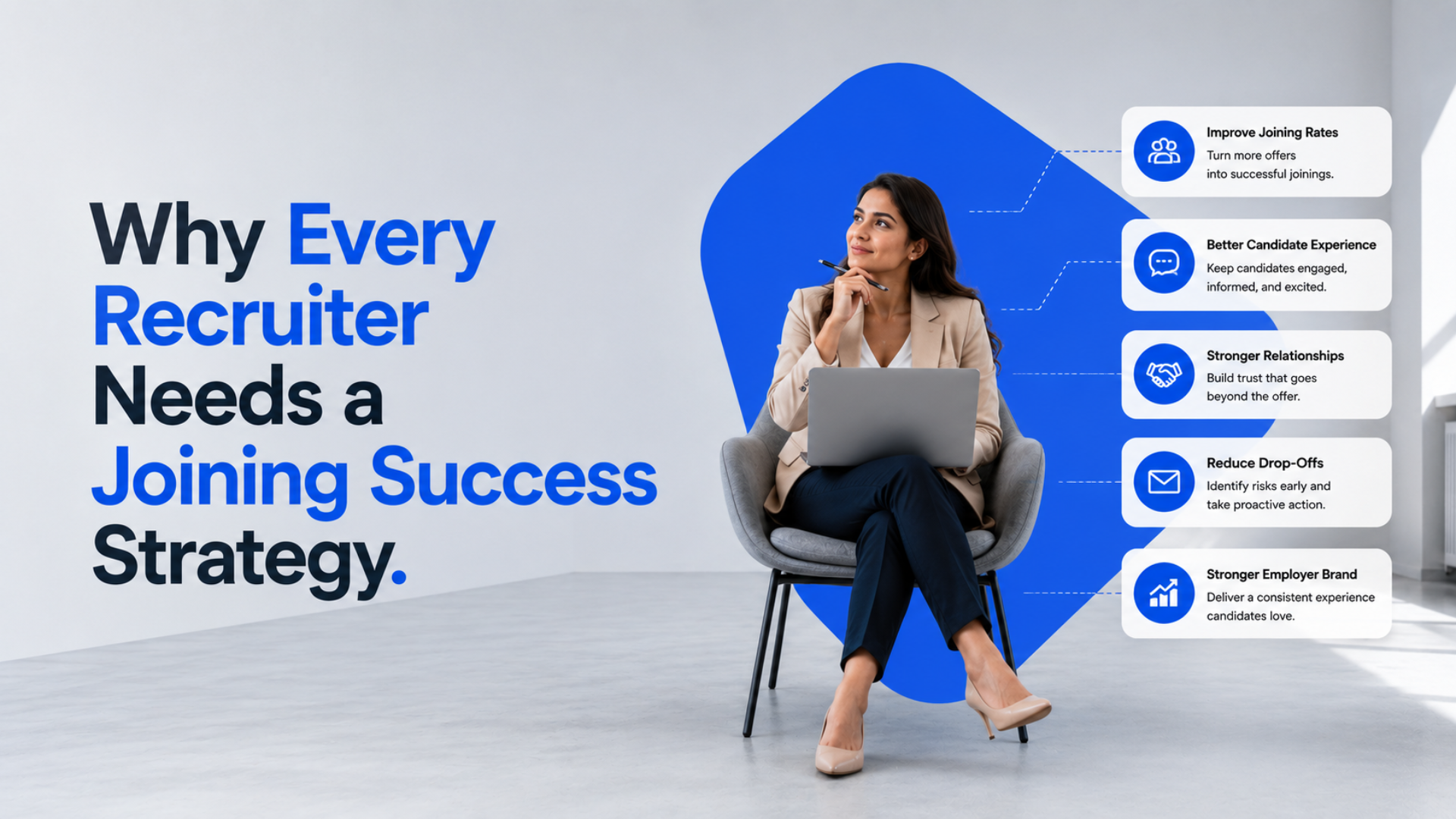
A recruiter closes a senior engineering role after six weeks of sourcing, twelve interviews, and three rounds of negotiation. The candidate signs on Friday. The recruiter marks the requisition as filled and moves to the next one. Three weeks later, the candidate emails to withdraw. The vacancy clock resets. The hiring manager is furious. The recruiter's metrics show a perfect offer acceptance rate but a broken joining rate. This gap between what recruiters are measured on, offers accepted, and what the business actually needs, people who start and stay, is the defining performance problem in modern recruiting. The solution is not working harder at sourcing or screening. It is building a joining success strategy that treats the period between acceptance and day ninety as a managed process with clear ownership, defined interventions, and measurable outcomes.
The recruiting industry has historically measured success at the point of offer acceptance. Time to fill, cost per hire, offer acceptance rate: these are the standard metrics, and they all stop counting at the moment the candidate says yes. But the business does not benefit from an accepted offer. It benefits from a productive employee. The distance between those two outcomes, the accepted offer and the productive employee, is where most recruiting ROI evaporates. According to SHRM’s talent acquisition research, the average cost of a candidate who accepts an offer but never starts is between fifteen thousand and forty thousand dollars. The average cost of a new hire who leaves within ninety days is two to three times their monthly salary. For a senior role, that can exceed fifty thousand dollars. These costs are almost never attributed to the recruiting function, because the recruiting function has already declared victory at the point of offer acceptance. A joining success framework changes this by extending the recruiter's accountability, and the recruiting function's metrics, through the entire arc from
acceptance to employment stability.
The Metric That Matters: Offer-to-Start Conversion
The most important recruiting metric that most organizations do not track is the offer-to-start conversion rate: the percentage of accepted offers that result in a candidate actually beginning employment on the agreed start date. This metric captures the effectiveness of everything that happens after the offer is signed, and it is typically much lower than most recruiting leaders assume. Industry data suggests that the average offer-to-start rate across all industries is between seventy-five and eighty-five percent, meaning that fifteen to twenty-five percent of accepted offers never convert to actual starts. For senior roles, where counteroffers are more lucrative and the candidate's current employer has more to lose, the rate can be even lower. The organizations that track this metric rigorously are the ones that improve it, because measurement creates accountability. When a recruiter knows that their performance is evaluated not just on offers accepted but on candidates who actually start, they naturally shift their behavior. They maintain communication during the notice period. They involve the hiring manager in the post-acceptance phase. They proactively address the concerns that candidates typically experience during the transition. This shift from recruiter joining rate ownership being optional to being mandatory is the single most impactful change a recruiting team can make, and it costs nothing to implement.
The offer-to-start metric also reveals the true cost of recruiting. When an organization reports a cost per hire of eight thousand dollars, that figure typically includes sourcing, screening, interviewing, and offer negotiation costs. But it does not include the cost of the fifteen to twenty-five percent of accepted offers that never convert to starts. When these failure costs are allocated back to the recruiting function, the true cost per productive hire increases dramatically. A recruiting team that extends one hundred offers per year at a reported cost per hire of eight thousand dollars is actually spending closer to ten or eleven thousand dollars per productive start, once the cost of failed conversions is included. This hidden cost is one of the strongest arguments for investing in a post-acceptance success plan: even a modest improvement in the offer-to-start rate, from eighty percent to ninety percent, translates into significant cost savings and significant improvement in the hiring manager's experience. According to McKinsey’s people organization insights, organizations that measure and actively manage the offer-to-start rate achieve twelve to eighteen percent reduction in true cost per hire within the first year.
What a Joining Success Strategy Looks Like
A joining success strategy is a documented, repeatable process that manages every accepted candidate through the transition from their current role to their new one. It has four components. The first component is risk assessment. Within twenty-four hours of offer acceptance, the recruiter conducts a structured assessment of the candidate's risk profile, evaluating their motivation for leaving, their current employer's likely retention response, any practical complications in the transition, and the strength of their emotional connection to the new
organization. This assessment produces a risk score and a tailored intervention plan. The second component is a communication cadence. A pre-defined sequence of touchpoints, each with a specific owner, purpose, and content, covers the entire notice period. The cadence is not one-size-fits-all. It is calibrated to the candidate's risk profile: high-risk candidates receive more frequent, more personal touchpoints, while lower-risk candidates receive a lighter but still consistent communication schedule. The third component is stakeholder coordination. The strategy assigns specific responsibilities to the hiring manager, the onboarding specialist, and designated teammates, ensuring that the candidate receives engagement from multiple voices across the new organization. The fourth component is escalation protocols. When a candidate's risk level increases, whether because of a counteroffer, a delayed background check, or declining communication engagement, the strategy defines who is notified, what actions are taken, and how the situation is resolved. As we have explored in our analysis of how many follow-ups one hire actually needs, the right cadence varies by candidate, and a flexible strategy that adapts to the individual's situation consistently outperforms a rigid, template-based approach.
The Recruiter's Evolving Role: From Closer to Outcome Owner
Adopting a joining success strategy requires a fundamental shift in how recruiters think about their role. The traditional recruiter self-image is that of a closer: someone who persuades a candidate to accept an offer. This self-image is reinforced by the standard recruiting metrics, which measure the recruiter's performance at the point of acceptance. But in a world where fifteen to twenty-five percent of accepted offers never convert to starts, being a closer is necessary but not sufficient. The recruiter's role must evolve from closer to outcome owner: someone who takes responsibility for the entire journey from first contact through the candidate's first ninety days of employment. This does not mean the recruiter manages the onboarding process. It means the recruiter maintains ownership of the candidate's experience and outcome until the candidate is securely embedded in the new role. This evolution is already happening at the leading edge of the profession. According to LinkedIn’s recruiting resources, the fastest-growing recruiting metric at enterprise organizations is not time to fill or cost per hire but offer-to-start conversion rate, and the recruiters who are promoted fastest are the ones who demonstrate the highest joining rates, not the highest offer volumes. The message is clear: the market is shifting from rewarding activity to rewarding outcomes, and the recruiters who adapt fastest will be the ones who thrive. Effective candidate-to-employee conversion requires this broader definition of the recruiter's mandate.
The shift from closer to outcome owner also changes the recruiter's relationship with the hiring manager. In the traditional model, the recruiter's primary interaction with the hiring manager occurs during the intake, interview scheduling, and offer negotiation phases. After the offer is signed, the relationship goes dormant. In the outcome-owner model, the recruiter and the hiring manager are partners throughout the post-acceptance phase, collaborating on communication strategy, coordinating stakeholder involvement, and jointly monitoring the candidate's engagement level. This partnership produces better outcomes because it combines the
recruiter's expertise in candidate management with the hiring manager's authority and role-specific knowledge. A candidate who receives a personal call from the hiring manager during the notice period is far more likely to start the role than one who hears only from the recruiter. But this call only happens when the recruiter actively facilitates it, which requires the recruiter to think of the hiring manager as a partner in the joining success strategy, not just a stakeholder in the hiring process. This aligns with our understanding of the difference between AI sourcing and AI recruiting, where the recruiting function's value lies in relationship management, not transactional process execution.
The Financial Case for Joining Success Investment
The financial case for investing in a joining success strategy is straightforward and compelling. Consider a mid-size organization that hires two hundred people per year with an average cost per hire of ten thousand dollars and an offer-to-start rate of eighty percent. This means that forty accepted offers per year never convert to starts, representing four hundred thousand dollars in wasted recruiting spend. If a joining success strategy improves the offer-to-start rate from eighty percent to ninety percent, the organization saves two hundred thousand dollars annually in direct recruiting costs, plus the indirect costs of extended vacancies, hiring manager time, and team productivity loss, which typically double or triple the direct savings. The total annual impact is between four hundred thousand and eight hundred thousand dollars. The investment required to achieve this improvement is modest. A joining success strategy does not require a large budget or a new team. It requires a documented process, clear accountability, stakeholder alignment, and technology that can orchestrate communication and monitor risk at scale. According to Gartner’s HR trends analysis, the average ROI on joining success investments exceeds five hundred percent in the first year, making it one of the highest-return investments available to a talent acquisition leader. This kind of hiring outcome optimization is not a cost center. It is a profit center that generates measurable financial returns by reducing the waste embedded in the current process.
The financial case extends beyond the offer-to-start phase. Candidates who have a positive post-acceptance experience are more likely to be productive faster, more likely to still be employed at twelve months, and more likely to refer other candidates to the organization. Each of these outcomes has a financial value. Faster time to productivity means the hiring manager's team reaches full capacity sooner. Higher twelve-month retention means lower replacement costs. More employee referrals means lower future sourcing costs. These downstream benefits are rarely attributed to the joining success strategy, but they are real, measurable, and significant. Organizations that track them consistently find that the post-acceptance experience has a larger impact on long-term hiring outcomes than any single phase of the pre-acceptance process. As we have discussed in our analysis of why more tools produce the same hiring problems, the organizations that achieve the best outcomes are not the ones that invest in the most technology. They are the ones that invest in the right outcomes and build their processes around those outcomes.
How AI Makes Joining Success Scalable and Consistent
For recruiting teams that manage more than a handful of hires per month, a manual joining success strategy is difficult to sustain. Recruiters are already stretched thin, and adding post-acceptance management to their workload without technology support leads to inconsistent execution, missed touchpoints, and ultimately the same drop-off rates the strategy was designed to prevent. AI solves this problem by automating the orchestration of the joining success strategy while preserving the personalization and human judgment that make it effective. The AI system takes ownership of the communication schedule, stakeholder coordination, and risk monitoring, freeing the recruiter to focus on the high-touch interventions that require a human voice: the personal call to a candidate who received a counteroffer, the nuanced conversation with a candidate who is anxious about the role, the creative problem-solving needed when a practical blocker threatens to derail the transition. The AI also provides the measurement infrastructure that makes joining success a data-driven discipline. It tracks the offer-to-start rate in real time, breaks it down by recruiter, by role type, by source, and by risk factor, and identifies the specific interventions that have the greatest impact on joining outcomes. This measurement capability transforms joining success from a qualitative, intuition-driven activity into a quantitative, evidence-based practice. This is what distinguishes an agentic AI recruiting platform from a simple workflow automation tool: the ability to not just execute a pre-defined process but to continuously optimize it based on outcomes.
The technology also ensures consistency across the recruiting team. In a manual process, the quality of the post-acceptance experience varies dramatically from recruiter to recruiter, depending on their experience, their workload, and their personal commitment to the post-offer phase. A candidate managed by a senior recruiter who understands the importance of the notice period receives a fundamentally different experience than a candidate managed by a junior recruiter who has been trained to focus on sourcing and screening. AI eliminates this variability by providing every recruiter with the same orchestration capability, the same risk intelligence, and the same intervention recommendations, regardless of their individual experience level. As Deloitte’s talent research notes, the organizations that achieve the most consistent joining rates are the ones that embed joining success into their technology platform rather than relying on individual recruiter skill and motivation.
Why Huntlo.ai Makes Joining Success the Default, Not the Exception
Huntlo.ai is built on the principle that the recruiter's job is not done when the offer is signed. The platform provides a complete joining success framework that captures candidate intelligence during the recruiting phase, builds personalized post-acceptance engagement plans, coordinates communication across all stakeholders, monitors risk in real time, and measures the offer-to-start conversion rate with full drill-down capability. Every recruiter on the team has access to the same orchestration engine, the same risk intelligence, and the same intervention recommendations, ensuring that every candidate receives a consistently excellent post-acceptance experience regardless of which recruiter is managing their process. Huntlo ensures that
outdated candidate data in AI recruiting tools never undermines the joining success strategy, because every risk assessment and every intervention recommendation is based on fresh, continuously updated intelligence about the candidate's current state, concerns, and engagement level.
For recruiting leaders who are ready to hold their teams accountable for outcomes rather than activities, Huntlo provides the metrics, the workflows, and the intelligence to make joining success a measurable, manageable discipline. The platform makes it easy to see which recruiters have the highest joining rates, which interventions are most effective, and where the process is failing. It ensures that why referrals outperform cold outreach is understood not as a channel advantage but as an experience advantage, because every candidate, regardless of source, receives a post-acceptance experience that maximizes the probability of a successful start. And for organizations evaluating their technology options, understanding how to evaluate an AI sourcing tool before buying, means asking whether the platform measures and optimizes the offer-to-start conversion rate, or whether it stops at the offer acceptance like every other tool on the market.
The recruiter who closes the offer and moves on is doing half the job. The recruiter who closes the offer, manages the transition, and ensures the candidate arrives on day one ready to contribute is doing the whole job. The difference between these two recruiters is not talent or effort. It is strategy. A joining success strategy gives every recruiter, regardless of experience level, the framework to deliver the whole job consistently, at scale, and with measurable outcomes. That is not just a better way to recruit. It is the future of the profession.