Marcus Webb, the VP of Talent Acquisition at a mid-market logistics company, managed a technology stack that his own team struggled to navigate. His recruiting operation relied on eleven separate tools: an ATS for requisition management, a sourcing platform for candidate discovery, an outreach tool for email sequences, a screening assessment for skills testing, a scheduling platform for interview coordination, a CRM for candidate relationship management, an analytics dashboard for hiring metrics, a background check integration, an onboarding system for new hires, a job board aggregator for posting, and a communication platform for team collaboration. Each tool had its own login, its own data format, its own support team, and its own renewal cycle. Three of the tools did not integrate with each other at all, requiring his recruiters to manually transfer candidate data between systems. His monthly technology spend for recruiting alone exceeded forty-five thousand dollars, and his recruiters spent an estimated twenty percent of their time on administrative tasks related to managing the technology stack rather than recruiting. When he presented this analysis to his CFO, the response was blunt: consolidate or cut the budget. Marcus began evaluating AI-native recruiting platforms that could replace multiple point solutions with a single, integrated system, and what he found surprised him. The consolidation was not just possible. It was already happening across the industry, and the platforms driving it were delivering better outcomes at lower cost than his fragmented stack.
The Problem with Fragmented Recruiting Stacks
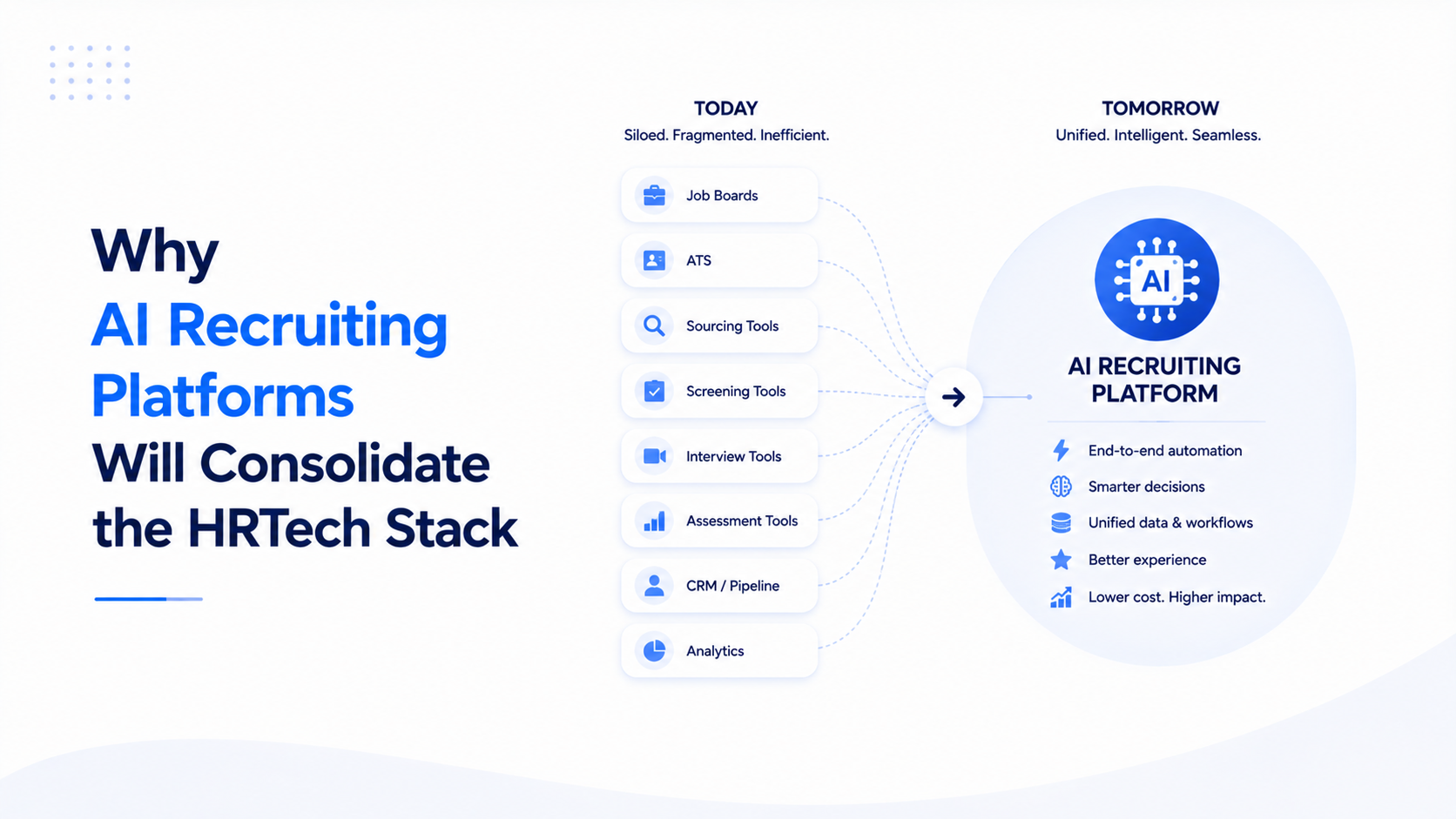
The modern enterprise recruiting technology stack did not emerge from a deliberate design. It accumulated over a decade as organizations adopted point solutions to address specific pain points: a sourcing tool to find candidates, an outreach tool to engage them, a screening tool to evaluate them, a scheduling tool to coordinate interviews, and an ATS to manage the workflow. Each purchase was rational in isolation. The sourcing tool solved a candidate identification problem. The outreach tool improved response rates. The screening tool reduced time spent on unqualified candidates. But the cumulative effect of these independent purchasing decisions was a fragmented technology ecosystem where candidate data lived in multiple systems, workflows required manual handoffs between tools, and recruiters spent a significant portion of their time on technology management rather than recruiting. Research from industry analysts consistently shows that the average enterprise recruiting operation uses between eight and twelve distinct technology tools, and that the annual cost of this fragmented stack ranges from two hundred thousand to over one million dollars depending on organization size and hiring volume, a figure that does not include the hidden cost of recruiter time spent managing integrations, reconciling data discrepancies, and navigating between systems.
The operational consequences of stack fragmentation extend far beyond cost. When candidate data is distributed across multiple systems, the organization loses the ability to create a unified view of the candidate journey. A candidate who was sourced through one platform, engaged through another, screened through a third, and interviewed through a fourth exists as four separate data records that may or may not be linked. This fragmentation makes it impossible to perform coherent analytics on the recruiting pipeline, because the data required to answer even basic questions, such as the conversion rate from sourced candidate to hired employee, resides in systems that do not share data natively. The integration layer that organizations build to connect these tools, typically a combination of APIs, middleware, and manual data transfers, is itself a source of cost, complexity, and failure. Each integration requires ongoing maintenance, breaks when either tool releases an update, and introduces latency that can cause candidate data to be stale or inconsistent across systems. According to SHRM, sixty-eight percent of talent acquisition leaders report that managing their recruiting technology stack takes more time than it did three years ago, and that the primary driver of increased management burden is the growing number of tools and the complexity of keeping them integrated and data-consistent.
The fragmentation problem is compounded by the misalignment of incentives across tool vendors. Each point solution vendor optimizes for its own feature set and usage metrics, not for the overall effectiveness of the recruiting operation. A sourcing tool vendor wants users to source more candidates. An outreach tool vendor wants users to send more messages. A screening tool vendor wants users to run more assessments. These individual optimizations do not necessarily add up to an optimized recruiting process. In fact, they often work against each other: the sourcing tool identifies candidates that the screening tool cannot evaluate, the outreach tool sends messages to candidates who have already been engaged through another channel, and the scheduling tool books interviews for candidates whose screening results have not yet been reviewed. This vendor-level optimization misalignment creates a recruiting
process that is individually efficient at each step but collectively suboptimal, because no single vendor has visibility into or incentive to optimize the end-to-end workflow. more tools same hiring problems explains why adding more point solutions to a fragmented stack often worsens the underlying problem, because each additional tool introduces another integration point, another data silo, and another vendor relationship to manage, increasing complexity without proportionally improving outcomes.
How AI-Native Platforms Subsume Point Solutions
AI-native recruiting platforms are fundamentally different from the point solutions they are replacing, because they are designed from the ground up to manage the entire recruiting workflow rather than a single step. An AI-native platform that sources candidates, generates personalized outreach, conducts AI-powered screening conversations, schedules interviews, and provides pipeline analytics is not five tools stitched together. It is a single system with a unified data model, a shared candidate profile, and an integrated workflow engine that moves candidates through the recruiting process without manual handoffs between modules. The key architectural difference is that the AI model sits at the center of the platform rather than at the edge. In a point solution, AI enhances a specific function, such as matching candidates to jobs or generating outreach messages. In an AI-native platform, AI orchestrates the entire workflow, using the output of each step to inform the next step, maintaining context across the entire candidate journey, and making real-time decisions about how to allocate resources and prioritize activities. This architectural difference is what enables an AI-native platform to subsume multiple point solutions without sacrificing capability, because the AI can perform the functions that previously required dedicated tools, and it can perform them better because it has access to the full candidate context rather than the partial view that each point solution provides.
The functional consolidation is already well advanced. Modern AI recruiting platforms can replace sourcing tools by using AI to search across public and proprietary databases, professional networks, and talent pools to identify candidates that match job requirements. They can replace outreach tools by generating personalized, context-aware messages and managing multi-channel communication sequences across email, LinkedIn, and SMS. They can replace screening tools by conducting AI-powered conversational assessments that evaluate candidate skills, experience, and cultural fit in real time. They can replace scheduling tools by automating interview coordination with candidates and interviewers, managing calendar conflicts, and sending reminders. They can replace CRM functionality by maintaining persistent candidate profiles that track every interaction, preference, and status update across the recruiting lifecycle. And they can replace analytics dashboards by providing real-time visibility into pipeline health, conversion rates, time to fill, and quality of hire, all derived from the unified data model that only an integrated platform can provide. According to Gartner, AI-native recruiting platforms that offer five or more of these functional capabilities in a single system can replace an average of four to six point solutions in the typical enterprise recruiting stack,
reducing technology costs by thirty to forty percent while improving data consistency and workflow efficiency.
The consolidation is not just about replacing individual tools. It is about creating capabilities that did not exist in the fragmented stack. When sourcing, outreach, screening, and scheduling operate within a single platform with a shared AI model, the system can make optimization decisions that are impossible when these functions are distributed across separate tools. The platform can prioritize outreach to candidates who are most likely to respond based on screening data. It can adjust screening questions based on sourcing context. It can reschedule interviews based on real-time candidate engagement signals. These cross-functional optimizations, where the output of one function directly informs the execution of another, are the unique value proposition of the consolidated platform. They represent a step-change improvement in recruiting efficiency that cannot be achieved by integrating even the best point solutions, because the integration layer always introduces latency, data loss, and optimization gaps. agentic AI platforms vs automated ones explains why agentic AI platforms that manage the end-to-end recruiting workflow autonomously are the natural endpoint of this consolidation trend, because the ability to make cross-functional optimization decisions in real time, without human coordination between tools, is what transforms a collection of features into a coherent recruiting system. McKinsey reports that organizations that have consolidated their recruiting stack onto AI-native platforms report twenty-five to thirty-five percent improvement in time to fill and fifteen to twenty percent improvement in quality of hire compared to organizations using fragmented stacks, because the unified data model and integrated AI optimization eliminate the information gaps and coordination delays that fragment stacks inherently create.
The Economic Case for Stack Consolidation
The economic case for consolidating the recruiting technology stack is compelling on multiple dimensions. The most visible dimension is direct cost reduction. When an organization replaces six to eight point solutions with a single AI-native platform, it eliminates multiple subscription fees, reduces integration maintenance costs, and decreases the internal IT resources required to manage the technology ecosystem. For a mid-market organization spending three hundred thousand to five hundred thousand dollars annually on recruiting technology, consolidation typically reduces direct technology costs by thirty to forty-five percent, depending on the number of tools replaced and the pricing model of the consolidated platform. But the direct cost savings, while significant, are often smaller than the indirect economic benefits. Recruiters who previously spent twenty percent of their time managing technology can redirect that time to candidate engagement, relationship building, and strategic hiring activities. The productivity gain from redirecting recruiter time from technology management to revenue-generating activities is often worth two to three times the direct technology cost savings, because recruiter time is the most expensive and most impactful resource in the recruiting operation.
The second economic dimension is the reduction in hiring outcome costs. Fragmented stacks increase time to fill because data handoffs between tools introduce delays, candidate data inconsistencies cause rework, and the lack of end-to-end visibility prevents proactive pipeline management. Each additional day that a position remains unfilled costs the organization in lost productivity, typically estimated at one to two percent of the position's fully loaded cost per month. For an organization with a hundred open positions and an average time to fill of fifty days, reducing time to fill by even five days through stack consolidation can save hundreds of thousands of dollars in lost productivity annually. Fragmented stacks also increase the cost of poor-quality hires, because the lack of unified candidate data makes it difficult to identify patterns that predict hiring success. When screening data, outreach response patterns, and interview performance live in separate systems, the organization cannot build the comprehensive candidate profiles that would enable more accurate hiring decisions. According to Deloitte, organizations with consolidated recruiting stacks report twelve to eighteen percent lower cost per hire and eight to fourteen percent faster time to fill compared to organizations with fragmented stacks, because the unified data model enables better candidate evaluation, faster workflow execution, and more accurate pipeline forecasting.
The third economic dimension is the total cost of ownership, which includes not only subscription fees but also implementation costs, integration costs, training costs, and ongoing management overhead. Point solutions each require separate implementation projects, separate integration builds, and separate training programs. The total cost of owning eight point solutions is not simply eight times the cost of one solution. It is eight times the subscription cost plus the cumulative cost of eight implementations, eight integrations, eight training programs, and the ongoing management of eight vendor relationships. AI-native platforms dramatically reduce the total cost of ownership by centralizing implementation, eliminating inter-tool integrations, providing unified training, and consolidating vendor management into a single relationship. The total cost of ownership advantage is particularly significant for mid-market organizations that lack dedicated HR technology teams, because the management overhead of a fragmented stack is proportionally much larger for organizations with limited IT resources. how to evaluate an AI sourcing tool provides a framework for evaluating the total cost of ownership of AI recruiting platforms versus fragmented stacks, because the evaluation must account for hidden costs like integration maintenance, data reconciliation, recruiter training time, and vendor management overhead that are often excluded from direct cost comparisons but represent a significant portion of the real economic burden of a fragmented technology stack.
The Data Advantage of Unified Platforms
The most strategically important benefit of stack consolidation is not cost reduction. It is the creation of a unified candidate data asset that enables capabilities which are impossible with fragmented systems. When all recruiting activities, sourcing, outreach, screening, scheduling, and feedback, occur within a single platform, every interaction generates data that enriches
the same candidate profile and feeds the same AI model. A candidate who is sourced, receives three outreach messages across two channels, completes a screening conversation, schedules and completes two interviews, and receives and accepts an offer generates a rich interaction dataset that captures not just the candidate's qualifications but their engagement patterns, communication preferences, decision-making timeline, and fit signals. This unified interaction dataset is exponentially more valuable than the sum of its parts, because it enables the AI model to learn from the complete candidate journey rather than from isolated data points. The model can identify that candidates who respond to outreach within two hours and complete screening within twenty-four hours are thirty percent more likely to accept an offer, a pattern that is invisible when outreach and screening data live in separate systems.
The data advantage compounds over time through the same flywheel mechanism that powers other AI platform moats. As the unified platform processes more candidates, more interactions, and more hiring outcomes, its understanding of what works in recruiting improves. The model learns which sourcing channels produce the best candidates for specific roles. It learns which outreach messages generate the highest response rates for specific candidate profiles. It learns which screening questions predict on-the-job success most accurately. It learns which interview formats yield the most reliable evaluation signals. Each of these learnings improves the platform's performance, which attracts more usage, which generates more data, which drives further improvement. This data flywheel is fundamentally stronger in a unified platform than in a fragmented stack, because the unified data model captures cross-functional patterns that are invisible when data is siloed. A fragmented stack can generate data about sourcing effectiveness and data about screening accuracy, but it cannot generate data about how sourcing channel quality predicts screening performance, because the two datasets are not connected. According to LinkedIn, AI recruiting platforms with unified candidate data models improve their matching and screening accuracy by ten to fifteen percent annually through organic data accumulation, while organizations using fragmented stacks report minimal year-over-year improvement because their data remains siloed and cannot generate the cross-functional insights that drive model improvement.
The data advantage also creates a significant switching cost that reinforces the consolidation trend. Once an organization has accumulated twelve to twenty-four months of unified candidate interaction data on a single platform, that data becomes a proprietary asset that does not transfer to a competitor's platform. The accumulated data includes not just candidate profiles and hiring outcomes but the organization's specific patterns: which job categories have the highest response rates, which sourcing channels work best for which roles, and what candidate characteristics predict long-term retention for the organization's specific culture and work environment. This organization-specific model, built from the organization's own historical data, is a competitive advantage that is lost when switching platforms. The new platform starts with a generic model that must be trained from scratch on the organization's data, a process that takes months and during which hiring performance temporarily declines. This data lock-in effect means that the consolidation decision, once made, tends to be self-reinforcing: the longer an organization uses a unified platform, the more valuable its accumulated
data becomes, and the more costly it is to switch to an alternative. AI sourcing vs AI recruiting explains why the data advantage is even more pronounced for platforms that manage both sourcing and recruiting, because the unified data model captures the full candidate journey from initial identification through hiring outcome, enabling the AI to learn from patterns that span the entire recruiting lifecycle rather than just a single phase. why AI tools have outdated candidate data demonstrates why fragmented data environments, where candidate information is scattered across multiple tools and often becomes stale, cannot generate the data quality or completeness needed to build effective AI models, because the model's performance is only as good as the data it trains on, and fragmented data is inherently incomplete, inconsistent, and often outdated.
The Consolidation Timeline and Strategic Implications
The consolidation of the HRTech recruiting stack is not a future possibility. It is an active trend that is accelerating across the industry. In the last eighteen months, multiple AI-native recruiting platforms have expanded their functional scope significantly, adding capabilities that previously required separate tools. Platforms that started as AI sourcing tools have added screening, outreach, and analytics. Platforms that started as conversational AI screening tools have added sourcing, scheduling, and CRM features. This feature expansion is not random. It follows a deliberate strategy of building comprehensive platforms that can serve as the primary recruiting technology system for enterprise clients, reducing the client's dependence on point solutions and increasing the platform's share of the client's recruiting technology budget. The economic and operational incentives driving this consolidation are structural, not cyclical, which means the trend will continue and accelerate regardless of macroeconomic conditions. Organizations that delay consolidation will face increasing costs as they continue to maintain and integrate a growing number of point solutions, while competitors who consolidate early will accumulate the data advantages and cost savings that compound over time.
The strategic implications of consolidation extend beyond technology purchasing decisions. For HRTech vendors, the consolidation trend creates a binary strategic choice: expand to become a comprehensive platform or remain a point solution and accept a shrinking addressable market. Point solution vendors that cannot offer a credible path to platform-level comprehensiveness will face increasing competitive pressure from AI-native platforms that bundle their capabilities as features within a broader system. The vendors most at risk are those whose capabilities are easiest to replicate as features within a larger platform, which typically includes sourcing tools, outreach automation tools, and standalone screening assessments, because these functions are well-suited to AI optimization and do not require the deep domain specialization that creates defensible point solution positions. Vendors with deep vertical specialization, such as platforms designed specifically for healthcare credentialing or financial services compliance, may retain their positions longer because the domain expertise required to serve these verticals creates a natural moat that horizontal platforms cannot easily replicate. According to EY, venture capital investment in point solution HRTech companies has
declined by thirty-five to forty percent over the last two years, while investment in comprehensive AI-native recruiting platforms has increased by sixty to seventy percent, because investors recognize that the consolidation trend will concentrate market value in platform companies rather than point solution vendors.
For talent acquisition leaders, the consolidation trend creates both an opportunity and an urgency. The opportunity is to dramatically improve recruiting efficiency, reduce costs, and build a data asset that compounds in value over time. The urgency is that early movers in consolidation will accumulate data and cost advantages that late adopters will find difficult to match. An organization that consolidates its recruiting stack today will have twenty-four months of unified interaction data when competitors begin their consolidation process, giving the early mover a significant head start on the data flywheel that drives continuous improvement. The practical path to consolidation begins with a comprehensive audit of the current recruiting technology stack, mapping each tool to its function, its cost, its integration dependencies, and the data it generates. This audit typically reveals that three to five of the existing tools can be immediately replaced by a single AI-native platform, with the remaining tools integrated or phased out over six to twelve months. The key success factor is not choosing the platform with the most features but choosing the platform with the strongest data architecture and AI capabilities, because the long-term value of consolidation comes from the unified data model and the AI flywheel it enables, not from the breadth of features on a feature comparison checklist. how many follow-ups one hire needs illustrates how consolidated platforms manage candidate follow-up sequences more effectively than fragmented tool combinations, because the unified platform can adjust follow-up timing, channel, and content based on real-time data from every stage of the recruiting process, while fragmented tools can only optimize within their individual functional boundaries. why referrals outperform cold outreach shows how referral tracking and management, often a separate system in fragmented stacks, becomes a native and more effective capability when integrated into a unified platform that can connect referral source data to full-cycle hiring outcomes.