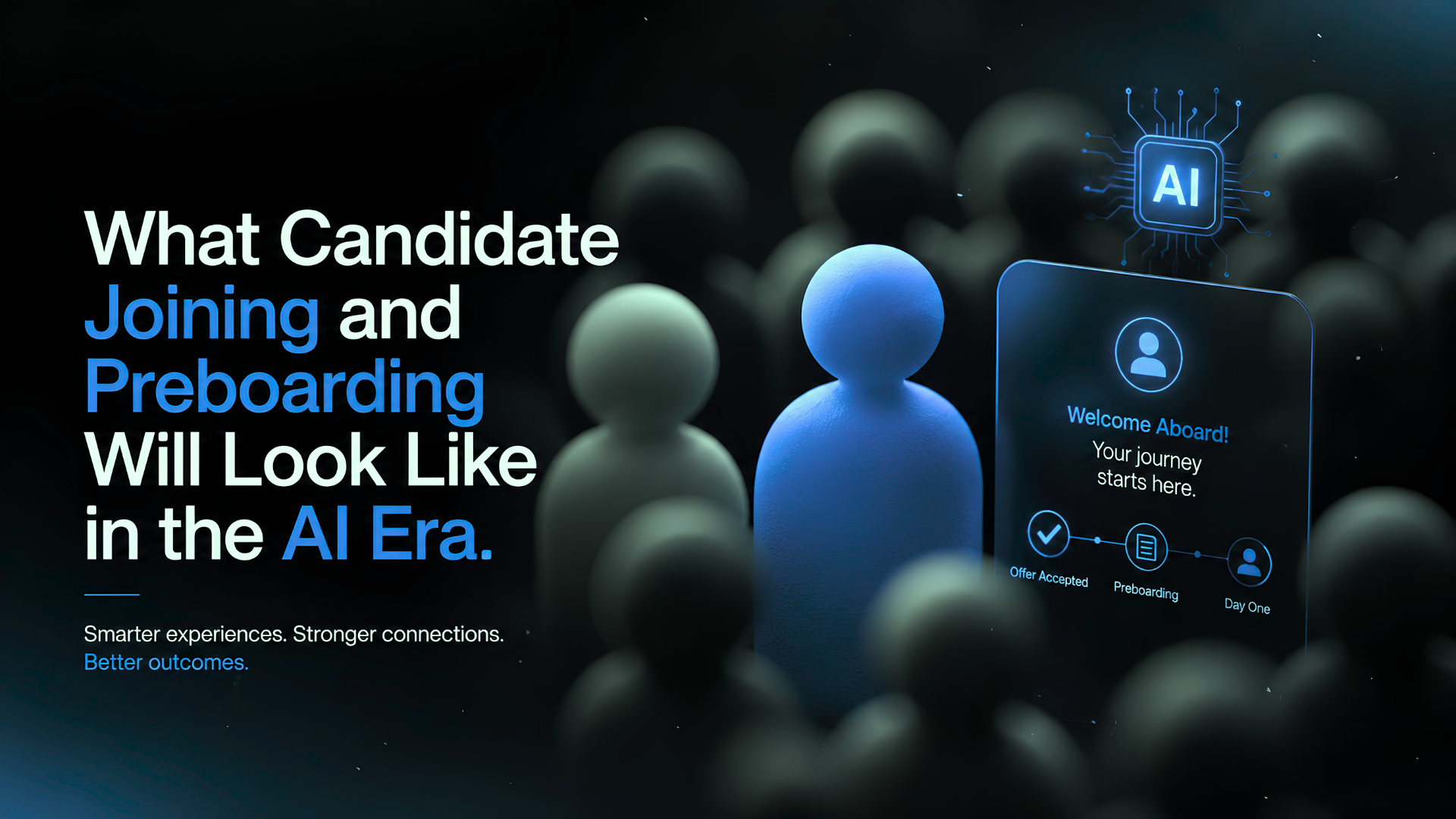
Imagine a candidate who signs an offer on Monday and receives a personalized welcome from their AI onboarding assistant within minutes. The assistant already knows the candidate's role, their team, their concerns from the interview process, and their practical needs for the transition. Over the next three weeks, the assistant coordinates every aspect of the preboarding experience: scheduling the IT setup, initiating benefits enrollment, arranging introductions with future teammates, and monitoring the candidate's engagement level in real time. When the candidate's response time slows on day twelve, the assistant alerts the recruiter, provides context about the likely cause, and recommends a specific intervention. When a counteroffer arrives on day fourteen, the assistant briefs the candidate on what to expect, schedules a call with the hiring manager, and tracks the resolution. On day one, the candidate walks through the door already connected to their team, already enrolled in benefits, and already provisioned with every tool they need. This is not science fiction. The technology to deliver this experience exists today. What is missing is the organizational will to deploy it.
The joining and preboarding process is one of the last areas of recruiting to be transformed by technology. Sourcing has been revolutionized by AI-powered candidate matching. Screening has been transformed by intelligent assessment tools. Interview scheduling has been automated. But the phase between offer acceptance and day one remains, for most organizations, a manual, ad hoc, and largely unmanaged process. The candidate signs the offer and enters a dead zone where communication is inconsistent, information is incomplete, and the risk of
dropout is highest. This is about to change dramatically. The convergence of three technology trends, agentic AI, real-time behavioral analytics, and unified candidate journey platforms, is creating the foundation for a fundamentally different preboarding experience. According to SHRM’s talent acquisition research, the organizations that adopt AI-driven preboarding early will achieve a significant competitive advantage in talent acquisition, because the preboarding experience is becoming a key differentiator in the competition for talent, particularly for senior and specialized roles where candidates often have multiple competing offers. The AI-powered preboarding experience of the near future will be defined by five characteristics: personalization, proactivity, continuity, intelligence, and seamlessness. Each of these characteristics represents a significant step forward from today's typical preboarding process, and together they create an experience that is qualitatively different from anything most candidates have encountered.
The AI Preboarding Assistant: Always On, Always Personal
The most visible change in the AI-era preboarding experience will be the emergence of the AI preboarding assistant: a dedicated, always-available AI agent that serves as the candidate's primary point of contact throughout the transition. This is not a chatbot that answers frequently asked questions from a static knowledge base. It is an intelligent agent that has access to the candidate's complete profile, their interview history, their motivations, their concerns, their risk assessment, and their communication preferences, and that uses this intelligence to provide personalized, context-aware support at every stage of the preboarding journey. The AI assistant can answer questions about benefits, IT setup, team structure, and first-day logistics with a level of detail and specificity that no human recruiter could match, because it draws on real-time data from the organization's HRIS, IT systems, and team communication platforms. The AI assistant is also available twenty-four hours a day, seven days a week, which matters enormously for candidates who are managing their transition alongside their current job. A candidate who has a question about their benefits enrollment at ten o'clock on a Sunday evening does not have to wait until Monday morning for an answer. The AI assistant provides an immediate, accurate response, and if the question requires human involvement, it escalates with full context so the human can resolve it quickly on Monday. This is the core promise of intelligent candidate onboarding: support that is available whenever the candidate needs it, personalized to their specific situation, and backed by real-time organizational data. According to McKinsey’s people organization insights, candidates who have access to an always-on support resource during the notice period report thirty percent higher satisfaction with the preboarding experience and are significantly less likely to withdraw before their start date.
The AI assistant also adapts its communication style to the candidate's preferences and behavior. A candidate who prefers brief, to-the-point email responses receives concise updates. A candidate who enjoys longer, more conversational exchanges receives a more detailed communication style. A candidate who is anxious and needs frequent reassurance receives more touchpoints. A candidate who is confident and needs minimal hand-holding receives a lighter
touch. This adaptive personalization is impossible at scale through manual effort, but it is precisely the kind of experience that differentiates a world-class preboarding process from a generic one. The AI assistant learns from every interaction, continuously refining its understanding of the candidate's needs and preferences, and adjusting its approach accordingly. This is the future of candidate preboarding: an experience that feels individually crafted for each candidate, even when the organization is onboarding dozens of new hires simultaneously.
Predictive Engagement: Knowing What the Candidate Needs Before They Ask
Today's preboarding process is reactive. The candidate asks a question, and someone answers it. The candidate reports a problem, and someone resolves it. The candidate signals doubt, and someone intervenes. The AI era will shift this paradigm from reactive to predictive. By analyzing behavioral signals, communication patterns, and contextual data, the AI system will anticipate the candidate's needs and address them before the candidate has to ask. A candidate who is relocating will automatically receive information about the new office's neighborhood, including housing resources, commuting options, and local amenities, before they think to ask. A candidate whose background check is taking longer than average will receive a proactive update explaining the reason and the expected resolution timeline, before anxiety sets in. A candidate whose engagement metrics suggest declining confidence will receive a targeted intervention from the hiring manager, before the doubt crystallizes into a decision to withdraw. This predictive capability is made possible by the AI's ability to process far more data than any human can. The system analyzes the candidate's email response time, message length, question frequency, and emotional tone across every touchpoint. It correlates these signals with the candidate's risk profile, their notice period timeline, and the behavioral patterns of thousands of previous candidates who were in similar situations. The result is a risk forecast that identifies not just whether a candidate is at risk, but when they are most likely to experience a crisis of confidence and what type of intervention will be most effective. According to LinkedIn’s recruiting resources, organizations that deploy predictive engagement models during the preboarding phase reduce candidate drop-offs by thirty to forty percent, because they are addressing the candidate's needs at the moment the needs arise, not days or weeks later when the candidate has already disengaged. Understanding how many follow-ups one hire actually needs, becomes irrelevant when the system can predict the optimal number and timing of touchpoints for each individual candidate.
Predictive engagement also transforms the hiring manager's role in the preboarding process. Today, hiring managers are asked to make periodic touchpoints with incoming candidates, but they receive little guidance on when to reach out, what to say, or whether the candidate even needs contact at that moment. In the AI era, the hiring manager receives targeted prompts: "Your new hire's engagement level has declined over the past three days. A brief call about the project they'll be leading would be the most effective intervention right now. Here are three talking points based on what the candidate expressed interest in during the interviews." This type of guidance makes the hiring manager's involvement dramatically more effective,
because it is targeted, timely, and grounded in data. As we have explored in our analysis of the difference between AI sourcing and AI recruiting, the most impactful recruiting technology does not replace human judgment. It informs and directs it, ensuring that every human interaction is as valuable as possible.
The Seamless Handoff: Recruiting, Preboarding, and Onboarding as One Flow
One of the most consequential changes in the AI era will be the elimination of the handoff gaps that currently fragment the candidate experience. Today, the recruiting team owns the candidate through offer acceptance. The preboarding phase, if it exists at all, is a no-man's land. The onboarding team takes over on day one. Each of these teams operates in a different system, with different data, different metrics, and different definitions of success. The result is an experience that feels disjointed to the candidate, who must repeatedly provide the same information, answer the same questions, and navigate the same administrative hurdles as they move from one phase to the next. The AI era will replace this fragmented experience with a single, continuous flow. An AI-driven joining workflow spans the entire journey from offer acceptance through the first ninety days of employment, maintaining a unified candidate record that is accessible to every stakeholder. The recruiter's intelligence about the candidate's motivations and concerns flows seamlessly into the preboarding plan, which flows seamlessly into the onboarding agenda. The candidate never has to repeat themselves. The onboarding team never has to start from scratch. Every interaction, from the first post-acceptance email to the ninety-day check-in, is informed by the complete history of the candidate's journey. According to Gartner’s HR trends analysis, organizations that implement a unified joining workflow reduce new-hire time to productivity by twenty to thirty percent, because the onboarding team can design a first-day and first-week experience that builds on the candidate's existing knowledge and connections rather than starting from zero.
The seamless handoff also changes the metrics by which the preboarding process is evaluated. Today, recruiting measures offer acceptance rate. Onboarding measures time to productivity. Preboarding measures nothing. In the AI era, a single metric, the offer-to-productivity conversion rate, spans the entire journey and holds every team accountable for their contribution to the ultimate outcome: a productive, committed employee. This metric creates alignment across recruiting, preboarding, and onboarding, because every team's performance is evaluated against the same standard. It also creates a powerful feedback loop: when a new hire leaves within ninety days, the system can trace the root cause back through the preboarding and recruiting phases, identifying the specific point where the experience failed and recommending targeted improvements. This is the kind of AI joining process automation that transforms preboarding from an afterthought into a data-driven discipline. As we have discussed in our analysis of why more tools produce the same hiring problems, the problem is not a lack of data. It is a lack of integration, and the AI-era platform provides that integration by connecting every phase of the journey in a single, continuous system.
Hyper-Personalized First-Day Experiences
The first day of employment is a make-or-break moment. Research consistently shows that a new hire's experience on day one has an outsized impact on their long-term engagement, retention, and performance. Yet most organizations deliver a generic first-day experience that is identical for every new hire, regardless of their role, level, background, or individual needs. The AI era will replace this one-size-fits-all approach with a hyper-personalized first day that is tailored to each individual candidate. The AI system designs the first-day agenda based on the candidate's specific profile. A candidate who expressed excitement about a particular project during the interviews starts the day with a briefing on that project. A candidate who was anxious about the team's remote work culture starts the day with a detailed walkthrough of the collaboration tools and norms. A candidate who is relocating starts the day with an introduction to a colleague who also relocated recently and can provide practical advice. A candidate who is a visual learner receives a video-based introduction to the team rather than a text-heavy document. Every element of the first day, from the schedule to the content to the people the candidate meets, is optimized for that specific individual. According to Deloitte’s talent research, candidates who receive a personalized first-day experience report sixty percent higher satisfaction and are forty percent less likely to experience early regret. This level of personalization requires the kind of continuous candidate intelligence that only an agentic AI recruiting platform can provide.
The hyper-personalized first day also extends to the physical and digital environment. The candidate's desk or workspace is prepared with the specific tools, access credentials, and resources they need for their role. Their email inbox contains personalized welcome messages from their team members, not generic templates. Their calendar is pre-populated with meetings and events that are relevant to their role and their interests. Their first assignment is aligned with the skills and experiences they discussed during the interview process, allowing them to contribute meaningfully from the earliest possible moment. This is the experience that transforms a new hire from a nervous arrival into a confident contributor, and it is the experience that separates the organizations that compete for talent on culture and experience from those that compete only on compensation.
What This Means for Recruiters, Hiring Managers, and Candidates
The AI-era preboarding experience changes the role of every participant in the joining process. For recruiters, it elevates the profession from task execution to strategic outcome management. The AI handles the communication scheduling, the information distribution, the risk monitoring, and the administrative coordination, freeing the recruiter to focus on the high-value activities that require human judgment: building relationships with candidates, coaching hiring managers on their preboarding involvement, and managing the complex, high-stakes situations that AI flags for human attention. The recruiter's value shifts from the volume of tasks they complete to the quality of outcomes they produce. For hiring managers, it reduces the burden of preboarding involvement while increasing its impact. Instead of being asked to "reach out to the candidate at some point before they start," the hiring manager receives specific, data-driven recommendations for when to engage, what to discuss, and how
their involvement will have the greatest effect on the candidate's confidence and commitment. A fifteen-minute call that is targeted, timely, and relevant is far more valuable than a thirty-minute call that is generic and poorly timed. For candidates, the AI-era preboarding experience means a transition that is less anxious, more informative, and more personally supportive than anything available today. The candidate feels known, valued, and prepared, not processed, ignored, and uncertain. As we have discussed in our exploration of why referrals outperform cold outreach, the referral advantage has always been about the quality of the pre-hire relationship. AI-era preboarding extends that relationship quality to every candidate, regardless of source.
The transition to AI-era preboarding will not happen overnight. It will happen in stages, as organizations adopt the technology and refine their processes. The organizations that move first will gain a significant advantage in the competition for talent, because the preboarding experience is becoming a key factor in candidates' decisions about where to work, particularly for senior and specialized roles. Candidates talk to each other about their hiring experiences. A candidate who has a seamless, personalized, AI-supported preboarding experience at one organization will compare it unfavorably to the generic, neglectful experience they received at a previous employer, and they will share that comparison with their network. According to the best way to evaluate an AI sourcing tool before buying, the most forward-thinking organizations are already evaluating their technology partners based on their ability to deliver this type of experience, not just on their ability to source and screen candidates.
Why Huntlo.ai Is Building the AI-Era Joining Experience Today
Huntlo.ai is building the joining and preboarding experience that the AI era demands. The platform's agentic AI capabilities already provide many of the features described in this article: personalized engagement plans, real-time risk monitoring, multi-stakeholder coordination, and continuous candidate intelligence that spans the entire journey from first contact through day one and beyond. The AI assistant is available around the clock to answer candidate questions, the predictive engagement engine identifies at-risk candidates before they disengage, and the unified candidate record eliminates the information loss that currently plagues the handoff between recruiting, preboarding, and onboarding. Huntlo ensures that outdated candidate data in AI recruiting tools never undermines the preboarding experience, because every interaction is grounded in fresh, continuously updated intelligence. The platform is designed for the organizations that understand that the future of recruiting is not about finding more candidates. It is about ensuring that the candidates you find actually show up, are productive faster, and stay longer. That is the promise of the AI-era joining experience, and it is a promise that Huntlo is delivering today.
The preboarding experience of the future is not a distant vision. It is a present capability, available to any organization that is willing to treat the period between offer acceptance and day one as a first-class part of the hiring process. The technology exists. The evidence supports it. The candidates are ready for it. The only question is whether your organization will lead the transition or follow it.