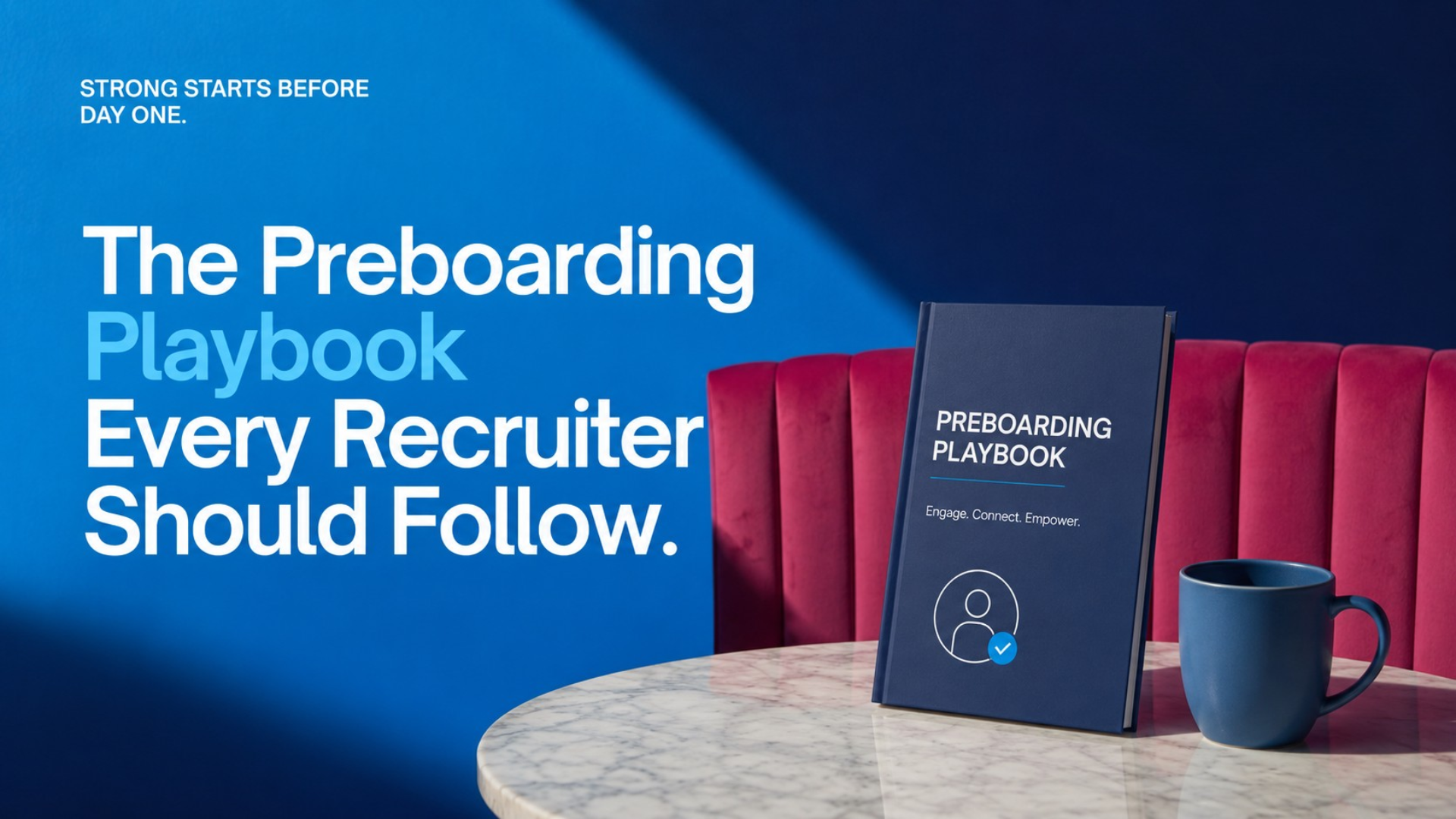
The candidate signed the offer. The hiring manager celebrated. The recruiter moved on to the next requisition. And the candidate entered a two-to-four-week period that will determine whether they actually show up on day one. What happens during this window, commonly called pre-boarding, is the single most consequential and most neglected phase of the entire hiring process. Get it right, and you convert acceptances into engaged new hires. Get it wrong, and you join the growing ranks of recruiting teams that lose ten to twenty percent of their accepted candidates before they ever walk through the door.
Pre-boarding is not an administrative afterthought. It is not sending a benefits enrollment link and a parking pass. It is a structured, strategic engagement process that maintains the candidate’s excitement, addresses their concerns, and builds the emotional connection that makes joining day feel like a homecoming rather than a leap into the unknown. This playbook provides the framework that every recruiting team needs, whether you are hiring five people a year or five hundred. And as we have explored in our analysis of why more tools produce the same hiring problems, the key is not adding another standalone tool to a broken process. It is building a systematic approach that integrates pre-boarding into the full candidate journey.
Why Most Pre-Boarding Efforts Fail
The most common pre-boarding failure is treating it as a checklist of administrative tasks rather than an engagement strategy. Benefits enrollment. Tax forms. IT setup. Emergency contacts. Policy acknowledgments. These are necessary activities, but they communicate bureaucracy, not excitement. When a candidate’s first extended experience of their future employer is a flood of forms and portals, they form an immediate impression about what it will be like to work there. And that impression is rarely positive. According to SHRM’s talent acquisition research, candidates who rate their pre-boarding experience as poor are four times more likely to consider withdrawing before their start date compared to those who rate it
positively. The administrative tasks are not the problem. The problem is that administrative tasks are the only thing most organizations offer.
The second failure mode is inconsistency. One candidate receives a personal call from the hiring manager and a team lunch invitation before they start. Another candidate, at the same company, for a similar role, receives nothing but automated emails. This inconsistency is inevitable when pre-boarding depends on individual recruiter initiative rather than a systematic process. Some recruiters are naturally diligent about post-offer engagement. Others are not. Some hiring managers are proactive about welcoming new hires. Others are too busy. The result is a pre-boarding experience that varies wildly from candidate to candidate, and the variance directly correlates with joining rates. The teams that perform best are the ones that systematize pre-boarding so that every candidate receives a high-quality experience, regardless of which recruiter or hiring manager is involved.
The Five-Day Post-Offer Kickoff
The first five days after offer acceptance are the most critical window of the entire pre-boarding process. During this period, the candidate’s emotional state is at its most volatile. They have made a significant decision, and their brain is actively searching for evidence that the decision was either right or wrong. Every piece of information they receive from their future employer during this window carries disproportionate weight. The goal of the five-day kickoff is to reinforce the candidate’s decision with positive, substantive communication that reminds them why they were excited about the opportunity in the first place. Understanding how many follow-ups one hire actually needs, and front-loading the most impactful touchpoints in the first five days, is the foundation of an effective pre-boarding strategy.
Day one, the day after acceptance, should include a personal message from the hiring manager expressing genuine excitement about the candidate joining the team. This message should be specific, referencing something from the interview process that made the hiring manager enthusiastic about this particular candidate. It should not be a generic welcome template. Day two should include an introduction to the candidate’s onboarding buddy, a peer who will be their informal point of contact for questions and concerns during the pre-boarding period. Day three should include a piece of substantive information about the team or the project they will be working on, something that makes the role feel real and tangible. Day four should include a logistics communication covering practical details like the first-day schedule, dress code, and arrival instructions. Day five should include a personal check-in from the recruiter to gauge the candidate’s overall sentiment and address any emerging concerns.
The Notice Period Engagement Cadence
After the initial five-day kickoff, the pre-boarding process settles into a sustained engagement cadence that continues throughout the candidate’s notice period. The cadence should include at least one meaningful touchpoint per week, with the intensity increasing as the start date approaches. These touchpoints should mix formats and senders to keep the experience fresh and
to demonstrate that the candidate’s future team is genuinely engaged in their arrival. A scalable hiring platform that manages this cadence automatically ensures that no candidate falls through the cracks, regardless of how many are in the pipeline. The platform should track every touchpoint, monitor the candidate’s responsiveness, and escalate to the recruiting team if engagement declines.
The content of each weekly touchpoint should be personalized based on what the team learned about the candidate during the interview process. A candidate who expressed excitement about a specific product feature should receive an update on that feature’s development. A candidate who was nervous about a particular technical requirement should receive reassurance or resources that address that concern. A candidate who is relocating should receive practical information about the new city. This level of personalization is what transforms pre-boarding from a generic process into a relationship-building experience. And it is what separates talent acquisition software that drives actual outcomes from tools that merely track administrative tasks. According to Deloitte’s talent insights, personalized pre-boarding engagement is the strongest predictor of new-hire satisfaction and joining-day attendance.
The Risk Detection and Intervention Protocol
An effective pre-boarding playbook must include a formal risk detection protocol that identifies candidates who are likely to withdraw before they actually do. Risk signals include declining response times, shorter and less detailed replies, cancellations or rescheduling of pre-boarding calls, and reduced engagement with pre-boarding materials. Each of these signals on its own is easy to dismiss. Together, they form a pattern that indicates a candidate who is actively reconsidering their decision. An AI system that monitors these signals in real time can detect the pattern before it becomes a withdrawal, giving the recruiting team a window to intervene. This is why the issue of outdated candidate data in AI recruiting tools, is so consequential during pre-boarding. The AI’s risk assessments are only as good as the data they are based on, and stale data produces false negatives that allow at-risk candidates to slip through the net.
The intervention protocol should define three escalation levels based on risk severity. Level one, mild risk, triggers an increased frequency of automated touchpoints and a prompt for the recruiter to schedule a personal check-in call. Level two, moderate risk, triggers a personal outreach from the hiring manager in addition to the recruiter’s intervention, because the hiring manager’s voice carries more weight than the recruiter’s at this stage. Level three, high risk, triggers involvement from a senior leader or the candidate’s designated executive sponsor, because at this point the candidate needs to hear from someone with organizational authority who can address concerns, make commitments, or adjust terms if necessary. This three-level escalation model is a hallmark of an agentic AI recruiting platform, because it combines automated risk detection with intelligent routing to the right human intervener at the right time.
The Final Week Before Day One
The last seven days before joining are when practical anxiety peaks. The candidate is thinking about their commute, their first-day outfit, whether they will fit in with the team, and whether they made the right decision. The pre-boarding playbook must address each of these anxiety sources directly. The week should begin with a detailed first-day agenda that shows the candidate exactly what to expect from the moment they arrive. This agenda should include the name and role of the person who will greet them, the schedule for their first day including breaks, and any materials they should bring. Knowing exactly what will happen on day one eliminates the uncertainty that feeds anxiety and gives the candidate a concrete mental picture of their first morning.
The mid-week touchpoint should be a personal call from the onboarding buddy, not the recruiter, because the buddy represents the candidate’s future peer group. This call should be casual and conversational, focused on answering the candidate’s practical questions and making them feel like they already have a friend on the team. The day-before touchpoint should come from the hiring manager and should express genuine anticipation about the candidate’s arrival. This final message is disproportionately impactful because it is the last thing the candidate hears before making the decision to show up. When this sequence is managed by a recruitment management software platform, every touchpoint is scheduled, tracked, and completed on time, without requiring manual coordination from the recruiting team. According to LinkedIn’s recruiting research, candidates who receive a personal message from their hiring manager in the final twenty-four hours before joining are fifty percent less likely to no-show.
Pre-Boarding for Different Hiring Contexts
The playbook needs to adapt to different hiring contexts because the risks and opportunities vary significantly depending on the type of role, the candidate’s background, and the organizational context. For high-volume hiring, where dozens of candidates may be in pre-boarding simultaneously, the playbook must rely heavily on automation while reserving personal touchpoints for the highest-priority roles. A scalable hiring platform that can manage hundreds of pre-boarding sequences in parallel, with automated personalization and real-time risk monitoring, is essential in this context. For enterprise hiring, where notice periods can be long and organizational changes frequent, the playbook must include mechanisms for keeping the candidate informed of any changes that affect their role or team. For staffing agencies managing candidates on behalf of client organizations, a staffing CRM that tracks the candidate’s engagement across both the agency and the client ensures a seamless experience even when multiple parties are involved.
The playbook also needs to account for candidate-specific factors that affect pre-boarding risk. Relocating candidates need more practical support and more frequent touchpoints because the logistical and emotional complexity of their transition is higher. Candidates leaving long-tenured positions need more emotional reinforcement because the endowment effect, the tendency to overvalue what you already have, is stronger. Candidates in their first or second job need more reassurance because they have less experience evaluating career decisions. And candidates who received multiple competing offers need more validation because they
had genuine alternatives and may still be weighing them. The ability to adapt the pre-boarding sequence based on these factors is what allows the best teams to improve recruiter productivity without sacrificing quality. As we have discussed in our analysis of the difference between AI sourcing and AI recruiting, it is the recruiting phase, the relationship management phase, where this kind of contextual adaptation matters most.
Why Huntlo.ai Delivers the Pre-Boarding Playbook at Scale
Huntlo.ai provides a complete pre-boarding solution that implements every element of this playbook automatically. The platform’s AI engine creates a personalized engagement plan for every accepted candidate based on their role, their profile, and the intelligence gathered during the interview process. The five-day kickoff, the weekly engagement cadence, the risk detection protocol, and the final-week sequence are all orchestrated by the system, with human touchpoints scheduled and tracked automatically. Real-time engagement monitoring identifies at-risk candidates and triggers the appropriate escalation level, ensuring that intervention happens before withdrawal. When evaluating an AI recruiting tool before buying, the ability to demonstrate a complete, systematized pre-boarding workflow is one of the most important differentiators, because it is the phase where the most hiring losses occur and where most competing platforms offer the least.
For recruiting teams that are ready to treat pre-boarding as the strategic priority it is, Huntlo provides the playbook, the technology, and the intelligence to deliver a world-class pre-boarding experience at any scale. One where every candidate feels valued, informed, and connected from acceptance through day one. One where referrals outperform cold outreach, not because of the referral itself, but because every candidate, referred or sourced, receives the same high-quality engagement during the most vulnerable phase of their hiring journey. And one where the pre-boarding experience is not a bottleneck or an afterthought, but a competitive advantage that sets your organization apart in a market where great candidates have more options than ever before.