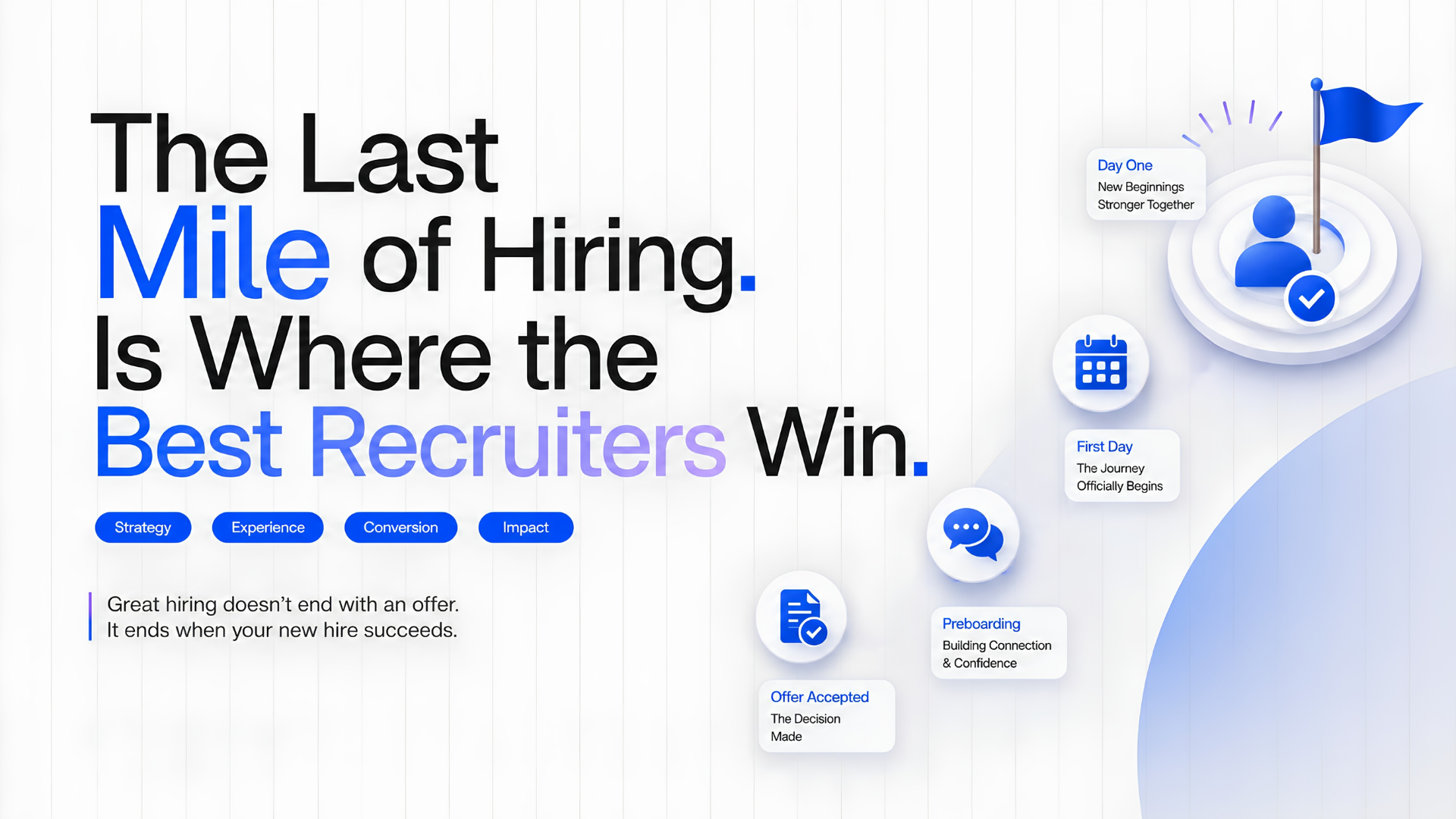
Two recruiters at the same company are working on similar roles. Both source strong candidates. Both move them through the interview process at a comparable pace. Both negotiate offers that candidates accept. But one recruiter has a joining rate of ninety-four percent. The other has a joining rate of seventy-six percent. The difference is not talent, effort, or budget. It is that one recruiter treats the period between offer acceptance and day one as the most important phase of the hiring process, and the other treats it as a waiting room. The last mile of hiring, the stretch between the signed offer and the first day of work, is where recruiting outcomes are actually determined. It is where candidates are won or lost, where the investment in sourcing and screening either pays off or evaporates, and where the best recruiters separate themselves from the rest.
The recruiting profession has historically organized itself around the front end of the process. Sourcing, screening, interviewing, and offer negotiation are the skills that are taught, measured, and rewarded. Post-acceptance management, if it is acknowledged at all, is treated as an afterthought, a few follow-up emails and a reminder about the start date. But the data tells a different story. The front end of the process determines whether you get to yes. The last mile determines whether yes becomes a real, productive hire. And the gap between the two is where recruiting ROI is made or lost. According to SHRM’s talent acquisition research, the post-acceptance phase accounts for a disproportionately large share of total hiring failures relative to its duration. A recruiter who masters the last mile of hiring delivers dramatically better outcomes than one who does not, even when both recruiters are equally skilled at sourcing and closing.
What the Last Mile Actually Is
The last mile of hiring is the period between the moment a candidate signs the offer and the moment they complete their first ninety days of employment. It encompasses three sub-phases: the notice period, when the candidate is still at their current employer; the transition, when the candidate is moving between organizations; and the early-employment period, when the candidate is settling into the new role. Each sub-phase presents distinct risks and requires distinct skills. During the notice period, the primary risk is withdrawal. The candidate's current employer will respond to the departure with retention efforts. The candidate's own doubts about the decision will surface. Practical concerns about the transition, relocation, visa status, family logistics, will create anxiety. The recruiter's job during this phase is to maintain and deepen the candidate's commitment through consistent, personalized, multi-stakeholder engagement. This is the phase where most drop-offs occur, and it is the phase where the recruiter's skill has the greatest impact on the outcome. During the transition, the primary risk is a poor first-day experience. If the candidate arrives to a disorganized, impersonal, or chaotic first day, the confidence built during the notice period is immediately undermined. The recruiter's job during this phase is to ensure a seamless handoff to the onboarding team, with complete information transfer and no gaps. During the early-employment period, the primary risk is early regret and attrition. The candidate's initial experience in the role either validates or contradicts the expectations set during the hiring process. According to McKinsey’s people organization insights, candidates who report a positive experience across all three sub-phases are four times more likely to still be employed at the twelve-month mark, making the last mile the single strongest predictor of long-term hiring success.
The critical insight is that the last mile is not a single event. It is a process that unfolds over weeks or months, and it requires a different set of skills than the front-end hiring process. Sourcing requires research skills and persistence. Screening requires analytical skills and judgment. Interviewing requires communication skills and emotional intelligence. Offer negotiation requires business acumen and influence. The last mile requires all of these, plus a set of skills that are rarely taught and even more rarely measured: relationship orchestration, stakeholder management, risk monitoring, and the ability to maintain engagement and build trust over an extended period without the natural momentum of the interview process to drive the interaction forward. This is the post-acceptance recruiting skill that separates elite recruiters from average ones, and it is the skill that has the greatest impact on the outcomes the business actually cares about.
The Eight Practices of Recruiters Who Own the Last Mile
Through the analysis of thousands of hiring outcomes and the practices of recruiters who consistently achieve joining rates above ninety percent, eight practices emerge that define hiring finish line execution. The first practice is immediate post-acceptance engagement. Within hours of the candidate signing, the elite recruiter has already initiated the joining success process: a personalized welcome email, a hiring manager outreach request, and a risk
assessment that identifies the candidate's specific vulnerabilities. The second practice is structured communication cadence. The elite recruiter maintains a deliberate, planned sequence of touchpoints throughout the notice period, calibrated to the candidate's risk profile. The cadence is not random. It is designed to deliver the right type of support at the right time. The third practice is multi-stakeholder orchestration. The elite recruiter does not try to manage the post-acceptance experience alone. They actively involve the hiring manager, the onboarding buddy, and future teammates at strategically chosen moments. The fourth practice is proactive counteroffer preparation. The elite recruiter briefs the candidate on what to expect before the resignation conversation, reducing the shock and confusion that make counteroffers effective. The fifth practice is real-time risk monitoring. The elite recruiter tracks engagement signals, response times, and communication tone, and intervenes when they detect early signs of disengagement. Understanding how many follow-ups one hire actually needs, the elite recruiter calibrates the cadence to the candidate's individual situation rather than following a rigid template. The sixth practice is personalized information delivery. The elite recruiter anticipates the candidate's questions and provides answers before the candidate has to ask, reducing the anxiety of uncertainty. The seventh practice is seamless handoff management. The elite recruiter ensures that the onboarding team has complete information about the candidate's motivations, concerns, and expectations, so the first-day experience reinforces the decision to join rather than undermining it. The eighth practice is post-start follow-through. The elite recruiter checks in at the one-week, one-month, and three-month marks to ensure the candidate is settling in successfully, creating a feedback loop that improves future hiring outcomes.
These eight practices are not secrets. They are straightforward, repeatable behaviors that any recruiter can adopt. What distinguishes the elite recruiter is not knowledge of these practices but the discipline to execute them consistently, for every candidate, even when workload is high and other priorities compete for attention. This consistency is what creates the elite recruiter differentiator: not a single brilliant intervention but a systematic, reliable process that produces predictable outcomes. According to LinkedIn’s recruiting resources, recruiters who execute all eight practices consistently achieve joining rates that are twenty to thirty percentage points higher than recruiters who execute them sporadically, regardless of experience level, role complexity, or market conditions.
Why Most Recruiters Neglect the Last Mile
Given the clear impact of last-mile execution on hiring outcomes, the question is not whether recruiters should invest in it. The question is why most do not. The answer lies in three structural factors. The first factor is metric misalignment. Most recruiting teams are measured on time to fill, cost per hire, and offer acceptance rate. None of these metrics capture the quality of the post-acceptance experience. A recruiter who spends five hours per week managing the post-acceptance phase will see no improvement in their reported metrics, because the metrics stop counting at the point of offer acceptance. The recruiter's rational response is to invest their time in activities that are measured, which means sourcing and screening, not
post-acceptance management. This is the core of the recruiter competitive advantage problem: the activities that have the greatest impact on the business outcome are the activities that the current metrics do not measure. The second factor is organizational ownership ambiguity. Who owns the post-acceptance experience? In most organizations, the answer is nobody. The recruiter has moved on to the next requisition. The hiring manager is focused on operational responsibilities. The onboarding team does not engage until day one. The result is a gap in ownership that leaves the candidate without a clear point of contact during the most vulnerable phase of their transition. The third factor is technology limitation. Most applicant tracking systems are designed to manage the front-end process. They have robust functionality for sourcing, screening, and interview scheduling, but minimal functionality for post-acceptance engagement, risk monitoring, and joining rate measurement. Without technology support, the recruiter who wants to own the last mile must do so through manual effort, which is not scalable. According to Gartner’s HR trends analysis, these three structural factors, metric misalignment, ownership ambiguity, and technology limitation, are the primary barriers to last-mile investment, and they must all be addressed simultaneously for the investment to produce results.
The good news is that all three barriers are solvable, and the solutions reinforce each other. Adopting joining rate as a primary metric creates the measurement incentive for recruiters to invest in the last mile. Defining clear ownership of the post-acceptance experience, whether it is the recruiter, a dedicated preboarding specialist, or a shared responsibility between the recruiter and the hiring manager, eliminates the ownership gap. And deploying technology that automates the structural elements of last-mile management, communication scheduling, risk monitoring, and stakeholder coordination, makes it scalable. When all three solutions are implemented together, the result is a self-reinforcing system: better metrics drive better behavior, better behavior drives better outcomes, and better outcomes justify continued investment. As we have explored in our analysis of why more tools produce the same hiring problems, the organizations that overcome the structural barriers are the ones that address all three simultaneously, because partial solutions create partial improvements that quickly plateau.
The Business Case for Last-Mile Investment
The business case for investing in the last mile is compelling at any scale. Consider a recruiting team that extends two hundred offers per year with an average recruiting cost of ten thousand dollars per offer and a joining rate of eighty percent. This team produces one hundred sixty actual starts per year, at a true cost per productive start of twelve thousand five hundred dollars. If last-mile investment improves the joining rate from eighty percent to ninety percent, the team produces one hundred eighty starts per year from the same two hundred offers, at a true cost per productive start of eleven thousand one hundred dollars. The annual savings in direct recruiting costs alone are two hundred fifty thousand dollars. When the indirect costs of extended vacancies are included, the total savings typically double or triple. The investment required is modest. The primary investments are in process design, the documentation and standardization of the eight practices described above, in technology, the platform that
orchestrates communication, monitors risk, and measures joining rate, and in training, the development of recruiters' post-acceptance management skills. According to Deloitte’s talent research, the typical ROI on last-mile investment exceeds four hundred percent in the first year, because the cost of the investment is small relative to the cost of the failures it prevents. This makes last-mile investment one of the highest-return investments available to a talent acquisition leader. Understanding the difference between AI sourcing and AI recruiting, the organizations that achieve the highest returns are the ones that invest in the relationship management capabilities that define the last mile, not just in the transactional efficiency of the front-end process.
How AI Amplifies the Recruiter's Last-Mile Effectiveness
AI does not replace the recruiter's last-mile skills. It amplifies them. The eight practices described above are all things that a skilled recruiter can do manually for a small number of candidates. But no recruiter can execute all eight practices consistently for twenty or thirty simultaneous candidates without technology support. AI provides that support by automating the structural elements, communication scheduling, risk monitoring, and information delivery, while preserving the recruiter's ability to exercise judgment, build relationships, and handle the high-stakes situations that require a human voice. The AI system maintains the communication cadence, ensuring that no candidate misses a planned touchpoint. It monitors engagement signals in real time, alerting the recruiter to candidates whose behavior suggests disengagement. It provides the risk assessment that drives personalized intervention strategies. It coordinates multi-stakeholder engagement, prompting the hiring manager, the onboarding buddy, and the future teammates at the right moments. And it provides the measurement infrastructure, joining rate tracking, segment-level breakdowns, and trend analysis, that makes the last mile a data-driven discipline rather than a matter of individual recruiter intuition. This is what distinguishes an agentic AI recruiting platform from a simple automation tool: the ability to reason about each candidate's situation and recommend the most effective action, rather than simply executing a pre-defined sequence. As we have discussed in our analysis of why referrals outperform cold outreach, the best recruiters are already doing many of these things intuitively. AI makes it possible for every recruiter to do them consistently, at scale, and with the data-driven precision that turns good outcomes into great ones.
Why Huntlo.ai Gives Every Recruiter the Power to Win the Last Mile
Huntlo.ai provides the complete last-mile toolkit that transforms joining rate from a metric that varies by recruiter into a capability that is embedded in the platform and available to every member of the recruiting team. The system captures candidate intelligence during the interview process, builds personalized engagement plans for the notice period, orchestrates multi-stakeholder communication, monitors risk in real time, and measures the joining rate with full segment-level drill-down. Every recruiter, regardless of experience level, has access to the same orchestration engine, the same risk intelligence, and the same intervention recommendations, ensuring that every candidate receives a consistently excellent post-acceptance
experience. Huntlo ensures that outdated candidate data in AI recruiting tools never undermines the last-mile strategy, because every recommendation is based on fresh, continuously updated intelligence about the candidate's current state, concerns, and engagement level. For recruiting leaders who want their teams to win the last mile consistently, Huntlo provides the technology, the workflow, and the measurement to make it happen. And for organizations evaluating their options, understanding how to evaluate an AI sourcing tool before buying, means asking whether the platform gives every recruiter the tools to own the last mile, or whether it stops at the offer acceptance like every other tool on the market.
The best recruiters have always known that the last mile is where hiring is won or lost. They have always invested more time, more energy, and more care in the post-acceptance phase than their peers, and their joining rates have reflected that investment. What AI changes is not the importance of the last mile but the accessibility of the skills needed to master it. With the right technology, every recruiter can be a last-mile recruiter. And when every recruiter owns the last mile, the entire organization wins.