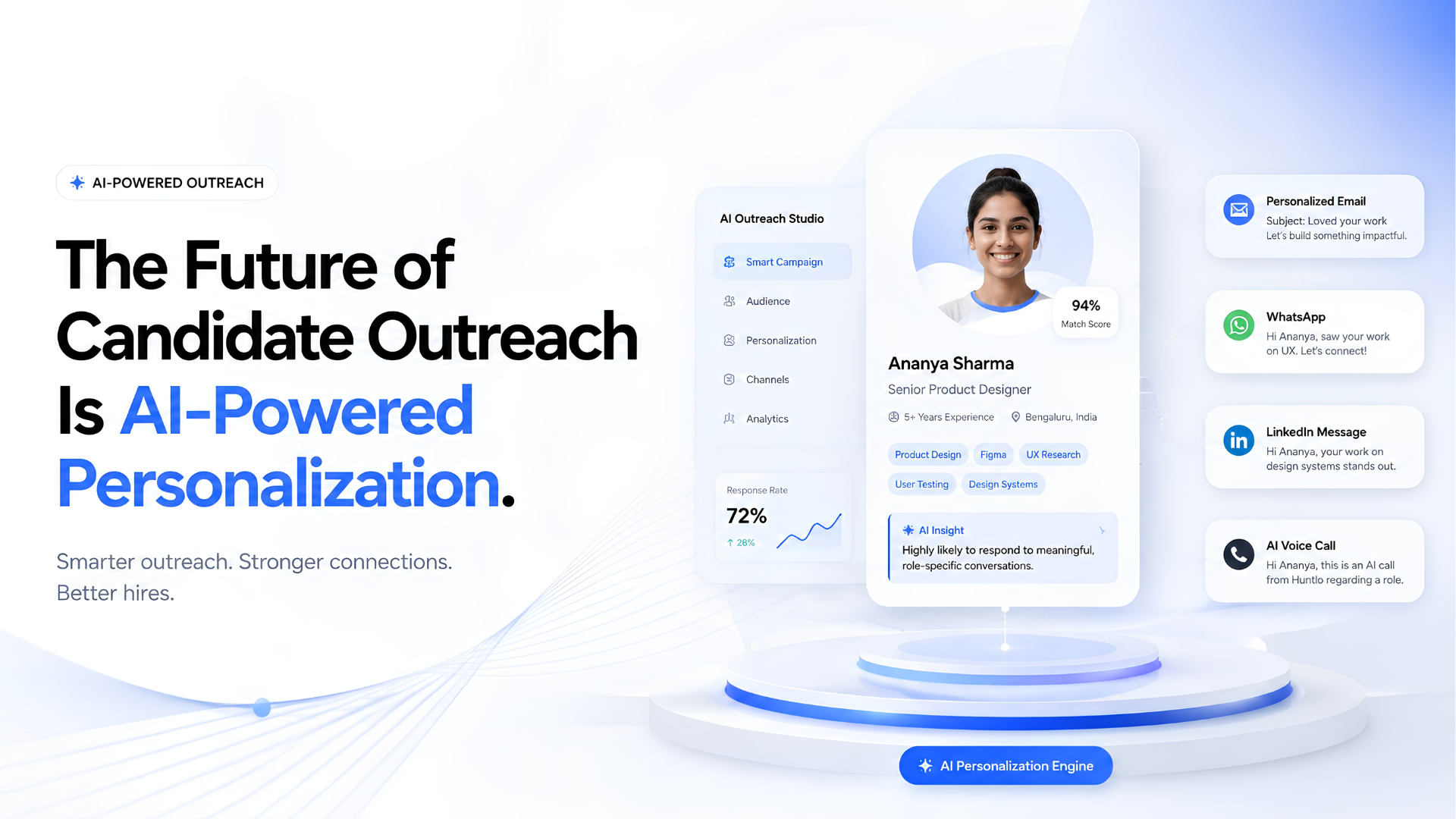
The recruitment industry has spent the last decade optimizing for volume. Sourcing tools could identify more candidates from more platforms. Outreach tools could send more messages through more channels. Automation platforms could execute more follow-ups with less manual effort. Each of these capabilities delivered genuine efficiency gains, and together they transformed the recruitment function from a manually intensive, relationship-driven activity into a scalable, technology-supported operation. But somewhere in the pursuit of scale, a critical truth got lost: volume without relevance is noise, and candidates have become exceptionally skilled at filtering noise from their professional lives. The average passive candidate in a competitive talent market receives between ten and thirty recruiting messages per month. They do not respond to most of them, and the ones they do respond to are almost always the ones that demonstrate genuine understanding of who they are, what they do, and what might genuinely interest them. The future of candidate outreach is not about reaching more people. It is about reaching the right people with messages that feel personally relevant, contextually informed, and genuinely worth their time. AI makes this possible at a scale that was previously impossible, and the organizations that embrace this shift early will build a sustainable competitive advantage in the competition for talent.
Why Mass Outreach Is Entering Its Final Chapter
For most of the past decade, the dominant outreach strategy in recruitment was a simple one: find as many candidates as possible who match the job requirements, and send them all a version of the same message. The logic was straightforward and, at the time,
defensible. If the average response rate to cold outreach was three to five percent, then sending one hundred messages would produce three to five responses. Sending one thousand messages would produce thirty to fifty. The path to more conversations was more messages, and technology made more messages cheap and easy to produce. Template libraries, mail merge tools, and bulk messaging platforms reduced the per-message cost to near zero, and recruitment teams scaled their outreach volumes accordingly.
This strategy worked — or at least it produced enough results to justify continued investment — because the volume of recruiting messages in most talent markets was still relatively low. Candidates might receive a handful of outreach messages per month, and even generic ones had a reasonable chance of being noticed and considered. But as every recruitment team adopted the same volume-first approach, the message volume in candidate inboxes and LinkedIn message folders increased dramatically. Candidates adapted by developing faster, more ruthless filtering behaviors. Subject lines that mentioned a job opportunity were archived without reading. Messages from unknown senders were ignored. Generic templates were identified and dismissed within seconds. The response rates that made volume-first outreach economically viable began to decline, and recruitment teams responded to the decline by sending even more messages, which accelerated the cycle of candidate desensitization. According to LinkedIn’s talent solutions trend data, response rates to InMail outreach have declined by approximately forty percent over the past five years, even as the total volume of InMails sent has increased by more than sixty percent. The math of volume-first outreach is collapsing, and no amount of template optimization is going to restore it.
What AI-Powered Personalization Actually Means
The term “personalization” in recruitment outreach has been used so broadly that it has lost much of its meaning. For many teams, personalization still means inserting the candidate’s first name into a template or swapping out the company name based on the candidate’s current employer. This is personalization in the most mechanical sense, and candidates recognize it for what it is: a template with a variable. AI-powered personalization is something fundamentally different. It refers to the ability of an AI system to analyze a candidate’s complete professional profile — their career trajectory, technical skills, recent projects, published work, conference presentations, professional network, and publicly available activity — and use that analysis to generate a message that is contextually unique to that candidate. Not a template with their name inserted. A message that could not have been sent to any other candidate because it is grounded in specific, identifiable details of that candidate’s professional life.
The practical difference between template-based personalization and AI-powered personalization is the difference between saying “I noticed your experience with Python” and saying “I saw your recent talk at PyCon about building real-time data pipelines with Apache Kafka — the architecture decisions you described are remarkably similar to the challenges our platform team is working through right now.” The first message could have been sent to any Python developer. The second message could only have been sent to
someone who gave that specific talk. The first message is recognizable as a template. The second message is recognizable as a message from someone who actually did their homework. The impact on response rates is dramatic. Gartner’s research on AI in human resources projects that by 2028, organizations using AI-driven personalization in their talent acquisition outreach will outperform mass-outreach competitors by sixty to eighty percent in qualified response rates, because the candidates who receive personalized messages are not just more likely to respond — they are more likely to be genuinely qualified and interested, which means the downstream conversion rate from response to hire is also significantly higher.
From Templates to Tailored Conversations: How AI Changes the Outreach Workflow
The shift from template-based outreach to AI-powered personalization does not just change the content of messages. It changes the entire outreach workflow in ways that have significant operational implications. In a template-based workflow, the recruiter’s primary activity is list-building: searching for candidates, filtering by basic criteria, adding names to a spreadsheet or outreach tool, and hitting send. The message content is largely pre-determined, and the recruiter’s judgment is applied at the targeting stage rather than the messaging stage. In an AI-personalized workflow, the targeting and messaging are integrated. The AI system analyzes each candidate’s profile, identifies the most compelling angle for outreach based on that specific candidate’s context, and generates a message that is tailored to that angle. The recruiter’s role shifts from message-writer to message-reviewer and strategy-setter: defining the parameters of the outreach campaign, reviewing the AI-generated messages for accuracy and tone, and focusing their direct effort on the high-priority candidates where personal involvement adds the most value.
This workflow shift has a parallel in the broader evolution of AI in business operations. The distinction between a system that automates individual tasks and a system that intelligently orchestrates an entire process is the same distinction that What Makes an AI Recruiting Platform Agentic vs. Just Automated? describes. A traditional outreach tool automates the sending of messages. An agentic AI outreach system understands the candidate, generates the message, selects the channel, determines the timing, executes the follow-up sequence, and adapts the approach based on the candidate’s response or non-response. The recruiter sets the strategy. The AI executes the tactics. This division of labor is not about replacing recruiters — it is about enabling them to operate at a higher level of strategic impact by offloading the repetitive, low-judgment aspects of outreach to a system that can perform them more consistently and at greater scale.
The workflow transformation also extends to how follow-up is handled. In a manual or template-based system, follow-up is the first thing that gets dropped when the recruiter is busy, because crafting a differentiated follow-up message for each candidate is time-consuming and the immediate payoff is uncertain. In an AI-personalized system, follow-up is not an afterthought — it is a built-in, automated part of the outreach sequence. The AI generates a follow-up message that references the original outreach, adds a new piece of
information or a new angle, and adjusts the tone based on whether the candidate has opened the original message, clicked any links, or visited the company’s career page. Each touchpoint in the sequence is personalized, not just the first one. This multi-touch, multi-angle approach is far more effective than a single personalized message followed by silence, because it mirrors the way human relationships actually develop: through progressive, escalating engagement rather than a single cold approach.
The Data Foundation That Makes AI Personalization Work
AI-powered personalization is only as good as the data it is built on. An AI system that generates a personalized message based on outdated, incomplete, or inaccurate candidate data will produce a message that is not just unpersonalized but actively counterproductive — a message that references a project the candidate left two years ago, a role they no longer hold, or a skill they have explicitly moved away from. The harm from inaccurate personalization is greater than the harm from no personalization at all, because a message that gets the details wrong signals to the candidate that the sender did not actually do their research and is simply automating a veneer of personalization over the same generic approach. This is why the quality of the underlying candidate data is not a secondary concern but a primary requirement for AI-powered outreach to work. As discussed in Why Do Some AI Recruiting Tools Have Outdated Candidate Data?, the challenge of data freshness in AI recruiting tools is one of the most significant barriers to effective personalization, and it is a challenge that most tools have not adequately solved because they rely on static data sources that are updated infrequently and do not capture real-time career changes, project completions, or skill developments.
The data foundation for effective AI personalization requires three capabilities. First, broad coverage: the system must be able to access candidate information from multiple sources, not just a single platform like LinkedIn, because different candidates are active on different platforms and the most relevant professional information may not be on the platform the recruiter is checking. Second, real-time freshness: the system must update candidate profiles frequently enough that the information used to generate personalized messages reflects the candidate’s current situation, not their situation six months ago. Third, deep analysis: the system must be able to go beyond surface-level keywords and job titles to understand the substance of a candidate’s work — the specific problems they have solved, the technologies they have used, the scale at which they have operated, and the trajectory of their career progression. Mercer’s talent trends research highlights that organizations with the most effective talent acquisition functions treat candidate data as a strategic asset rather than an operational byproduct, investing in data quality, coverage, and analysis capabilities that their competitors have not yet prioritized.
Personalization at Scale Without Sacrificing Authenticity
One of the most common objections to AI-powered personalization is the concern that it will feel inauthentic — that candidates will recognize the messages as AI-generated and respond negatively, or that the personalization will be superficial enough to feel
manipulative rather than genuine. This is a legitimate concern, and it points to an important distinction: not all AI personalization is created equal. AI that generates messages by stitching together surface-level profile details into a formulaic template is indeed at risk of feeling inauthentic, because the resulting messages often follow predictable patterns that candidates learn to recognize. But AI that is trained to understand context, tone, and the nuances of professional communication can generate messages that are indistinguishable from — and in many cases better than — the messages that a busy recruiter would write manually.
The authenticity question also depends heavily on the specificity of the personalization. A message that says “I noticed you work at Google” is not personalized in any meaningful sense, because that information is visible to anyone and requires no insight. A message that says “Your recent work on the open-source distributed caching layer caught our attention because we are dealing with a very similar consistency challenge in our microservices architecture” demonstrates a level of understanding and relevance that candidates recognize as genuine, regardless of whether the message was drafted by a human or generated by AI. The candidate’s judgment about authenticity is based on the quality and specificity of the content, not the identity of the author. When AI personalization is done well — when it produces messages that are specific, relevant, and genuinely informative — candidates do not experience it as automated or impersonal. They experience it as a well-researched, professional outreach message from someone who understands their work. This is particularly important in specialized and technical recruiting, where the bar for demonstrating genuine understanding of a candidate’s expertise is high, and where generic outreach is especially ineffective. The challenges of niche and technical role recruiting are fundamentally challenges of knowledge and relevance, and AI personalization that can demonstrate deep understanding of a candidate’s technical domain is one of the most effective tools available for overcoming those challenges.
Huntlo: AI-Powered Personalization Built for Recruitment from Day One
The transition to AI-powered personalized outreach is not a future aspiration. It is a present capability, and organizations that begin building it now will have a significant advantage over those that wait. But building effective AI personalization in-house is a substantial undertaking that requires AI engineering talent, candidate data infrastructure, and iterative testing that most recruitment organizations are not positioned to deliver. This is where purpose-built AI recruiting platforms provide immediate value. Huntlo was designed with AI-powered personalization as a core capability, not an afterthought. Its sourcing engine analyzes candidate profiles across more than fifty platforms, building rich candidate profiles that go beyond keyword matching to understand career context, skill depth, and professional trajectory. Its outreach engine uses these profiles to generate messages that are tailored to each candidate’s specific situation — referencing their recent work, addressing their likely career motivations, and presenting the opportunity in terms that are relevant to their professional goals. And its multi-channel delivery ensures that these personalized messages reach candidates through the channel they are most likely to notice and
engage with, whether that is email, LinkedIn, SMS, or WhatsApp.
What distinguishes Huntlo’s approach to AI personalization from the template-with-variables approach that most outreach tools offer is the depth of analysis that informs each message. Huntlo does not insert a candidate’s current job title into a pre-written sentence. It reads the candidate’s professional history, identifies the most compelling connection between the candidate’s experience and the role being offered, and constructs a message around that connection. The result is outreach that feels genuinely personal and professionally informed, because it is genuinely personal and professionally informed — the AI is doing the research and analysis that a skilled recruiter would do manually, but doing it for every candidate in the pipeline rather than just the top five. For organizations that are evaluating AI outreach tools and trying to distinguish genuine personalization capability from marketing claims, the practical test is straightforward: does the tool generate different messages for different candidates based on their specific profiles, or does it generate variations of the same template? As explored in What’s the Best Way to Evaluate an AI Sourcing Tool Before Buying?, the evaluation criteria for AI recruiting tools should focus on the depth and specificity of the AI’s analysis, not just the breadth of its data sources or the speed of its execution. A tool that sources a thousand candidates but personalizes outreach for none of them is less valuable than a tool that sources five hundred candidates and personalizes outreach for every one of them, because the personalized approach will produce more qualified responses, higher engagement rates, and better downstream hiring outcomes.
The future of candidate outreach is not a choice between human and AI. It is a combination of both, where AI handles the data analysis, message generation, and multi-touch execution at a scale that humans cannot match, and humans provide the strategic direction, relationship building, and hiring decisions that AI cannot replicate. Organizations that get this combination right — that deploy AI for personalized outreach while elevating their recruiters to higher-value strategic activities — will define the next standard of recruiting excellence. The ones that continue relying on volume and templates will find that their outreach produces diminishing returns with each passing quarter, as candidates become more selective about which messages deserve their attention and more skilled at identifying and ignoring the ones that do not. The shift to AI-powered personalization is not a trend that will arrive someday. It is the direction the industry is already moving, and the question for every recruitment leader is not whether to make this transition but how quickly they can make it before their competitors do.
Related Topics:
How Many Follow-Ups Does One Hire Need?
What’s the Difference Between AI Sourcing and AI Recruiting?