Candidate screening is the most consequential stage of the hiring funnel, yet it is also the stage where most organizations invest the least deliberate design. Job descriptions are crafted with care. Interview processes are calibrated with multiple rounds and panel formats. Offer negotiations are handled with strategic precision. But the screening stage, the filter that determines which candidates even get the chance to be interviewed, is typically left to whatever process the recruiting team has defaulted to over time: a combination of resume keyword matching, recruiter intuition, and whatever ATS filters happen to be configured. The result is a screening stage that is simultaneously the highest-volume and the least scientifically grounded part of the entire hiring process.
This guide provides a comprehensive framework for modernizing your candidate screening process. It is organized around five core dimensions: what modern screening science tells us about which methods actually predict job performance, how to structure the screening workflow so that it scales without sacrificing quality, which data signals to evaluate and which to ignore, how to select and deploy the right screening technology, and how to measure and continuously improve screening outcomes over time. Each section is grounded in the research from industrial-organizational psychology, decision science, and AI evaluation systems, and each includes practical implementation guidance that you can apply immediately. Whether you are a recruiting leader redesigning your team’s screening process from scratch or an individual recruiter looking to improve your personal screening accuracy, this guide gives you the framework and the evidence to make screening decisions that are measurably better than the ones most organizations make today.
The Foundation: What Screening Science Actually Says Works
Before designing any screening process, it is essential to understand what the scientific evidence tells us about which assessment methods predict job performance. The field of
industrial-organizational psychology has been studying this question for nearly a century, and the results are remarkably consistent. The hierarchy of predictive validity, as established through meta-analyses by Frank Schmidt, John Hunter, and their colleagues, ranks assessment methods from most to least predictive. At the top of the hierarchy are structured work sample tests, structured interviews with consistent criteria, and cognitive ability assessments, all of which produce predictive validity coefficients in the range of 0.5 to 0.6. In the middle are assessments of job knowledge and structured behavioral assessments, with coefficients around 0.4 to 0.5. And at the bottom are unstructured interviews, resume reviews, and years-of-experience counts, all of which produce coefficients in the 0.2 to 0.3 range.
The practical implication of this hierarchy is clear: the methods that most organizations rely on most heavily for screening are the methods with the weakest predictive validity. Resume reviews and keyword matching, which form the backbone of virtually every screening process, have low predictive validity because a resume is a self-reported document designed to present the candidate in the best possible light rather than to provide an objective assessment of capability. The title a candidate holds, the company name on their resume, and the keywords they include are all indicators that can be manipulated or optimized, and their correlation with actual job performance is weak. The methods with the strongest predictive validity, structured evaluation against role-specific criteria, work samples, and evidence-based assessment of demonstrated capability, are the methods that most screening processes apply least, because they require more effort per candidate and are harder to implement at scale.
The entire premise of modern AI screening is to bridge this gap: to apply the high-validity evaluation methods that the science recommends, but to do so at the speed and scale that high-volume recruiting demands. According to SHRM’s guidance on evidence-based hiring, organizations that structure their screening around validated assessment principles see 25% to 40% improvements in quality-of-hire. The challenge has never been knowing what works. It has been implementing what works within the time and resource constraints that real recruiting teams face. That is the problem that modern screening technology is designed to solve, and it is the problem that agentic AI recruiting platforms solve by applying structured, validated evaluation methods autonomously across the entire candidate pool.
The Workflow: Structuring Screening for Scale and Accuracy
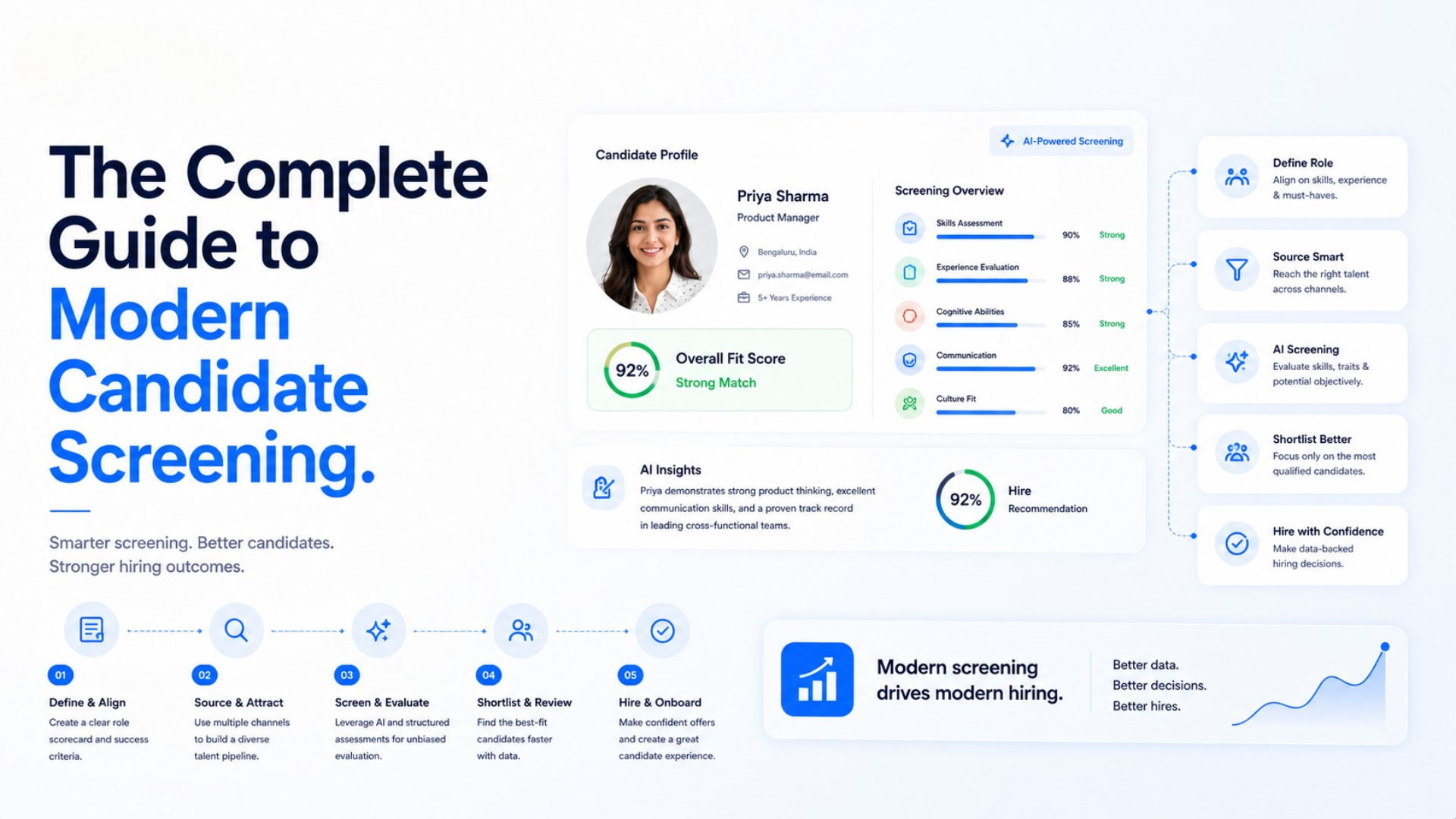
A modern screening workflow is not a single pass through a list of resumes. It is a tiered evaluation system that applies progressively more analysis to progressively fewer candidates, preserving the most expensive and nuanced evaluation methods for the candidates who are most likely to deserve them. The first tier is a rapid initial assessment designed to separate the clearly unqualified from the potentially interesting. This tier should be automated, evaluating every candidate against a set of objective, role-specific criteria in seconds. The second tier is a focused evaluation of the candidates who passed the first tier, applying a more detailed assessment of their fit for the role. The third tier is a validation pass on the final shortlist, where the recruiter compares the top candidates against each other and confirms the ranking before presenting it to the hiring manager.
The critical design principle is that the criteria for each tier must be explicit, consistent, and ideally the same criteria that were used to define the role in the first place. Before screening begins, the recruiting team should collaborate with the hiring manager to identify two to three must-have competencies that are genuinely predictive of success in this specific role, three to five important-but-not-essential skills, and a set of positive differentiators that would make a candidate stand out. These criteria then become the framework for every evaluation decision across all three tiers, ensuring that the screening process is calibrated to the role rather than to a generic template. A senior data scientist role and a senior product manager role may both require “five plus years of experience,” but the specific capabilities that predict success in those two roles are fundamentally different, and the screening process should reflect that difference.
This tiered approach is also how the distinction between AI sourcing and AI recruiting becomes operationally relevant. Sourcing is the process of identifying candidates who match certain surface-level criteria, and it maps directly to the first tier of the screening workflow. Recruiting is the process of evaluating those candidates on deeper, more nuanced signals, and it maps to the second and third tiers. A platform that can execute both stages, finding candidates and then evaluating them with increasing depth, is the platform that produces the best outcomes at scale. The alternative, using one tool for sourcing and another for evaluation, is one of the patterns that produces more tools and the same hiring problems, because the handoff between tools introduces friction, data loss, and inconsistency that degrades screening quality.
The Signals: What to Evaluate and What to Ignore
Modern screening draws on multiple data signals, not just the resume. The signals with the highest demonstrated predictive validity are specific, contextualized evidence of past performance and career trajectory. Not the title the candidate held, but what they accomplished in that role and at what scale. Not the name of the company on their resume, but the complexity of the problems they solved there and the impact of their solutions. Not a list of technologies they claim familiarity with, but evidence of how they applied those technologies to produce measurable outcomes. These high-signal data points require more effort to evaluate than a keyword match, but their predictive validity is significantly higher, which means they produce shortlists that are more accurate and more likely to contain the candidates who will actually perform well after being hired.
The signals that should be deprioritized or ignored entirely are the ones that have high salience but low predictive validity. The prestige of the candidate’s previous employer is the most common example. A candidate from a well-known company is not automatically a better performer than a candidate from a less well-known company, but the halo effect causes recruiters to rate them higher on every dimension, including dimensions where there is no evidence to support the higher rating. Similarly, the specific name of the candidate’s degree-granting institution has very low predictive validity for most roles, but it receives disproportionate weight in screening because it is a salient, easy-to-evaluate signal. Educational
credentials matter for some roles, particularly early-career positions, but for experienced hires, demonstrated capability and career trajectory are far more predictive, and screening processes should be weighted accordingly.
The data freshness of the signals being evaluated is also critical. A candidate’s professional profile from six months ago may not reflect their current capabilities. As we have examined in our analysis of why some AI recruiting tools have outdated candidate data, screening against stale data introduces a systematic error that undermines even the most carefully designed evaluation framework. Modern screening processes must include data enrichment as a built-in step, verifying and updating candidate information at the point of evaluation rather than relying on cached profiles. The quality of any screening decision is bounded by the quality of the data it is based on, and no amount of methodological sophistication can compensate for fundamentally outdated information about a candidate’s current capabilities.
The Technology: Choosing the Right Screening Platform
The screening technology market has expanded rapidly, and the range of available options can be overwhelming. But the evaluation criteria for screening platforms are straightforward if you know what to look for. The first and most important question is whether the platform applies structured, role-specific evaluation criteria or generic keyword matching. A platform that evaluates every candidate against the same criteria regardless of the role is not a modern screening tool. It is an automated version of the same flawed process you already have. The platform should allow you to define role-specific criteria, or better yet, should derive those criteria automatically from the job description and hiring context, and then evaluate every candidate against those specific criteria with consistent scoring.
The second question is whether the platform evaluates multiple signals or just the resume. A resume-only screening tool, even an AI-powered one, is limited to the information that the candidate chose to include in a single self-reported document. Modern screening platforms should incorporate professional profile data, career trajectory analysis, domain-specific evidence, and real-time data enrichment to build a more complete and more accurate picture of each candidate. The third question is about consistency: does the platform produce calibrated, comparable scores across the entire candidate pool, or does its evaluation quality vary depending on volume, timing, or the characteristics of the candidates being evaluated? A platform whose accuracy degrades under load is not scalable, regardless of how fast it processes candidates.
The fourth and often overlooked question is whether the platform has a feedback mechanism that connects screening outcomes to downstream hiring performance. A screening system that does not learn from its outcomes will produce the same quality of shortlists indefinitely, regardless of how many hires it processes. A system that tracks the correlation between screening scores and performance reviews, retention data, and hiring manager satisfaction, and adjusts its evaluation accordingly, produces shortlists that improve with every hiring cycle. When you are evaluating an AI screening tool before buying, the presence and sophistication
of this feedback loop is one of the most important differentiators between platforms that will improve your hiring outcomes over time and platforms that will not. According to Gartner’s HR technology research, the AI hiring tools that deliver the strongest ROI are the ones that combine real-time evaluation with continuous learning, because the value of the platform compounds over time rather than plateauing after initial deployment.
The Pitfalls: Screening Mistakes That Destroy Hiring Quality
Even with the best technology and the most well-designed workflow, screening processes are vulnerable to a set of recurring mistakes that research has shown to be particularly damaging to hiring quality. The first is the halo effect, where a single positive signal, such as a prestigious employer or an impressive credential, causes the reviewer to rate the candidate higher on all dimensions. The second is confirmation bias, where the reviewer forms an initial impression and then interprets all subsequent evidence through the lens of that impression, confirming what they already believe rather than evaluating the evidence objectively. The third is decision fatigue, where the quality of evaluation degrades after roughly 20 to 30 complex screening decisions, causing the candidates reviewed later in the process to receive a fundamentally different quality of assessment than those reviewed earlier.
The fourth pitfall is inconsistency across reviewers. When multiple recruiters are screening candidates for the same role, each one brings different implicit criteria, different levels of domain expertise, and different cognitive states to the evaluation. The result is that the same candidate can receive very different assessments depending on which recruiter happens to review them, introducing random variation that reduces overall shortlist quality. The fifth pitfall is failing to screen against current data, a mistake that is particularly costly in fast-moving fields where the relevance of specific skills and experiences changes rapidly. And the sixth is treating screening as a one-way filter that produces shortlists but never learns from the results of those shortlists, which means that screening accuracy never improves regardless of how many hiring cycles the organization completes.
These pitfalls are not theoretical. They are the patterns that show up in every quality-of-hire analysis and every post-hire retrospective. The organizations that eliminate them are the ones that treat screening as a science rather than an art, and that implement the structural safeguards that prevent these mistakes from influencing hiring decisions. This is also why the question of whether recruiters should worry about AI replacing their jobs misses the point. The AI does not replace the recruiter. It replaces the cognitive biases, the decision fatigue, and the inconsistency that undermine the recruiter’s screening decisions. The recruiter’s expertise in understanding candidate context, assessing cultural fit, and building relationships is preserved and amplified, because it is no longer diluted by the high-volume, low-nuance evaluations that consume most of a recruiter’s screening time. According to McKinsey’s talent management insights, organizations that implement this division of labor, AI for high-volume evaluation and humans for high-nuance judgment, consistently produce better hiring outcomes than organizations that rely on either AI or humans alone.
The Measurement: How to Know If Your Screening Is Actually Working
The final and most often neglected dimension of modern screening is measurement. Most organizations do not measure the accuracy of their screening process in any systematic way. They measure time-to-fill and cost-per-hire, which are important operational metrics but say nothing about whether the screening process is identifying the right candidates. They measure the diversity of their shortlists, which is important for equity but does not indicate whether the screening process is predictive of performance. What they almost never measure is the correlation between screening scores and downstream hiring outcomes: do the candidates who received the highest screening scores turn out to be the strongest performers after they are hired? If the answer is yes, the screening process is working. If the answer is no, or if the organization does not know the answer, the screening process is operating without feedback, and it is almost certainly less accurate than it could be.
The most effective screening measurement framework tracks three metrics over time. The first is screening-to-performance correlation, which measures how strongly screening scores predict performance reviews, retention, and hiring manager satisfaction at six months, twelve months, and twenty-four months post-hire. The second is false-negative rate, which measures the proportion of strong candidates who were screened out and could only be identified through later analysis or through their performance at competing organizations. The third is screening consistency, which measures how much variation exists in screening outcomes across different reviewers and different review sessions. These three metrics together provide a comprehensive picture of screening accuracy, and they create the feedback signal that a learning screening system needs to improve over time.
This measurement framework is also the basis for evaluating whether your screening technology is delivering value. A screening platform that cannot report on these metrics, or that cannot connect its screening scores to downstream outcomes, is a platform that cannot demonstrate its impact on hiring quality. When you are evaluating an AI sourcing tool, the ability to track and report these outcome correlations is one of the most important capabilities to assess. According to LinkedIn’s talent solutions research, the recruiting teams that measure screening accuracy and close the feedback loop between screening and outcomes improve their quality-of-hire by 30% or more within the first year, and the improvement compounds over time as the system accumulates more outcome data. Measurement is not an optional add-on to modern screening. It is the mechanism that transforms screening from a static process into a continuously improving one, and it is the feature that separates screening platforms that deliver lasting value from those that deliver a one-time productivity gain.
How Huntlo Implements the Complete Modern Screening Framework
Huntlo was built to implement every dimension of the modern screening framework described in this guide. The platform applies structured, role-specific evaluation criteria that are calibrated to maximize the correlation between screening scores and job performance,
drawing on the same predictive validity principles that the screening science recommends. Its tiered evaluation workflow handles the high-volume first-pass assessment autonomously, reserving human recruiter judgment for the focused second-tier review of the pre-ranked shortlist. It evaluates candidates on multiple signals, including career trajectory, demonstrated impact, domain expertise, and real-time enriched profile data, producing assessments that are based on a richer and more current picture of each candidate than a resume-only review can provide.
Huntlo also addresses every pitfall identified in this guide. Its structured scoring framework eliminates the halo effect, confirmation bias, and similarity bias by evaluating every candidate on the same dimensions with the same weighting. Its AI-first architecture eliminates decision fatigue by handling the high-volume evaluations that would degrade human judgment. Its real-time data enrichment ensures that every screening decision is based on current information. And its outcome feedback loop connects screening scores to downstream performance data, producing a system that improves its accuracy with every hiring cycle. For teams hiring niche or technical roles where the evaluation requires deep domain understanding, Huntlo’s adaptive criteria ensure that the screening framework is calibrated to the specific requirements of each role rather than applied from a generic template. The complete guide to modern screening is not a theoretical exercise. It is a practical framework, and Huntlo is the platform that puts it into practice.