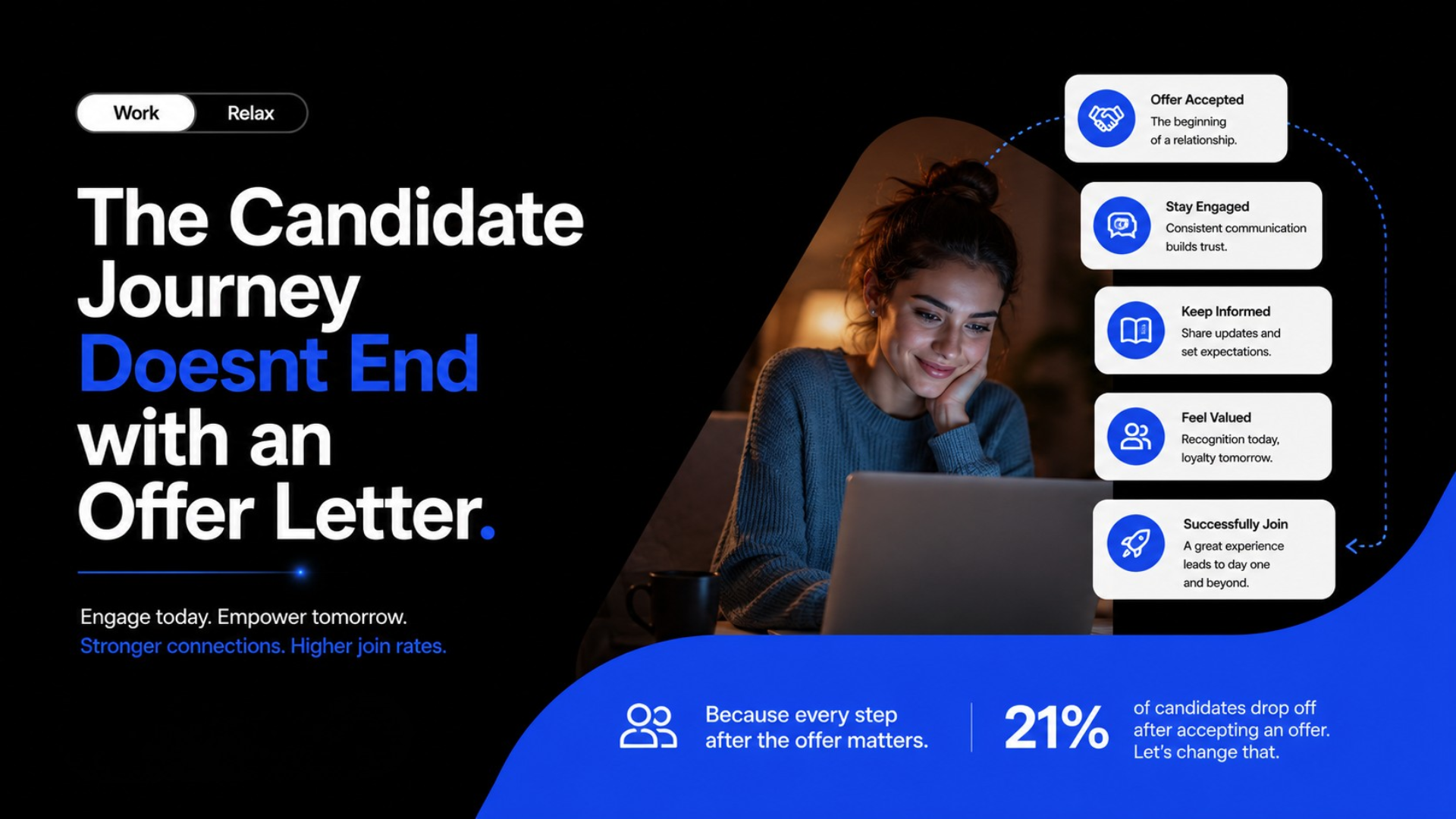
The candidate signed the offer letter at two o'clock on a Tuesday afternoon. By two fifteen, the recruiter had already moved on to the next open requisition. By Wednesday morning, the hiring manager had forgotten the candidate's name. By Friday, the candidate was sitting in their current office, listening to their manager make a case for staying, with no voice from the new employer to counter the message. The candidate journey, as far as the recruiting team was concerned, was complete. The candidate's journey, as far as the candidate was concerned, was just entering its most vulnerable phase. This disconnect between organizational perception and candidate reality is the single largest source of preventable hiring failures, and it persists because most recruiting teams have never designed a process for what happens after the offer is signed.
The offer letter is not the finish line. It is a milestone in a longer journey that continues through the notice period, the transition, and the first ninety days of employment. Treating it as the endpoint creates a dangerous dead zone, a period of weeks where the candidate is neither actively recruited nor actively onboarded, left alone with their doubts, their current employer's retention efforts, and the growing anxiety of leaving a familiar environment for an unknown one. According to SHRM’s talent acquisition research, the post-offer phase accounts for a disproportionate share of hiring failures relative to its duration. Between fifteen and thirty percent of accepted offers never convert to actual starts, and the vast majority of these failures occur not because the candidate found a better opportunity, but because the new employer failed to maintain the relationship after the offer was signed. A commitment to candidate journey continuity means treating every day between the signed offer and the first day of work as part of the recruiting process, with the same intentionality, communication quality,
and candidate focus that defined the pre-offer phase.
The Post-Offer Dead Zone: Why Candidates Feel Abandoned
The experience of being abandoned after signing an offer is remarkably common, and it is remarkably damaging. The candidate has just made one of the most significant decisions of their professional life. They have told their current employer they are leaving. They have committed to a new organization, a new team, and a new role. In the hours and days that follow, they need reassurance that they made the right decision. Instead, what they typically receive is silence. The recruiter, who was their primary point of contact throughout the process, is now focused on other candidates. The hiring manager, who was enthusiastic during the interviews, is back to their operational responsibilities. The onboarding team has not yet been engaged because, in most organizations, onboarding does not begin until the candidate arrives on day one. The result is a candidate who feels like a transaction that has been completed rather than a person who is about to join a team. This feeling of abandonment is not merely uncomfortable. It is actively dangerous to the hiring outcome, because it creates the emotional space for doubt to grow. Research from McKinsey’s people organization insights shows that candidates who report feeling “ignored” or “forgotten” after signing their offer are three times more likely to entertain a counteroffer and twice as likely to ghost before their start date. The mechanism is straightforward: when the new employer goes silent, the current employer's voice becomes the only one the candidate is hearing, and that voice is invariably making a case for staying.
The dead zone also creates practical problems that compound the emotional ones. During the notice period, candidates have questions that need answers. What is the benefits enrollment timeline? Who should they contact about IT setup? What does the first week look like? Where should they park on day one? These questions feel trivial to the recruiting team, which has already moved on, but they feel significant to the candidate, who is trying to mentally prepare for a major life transition. Every unanswered question is a small reminder that the new organization may not be as organized or as welcoming as it appeared during the interview process. Every delayed response is a small crack in the candidate's confidence. Over the course of a two- or three-week notice period, these small cracks accumulate into a serious structural weakness in the candidate's commitment. This is the opposite of effective post-offer candidate nurture, and it is the default state in most organizations because nobody has been assigned ownership of the post-offer experience.
Designing the Post-Offer Phase as a First-Class Process
The solution to the post-offer dead zone is not more ad hoc communication from the recruiter. It is a designed process, with clear objectives, assigned owners, defined touchpoints, and measurable outcomes, that treats the period between offer acceptance and day one as a distinct phase of the candidate journey. This process has three design principles. The first principle is progressive engagement. The post-offer phase should feel like a ramp, not a cliff. Communication intensity should be highest in the first week after signing, when the
candidate's excitement is fresh and their vulnerability to counteroffers is at its peak, and should taper gradually toward the start date as the candidate's commitment solidifies and their practical questions shift from “Did I make the right decision?” to “What do I need to do to prepare?” This progression mirrors the candidate's emotional journey and ensures that the right type of support arrives at the right time. According to LinkedIn’s recruiting resources, candidates who experience a progressively structured post-offer engagement are fifty percent more likely to start the role than candidates who receive either no communication or communication that arrives at random intervals.
The second principle is multi-stakeholder involvement. The post-offer phase should not be owned by the recruiter alone. It should involve the hiring manager, who provides role-specific context and career vision; the future teammates, who provide social belonging and cultural context; and an onboarding specialist, who provides logistical clarity and administrative support. Each stakeholder brings a different type of value to the candidate's experience, and the absence of any one of them creates a gap that the candidate's current employer will happily fill. The third principle is personalization. Every candidate's post-offer experience should be tailored to their specific situation, concerns, and decision-making context. A candidate who is relocating needs different support than a candidate who is staying in the same city. A candidate who is leaving a long-tenured role needs different emotional support than a candidate who changes jobs frequently. A candidate whose current employer is known for aggressive counteroffers needs a different intervention strategy than a candidate whose employer is unlikely to counter. This level of personalization is the hallmark of a mature candidate experience lifecycle approach, and it is impossible to achieve at scale without technology that can track and respond to each candidate's individual context.
The Offer-to-Onboarding Transition: Closing the Handoff Gap
The most dangerous moment in the post-offer phase is not the counteroffer conversation. It is the handoff between the recruiting team and the onboarding team. In most organizations, this handoff does not exist. The recruiter closes the requisition when the offer is signed. The onboarding team picks up the new hire when they arrive on day one. Between these two events, there is no process, no owner, and no continuity. The candidate falls into a gap between two organizational functions, and the experience suffers. The offer-to-onboarding transition should be a seamless bridge, not a gap. The bridge is built by creating a single, continuous record of the candidate's journey that is accessible to both the recruiting team and the onboarding team. When the onboarding specialist can see the candidate's motivations, concerns, and communication history from the recruiting phase, they can design a first-day experience that reinforces the candidate's decision to join rather than repeating generic orientation content that the candidate has already heard during the interview process.
The handoff gap also creates information loss that damages the candidate's experience. During the interview process, the recruiter learns that the candidate is particularly excited about leading a new initiative, concerned about the team's remote work culture, and motivated by the opportunity to work with a specific senior leader. This intelligence is extremely
valuable for the onboarding team, which can ensure that the candidate's first-week agenda includes a meeting with that senior leader, a detailed overview of the new initiative, and a clear explanation of the team's remote work norms. But in most organizations, this intelligence lives in the recruiter's notes and is never transferred to the onboarding team. The candidate arrives on day one, discovers that none of their specific interests or concerns have been anticipated, and concludes that the organization is not as attentive or as organized as it appeared during the interview process. As we have explored in our analysis of why more tools produce the same hiring problems, the problem is not a lack of tools. It is a lack of continuity between the tools and the teams that use them. A unified platform that spans the entire candidate journey, from first contact through first ninety days, eliminates this information loss and ensures that every team member who interacts with the candidate has access to the same intelligence.
What the Post-Offer Candidate Actually Needs
Understanding what candidates need during the post-offer phase requires empathy, but it also requires data. Across thousands of candidate journeys, the needs cluster around four categories. The first category is validation. The candidate needs to hear, repeatedly and from multiple sources, that they made a good decision. This is not about ego. It is about managing the natural anxiety that accompanies any major life transition. A personal call from the hiring manager in the first forty-eight hours after signing, expressing genuine excitement about the candidate's arrival and discussing the impact they will have, is the single most effective validation action. The second category is clarity. The candidate needs to understand what is going to happen, when it is going to happen, and what they need to do. A detailed timeline of the pre-boarding process, a clear list of action items with deadlines, and a single point of contact for questions all provide the clarity that reduces anxiety and builds confidence. Research from Gartner’s HR trends analysis indicates that candidates who receive a structured pre-boarding timeline are sixty percent less likely to report anxiety about their transition and forty percent less likely to consider withdrawing.
The third category is connection. The candidate needs to feel connected to their future team before they arrive. This means more than a Slack invitation. It means a personal introduction from the onboarding buddy, an invitation to a team social event before the start date, or a brief call with a future teammate who can answer questions about the day-to-day reality of the role. These connections give the candidate social anchors at the new organization, which are critical for resisting the pull of their current team during the notice period. The fourth category is anticipation. The candidate needs something to look forward to. A preview of an exciting project, an introduction to a tool or technology they will be working with, or a description of the team's upcoming offsite all give the candidate a positive vision of their future at the organization. This vision is the most powerful counterweight to the counteroffer, because it replaces the abstract promise of “a better opportunity” with a concrete, tangible picture of what their professional life will actually look like. Understanding how many follow-ups one hire actually needs, and distributing these four categories of support across the right number of touchpoints, is essential for effective recruitment beyond the offer.
How AI Maintains Journey Continuity at Scale
For recruiting teams that manage dozens or hundreds of hires per month, maintaining journey continuity through manual effort is not feasible. AI makes it possible by automating the structural elements of the post-offer experience while preserving the personalization that makes it effective. The AI system maintains a continuous profile of each candidate, capturing their motivations, concerns, communication patterns, and context from the recruiting phase and using that profile to drive every post-offer interaction. It schedules and orchestrates communication across multiple stakeholders, ensuring that the hiring manager, the onboarding buddy, and the future teammates all engage with the candidate at the right time and with the right message. It monitors the candidate's engagement level in real time, detecting the early signals of disengagement that precede a withdrawal and recommending specific interventions based on the candidate's individual situation.
The AI also solves the handoff problem by maintaining a single, continuous record that spans the recruiting, post-offer, and onboarding phases. When the onboarding specialist picks up the new hire's file, they have access to everything the recruiting team learned about the candidate's motivations, concerns, and decision-making context. There is no information loss, no gap, and no need for the candidate to repeat themselves. This is the capability that distinguishes an agentic AI recruiting platform from a collection of point solutions: the ability to maintain continuity across the entire candidate journey, not just within a single phase. As Deloitte’s talent research notes, the organizations that achieve the highest joining rates and the strongest new-hire retention are the ones that treat the candidate journey as a single, unbroken arc from first contact through the first ninety days, with technology that maintains the continuity of intelligence, communication, and experience across every phase transition.
Why Huntlo.ai Keeps the Journey Alive After the Offer
Huntlo.ai is built on the principle that the candidate journey does not end when the offer is signed. The platform maintains a living profile for every candidate that captures their complete journey, from the first outreach message through the post-acceptance phase, and uses that profile to drive a personalized, multi-stakeholder engagement experience that keeps every candidate connected, informed, and confident throughout their transition. The system automatically orchestrates communication across the recruiting team, the hiring manager, and the onboarding specialist, ensuring that no candidate falls into the gap between teams. It monitors engagement signals in real time and alerts recruiters to at-risk candidates while there is still time to intervene. And it ensures that outdated candidate data in AI recruiting tools never undermines the post-offer experience, because every recommendation and every communication is based on fresh, accurate intelligence about the candidate's current state.
For organizations that are ready to treat the post-offer phase as a first-class part of the hiring process, Huntlo provides the technology, the workflow, and the intelligence to make it happen at any scale. The platform ensures that why referrals outperform cold outreach is not about
the source of the candidate but about the quality and continuity of the experience they receive after they say yes. And for organizations evaluating their technology options, understanding how to evaluate an AI sourcing tool before buying, means asking whether the platform maintains candidate journey continuity across the offer-to-onboarding transition, or whether it treats the signed offer as the end of its responsibility.
The candidate's journey does not end with an offer letter. It ends, or rather continues, when the candidate walks through the door on day one, meets their team, and begins the work they were hired to do. Every day between the offer and that moment is an opportunity to reinforce the candidate's decision, or to let it erode. The organizations that understand this, and invest in the technology and processes to act on it, are the ones that consistently turn accepted offers into productive, committed employees. As we have discussed in our exploration of the difference between AI sourcing and AI recruiting, recruiting is about building relationships, not filling requisitions, and relationships do not end when the contract is signed.