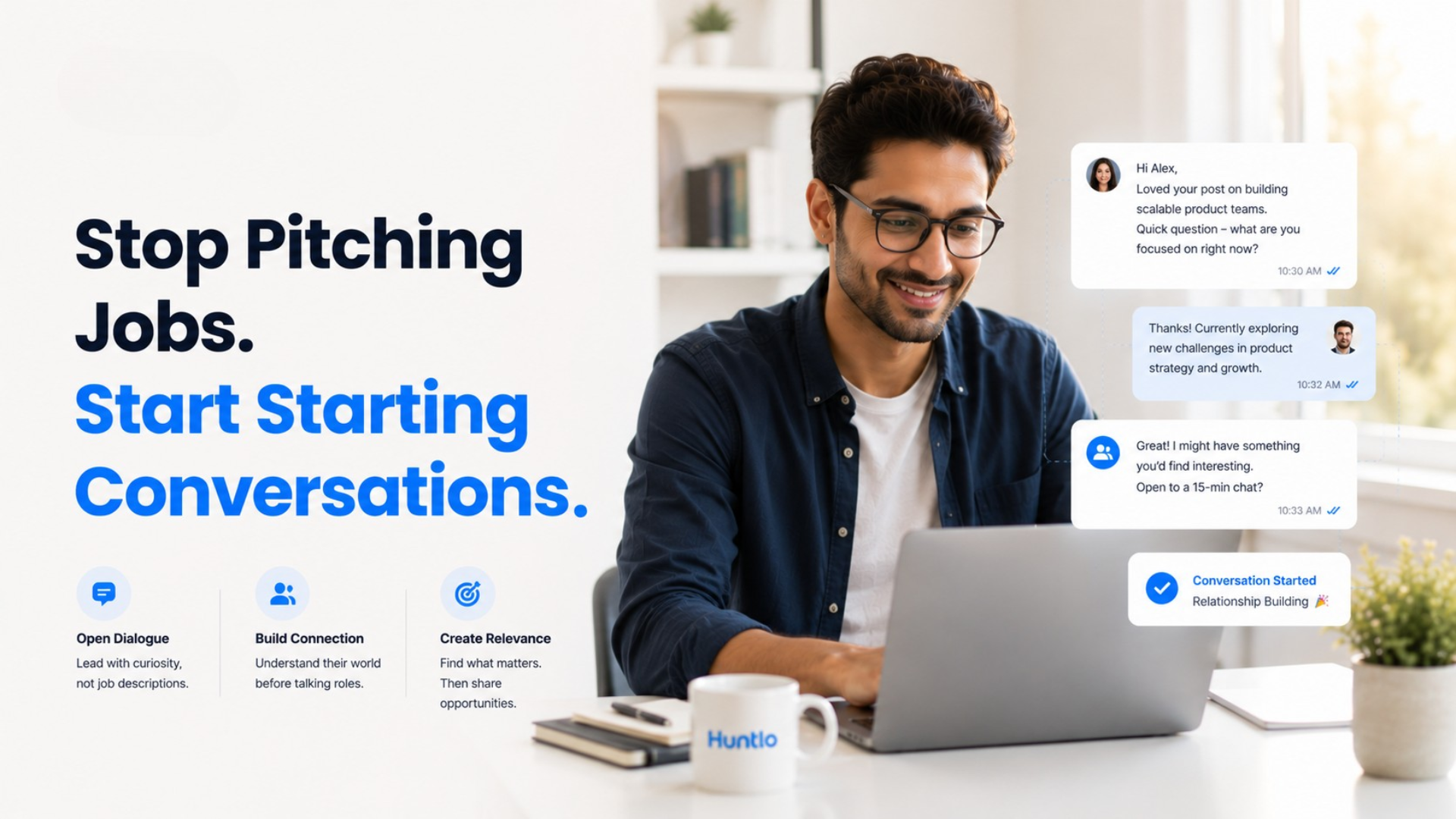
Every day, millions of recruiter messages land in inboxes around the world. The vast majority share the same structural flaw: they open with a job, not with a thought. Phrases like "I have an exciting opportunity" or "We are hiring for a Senior Engineer" dominate the first sentence, and the candidate's brain immediately categorizes the message before finishing the paragraph. It goes into the same mental folder as every other recruiter message they have received this month—the folder labeled "not relevant right now."
The problem is not the role, the company, or even the compensation. The problem is the frame. When you lead with a pitch, you are asking the candidate to evaluate an opportunity they did not ask for. That is a cognitive burden, and passive candidates—who are already employed and generally satisfied—have no incentive to carry it. But when you lead with a genuine observation, a question, or a perspective that demonstrates you actually understand their world, something different happens. They read the next sentence. And the one after that. You have bypassed the mental spam filter not by being clever, but by being relevant.
This article is not about writing better templates. It is about a fundamental reframe in how recruiters approach first contact—from broadcasting openings to initiating conversations that feel worth having. The shift sounds small, but its impact on response rates, candidate quality, and long-term pipeline health is profound. According to research from LinkedIn Talent Solutions, message personalization that demonstrates genuine awareness of a candidate's background can improve response rates by as much as 3–4× compared to generic outreach. The question is: what does that personalization actually look like when it is done right, and how do you scale it beyond a handful of handcrafted messages per day?
Why Pitching Jobs Triggers the Wrong Response
To understand why the job pitch fails, you have to understand what happens in the first 1.7 seconds after a candidate opens your message. That is roughly the window of time research suggests people use to decide whether an email deserves further attention or immediate
dismissal. In that tiny window, the candidate is not evaluating your company or parsing the job title. They are asking a single, unconscious question: "Is this about me, or is this about them?"
A job pitch answers that question immediately. It is about the company's need, the hiring manager's urgency, the role's requirements. Even when the pitch is well-written and the role is genuinely attractive, the framing centers the recruiter's objective, not the candidate's reality. The candidate did not wake up thinking about a career move. They woke up thinking about their current project, their upcoming deadline, the meeting they are dreading at 2 PM. When your message interrupts that reality with "I have a great role for you," it creates a disconnect. The candidate has not been warmed up to the idea of change, and you are asking them to start evaluating an opportunity from a cold start.
This is not speculation. Research on candidate behavior consistently shows that passive candidates evaluate outreach based on perceived relevance to their specific career trajectory, not based on the objective quality of the opportunity. A brilliant role at a top company will still be ignored if the outreach feels like it could have been sent to anyone with the same job title. The pitch frame activates the candidate's defenses. The conversation frame does the opposite—it activates their curiosity. And curiosity is the gateway to engagement.
What ‘Starting a Conversation’ Actually Means in Recruiting
Starting a conversation does not mean sending a casual "Hey, how are you?" message. That is not a conversation—it is a weak opener that puts the burden of substance entirely on the candidate. A genuine conversation starter in recruiting has three specific characteristics that distinguish it from both a pitch and a generic greeting.
First, it demonstrates specific knowledge. The recruiter has clearly done more than scan a LinkedIn headline. They have identified something particular about the candidate's work—a project they led, a technology they pioneered, a talk they gave, a problem they solved—and they reference it with enough detail to prove it is not a template insertion. This is the moment where the candidate's internal monologue shifts from "another recruiter" to "wait, this person actually knows something about me." That shift is everything.
Second, it introduces a perspective, not just a request. Rather than asking "Are you open to new opportunities?"—a yes/no question that most passive candidates will answer with silence—a conversation starter offers something: an insight about the candidate's field, a trend that affects their role, or an observation about a challenge their industry faces. The candidate is not being asked to do anything. They are being invited to react to something interesting. This is a fundamentally different psychological posture, and it is why conversation-driven messages consistently outperform pitch-driven ones.
Third, it creates an asymmetric exchange. In a job pitch, the recruiter wants something (the candidate's interest), and the candidate has to decide whether to give it. The power dynamic is lopsided. In a conversation, the recruiter offers value first—an observation, a relevant piece
of information, a thoughtful question—and the candidate responds because they want to, not because they are being sold to. This distinction is subtle in the text of a message but enormous in how the candidate experiences it. As we explored in our article on why referrals outperform cold outreach, the perception of genuine human connection is the single strongest predictor of whether a candidate will engage, and conversation-first outreach creates that perception by design.
The Architecture of a Conversation-First Message
Moving from theory to practice, what does a conversation-first message actually look like? The architecture follows a four-part structure that can be adapted to virtually any role, industry, or seniority level, but the key is that each part earns the right to the next.
The hook is where you lead with a specific, non-generic observation about the candidate. Not "I saw your profile on LinkedIn," but something like: "Your work on the migration from monolith to microservices at [Company]—particularly the decision to use event-driven architecture for the payments module—caught my attention because we are seeing a similar pattern across fintech companies right now." The hook works because it is immediately specific, it shows research, and it connects the candidate's experience to a broader trend. The candidate does not feel targeted; they feel recognized.
The bridge connects your observation to a question or insight that invites dialogue. It might be: "I am curious—when you made that architectural decision, was the team alignment the hardest part, or was it the data consistency challenge?" Notice what is happening here: you are not asking about their job search status. You are asking about their professional experience in a way that signals you understand the complexity of their work. This question is interesting enough to answer on its own merits, regardless of whether the candidate is open to a job.
The context is where you briefly introduce who you are and why you are reaching out, but critically, you frame it around the conversation, not the role. Something like: "I work with engineering leaders across the fintech space, and I am building a network of people who have navigated exactly these kinds of scaling challenges. Would be great to exchange perspectives." You have not mentioned a specific job. You have positioned yourself as someone worth knowing in their professional domain.
The close is a low-friction invitation. Not "Can we schedule a call?" but "If this resonates, I would love to hear your take—even a quick reply would be great." The ask is small, the barrier is low, and the candidate feels in control of the interaction. This is the architecture that turns a cold outreach attempt into a genuine professional exchange. The difference between AI sourcing and AI recruiting is relevant here: sourcing can identify the right person, but it is the conversational architecture in the outreach that determines whether they will actually engage.
Why Most Recruiters Default to Pitching (And How to Break the Habit)
If conversation-first outreach is so much more effective, why do most recruiters still lead with job pitches? The answer is not laziness or lack of skill. It is structural. Recruiting teams are measured on fills, not conversations. Hiring managers want to see candidates, not relationship-building metrics. The entire incentive system pushes recruiters toward the fastest path to a submitted resume, and that path is the job pitch: "Here is the role. Are you interested? Yes? Great, let us schedule." It is efficient for the recruiter's workflow but ineffective for the candidate's experience.
There is also a volume problem. When a recruiter is responsible for filling 15–20 open roles simultaneously, crafting individualized conversation starters for each potential candidate feels like a luxury they cannot afford. The pitch template becomes a survival mechanism—not because it works well, but because it works fast enough to keep the pipeline moving. The tragedy is that this approach generates a high volume of low-quality interactions: hundreds of sent messages, dozens of polite declines, and a handful of marginal candidates who responded not because they were excited, but because they happened to be looking at that exact moment. Our piece on more tools, same hiring problems examines this dynamic in detail—the industry keeps adding tools but rarely changes the underlying behavior that produces poor results.
Breaking the pitch habit requires two things: a mindset shift and a systems shift. The mindset shift is recognizing that a conversation-first approach is not slower—it is actually more efficient per unit of outcome. Ten personalized conversation starters might yield five meaningful replies and two qualified candidates, while a hundred job pitches might yield the same two candidates but with 20× the effort and a damaged sender reputation. The systems shift is about having the right infrastructure to make conversation-quality outreach feasible at volume. That is where technology becomes the bridge between intention and execution.
The Follow-Up Is Where Most Conversations Die (Or Come Alive)
Here is an uncomfortable truth: most conversation-first messages will not get a reply on the first attempt either. The difference is that a good conversation starter makes the follow-up natural, while a job pitch makes the follow-up feel desperate. When your first message offered a genuine insight or question, your follow-up can build on it: "I shared that observation about event-driven architecture trends in fintech—since then, I came across a case study from [Company] that took a completely different approach. Happy to share if useful." This is a follow-up that adds value. It does not say "Just checking in on my previous message." It says "I have more to offer."
The follow-up is where the conversation-first approach reveals its true advantage over the pitch. A job pitch follow-up is inherently repetitive: "Still interested in the role?" There is nowhere to go but back to the original ask, and the candidate has already implicitly declined
by not responding. But a conversation follow-up can branch in multiple directions—a new data point, a related trend, a relevant event. Each touchpoint adds to the recruiter's credibility and the candidate's sense that this is a professional worth engaging with. As we covered in how many follow-ups one hire actually needs, the majority of successful placements involve multiple touches, and the quality of those touches matters far more than the quantity.
This is also where AI changes the game for recruiters who understand the distinction. An AI system that can track the conversation thread, identify new relevant context about the candidate's company or industry, and generate a value-adding follow-up takes the conversation-first approach from something only the most dedicated recruiters can sustain to something that is systematic and scalable. The key, as we have discussed in our analysis of agentic vs. just automated AI platforms, is that the AI needs to be genuinely intelligent about context, not just triggering timed reminders. A dumb automation sends "just checking in." An agentic AI sends "I noticed your team just announced a new product feature that relates to what we discussed." The difference in candidate experience is night and day.
Conversation-First Outreach as a Long-Term Talent Strategy
Perhaps the most overlooked benefit of conversation-first outreach is what it builds over time. A recruiter who consistently starts genuine conversations—even with candidates who do not convert immediately—is building a reputation and a network that compounds. Candidates remember the recruiter who asked them an interesting question about their work six months ago, even if they were not ready to move then. When they are ready, that recruiter is the first person they think of, because the relationship already exists. It was not built on a transaction; it was built on a real exchange.
This long-game approach is particularly powerful for specialized roles where the talent pool is small and candidates are highly selective. In niche technical domains, as we have explored in our article on whether AI recruiting tools work for niche roles, the candidates who matter most are also the hardest to reach through conventional outreach. They have seen every pitch variation. What they have not seen enough of is a recruiter who genuinely understands their domain and wants to talk about the substance of their work. That rarity is what makes conversation-first outreach so effective in competitive talent markets—it is not just a better message; it is a fundamentally different approach to the recruiter-candidate relationship.
There is also a data dimension that is easy to underestimate. Every conversation you start generates information: what the candidate cares about, what their timeline looks like, what their concerns are, what motivates them. This information is far more valuable than a binary "interested / not interested" response to a job pitch. It feeds into your understanding of the talent market, helps you advise hiring managers more effectively, and creates a rich candidate profile that makes future outreach dramatically more relevant. The recruiter who pitches gets a yes or a no. The recruiter who converses gets a map of the candidate's professional psyche. Over hundreds of interactions, that map becomes an invaluable strategic asset for the entire talent acquisition function. As McKinsey workforce research highlights, organizations that
treat talent intelligence as a strategic capability consistently outperform those that treat recruiting as a purely transactional function.
How Huntlo Makes Conversation-First Outreach Scalable
The case for conversation-first outreach is compelling. The barrier has always been execution at scale. Writing a genuinely insightful, personalized conversation starter for each of the 50–100 candidates you need to reach each week is not realistic for a human recruiter working at full capacity. That is precisely the problem Huntlo was built to solve.
Huntlo's AI does not generate pitch templates disguised as personalization. It researches each candidate's professional background, identifies specific, reference-worthy details—projects, publications, technical choices, career transitions—and constructs outreach messages that lead with genuine observations and open-ended questions. The system understands the difference between "I see you are a software engineer" (surface-level, pitch-adjacent) and "Your decision to implement CQRS at [Company] during the 2024 rearchitecture—that is a pattern we see in only about 12% of engineering leaders making that transition" (specific, conversation-worthy).
Crucially, Huntlo maintains conversation quality across follow-ups. Because the platform uses agentic AI rather than simple automation, each follow-up is informed by new context—company news, industry developments, the candidate's recent activity. The conversation evolves naturally instead of looping back to the same pitch. And because Huntlo integrates real-time data validation, you are never reaching out to candidates with outdated information that would immediately undermine the credibility you are trying to build.
The result is an outreach system that scales conversation quality instead of compromising it. Recruiters using Huntlo report that their response rates from passive candidates increase not because the AI is tricking anyone, but because the messages are genuinely more interesting, more relevant, and more respectful of the candidate's intelligence. That is not a small optimization. It is a different philosophy of recruiting, powered by technology that finally makes that philosophy practical.
Related reading:
Why Referrals Outperform Cold Outreach | More Tools, Same Hiring Problems | AI Sourcing vs. AI Recruiting: What Is the Difference?